| Oesho | |
|---|---|
 | |
| Bactrian script | Οηϸο |
| Affiliation | Shiva |
| Consort | Umā |
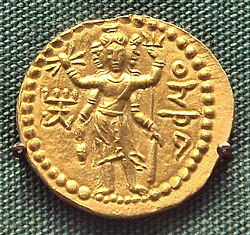
Oesho (Bactrian: Οηϸο, romanized: Oēšo) is a deity found on coins of 2nd to 6th-century, particularly the 2nd-century Kushan era. He was apparently one of the titular deities of the Kushan dynasty. Oesho is an early Kushan deity that is regarded as an amalgamation of Shiva.2
By the time of the Kushan emperor Ooishki (Bactrian Οοηϸκι; often Romanised as Huvishka), who reigned in 140–180 CE, Oesho and the female deity Ardoksho (Ardoxsho; Ardochsho; Ardokhsho) were the only deities appearing on Kushan coins.
Connections
Connections to several contemporaneous deities worshipped by neighbouring cultures have been suggested.
- During the Kushan era, Oesho was often linked to the Hindu concept of Ishvara, which was embodied by the god Shiva;3 Oesho may share the same etymology as Ishvara and/or represent a variant of the word in the Bactrian language spoken by the Kushans.45
- Some later representations, evidently influenced by Greco-Bactrian culture, depict Oesho with a trishula, the traditional implement of Shiva, similar to a trident that is part of Poseidon's iconography.6
Consort
The consort of Oesho was Ommo (Ομμο, Umā), as shown on a coin type of Kushan ruler Huvishka with, on the reverse,Ommo holding a flower, and Oesho with four arms holding attributes.78
Depictions of Oesho
-
![Coin of Huvishka with deity Oesho ("ΟΗϷΟ", Shiva).[9]](/weird-wikipedia/img/c/60/606e77c4bcc884ca.jpg)
-
![Coinage of Kushan ruler Huvishka with, on the reverse, the divine couple Ommo ("ΟΜΜΟ", Umā) holding a flower, and Oesho ("ΟΗϷΟ", Shiva) with four arms holding attributes. Circa 150-180 CE.[10][11]](/weird-wikipedia/img/c/67/67710f15ba47ac6f.jpg)
-
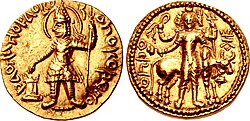 Oesho, with a second human face, and the head of a horned animal, on a coin of Vasudeva I
 -
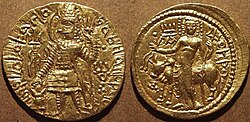 Coin of the Kushan king Kanishka II with, on the reverse, a depiction of Oesho and the word "Oesho" in modified Greek script.
 -
![Kushan worshipper with Oesho, Bactria, 3rd century CE.[12]](/api/ext/img?url=https%3A%2F%2Fupload.wikimedia.org%2Fwikipedia%2Fcommons%2Fthumb%2F5%2F50%2FShivaOeshoBactria3rdCenturyCE.jpg%2F120px-ShivaOeshoBactria3rdCenturyCE.jpg) Kushan worshipper with Oesho, Bactria, 3rd century CE.12
Kushan worshipper with Oesho, Bactria, 3rd century CE.12
Notes
Notes
- Rosenfield, John M. (1967). The Dynastic Arts of the Kushans. University of California Press. p. 93.
- Carter, Martha L. (1994). A Treasury of Indian Coins. Marg Publications. ISBN 978-81-85026-25-1.
- Sivaramamurti, p. 56-59.
- The Dynasty Arts of the Kushans. University of California Press. 1967. pp. 92–93.
- Blurton, T. Richard (1993). Hindu Art. Harvard University Press. p. 84. ISBN 0-674-39189-6.
- "Coins of Vima Kadphises". Archived from the original on 2011-05-14. Retrieved 2010-12-05.
- Dani, Ahmad Hasan; Harmatta, János (1999). History of Civilizations of Central Asia. Motilal Banarsidass Publ. p. 326. ISBN 978-81-208-1408-0.
- "Ommo-Oesho coin of Huvishka British Museum". The British Museum.
- Dani, Ahmad Hasan; Harmatta, János (1999). History of Civilizations of Central Asia. Motilal Banarsidass Publ. p. 326. ISBN 978-81-208-1408-0.
- Dani, Ahmad Hasan; Harmatta, János (1999). History of Civilizations of Central Asia. Motilal Banarsidass Publ. p. 326. ISBN 978-81-208-1408-0.
- "Ommo-Oesho coin of Huvishka British Museum". The British Museum.
- Metropolitan Museum of Art exhibition
References
References
- Bopearachchi, Osmund (2003). De l'Indus à l'Oxus, Archéologie de l'Asie Centrale (in French). Lattes: Association imago-musée de Lattes. ISBN 2-9516679-2-2.