| Oenomys Temporal range: Late Pliocene to Recent
| |
|---|---|
| |
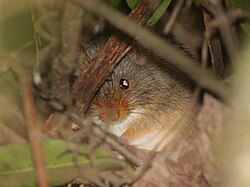
| Oenomys hypoxanthus | |
Scientific classification 
| |
| Kingdom: | Animalia |
| Phylum: | Chordata |
| Class: | Mammalia |
| Infraclass: | Placentalia |
| Order: | Rodentia |
| Family: | Muridae |
| Tribe: | Arvicanthini |
| Genus: | Oenomys Thomas, 1904 |
| Type species | |
| Mus hypoxanthus | |
| Species | |
|
See text | |
Oenomys is a genus of African rodents known as rufous-nosed rats.1 They occur from south-east Guinea and Ghana through the Congo forest to Uganda and Kenya.2 The nose is reddish, or at least the cheeks, which suggested both the English and scientific names (oeno- means "wine" and -mys denotes a mouselike animal in Greek).34
The two recognised, living species occupy separate geographical ranges:
- Oenomys hypoxanthus (Pucheran, 1855), common rufous-nosed rat
- Oenomys hypoxanthus albiventris (Eisentraut, 1968), a montane subspecies5
- Oenomys ornatus (Thomas, 1911), Ghana rufous-nosed rat
- †Oenomys tiercelini6
References
References
- "Oenomys - rufous-nosed rats". Animal Diversity Web. University of Michigan. Archived from the original on 14 December 2024. Retrieved 26 September 2025.
- Renaud, Sabrina (1999). "Size and shape variability in relation to species differences and climatic gradients in the African rodent Oenomys". Journal of Biogeography. 26 (4): 857–865. doi:10.1046/j.1365-2699.1999.00327.x. ISSN 1365-2699.
- "Definition of OENO-". www.merriam-webster.com. Retrieved 2025-09-26.
- "Definition of -MYS". www.merriam-webster.com. Retrieved 2025-09-26.
- Zoologisches Forschungsinstitut und Museum Alexander Koenig. (1950). Bonner zoologische Beiträge : Herausgeber: Zoologisches Forschungsinstitut und Museum Alexander Koenig, Bonn (Vol. 19, p. 8). Das Forschungsinstitut. https://www.biodiversitylibrary.org/page/44746670
- Sabatier M., 1982. Les rongeurs du site Pliocène à Hominidés de Hadar (Ethiope). Palaeovertebrata 12 (1): 1-56.