  | |
| Observation data Epoch J2000 Equinox ICRS | |
|---|---|
| Constellation | Perseus |
| Right ascension | 03h 45m 11.63204s1 |
| Declination | +42° 34′ 42.7829″1 |
| Apparent magnitude (V) | 3.802 |
| Characteristics | |
| Spectral type | F5II3 |
| U−B color index | +0.282 |
| B−V color index | +0.422 |
| Variable type | suspected4 |
| Astrometry | |
| Radial velocity (Rv) | −12.105 km/s |
| Proper motion (μ) | RA: −14.451 mas/yr Dec.: +2.531 mas/yr |
| Parallax (π) | 5.86±0.22 mas1 |
| Distance | 560 ± 20 ly (171 ± 6 pc) |
| Absolute magnitude (MV) | −2.396 |
| Details | |
| Mass | 5.017 M☉ |
| Radius | 20.62+1.72 −1.768 R☉ |
| Luminosity | 603.6±41.28 L☉ |
| Surface gravity (log g) | 3.049 cgs |
| Temperature | 6,300+287 −1588 K |
| Metallicity [Fe/H] | +0.419 dex |
| Rotational velocity (v sin i) | 48.910 km/s |
| Age | 10911 Myr |
| Other designations | |
| ν Per, 41 Persei, NSV 1261, BD+42°815, FK5 134, GC 4474, HD 23230, HIP 17529, HR 1135, SAO 39078, CCDM J03452+4235A, WDS J03452+4235A12 | |
| Database references | |
| SIMBAD | data |
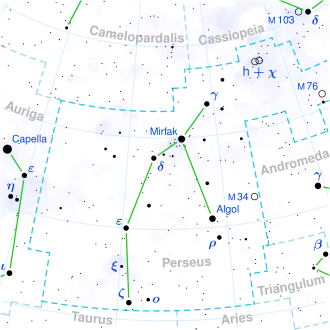
ν Persei, Latinized as Nu Persei, is a single13 star and a suspected variable in the northern constellation of Perseus. It has a yellow-white hue and is visible to the naked eye with an apparent visual magnitude of 3.80.2 This object is located approximately 560 light-years from the Sun based on parallax1 but is drifting closer with a radial velocity of −12 km/s.5
This object is a highly luminous bright giant star with a stellar classification of F5II.3 It has five7 times the mass of the Sun but has expanded to around 218 times the Sun's radius. The star has a relatively high rotation rate, spinning with a projected rotational velocity of 48.9 km/s.10 It is radiating 6048 times the luminosity of the Sun from its enlarged photosphere at an effective temperature of 6,300 K.8
Several visual companions beside the primary have been recorded. B, with magnitude 12.1 and separation 31.6", has its own companion, E, with magnitude 14.3 and separation 7.7". Additionally, C has magnitude 13.2 and separation 55.7", and D has magnitude 13.8 and separation 22.8".14
References
References
- Van Leeuwen, F. (2007). "Validation of the new Hipparcos reduction". Astronomy and Astrophysics. 474 (2): 653–664. arXiv:0708.1752. Bibcode:2007A&A...474..653V. doi:10.1051/0004-6361:20078357. S2CID 18759600. Vizier catalog entry
- Ducati, J. R. (2002). "VizieR Online Data Catalog: Catalogue of Stellar Photometry in Johnson's 11-color system". CDS/ADC Collection of Electronic Catalogues. 2237. Bibcode:2002yCat.2237....0D.
- Hoffleit, D.; Warren, W. H. (1995). "Bright Star Catalogue". VizieR On-line Data Catalog: V/50. Originally Published in: 1964BS....C......0H. 5050 (5th Revised ed.). Bibcode:1995yCat.5050....0H.
- Samus, N. N.; Durlevich, O. V.; et al. (2009). "VizieR Online Data Catalog: General Catalogue of Variable Stars (Samus+ 2007-2013)". VizieR On-line Data Catalog: B/GCVS. Originally Published in: 2009yCat....102025S. 1: B/GCVS. Bibcode:2009yCat....102025S.
- Gontcharov, G. A. (2006). "Pulkovo Compilation of Radial Velocities for 35 495 Hipparcos stars in a common system". Astronomy Letters. 32 (11): 759–771. arXiv:1606.08053. Bibcode:2006AstL...32..759G. doi:10.1134/S1063773706110065. S2CID 119231169.
- Anderson, E.; Francis, Ch. (2012). "XHIP: An extended hipparcos compilation". Astronomy Letters. 38 (5): 331. arXiv:1108.4971. Bibcode:2012AstL...38..331A. doi:10.1134/S1063773712050015. S2CID 119257644. Vizier catalog entry
- Hohle, M.M.; et al. (2010). "Masses and luminosities of O- and B-type stars and red supergiants". Astronomische Nachrichten. 331 (4): 349. arXiv:1003.2335. Bibcode:2010AN....331..349H. doi:10.1002/asna.200911355. S2CID 111387483. Vizier catalog entry
- Brown, A. G. A.; et al. (Gaia collaboration) (August 2018). "Gaia Data Release 2: Summary of the contents and survey properties". Astronomy & Astrophysics. 616. A1. arXiv:1804.09365. Bibcode:2018A&A...616A...1G. doi:10.1051/0004-6361/201833051. Gaia DR2 record for this source at VizieR.
- Earle Luck, R. (2014). "Parameters and Abundances in Luminous Stars". The Astronomical Journal. 147 (6): 137. Bibcode:2014AJ....147..137L. doi:10.1088/0004-6256/147/6/137.
- De Medeiros, J. R.; Mayor, M. (1999). "A catalog of rotational and radial velocities for evolved stars". Astronomy and Astrophysics Supplement Series. 139 (3): 433. arXiv:astro-ph/0608248. Bibcode:1999A&AS..139..433D. doi:10.1051/aas:1999401. Vizier catalog entry
- Lyubimkov, Leonid S.; Lambert, David L.; Rostopchin, Sergey I.; Rachkovskaya, Tamara M.; Poklad, Dmitry B. (2010). "Accurate fundamental parameters for A-, F- and G-type Supergiants in the solar neighbourhood". Monthly Notices of the Royal Astronomical Society. 402 (2): 1369–1379. arXiv:0911.1335. Bibcode:2010MNRAS.402.1369L. doi:10.1111/j.1365-2966.2009.15979.x. S2CID 119096173.
- "nu. Per". SIMBAD. Centre de données astronomiques de Strasbourg. Retrieved 2019-10-02.
- Eggleton, P. P.; Tokovinin, A. A. (September 2008). "A catalogue of multiplicity among bright stellar systems". Monthly Notices of the Royal Astronomical Society. 389 (2): 869–879. arXiv:0806.2878. Bibcode:2008MNRAS.389..869E. doi:10.1111/j.1365-2966.2008.13596.x. S2CID 14878976.
- Mason, Brian D.; et al. (2001). "The 2001 US Naval Observatory Double Star CD-ROM. I. The Washington Double Star Catalog". The Astronomical Journal. 122 (6): 3466. Bibcode:2001AJ....122.3466M. doi:10.1086/323920. Vizier catalog entry
External links
External links
- Kaler, James B. (March 11, 2011). "Nu Persei". STARS. Retrieved 2019-10-03.