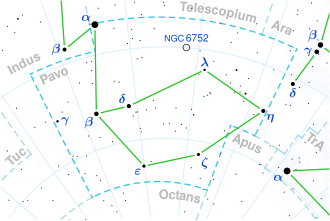
  | |
| Observation data Epoch J2000 Equinox ICRS | |
|---|---|
| Constellation | Pavo |
| Right ascension | 18h 31m 22.42509s1 |
| Declination | −62° 16′ 41.8853″1 |
| Apparent magnitude (V) | 4.64 (4.60 - 4.642) |
| Characteristics | |
| Evolutionary stage | main sequence3 |
| Spectral type | B7III4 |
| U−B color index | −0.395 |
| B−V color index | −0.115 |
| Variable type | SPB2 |
| Astrometry | |
| Radial velocity (Rv) | +16.956 km/s |
| Proper motion (μ) | RA: −1.111 mas/yr Dec.: −45.311 mas/yr |
| Parallax (π) | 7.43±0.24 mas1 |
| Distance | 440 ± 10 ly (135 ± 4 pc) |
| Absolute magnitude (MV) | -1.014 |
| Orbit7 | |
| Period (P) | 1.711529±0.000005 d |
| Eccentricity (e) | 0.0 |
| Periastron epoch (T) | 2,450,276.5502±0.0007 HJD |
| Argument of periastron (ω) (secondary) | 127±12° |
| Semi-amplitude (K1) (primary) | 43.8±0.1 km/s |
| Details | |
| Mass | 4.398 M☉ |
| Luminosity | 6598 L☉ |
| Temperature | 12,7648 K |
| Rotational velocity (v sin i) | 125.09 km/s |
| Other designations | |
| ν Pav, CD−62°1213, GC 25227, HD 169978, HIP 90797, HR 6916, SAO 254273, WDS J18314-6217AB10 | |
| Database references | |
| SIMBAD | data |
Nu Pavonis is a possible triple star system11 in the southern constellation of Pavo. It is visible to the naked eye as a faint star that varies in apparent visual magnitude from 4.60 to 4.64 over a period of 0.85584 days.2 The system lies approximately 440 light years from the Sun based on parallax,1 and is drifting further away with a radial velocity of +17 km/s.6 It is a possible member of the Wolf 630 group of co-moving stars.3

This is a single-lined spectroscopic binary system with an orbital period of just 1.71 days in a circular orbit.7 The unresolved3 components are close enough that their tidal interaction is significant.7 Nu Pavonis was discovered to be a variable star when the Hipparcos data was analyzed.13 The visible component is a slowly pulsating B-type star with a stellar classification of B7III.4 This implies it is an evolved giant star, but it is actually more likely to be on the main sequence. An X-ray emission has been detected from the pair.3
The third component is a visible companion, probably a pre-main-sequence star, at magnitude 13.7 and separation 3.1″. This star is estimated at 0.15 solar masses and an effective temperature of 3,192 K.8 It too is an X-ray source.3
References
References
- Van Leeuwen, F. (2007). "Validation of the new Hipparcos reduction". Astronomy and Astrophysics. 474 (2): 653–664. arXiv:0708.1752. Bibcode:2007A&A...474..653V. doi:10.1051/0004-6361:20078357. S2CID 18759600. Vizier catalog entry
- Watson, C. L. (2006). "The International Variable Star Index (VSX)". The Society for Astronomical Sciences 25th Annual Symposium on Telescope Science. Held May 23–25. 25: 47. Bibcode:2006SASS...25...47W.
- Stelzer, B.; et al. (September 2003). "Late B-type stars and their candidate companions resolved with Chandra". Astronomy and Astrophysics. 407 (3): 1067–1078. arXiv:astro-ph/0306401. Bibcode:2003A&A...407.1067S. doi:10.1051/0004-6361:20030934. S2CID 16766165.
- Anderson, E.; Francis, Ch. (2012). "XHIP: An extended hipparcos compilation". Astronomy Letters. 38 (5): 331. arXiv:1108.4971. Bibcode:2012AstL...38..331A. doi:10.1134/S1063773712050015. S2CID 119257644. Vizier catalog entry
- Ducati, J. R. (2002). "VizieR On-line Data Catalog: Catalogue of Stellar Photometry in Johnson's 11-color system". CDS/ADC Collection of Electronic Catalogues. 2237. Bibcode:2002yCat.2237....0D.
- Pourbaix, D.; et al. (2004). "SB9: The ninth catalogue of spectroscopic binary orbits". Astronomy and Astrophysics. 424 (2): 727–732. arXiv:astro-ph/0406573. Bibcode:2004A&A...424..727P. doi:10.1051/0004-6361:20041213. S2CID 119387088.
- De Cat, P.; Aerts, C.; De Ridder, J.; Kolenberg, K.; Meeus, G.; Decin, L. (2000). "A study of bright southern slowly pulsating B stars. I. Determination of the orbital parameters and of the main frequency of the spectroscopic binaries". Astronomy and Astrophysics. 355: 1015–1030. Bibcode:2000A&A...355.1015D.
- Hubrig, S.; Le Mignant, D.; North, P.; Krautter, J. (2001). "Search for low-mass PMS companions around X-ray selected late B stars". Astronomy and Astrophysics. 372: 152–164. arXiv:astro-ph/0103201. Bibcode:2001A&A...372..152H. doi:10.1051/0004-6361:20010452. S2CID 17507782.
- Glebocki, R.; Gnacinski, P. (2005). "Catalog of Stellar Rotational Velocities". VizieR On-line Data Catalog: III/244. 3244. Bibcode:2005yCat.3244....0G. Vizier catalog entry
- "nu. Pav". SIMBAD. Centre de données astronomiques de Strasbourg. Retrieved 2019-10-01.
- Eggleton, P. P.; Tokovinin, A. A. (September 2008). "A catalogue of multiplicity among bright stellar systems". Monthly Notices of the Royal Astronomical Society. 389 (2): 869–879. arXiv:0806.2878. Bibcode:2008MNRAS.389..869E. doi:10.1111/j.1365-2966.2008.13596.x. S2CID 14878976.
- "MAST: Barbara A. Mikulski Archive for Space Telescopes". Space Telescope Science Institute. Retrieved 24 September 2022.
- Kazarovets, E. V.; Samus, N. N.; Durlevich, O. V.; Frolov, M. S.; Antipin, S. V.; Kireeva, N. N.; Pastukhova, E. N. (January 1999). "The 74th Special Name-list of Variable Stars" (PDF). Information Bulletin on Variable Stars. 4659: 1–27. Bibcode:1999IBVS.4659....1K. Retrieved 24 December 2024.