 | |
 | |
 | |
| Names | |
|---|---|
| Preferred IUPAC name
Bicyclo[2.2.1]heptane | |
| Other names
norcamphane, norbornylane
| |
| Identifiers | |
| |
3D model (JSmol)
|
|
| 1900379 | |
| ChEBI | |
| ChemSpider |
|
| ECHA InfoCard | 100.005.452 |
| EC Number |
|
PubChem CID
|
|
| UNII | |
CompTox Dashboard (EPA)
|
|
| |
| |
| Properties | |
| C7H12 | |
| Molar mass | 96.17 g mol−1 |
| Appearance | white volatile solid |
| Melting point | 85 to 88 °C (185 to 190 °F; 358 to 361 K) |
Except where otherwise noted, data are given for materials in their standard state (at 25 °C [77 °F], 100 kPa).
| |


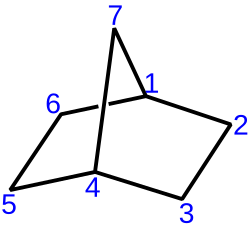
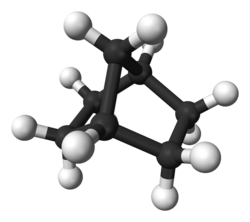
Norbornane (also known as bicyclo[2.2.1]heptane) is an organic compound and a saturated hydrocarbon with chemical formula C7H12. It is a crystalline compound with a melting point of 88 °C. The carbon skeleton is derived from cyclohexane ring with a methylene bridge in the 1,4- position, and is a bridged bicyclic compound. The compound is a prototype of a class of strained bicyclic hydrocarbons.1
The compound was originally synthesized by reduction of norcamphor.2
The name norbornane is derived from bornane, which is 1,7,7-trimethylnorbornane, being a derivative of camphor (bornanone). The prefix nor- refers to the stripping of the methyl groups from the parent molecule bornane.
See also
See also
- 2-Norbornyl cation
- Norbornene
- Norbornadiene
- endo-Norborneol
- exo-Norborneol
- Norcamphor, the ketone derivative of norbornane
References
References
- Fort, Raymond C. Adamantane. Studies in Organic Chemistry. Vol. 5. New York, NY: Marcel Dekker. p. 123.
Whereas noradamantane certainly is strained relative to, say, adamantane, it is the most stable of the tricyclononanes, being the only one that does not contain a bicyclo[2.2.1]heptane.
- Komppa, Gust.; Beckmann, Siegfried (1934). "Der Grundkörper der Camphergruppe, das Bicyclo-[1.2.2]-heptan, und die stereoisomeren Norborneole". Naturwissenschaften. 22: 171. doi:10.1007/BF01496254.
External links
External links
- Norbornane in 3D Archived 2011-05-14 at the Wayback Machine
- Datasheet at Sigma-Aldrich