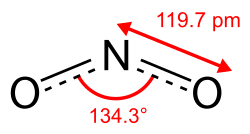
Nitryl is the nitrogen dioxide (NO2) moiety when it occurs in a larger compound as a univalent fragment. Examples include nitryl fluoride (NO2F) and nitryl chloride (NO2Cl).1
Like nitrogen dioxide, the nitryl moiety contains a nitrogen atom with two bonds to the two oxygen atoms, and a third bond shared equally between the nitrogen and the two oxygen atoms. The nitrogen-centred radical is then free to form a bond with another univalent fragment (X) to produce an N−X bond, where X can be F, Cl, OH, etc.
In organic nomenclature, the nitryl moiety is known as the nitro group. For instance, nitryl benzene is normally called nitrobenzene (PhNO2).2
See also
See also
- Dinitrogen tetroxide
- Nitro compound
- Nitrosyl (R−N=O)
- Isocyanide (R−N≡C)
- Nitryl fluoride
- Nitrate
References
References
- Nomenclature of Inorganic Chemistry IUPAC Recommendations 2005 (PDF). IUPAC. 2005. Archived from the original (PDF) on 2014-12-22. Retrieved 2018-11-27.
- International Union of Pure and Applied Chemistry, Commission on the Nomenclature of Organic Chemistry (1993). A guide to IUPAC nomenclature of organic compounds: Recommendations 1993. Panico, Robert; Powell, Warren H.; Richer, Jean-Claude. Oxford: Blackwell Scientific Publications. ISBN 0632037024. OCLC 27431284.