| NGC 524 | |
|---|---|
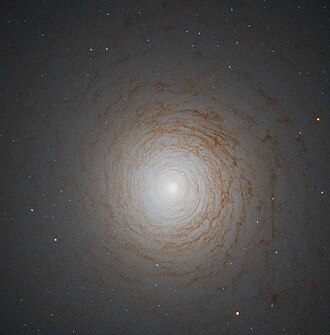 NGC 524 imaged by the Hubble Space Telescope | |
| Observation data (J2000 epoch) | |
| Constellation | Pisces |
| Right ascension | 01h 24m 47.7s1 |
| Declination | +09° 32′ 20″1 |
| Redshift | 2403 ± 5 km/s1 |
| Distance | 86.1 ± 13.7 Mly (26.4 ± 4.2 Mpc)1 |
| Apparent magnitude (V) | 10.5 |
| Characteristics | |
| Type | SA(rs)0+1 |
| Apparent size (V) | 2.8′ × 2.8′1 |
| Other designations | |
| UGC 968, PGC 52221 | |
NGC 524 is a lenticular galaxy in the constellation Pisces. It is at a distance of about 90 million light-years away from Earth. In the central bulge of the galaxy is visible gas forming a spiral structure.2 It is the largest galaxy in the small NGC 524 group of galaxies, which is associated with NGC 488 and its group.3 It was discovered by William Herschel on 4 September 1786.4
Observation
On 4 May 1985 (the May 1985 lunar eclipse) it was occulted by the Moon during a Total Lunar Eclipse over South Africa and Antarctica.5: 160
Supernovae
Two supernovae have been observed in the galaxy:
- SN 2000cx (Type Ia-pec, mag. 14.5) was discovered by the Lick Observatory Supernova Search (LOSS) on 17 July 2000.67 This supernova reached magnitue 13.1, and was the brightest observed in the year 2000.8
- SN 2008Q (Type Ia, mag. 16.5) was discovered by Giancarlo Cortini on 26 January 2008.910
Gallery
-
 NGC 524 (SDSS DR14)
 -
 NGC 524 (HST)
References
References
- "NASA/IPAC Extragalactic Database". Results for NGC 524. Retrieved 2006-11-18.
- "Hubble Eyes a Mysterious Old Spiral". NASA. 26 July 2013. Archived from the original on 2023-06-09.
- Dmitry Makarov and Igor Karachentsev (2011). "Galaxy groups and clouds in the local (z~ 0.01) Universe". MNRAS. 412 (4): 2498–2520. arXiv:1011.6277. Bibcode:2011MNRAS.412.2498M. doi:10.1111/j.1365-2966.2010.18071.x. S2CID 119194025.
- Seligman, Courtney. "New General Catalogue Objects: NGC 524". Celestial Atlas. Retrieved 7 December 2024.
- Meeus, Jan (2002). "Occultations of deep-sky objects during a total lunar eclipse". More Mathematical Astronomy Morsels (PDF). Willmann-Bell. pp. 157–162. ISBN 0943396743.
- Yu, C.; Modjaz, M.; Li, W. D. (2000). "Supernova 2000cx in NGC 524". International Astronomical Union Circular (7458): 1. Bibcode:2000IAUC.7458....1Y.
- "SN 2000cx". Transient Name Server. IAU. Retrieved 7 December 2024.
- Bishop, David. "Bright Supernovae - 2000". Rochester Astronomy. Retrieved 7 December 2024.
- Villi, M.; Moretti, S.; Tomaselli, S.; Cherini, G. (2008). "Supernova 2008Q in NGC 524". Central Bureau Electronic Telegrams (1228): 1. Bibcode:2008CBET.1228....1V.
- "SN 2008Q". Transient Name Server. IAU. Retrieved 7 December 2024.
External links
External links
- Media related to NGC 524 at Wikimedia Commons
- NGC 524 on WikiSky: DSS2, SDSS, GALEX, IRAS, Hydrogen α, X-Ray, Astrophoto, Sky Map, Articles and images
- SEDS