| NGC 2002 | |
|---|---|
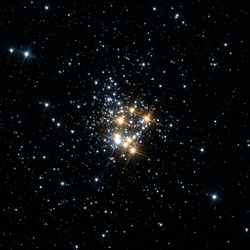 Hubble Space Telescope image of NGC 2002 | |
| Observation data (J2000 epoch) | |
| Right ascension | 05h 30m 20.4s1 |
| Declination | −66° 53′ 03″1 |
| Apparent dimensions (V) | 10.842 |
| Physical characteristics | |
| Other designations | ESO 86-SC3 |
| Associations | |
| Constellation | Dorado |
NGC 2002 (also known as ESO 86-SC3) is an open cluster located in the Dorado constellation and is part of the Large Magellanic Cloud. It was discovered by James Dunlop on September 24, 1826. Its apparent magnitude is 10.1, and its size is 2.0 arc minutes.13
NGC 2002 contains five red supergiants, prominent in deep images of the cluster. Together with the main sequence turnoff, these tightly constrain the age of the cluster to 18 million years. The cluster shows strong stellar stratification with the brightest stars concentrated at the centre of the cluster and fainter stars dominating further out.4
References
References
- "Object: NGC 2002 (*)". Seds. Retrieved 23 October 2017.
- "NGC 2002". SIMBAD. Centre de données astronomiques de Strasbourg. Retrieved 23 October 2017.
- "NGC 2002 (= an OCL in the Large Magellanic Cloud)". cseligman. Retrieved 23 October 2017.
- Gouliermis, Dimitrios A; MacKey, Dougal; Xin, Yu; Rochau, Boyke (2010). "Assessment of Stellar Stratification in Three Young Star Clusters in the Large Magellanic Cloud". The Astrophysical Journal. 709 (1): 263–277. arXiv:1001.0135. Bibcode:2010ApJ...709..263G. doi:10.1088/0004-637X/709/1/263. S2CID 119278804.