| NGC 1978 | |
|---|---|
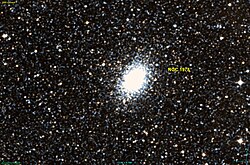 The globular cluster NGC 1978 | |
| Observation data (J2000 epoch) | |
| Class | VI1 |
| Constellation | Dorado |
| Right ascension | 05h 28m 48s2 |
| Declination | −66° 13′ 59″2 |
| Distance | 159,700 ly3 (49,000 pc3) |
| Apparent magnitude (V) | 10.124 |
| Apparent dimensions (V) | 10.7′ × 3.9′3 |
| Physical characteristics | |
| Mass | 2×1055 M☉ |
| Metallicity | [Fe/H] = −0.38 ± 0.02 dex |
| = 0.0086 dex | |
| Estimated age | 1.9 ± 0.1 Gyr6 |
| Other designations | ESO 85-SC90, KMHK 944 |
NGC 1978 (also known as ESO 85-SC90) is an elliptical shaped globular cluster in the constellation Dorado. It is located within the Large Magellanic Cloud. It was discovered by James Dunlop on November 6, 1826.7 At an aperture of 50 arcseconds, its apparent V-band magnitude is 10.20, but at this wavelength, it has 0.16 magnitudes of interstellar extinction.4 It appears 3.9 arcminutes wide.8 NGC 1978 has a radial velocity of 293.1 ± 0.9 km/s.9
The northwest half of NGC 1978 is iron-rich and younger whereas the southeast part of the cluster has very little iron.9 NGC 1978 is also highly elliptical (ε ~ 0.30 ± 0.02),6 suggesting tidal action between it and the Large Magellanic Cloud.9 It is rich in pulsating asymptotic giant branch stars, often oxygen-rich or carbon-rich.5 NGC 1978 is about 2 billion years old. Its estimated mass is 1.36×10⁵ M☉, and its total luminosity is 3.41×10⁵ L☉, leading to a mass-to-luminosity ratio of 0.40 M☉/L☉.4 All else equal, older star clusters have higher mass-to-luminosity ratios; that is, they have lower luminosities for the same mass.4
References
References
- Bomans, D. J.; Vallenari, A; De Boer, K. S (1995). "NGC 1978 in the LMC: The cluster and surrounding field". Astronomy and Astrophysics. 298: 427. Bibcode:1995A&A...298..427B.
- "Globular Cluster NGC 1978". DSO. Retrieved 15 October 2017.
- "The globular cluster NGC 1978". In the sky. Retrieved 22 October 2017.
- Song, Ying-Yi; Mateo, Mario; Bailey, John I.; Walker, Matthew G.; Roederer, Ian U.; Olszewski, Edward W.; Reiter, Megan; Kremin, Anthony (2021). "Dynamical masses and mass-to-light ratios of resolved massive star clusters – II. Results for 26 star clusters in the Magellanic Clouds". Monthly Notices of the Royal Astronomical Society. 504 (3): 4160–4191. arXiv:2104.06882. doi:10.1093/mnras/stab1065.
- Kamath, D.; Wood, P. R.; Soszyński, I.; Lebzelter, T. (October 2010). "The pulsation of AGB stars in the Magellanic Cloud clusters NGC 1978 and 419". Monthly Notices of the Royal Astronomical Society. 408 (1): 522–534. arXiv:1006.3121. Bibcode:2010MNRAS.408..522K. doi:10.1111/j.1365-2966.2010.17137.x. S2CID 118506707.
- Mucciarelli, Alessio; Ferraro, Francesco R.; Origlia, Livia; Fusi Pecci, Flavio (May 2007). "The Globular Cluster NGC 1978 in the Large Magellanic Cloud". The Astronomical Journal. 133 (5): 2053–2060. arXiv:astro-ph/0701649. Bibcode:2007AJ....133.2053M. doi:10.1086/513076. S2CID 17715270.
- "NGC 1978 (in the Large Magellanic Cloud)". cseligman. Retrieved 16 October 2017.
- "Object: NGC 1978 (*)". SEDS. Retrieved 16 October 2017.
- Lederer, M. T; Lebzelter, T; Cristallo, S; Straniero, O; Hinkle, K. H; Aringer, B (2009). "The puzzling dredge-up pattern in NGC 1978". Astronomy & Astrophysics. 502 (3): 913. arXiv:0906.1279. Bibcode:2009A&A...502..913L. doi:10.1051/0004-6361/200911857. S2CID 17017344.