 | |
| Operator |  European Space Agency European Space Agency |
|---|---|
| Start of mission | |
| Launch date | 2032 (planned) |
| Orbital parameters | |
| Reference system | geocentric |
| Altitude | 400 km |
| Inclination | Between 65° and 75° |
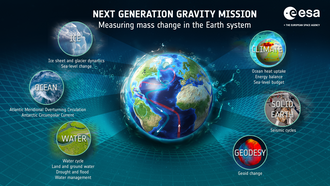
The Next Generation Gravity Mission (NGGM) is a proposed Earth observation satellite mission under development by the European Space Agency's FutureEO programme.12 If approved, it will launch in 2032 as a pair of satellites flying in the same low Earth orbit in an in-line formation, separated by approximately 100 km.3 The satellites will precisely map Earth's gravity field by monitoring short-period changes in the distance between them using laser interferometry.4
NGGM will form part of the MAss Change and Geosciences International Constellation (MAGIC) together with NASA's GRACE-C pair of satellites.567 The MAGIC satellite constellation is intended to extend the more than two decades long time series of monthly gravity field models by the GRACE and GRACE-FO missions.8 If implemented, NGGM will be the first Mission of Opportunity in the FutureEO programme.9
References
References
- "FutureEO at ESA's Ministerial Council 2025". www.esa.int. Retrieved 2025-11-08.
- "NGGM Phase A Study". www.dlr.de. Retrieved 2025-11-08.
- Haagmans, Roger; Siemes, Christian; Massotti, Luca; Carraz, Olivier; Silvestrin, Pierluigi (2020-10-01). "ESA's next-generation gravity mission concepts". Rendiconti Lincei. Scienze Fisiche e Naturali. 31 (1): 15–25. doi:10.1007/s12210-020-00875-0. ISSN 1720-0776.
- Bender, P. L.; Conklin, J. W.; Wiese, D. N. (2025). "Short-Period Mass Variations and the Next Generation Gravity Mission". Journal of Geophysical Research: Solid Earth. 130 (1) e2024JB030290. doi:10.1029/2024JB030290. ISSN 2169-9356.
- "Citation for Next Generation Gravity Mission Mission Requirements Document". www.esa.int. Retrieved 2025-11-08.
- Next Generation Gravity Mission design activities within the Mass Change and Geoscience International Constellation
- NEXT GENERATION GRAVITY MISSION (NGGM): STATO DELLA MISSIONE
- "S-NGGM | Studies for Next Generation Gravity Missions". www.gfz.de. Retrieved 2025-11-08.
- "ESA Project MAGIC/Science". www.asg.ed.tum.de (in German). Retrieved 2025-11-08.