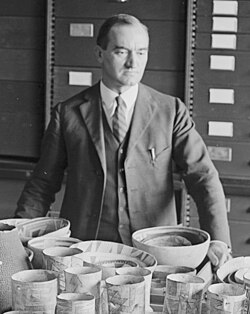
Neil Merton Judd (October 27, 1887 – December 19, 1976) was an American archaeologist who studied under both Byron Cummings and Edgar Lee Hewett. He was the long-term curator of archaeology at the United States National Museum, part of the Smithsonian Institution. He is noted for his discovery and excavation of ruins left by the Ancestral Pueblo People (also known as Anasazi) of the Four Corners area, especially sites located within Chaco Canyon, a region located within the now-arid San Juan Basin of northwestern New Mexico. He headed the first federally backed archeological expeditions sent to Chaco Canyon, excavating the key ruins of Pueblo Bonito and Pueblo del Arroyo.1 He was also a member of the 1909 expedition that publicized Utah's Rainbow Bridge.2
Citations
Citations
- Strutin 1994, pp. 20–24.
- Smith, Watson (2017). "Review of Men Met Along the Trail: Adventures in Archaeology by Neil M. Judd". American Antiquity. 35 (3): 391. doi:10.2307/278353. ISSN 0002-7316. JSTOR 278353.
References
References
- Brew, JO (1978), "Neil Merton Judd, 1887–1976", American Anthropologist, 80 (2): 352–354, doi:10.1525/aa.1978.80.2.02a00060
- Strutin, M (1994), Chaco: A Cultural Legacy, Southwest Parks and Monuments Association, ISBN 978-1-877856-45-7
Further reading
Further reading
- Neil M. Judd, Men Met along the Trail: Adventures in Archaeology, 1968, University of Oklahoma Press. Judd's professional memoirs.
- Chaco Culture National Historical Park: A Brief History of Investigations & Excavations in Chaco Canyon: 1877 to Present
- Register to the Papers of Neil Merton Judd, National Anthropological Archives, Smithsonian Institution