| Navekat | |
|---|---|
| Nevkat | |
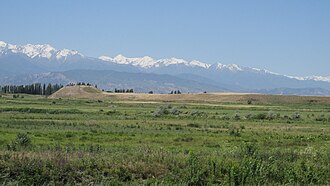 Ruins of Navekat | |
Location of Navekat in Kyrgyzstan Show map of KyrgyzstanNavekat (West and Central Asia) Show map of West and Central Asia | |
| 42°54′56.2″N 75°0′29.9″E / 42.915611°N 75.008306°E / 42.915611; 75.008306 | |
| Type | Settlement |
| Location | Chüy Region, Kyrgyzstan |
| History | |
| Built | 5–6th century |
| Abandoned | 12th century |
| Site notes | |
| Condition | In ruins |
Navekat or Nevkat1 was an ancient Silk Road city that flourished between the 6th and 12th centuries. It lies near the modern village of Krasnaya Rechka, in the Chüy Valley, present-day Kyrgyzstan, about 30 km (19 mi) east of Bishkek. It was one of the most important trading centres of the region.2 Navekat was inscribed as a UNESCO World Heritage Site in 20143 as a part of the site "Silk Roads: the Routes Network of Chang'an-Tianshan Corridor".
Archaeological site
Navekat had two walls: the first around the shahristan, the traditional administrative center of this type of city; the second wall was more than 18 km (11 mi) long, with public buildings, markets, gardens and even farms inside. There was a citadel (Persian: كهندز, romanized: kuhandiz) in the northeastern part of the city built on a massive earthen platform. The volume of this platform was about 13 million cubic meters, probably the largest man-made mound in the world.
During archaeological excavations, artifacts uncovered included a golden burial mask and an 8-metre (26 ft)-long reclining Buddha statue in one of the two Buddhist temples.4 Other artifacts demonstrate the presence of Buddhists, Zoroastrians, Eastern Christians, and Manicheans.
References
References
- "Himalayan and central asian studies" (PDF). Archived from the original (PDF) on 2022-11-28.
- Nevkat – An Ancient Silk Road City Retrieved 22 May 2018
- "UNESCO World Heritage List".
- Guides, Insight (April 2017). Insight Guides Silk Road (Travel Guide eBook). Apa Publications (UK) Limited. ISBN 9781786716996.