 | |
 | |
| Names | |
|---|---|
| Preferred IUPAC name
Diethylnitrous amide | |
| Other names
N-Ethyl-N-nitrosoethanamine
Diethylnitrosamine DENA NDEA | |
| Identifiers | |
| |
3D model (JSmol)
|
|
| ChEBI | |
| ChemSpider | |
| ECHA InfoCard | 100.000.206 |
| EC Number |
|
| KEGG | |
| MeSH | D004052 |
PubChem CID
|
|
| UNII | |
CompTox Dashboard (EPA)
|
|
| |
| |
| Properties | |
| C4H10N2O | |
| Molar mass | 102.137 g·mol−1 |
| Appearance | Yellow liquid1 |
| Density | 0.95 g/mL1 |
| Boiling point | 177 °C (351 °F; 450 K)1 |
| −59.3·10−6 cm3/mol | |
| Related compounds | |
Related compounds
|
Diethylamine, N-Nitrosodimethylamine |
Except where otherwise noted, data are given for materials in their standard state (at 25 °C [77 °F], 100 kPa).
| |

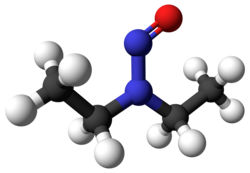
N-Nitrosodiethylamine (NDEA) is an organic compound with the formula Et2NNO (Et = C2H5). A member of the nitrosamines, it is a light-sensitive, volatile, clear yellow oil that is soluble in water, lipids, and other organic solvents. It has an amine or aromatic odor. It is used as gasoline and lubricant additive, antioxidant, and stabilizer for industry materials. When heated to decomposition, N-nitrosodiethylamine emits toxic fumes of nitrogen oxides. N-Nitrosodiethylamine affects DNA integrity, probably by alkylation, and is used in experimental research to induce liver tumorigenesis.2 It is carcinogenic and mutagenic.3 NDEA has also been found to perturb amino acid biosynthesis including arginine, as well as DNA damage repair and mitochondrial genome maintenance in yeast.4
It is found in tobacco smoke.56
It is classified as a Group 2A carcinogen (probable human carcinogen) by the World Health Organization.7
NDEA involvement in recalls
In the year 2019, NDEA was found as an impurity in valsartan and other angiotensin II receptor blockers (ARBs) used to treat high blood pressure and heart failure. The U.S. Food and Drug Administration has confirmed levels of NDEA and/or NDMA exceeding the interim acceptable intake limits, and the affected medicines were recalled.8
References
References
- "N-Nitrosodiethylamine". Sigma-Aldrich.
- "N-Nitrosodiethylamine". PubChem. National Center for Biotechnology Information. May 8, 2021. Retrieved May 12, 2021.
- Verna, L; Whysner, J; Williams, G. M. (1996). "N-nitrosodiethylamine mechanistic data and risk assessment: Bioactivation, DNA-adduct formation, mutagenicity, and tumor initiation". Pharmacology & Therapeutics. 71 (1–2): 57–81. doi:10.1016/0163-7258(96)00062-9. PMID 8910949.
- Ogbede, J.U., Giaever, G. & Nislow, C. A genome-wide portrait of pervasive drug contaminants. Sci Rep 11, 12487 (2021). https://doi.org/10.1038/s41598-021-91792-1
- Tricker, A. R.; Ditrich, C; Preussmann, R (1991). "N-nitroso compounds in cigarette tobacco and their occurrence in mainstream tobacco smoke". Carcinogenesis. 12 (2): 257–61. doi:10.1093/carcin/12.2.257. PMID 1995191.
- Talhout, Reinskje; Schulz, Thomas; Florek, Ewa; Van Benthem, Jan; Wester, Piet; Opperhuizen, Antoon (2011). "Hazardous Compounds in Tobacco Smoke". International Journal of Environmental Research and Public Health. 8 (12): 613–628. doi:10.3390/ijerph8020613. ISSN 1660-4601. PMC 3084482. PMID 21556207.
- "List of Classifications, Volumes 1-115". IARC Monographs on the Evaluation of Risk to Humans. International Agency for Research on Cancer. February 22, 2016. Archived from the original on June 10, 2017. Retrieved July 26, 2016.
- "FDA Updates and Press Announcements on Angiotensin II Receptor Blocker (ARB) Recalls (Valsartan, Losartan, and Irbesartan)". Drug Safety and Availability. U.S. Food and Drug Administration. November 7, 2019. Retrieved May 12, 2021.