| Myzozoa | |
|---|---|
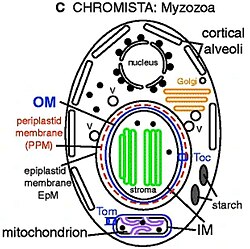
| |
| Myzozoa membrane structure | |
Scientific classification 
| |
| Domain: | Eukaryota |
| Clade: | Sar |
| Clade: | Alveolata |
| Clade: | Myzozoa Cavalier-Smith & Chao 2004 |
| Phyla | |
Myzozoa1 is a grouping of specific phyla within Alveolata,23 that either feed through myzocytosis, or were ancestrally capable of feeding through myzocytosis.1
It is sometimes described as a phylum, containing the major subphyla Dinozoa and Apicomplexa, plus minor subphyla.4
The term Myzozoa superseded the previous term Miozoa, by the same authority, and gave a slightly altered meaning.1
Phyla
Within Myzozoa, there are four phyla:
- Apicomplexa – parasitic protozoa that lack axonemal locomotive structures except in gametes
- Dinoflagellata – mostly marine flagellates many of which have chloroplasts
- Chromerida – a marine phylum of photosynthetic protozoa
- Perkinsozoa
Evolution
The most closely related large clade to the myzozoans are the ciliates.1 Both of these groups of organisms – unlike the majority of eukaryotes studied to date – seem to have a linear mitochondrial genome. Most other eukaryotes that have had their mitochondrial genomes examined have circular genomes. However, the taxonomic term Myzozoa specifically excludes ciliates1 which are rather under the higher taxonomic rank Alveolata. Thus, Alveoata includes two large groups: Myzozoa and Ciliophora5 plus the smaller groups discussed above.
All Myzozoa appears to have evolved from an ancestor that possessed plastids, required through endosymbiosis.6
The branching order within both Myzozoa and Protalveolata, is only partly understood. Three groups – the colpodellids, Chromerida and the Apicomplexa – appear to be sister clades.7 Three other groups – the perkinsids, Syndiniales and Oxyrrhis are distantly related to the dinoflagellates.89
Notes
Notes
Perkinsus marinus and the Apicomplexa both have histones while the dinoflagellates appear to have lost theirs.10
Chromerida are ancestrally myzocytotic, on the basis of evidence for myzocytosis by the chromerid Vitrella brassicaformis.11
References
References
- Cavalier-Smith, T.; Chao, E. E. (2004-09-06). "Protalveolate phylogeny and systematics and the origins of Sporozoa and dinoflagellates (phylum Myzozoa nom. nov.)". European Journal of Protistology. 40 (3): 185–212. doi:10.1016/j.ejop.2004.01.002. ISSN 0932-4739.
- Leander BS, Hoppenrath M (February 2008). "Ultrastructure of a novel tube-forming, intracellular parasite of dinoflagellates: Parvilucifera prorocentri sp. nov. (Alveolata, Myzozoa)". Eur. J. Protistol. 44 (1): 55–70. doi:10.1016/j.ejop.2007.08.004. PMID 17936600.
- "Alveolates". Retrieved 2009-06-14.
- Cavalier-Smith T (June 2004). "Only six kingdoms of life". Proc. Biol. Sci. 271 (1545): 1251–62. doi:10.1098/rspb.2004.2705. PMC 1691724. PMID 15306349.
- "Protalveolata – Wikispecies".
- Muñoz-Gómez, Sergio A.; Slamovits, Claudio H. (2018). "Plastid Genomes in the Myzozoa". Plastid Genome Evolution. Advances in Botanical Research. Vol. 85. pp. 55–94. doi:10.1016/bs.abr.2017.11.015. ISBN 9780128134573.
- Moore RB, Oborník M, Janouskovec J, et al. (February 2008). "A photosynthetic alveolate closely related to apicomplexan parasites". Nature. 451 (7181): 959–63. Bibcode:2008Natur.451..959M. doi:10.1038/nature06635. PMID 18288187.
- Saldarriaga, J. F.; McEwan, M. L.; Fast, N. M.; Taylor, F. J.; Keeling, P. J. (2003). "Multiple protein phylogenies show that Oxyrrhis marina and Perkinsus marinus are early branches of the dinoflagellate lineage". International Journal of Systematic and Evolutionary Microbiology. 53 (Pt 1): 355–365. doi:10.1099/ijs.0.02328-0. PMID 12656195.
- Leander BS, Kuvardina ON, Aleshin VV, Mylnikov AP, Keeling PJ (2003). "Molecular phylogeny and surface morphology of Colpodella edax (Alveolata): insights into the phagotrophic ancestry of apicomplexans". J. Eukaryot. Microbiol. 50 (5): 334–40. doi:10.1111/j.1550-7408.2003.tb00145.x. PMID 14563171.
- Gornik SG, Ford KL, Mulhern TD, Bacic A, McFadden GI, Waller RF (December 2012). "Loss of nucleosomal DNA condensation coincides with appearance of a novel nuclear protein in dinoflagellates". Curr. Biol. 22 (24): 2303–12. doi:10.1016/j.cub.2012.10.036. PMID 23159597.
- Molecular ecology and phylogeny of protistan algal symbionts from corals (Thesis). 2006.