| Mycotretus | |
|---|---|
| |
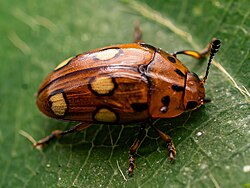
| Adult Mycotretus sexoculatus, São Bernardo do Campo, Brazil | |
Scientific classification 
| |
| Kingdom: | Animalia |
| Phylum: | Arthropoda |
| Clade: | Pancrustacea |
| Class: | Insecta |
| Order: | Coleoptera |
| Suborder: | Polyphaga |
| Infraorder: | Cucujiformia |
| Family: | Erotylidae |
| Tribe: | Tritomini |
| Genus: | Mycotretus Lacordaire, 1842 |
| Type species | |
| Erotylus lesueuri Lacordaire, 1842
| |
| Synonyms | |
|
Lybas Dejean, 1836 ("1837"; unavailable) | |
Mycotretus is a genus in the pleasing fungus beetle family (Erotylidae). They are small, oval beetles, and often very colorful and boldly patterned in yellowish, orange-red to chestnut-brown, and black hues; historically, they were popular with insect collectors. Among its family, this genus is placed in subfamily Tritominae, or – in taxonomic arrangements that prefer a more comprehensive subfamily Erotylinae – in tribe Tritomini of the Erotylinae.12
These beetles are found throughout the Neotropics except on high mountain ranges. Some isolated records from temperate North America presumably refer to introduced specimens. One species (M.nigromanicatus) ranges as far north as the Chiricahua Mountains of Arizona, USA, while in the south of the genus' range, several species are found in Paraguay and northern Argentina. While some species, such as M.ornatus, M.pygmaeus and M.scitulus, occur almost across the entire range of the genus, many are restricted to a single range of hills or to one area bordered by large rivers, with Mexico and the Amazon Basin having the highest diversity of Mycotretus.34 Like some of their relatives, they do not eat mainly polypores (shelf fungi) as most pleasing fungus beetles do, but prefer gilled Agaricales fungi; unlike in the close relative Pselaphacus, larvae of Mycotretus species feed individually and do not receive parental care.5
This genus has a convoluted nomenclatural history involving the related genera Ischyrus and Lybas;6 in addition, its delimitation against Mycomystes was long disputed and as of 2023 is still not fully resolved.2
Nomenclature and taxonomy
Mycotretus is one of the largest genera in this family – possibly the second-largest; after its latest revision in 2023, when numerous supposed species were synonymized with others (in particular the highly variable Mycotretus ornatus) or moved to other genera, it still contained almost 170 accepted species.2

The genus names Ischyrus, Lybas and Mycotretus were first published by Pierre Dejean in the second edition of his Catalogue des Coléoptères in 18367; however, he attributed these names to Louis Chevrolat instead of claiming authorship himself. Dejean's catalog was a simple list of names, with no diagostic criteria or descriptions, but as he included well-known species that hat been extensively described by previous authors in each of his genera, his genera are technically valid.6
Jean Lacordaire in 1842 published a monograph on the pleasing fungus beetles. Therein, he also used the genus names Ischyrus, Lybas and Mycotretus, attributing them to Chevrolat just as Dejean did. However, Lacordaire placed Dejean's Lybas species in Mycotretus and re-established the genus Lybas for Lybas normalis, a species mentioned by preceding authors such as Dejean, but never validly described until Lacordaire's 1842 work. Meanwhile, most of Dejean's small Mycotretus species were moved into Ischyrus by Lacordaire, where they formed a second "division" (subgenus) distinct from the large tropical species which had already been placed in Ischyrus by Dejean.6
In 1873, George Crotch split genus Ischyrus, elevating Lacordaire's groups to full genus status. But he retained the name Ischyrus for the second group, which had been treated as Mycotretus by Dejean. The first group, Dejean's Ischyrus, was named Megischyrus by Crotch. For his remaining Ischyrus, Crotch designated Olivier's Erotylus quadripunctatus as type species. As he only referred back to Lacordaire, Crotch overlooked that Dejean had included this species in Mycotretus, preventing its use as type species of Ischyrus.6
However, Crotch failed to designate a type species for Mycotretus. W.W.Boyle attempted to correct this in 1956, and selected the beetle described as Erotylus leseuri by Chevrolat in 1935. But like Crotch with his Ischyrus type species, Boyle did not note that Dejean had included this species in his genus Lybas at the time when he established Mycotretus, making Boyle's type designation invalid.6
Subsequent authors applied the genus names as proposed by Crotch and Boyle, until Moacyr Alvarenga in 1965 revalidated Dejean's Ischyrus with E.undatus as type species, making Megischyrus a junior objective synonym and invalidating it. For the second group, containing most of Dejean's Mycotretus, Alvarenga established the genus Micrischyrus, with E.quadripunctatus as type species to exactly replace Crotch's Ischyrus which had become a junior homonym by the abolishment of Megischyrus, and likewise invalidated. However, almost all Erotylidae research at that time was published in English, with Japanese and German having some minor relevance due to prolific experts Michio Chûjô and Kurt Delkeskamp, whereas Alvarenga published in Brazilian Portuguese and his nomenclatural acts appeared in the then little-known zoological bulletin of the Federal University of Paraná (now Acta Biologica Paranaense). Consequently, unaware of Alvarenga's proposed solution to a problem they often were not even aware of in the first place, other erotylid researchers continued to apply Crotch's nomenclature. As for Mycotretus, its authorship was mistakenly referred by Alvarenga to Chevrolat, 1837, with M.ornatus (under its original name Erotylus ornatus) as alleged type species.6
To resolve this situation, Paul E. Skelley and Michael A. Goodrich in 1994 petitioned the ICZN to rule Dejean's descriptions as invalid; this would preserve the prevailing genus assignments. In 1996, the ICZN agred to this proposal, establishing Lacordaire as the author of Mycotretus due to Crotch's and Boyle's revalidation of his genus. This also permitted E.leseuri to be type species of Mycotretus, courtesy of Lacordaire having moved it there.8
Species


- Mycotretus adalioides Crotch, 1876 (tentatively placed here)
- Mycotretus aegrotus Gorham, 1888
- Mycotretus aestuans Lacordaire, 1842
- Mycotretus alvarengai Pecci-Maddalena & Lopes-Andrade, 2018
- Mycotretus ambulator Lacordaire, 1842
- Mycotretus anchoralis Guérin, 1956
- Mycotretus arcuatus Lacordaire, 1842
- Mycotretus argus Lacordaire, 1842
- Mycotretus atricaudatus Gorham, 1888
- Mycotretus badius Gorham, 1888
- Mycotretus balteatus Crotch, 1876
- Mycotretus bicolor Taschenberg, 1870 (= M.monrosi)
- Mycotretus bicoloratus Kuhnt, 1911 (= M.bicolor Kirsch, 1876, nec Taschenberg, 1870: preoccupied)
- Mycotretus bipunctatus Gorham, 1888
- Mycotretus bistrigatus Lacordaire, 1842
- Mycotretus bistrioculatus Alvarenga, 1983
- Mycotretus brasilianus Crotch, 1876
- Mycotretus brevis Gorham, 1888
- Mycotretus centralis Arrow, 1909 (= M.tigrinus Gorham, 1887, nec Olivier, 1792: preoccupied)
- Mycotretus cercyonoides Gorham, 1888
- Mycotretus chilensis Crotch, 1876 (= M.bicinctus)
- Mycotretus cinctiger Crotch, 1876 (= M.luizi)
- Mycotretus clitelliger Lacordaire, 1842
- Mycotretus coccidulinus Gorham, 1888
- Mycotretus coelestinus Lacordaire, 1842
- Mycotretus consanguineus Gorham, 1888
- Mycotretus cordiger Crotch, 1876 (= M.zischkai)
- Mycotretus cribratus Gorham, 1888
- Mycotretus cruciger Crotch, 1876
- Mycotretus crudus Gorham, 1888
- Mycotretus cruentus Gorham, 1888
- Mycotretus cunctans Mader, 1942
- Mycotretus cyanopterus Lacordaire, 1842
- Mycotretus decoratus (Duponchel, 1825)
- Mycotretus decorus Crotch, 1876
- Mycotretus deyrollei Crotch, 1876 (= M.discipennis, M.sexlineatus)
- Mycotretus dichrous Kirsch, 1876
- Mycotretus dimidiatus Taschenberg, 1870
- Mycotretus distigma Lacordaire, 1842
- Mycotretus distinguendus Arrow, 1909
- Mycotretus dorsofasciatus Lacordaire, 1842 (= M.nugator)
- Mycotretus dorsonotatus Lacordaire, 1842 (= M.alternans, M.quadristriolatus)
- Mycotretus duodecimguttatus (Duponchel, 1825)
- Mycotretus durius Lacordaire, 1842
- Mycotretus dytiscoides Lacordaire, 1842
- Mycotretus egae Crotch, 1876 (= M.basalis)
- Mycotretus elegans Gorham, 1888
- Mycotretus episcaphoides Crotch, 1876
- Mycotretus episcopalis Lacordaire, 1842
- Mycotretus epopterus Gorham, 1888
- Mycotretus erraticus Gorham, 1898
- Mycotretus expressus Kuhnt, 1910
- Mycotretus fallax (Guérin-Méneville, 1841)
- Mycotretus fasciolatus Lacordaire, 1842
- Mycotretus fascipennis Kuhnt, 1910
- Mycotretus fidelis Delkeskamp, 1939 (= M.parallelus Kuhnt, 1909, nec Crotch, 1876: preoccupied)
- Mycotretus flavomarginatus Lacordaire, 1842 (= M.major)
- Mycotretus floriger Lacordaire, 1842
- Mycotretus fulviceps Crotch, 1876
- Mycotretus fulvilabris Crotch, 1876 (= M.rastratus)
- Mycotretus geminus Gorham, 1888
- Mycotretus guatemalae Crotch, 1876
- Mycotretus haemapterus Gorham, 1888
- Mycotretus haematicus Gorham, 1888
- Mycotretus hepaticus Lacordaire, 1842
- Mycotretus hilaris Lacordaire, 1842
- Mycotretus hirudo Gorham, 1888
- Mycotretus humeralis (Germar, 1824)
- Mycotretus humilis Lacordaire, 1842
- Mycotretus illustris Crotch, 1876
- Mycotretus incarnatus Gorham, 1888
- Mycotretus interstictus Gorham, 1888 (= M.interstitialis)
- Mycotretus jocosus Lacordaire, 1842
- Mycotretus laccophilinus Gorham, 1888
- Mycotretus lacertosus Lacordaire, 1842
- Mycotretus laeviventris Crotch, 1876
- Mycotretus lepidus Lacordaire, 1842 (= M.chontalesi, M.graniformis)
- Mycotretus leprosus Lacordaire, 1842
- Mycotretus lesueuri (Chevrolat, 1835) (= M.savignyi)
- Mycotretus limbatus (Lacordaire, 1842)
- Mycotretus lissomoides Crotch, 1876
- Mycotretus luteipes Lacordaire, 1842
- Mycotretus luteolus Gorham, 1888
- Mycotretus maculatus (Olivier, 1792) (= M.figuratus, M.mutabilis)
- Mycotretus magus Lacordaire, 1842
- Mycotretus marginicollis Lacordaire, 1842
- Mycotretus melanopterus Lacordaire, 1842
- Mycotretus melanotus Gorham, 1888
- Mycotretus miniatus Lacordaire, 1842
- Mycotretus minutus (Duponchel, 1825) (= M.quadrinus)
- Mycotretus misellus Lacordaire, 1842
- Mycotretus mycetophagoides Crotch, 1876
- Mycotretus mycetophiloides Crotch, 1876
- Mycotretus nigricollis Gorham, 1888
- Mycotretus nigripes Gorham, 1888
- Mycotretus nigrivittis Lacordaire, 1842
- Mycotretus nigromanicatus Boyle, 1954
- Mycotretus nitescens Crotch, 1876
- Mycotretus normalis Gorham, 1888
- Mycotretus noterinus Gorham, 1888
- Mycotretus octoculatus Alvarenga, 1983
- Mycotretus opalescens Crotch, 1876 (= M.pelliciens)
- Mycotretus opalizans Mader, 1942
- Mycotretus oppositipunctum Gorham, 1888
- Mycotretus ornatus (Duponchel, 1825) (= M.cognatus, M.coronatus, M.difficilis, M.dispar, M.dubius, M.godarti, M.graphoderus, M.intermedius, M.maculosus, M.melanostictus, M.nigropunctatus, M.partitialis, M.posticus, M.puncticollis, M.terminalis)
- Mycotretus pallidior (Crotch, 1876) (= M.nigrotinctus)
- Mycotretus palmiphilus Lacordaire, 1842
- Mycotretus panamanus Gorham, 1888
- Mycotretus parallelus Crotch, 1876
- Mycotretus partitus Lacordaire, 1842
- Mycotretus pebasensis Crotch, 1876
- Mycotretus pecari Lacordaire, 1842
- Mycotretus peruae Crotch, 1876
- Mycotretus pictopiceus Gorham, 1888
- Mycotretus planus Gorham, 1888
- Mycotretus polyophthalmus Lacordaire, 1842
- Mycotretus prioteloides Mader, 1942
- Mycotretus psittacus Lacordaire, 1842
- Mycotretus psylloboroides Crotch, 1876
- Mycotretus pulchellus Lacordaire, 1842
- Mycotretus puncticeps Kirsch, 1865
- Mycotretus pusillus Lacordaire, 1842
- Mycotretus pygmaeus Lacordaire, 1842
- Mycotretus quadrioculatus Alvarenga, 1983
- Mycotretus quadripunctatus Crotch, 1876
- Mycotretus quattuordecimguttatus Lacordaire, 1842 (= M.bisseptemguttatus)
- Mycotretus reticulatus Crotch, 1876 (= M.lopesi)
- Mycotretus rhodosomus Lacordaire, 1842 (= M.nigromaculatus)
- Mycotretus rubidus Gorham, 1888
- Mycotretus rufilabris (Lacordaire, 1842)
- Mycotretus rufipennis Gorham, 1888
- Mycotretus sallaei Crotch, 1876
- Mycotretus sandicatus Gorham, 1888
- Mycotretus sanguineus (Duponchel, 1825)
- Mycotretus sannio Lacordaire, 1842
- Mycotretus scalaris Lacordaire, 1842
- Mycotretus scitulus Lacordaire, 1842 (= M.derasofasciatus, M.nubifer)
- Mycotretus sedecimguttatus (Guérin-Méneville, 1844)
- Mycotretus seminiger Harold, 1876
- Mycotretus separandus Crotch, 1876
- Mycotretus sericeonitens Crotch, 1876
- Mycotretus sexoculatus Lacordaire, 1842
- Mycotretus sexpunctatus Gorham, 1888
- Mycotretus signatellus Crotch, 1876 (= M.fragosoi)
- Mycotretus singularis Lacordaire, 1842
- Mycotretus sobrinus (Guérin-Méneville, 1841) (= M.silaceus)
- Mycotretus spadiceus Gorham, 1888
- Mycotretus sticticollis Lacordaire, 1842
- Mycotretus stillatus Kuhnt, 1910
- Mycotretus stramineus Gorham, 1888
- Mycotretus succinctus Crotch, 1876
- Mycotretus suturalis Kirsch, 1876
- Mycotretus ternotatus Gorham, 1888
- Mycotretus tesserarius Lacordaire, 1842
- Mycotretus thoracicus Kuhnt, 1910
- Mycotretus tibialis Gorham, 1888
- Mycotretus tigratus Lacordaire, 1842 (= M.nigrocinctus, M.trabeatus)
- Mycotretus tigrinoides Mader, 1942
- Mycotretus tigrinus (Olivier, 1792) (= M.multimaculatus)
- Mycotretus tigripennis Mader, 1942
- Mycotretus tricolor Crotch, 1876
- Mycotretus trifasciatus Guérin, 1956 (= "M.bruchi" nomen nudum)
- Mycotretus tucuruiensis Alvarenga, 1983
- Mycotretus vilis Lacordaire, 1842
- Mycotretus vittatus Gorham, 1888
- Mycotretus xanthomelas Crotch, 1876
- Mycotretus ziczac Kuhnt, 1910
A supposed Mycotretus species from Isla de Mona near Puerto Rico collected by J.A.Ramos in the early 20th century is actually a species of the monommatine beetle genus Hyporhagus. These deceptively resemble certain erotylid beetles (such as Mycotretus) in overall appearance, but actually belong to another branch of Cucujiformia. As of 2009, no species of Mycotretus were known from the Caribbean offshore islands.9
In addition, the names "Mycotretus bruchi" and "M.unguicularis", despite having been attributed to Bruch, 1915, were never validly established; they are nomina nuda. The former has been identified as Mycotretus trifasciatus, while the latter is still undeterminable.2
Formerly placed here

In the 2023 revision, several species traditionally placed in Mycotretus turned out to belong to other genera:2
- "Mycotretus" apicalis (including M.coccinelloides, M.corallipennis, M.gemmula, M.gentilis, M.nigroterminatus and M.pulicarius), "Mycotretus" coccineus (including M.sanguinosus and M.unicolor), "Mycotretus" fuscitarsis, "Mycotretus" melanophthalmus (including M.cinctellus and M.discoidalis) and "Mycotretus" peruvianus are now in Mycomystes
- "Mycotretus" antesignatus is now in Mycolybas
- "Mycotretus" fasciatus belongs to genus Epopterus of family Endomychidae (handsome fungus beetles)
- "Mycotretus" virgatus is now in Iphiclus
References
References
- "Genus Mycotretus". iNaturalist. Retrieved 2026-06-15.
- Pecci-Maddalena, Italo Salvatore de Castro; Lopes-Andrade, Cristiano; Skelley, Paul (2023). "Catalogue of Mycotretus Lacordaire, 1842 (Coleoptera: Erotylidae: Tritomini): An annotated, illustrated and historical approach". European Journal of Taxonomy (876): 2149. Bibcode:2023EJTax.876.2149P. doi:10.5852/ejt.2023.876.2149.
- "Mycotretus Lacordaire, 1842". GBIF. Retrieved 2026-06-15.
- Alvarenga, Moacyr (1994). "Catálogo dos Erotylidae (Coleoptera) Neotropicais". Revista Brasileira de Zoologia. 11: 1–175. doi:10.1590/S0101-81751994000100001.
- Robertson, James A.; McHugh, Joseph V. & Whiting, Michael F. (2004): A molecular phylogenetic analysis of the pleasing fungus beetles (Coleoptera: Erotylidae): evolution of colour patterns, gregariousness and mycophagy. Syst.Entomol. 29(2): 173-187. doi:10.1111/j.0307-6970.2004.00242.x PDF fulltext
- Skelley, Paul E.; Goodrich, Michael A. (1994). "Ichyrus Lacordaire, 1842, Lybas Lacordaire, 1842, Mycotretus Lacordaire, 1842 and Megischyrus Crotch, 1873 (Insecta, Coleoptera): Proposed Conservation" (PDF). The Bulletin of Zoological Nomenclature. 51: 128–132. doi:10.5962/bhl.part.7176.
- Sometimes erroneously dated to 1837.
- ICZN (1996): Opinion 1824. Ischyrus Lacordaire, 1842, Lybas Lacordaire, 1842, Mycotretus Lacordaire, 1842 and Megischyrus Crotch, 1873 (Insecta, Coleoptera): conserved. Bull. Zool. Nomenclat. 53(1): 54-56. Fulltext
- Skelley, Paul E. (2009): Pleasing fungus beetles of the West Indies (Coleoptera: Erotylidae: Erotylinae). Insect.Mund. 82: 1-94. PDF fulltext
Further reading
Further reading
- Leschen, Richard A. B. (2003). Erotylidae (Insecta: Coleoptera: Cucujoidea) phylogeny and review. Fauna of New Zealand. Vol. 47. Manaaki Whenua Press. ISBN 978-0-478-09350-6. ISSN 0111-5383.
- Lobl, I.; Smetana, A., eds. (2007). Catalogue of Palaearctic Coleoptera, Volume 4: Elateroidea - Derodontoidea - Bostrichoidea - Lymexyloidea - Cleroidea - Cucujoidea. Apollo Books. ISBN 978-8788757675.