| Mycobacterium gordonae | |
|---|---|
Scientific classification 
| |
| Domain: | Bacteria |
| Kingdom: | Bacillati |
| Phylum: | Actinomycetota |
| Class: | Actinomycetes |
| Order: | Mycobacteriales |
| Family: | Mycobacteriaceae |
| Genus: | Mycobacterium |
| Species: | M. gordonae
|
| Binomial name | |
| Mycobacterium gordonae Bojalil et al. 1962, ATCC 14470
| |
Mycobacterium gordonae is a species of Mycobacterium named for Ruth E. Gordon.1 It is a species of the phylum Actinomycetota (Gram-positive bacteria with high guanine and cytosine content, one of the dominant phyla of all bacteria), belonging to the genus Mycobacterium.
Description
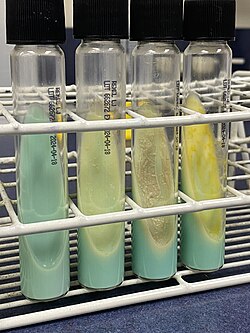
- Negative control
- M. tuberculosis: Dry-appearing colonies
- Mycobacterium avium complex: Wet-appearing colonies
- M. gordonae: Yellowish colonies source ↗
Gram-positive, nonmotile and moderate to long acid-fast rods.
- Commonly found in tap water and soil. Casual resident in human sputum and gastric lavage specimens.
Colony characteristics
- Smooth, with yellow or orange scotochromogenic colonies. Even though they are scotochromogenic pigment is intensified by growing in continuous light.
Physiology
- Growth on Löwenstein-Jensen medium and Middlebrook 7H10 agar within 7 or more days at 37 °C (optimal 25 °C).
- Does not grow in the presence of ethambutol (1 mg/L), isoniazid (10 mg/L) and sodium chloride (5%).
- Some strains can grow using carbon monoxide as a carbon and energy source.2
Differential characteristics
- A commercial hybridisation assay (AccuProbe) to identify M. gordonae exists.3
- Intraspecies variability in 16S rDNA sequences
Pathogenesis
- Rarely if ever implicated in disease processes even if patients are immunocompromised. Widely distributed in environment and usually a contaminant in laboratory specimens.4
- Biosafety level 2
Type strain
Strain ATCC 14470 = CCUG 21801 = CCUG 21811 = CIP 104529 = DSM 44160 = JCM 6382 = NCTC 10267.
References
References
- Mycobacterium gordonae at eMedicine
- King GM (December 2003). "Uptake of carbon monoxide and hydrogen at environmentally relevant concentrations by mycobacteria". Applied and Environmental Microbiology. 69 (12): 7266–72. doi:10.1128/aem.69.12.7266-7272.2003. PMC 310020. PMID 14660375.
- Reisner BS, Gatson AM, Woods GL (December 1994). "Use of Gen-Probe AccuProbes to identify Mycobacterium avium complex, Mycobacterium tuberculosis complex, Mycobacterium kansasii, and Mycobacterium gordonae directly from BACTEC TB broth cultures". Journal of Clinical Microbiology. 32 (12): 2995–8. doi:10.1128/JCM.32.12.2995-2998.1994. PMC 264213. PMID 7883888.
- Kasperbauer, Shannon (July 1, 2017). "NTM: Types". National Jewish Health.
Further reading
Further reading
- Bojalil LF, Cerbon J, Trujillo A (June 1962). "Adansonian classification of mycobacteria". Journal of General Microbiology. 28 (2): 333–46. doi:10.1099/00221287-28-2-333. PMID 13870716.
External links
External links