  | |
| Observation data Epoch J2000.0 Equinox ICRS | |
|---|---|
| Constellation | Octans |
| Right ascension | 20h 42m 02.9873s1 |
| Declination | −76° 10′ 50.131″1 |
| Apparent magnitude (V) | 5.98 ± 0.012 |
| Characteristics | |
| Spectral type | F6 II/III3 |
| U−B color index | +0.114 |
| B−V color index | +0.444 |
| Astrometry | |
| Radial velocity (Rv) | −36 ± 45 km/s |
| Proper motion (μ) | RA: +190.8911 mas/yr Dec.: −9.4791 mas/yr |
| Parallax (π) | 9.7399±0.0241 mas1 |
| Distance | 334.9 ± 0.8 ly (102.7 ± 0.3 pc) |
| Absolute magnitude (MV) | +0.976 |
| Details | |
| Mass | 1.36+0.26 −0.197 M☉ |
| Radius | 4.68+0.15 −0.327 R☉ |
| Luminosity | 34.38 L☉ |
| Surface gravity (log g) | 3.23+0.11 −0.077 cgs |
| Temperature | 6,5218 K |
| Metallicity [Fe/H] | +0.199 dex |
| Age | 9009 Myr |
| Other designations | |
| μ1 Oct, 50 G. Octantis, CD−76°1054, CPD−76°1434, GC 28731, HD 196051, HIP 102162, HR 7863, SAO 257838, LTT 8161 | |
| Database references | |
| SIMBAD | data |
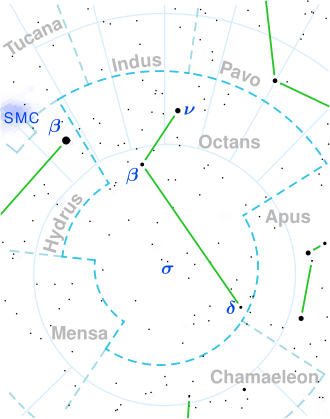
Mu1 Octantis, Latinized from μ1 Octantis, is a solitary star in the southern circumpolar constellation Octans. It has an apparent magnitude of 5.98,2 allowing it to be faintly visible to the naked eye under ideal conditions. Located 335 light years away,1 it is approaching the Sun with a heliocentric radial velocity of −36 km/s.5
This object is an F-type star with the blended luminosity class of a giant star and a bright giant.3 At present it has 1.36 times the mass of the Sun7 but has expanded to 4.68 times its girth.7 It radiates at 34.3 L☉ from its enlarged photosphere at an effective temperature of 6,521 K,8 giving it a yellow white glow. Mu1 Octantis is metal enriched and has an age of 900 million years.9
References
References
- Brown, A. G. A.; et al. (Gaia collaboration) (2021). "Gaia Early Data Release 3: Summary of the contents and survey properties". Astronomy & Astrophysics. 649: A1. arXiv:2012.01533. Bibcode:2021A&A...649A...1G. doi:10.1051/0004-6361/202039657. S2CID 227254300. (Erratum: doi:10.1051/0004-6361/202039657e). Gaia EDR3 record for this source at VizieR.
- Høg, E.; Fabricius, C.; Makarov, V. V.; Urban, S.; Corbin, T.; Wycoff, G.; Bastian, U.; Schwekendiek, P.; Wicenec, A. (March 2000). "The Tycho-2 catalogue of the 2.5 million brightest stars". Astronomy and Astrophysics. 355: L27–L30. Bibcode:2000A&A...355L..27H. ISSN 0004-6361.
- Houk, N.; Cowley, A. P. (1975). University of Michigan Catalogue of two-dimensional spectral types for the HD stars. Volume I. Declinations -90_ to -53_ƒ0. Bibcode:1975mcts.book.....H.
- Johnson, H. L.; Mitchell, R. I.; Iriarte, B.; Wisniewski, W. Z. (1 January 1966). "UBVRIJKL Photometry of the Bright Stars". Communications of the Lunar and Planetary Laboratory. 4: 99–110. Bibcode:1966CoLPL...4...99J.
- Gontcharov, G. A. (November 2006). "Pulkovo Compilation of Radial Velocities for 35 495 Hipparcos stars in a common system". Astronomy Letters. 32 (11): 759–771. arXiv:1606.08053. Bibcode:2006AstL...32..759G. doi:10.1134/S1063773706110065. ISSN 1063-7737. S2CID 119231169.
- Anderson, E.; Francis, Ch. (May 2012). "XHIP: An extended hipparcos compilation". Astronomy Letters. 38 (5): 331–346. arXiv:1108.4971. Bibcode:2012AstL...38..331A. doi:10.1134/S1063773712050015. ISSN 1063-7737. S2CID 255204555.
- Stassun, Keivan G.; et al. (9 September 2019). "The Revised TESS Input Catalog and Candidate Target List". The Astronomical Journal. 158 (4): 138. arXiv:1905.10694. Bibcode:2019AJ....158..138S. doi:10.3847/1538-3881/ab3467. ISSN 0004-6256.
- McDonald, I.; Zijlstra, A. A.; Watson, R. A. (2017). "Fundamental parameters and infrared excesses of Tycho-Gaia stars". Monthly Notices of the Royal Astronomical Society. 471 (1): 770. arXiv:1706.02208. Bibcode:2017MNRAS.471..770M. doi:10.1093/mnras/stx1433.
- Holmberg, J.; Nordström, B.; Andersen, J. (July 2009). "The Geneva-Copenhagen survey of the solar neighbourhood: III. Improved distances, ages, and kinematics". Astronomy & Astrophysics. 501 (3): 941–947. arXiv:0811.3982. Bibcode:2009A&A...501..941H. doi:10.1051/0004-6361/200811191. ISSN 0004-6361.