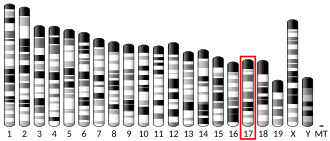
Mitochondrial carrier homolog 1 (MTCH1), also referred to as presenilin 1-associated protein (PSAP), is a protein that in humans is encoded by the MTCH1 gene on chromosome 6.567 MTCH1 is a proapoptotic mitochondrial protein potentially involved in Alzheimer's disease (AD).678
Structure
The protein encoded by this gene is named for its structural resemblance to the members of the mitochondrial carrier protein family.57 The MTCH1 gene contains 12 exons and produces four isoforms. These isoforms arise from alternative splicing of exon 8 and two potential start codons, which results in the deletion of 17 amino acid residues in the hydrophilic loop between two transmembrane domains of some isoforms.910 Though they differ in sequence and length, the four isoforms still share a similar topological structure, including six transmembrane domains, one of which is responsible for localization to the outer mitochondrial membrane (OMM), and two N-terminal apoptotic domains. As a result, all four isoforms retain these apoptotic domains and mitochondrial localization, both of which are required for the protein's proapoptotic function.7910
Function
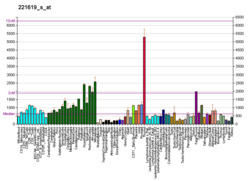
MTCH1 is a proapoptotic protein that localizes to the OMM and induces apoptosis independently of BAX and BAK.67 One possible mechanism proposes that its interactions with the mitochondrial permeability transition pore (MPTP) complex leads to depolarization of the mitochondrial membrane, release of cytochrome C, and activation of caspase-3.57 Expression of this protein is observed in 16 different tissue types, indicating that the protein may serve a housekeeping function.10
Clinical Significance
MTCH1 may be associated with AD and other neurodegenerative and neuroinflammatory diseases through its close interaction with presenilin.58 However, more research is required to confirm its clinical involvement.8
Interactions
MTCH1 has been shown to interact with PS1.5
References
References
- GRCh38: Ensembl release 89: ENSG00000137409 – Ensembl, May 2017
- GRCm38: Ensembl release 89: ENSMUSG00000024012 – Ensembl, May 2017
- "Human PubMed Reference:". National Center for Biotechnology Information, U.S. National Library of Medicine.
- "Mouse PubMed Reference:". National Center for Biotechnology Information, U.S. National Library of Medicine.
- Xu X, Shi YC, Gao W, Mao G, Zhao G, Agrawal S, Chisolm GM, Sui D, Cui MZ (Dec 2002). "The novel presenilin-1-associated protein is a proapoptotic mitochondrial protein". J Biol Chem. 277 (50): 48913–48922. doi:10.1074/jbc.M209613200. PMID 12377771.
- "Entrez Gene: MTCH1 mitochondrial carrier homolog 1 (C. elegans)".
- Lamarca, V; Marzo, I; Sanz-Clemente, A; Carrodeguas, JA (May 2008). "Exposure of any of two proapoptotic domains of presenilin 1-associated protein/mitochondrial carrier homolog 1 on the surface of mitochondria is sufficient for induction of apoptosis in a Bax/Bak-independent manner". European Journal of Cell Biology. 87 (5): 325–34. doi:10.1016/j.ejcb.2008.02.004. PMID 18375015.
- Vural, B; Sehitoğlu, E; Cavuş, F; Yalçınkaya, N; Haytural, H; Küçükerden, M; Ulusoy, C; Uğurel, E; Turan, S; Bulut, L; Türkoğlu, R; Shugaiv, E; Kürtüncü, M; Atakan, S; Güre, AO; Gül, A; Eraksoy, M; Akman-Demir, G; Tüzün, E (15 October 2013). "Mitochondrial carrier homolog 1 (Mtch1) antibodies in neuro-Behçet's disease". Journal of Neuroimmunology. 263 (1–2): 139–44. doi:10.1016/j.jneuroim.2013.08.007. hdl:11693/12552. PMID 24035008. S2CID 13300599.
- Mao, G; Tan, J; Gao, W; Shi, Y; Cui, MZ; Xu, X (April 2008). "Both the N-terminal fragment and the protein-protein interaction domain (PDZ domain) are required for the pro-apoptotic activity of presenilin-associated protein PSAP". Biochimica et Biophysica Acta (BBA) - General Subjects. 1780 (4): 696–708. doi:10.1016/j.bbagen.2008.01.013. PMC 3509497. PMID 18291114.
- Lamarca, V; Sanz-Clemente, A; Pérez-Pé, R; Martínez-Lorenzo, MJ; Halaihel, N; Muniesa, P; Carrodeguas, JA (October 2007). "Two isoforms of PSAP/MTCH1 share two proapoptotic domains and multiple internal signals for import into the mitochondrial outer membrane". American Journal of Physiology. Cell Physiology. 293 (4): C1347–61. doi:10.1152/ajpcell.00431.2006. PMID 17670888. S2CID 43241603.
Further reading
Further reading
- Maruyama K, Sugano S (1994). "Oligo-capping: a simple method to replace the cap structure of eukaryotic mRNAs with oligoribonucleotides". Gene. 138 (1–2): 171–174. doi:10.1016/0378-1119(94)90802-8. PMID 8125298.
- Suzuki Y, Yoshitomo-Nakagawa K, Maruyama K, et al. (1997). "Construction and characterization of a full length-enriched and a 5'-end-enriched cDNA library". Gene. 200 (1–2): 149–156. doi:10.1016/S0378-1119(97)00411-3. PMID 9373149.
- Xu X, Shi Y, Wu X, et al. (2000). "Identification of a novel PSD-95/Dlg/ZO-1 (PDZ)-like protein interacting with the C terminus of presenilin-1". J. Biol. Chem. 274 (46): 32543–32546. doi:10.1074/jbc.274.46.32543. PMID 10551805.
- Lai CH, Chou CY, Ch'ang LY, et al. (2000). "Identification of novel human genes evolutionarily conserved in Caenorhabditis elegans by comparative proteomics". Genome Res. 10 (5): 703–713. doi:10.1101/gr.10.5.703. PMC 310876. PMID 10810093.
- Strausberg RL, Feingold EA, Grouse LH, et al. (2003). "Generation and initial analysis of more than 15,000 full-length human and mouse cDNA sequences". Proc. Natl. Acad. Sci. U.S.A. 99 (26): 16899–16903. Bibcode:2002PNAS...9916899M. doi:10.1073/pnas.242603899. PMC 139241. PMID 12477932.
- Clark HF, Gurney AL, Abaya E, et al. (2003). "The secreted protein discovery initiative (SPDI), a large-scale effort to identify novel human secreted and transmembrane proteins: a bioinformatics assessment". Genome Res. 13 (10): 2265–2270. doi:10.1101/gr.1293003. PMC 403697. PMID 12975309.
- Mungall AJ, Palmer SA, Sims SK, et al. (2003). "The DNA sequence and analysis of human chromosome 6". Nature. 425 (6960): 805–811. Bibcode:2003Natur.425..805M. doi:10.1038/nature02055. PMID 14574404.
- Ota T, Suzuki Y, Nishikawa T, et al. (2004). "Complete sequencing and characterization of 21,243 full-length human cDNAs". Nat. Genet. 36 (1): 40–45. doi:10.1038/ng1285. PMID 14702039.
- Gerhard DS, Wagner L, Feingold EA, et al. (2004). "The status, quality, and expansion of the NIH full-length cDNA project: the Mammalian Gene Collection (MGC)". Genome Res. 14 (10B): 2121–2127. doi:10.1101/gr.2596504. PMC 528928. PMID 15489334.
- Lamarca V, Sanz-Clemente A, Pérez-Pé R, et al. (2007). "Two isoforms of PSAP/MTCH1 share two proapoptotic domains and multiple internal signals for import into the mitochondrial outer membrane". Am. J. Physiol., Cell Physiol. 293 (4): C1347–C1361. doi:10.1152/ajpcell.00431.2006. PMID 17670888. S2CID 43241603.