| Movima | |
|---|---|
| Chosineɬ di' mowi:maj | |
| Native to | Bolivia |
| Region | Beni Department |
| Ethnicity | Movima people |
Native speakers | 1,000 (2012)1 |
| Official status | |
Official language in | Bolivia2 |
| Language codes | |
| ISO 639-3 | mzp |
| Glottolog | movi1243 |
| ELP | Movima |
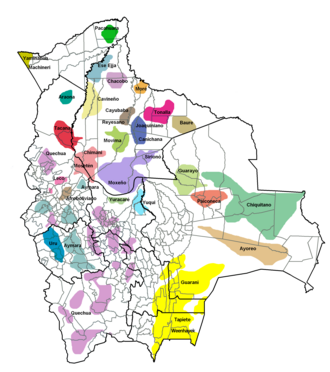 Map of indigenous groups in Bolivia, with Movima in light green | |
Movima (Movima: Chosineɬ di' mowi:maj3) is a language that is spoken by about 1,400 (nearly half) of the Movima, a group of Indigenous people of the Llanos de Moxos region of the Bolivian Amazon, in northeastern Bolivia. It is considered a language isolate, as it has not been proven to be related to any other language.
Locations
Movima is spoken in the locations of 18 de Noviembre, 20 de Enero, Bella Flor, Buen Día, Carmen de Iruyañez, Carnavales, Ipimo, Miraflores, Navidad, San Lorenzo, and the town of Santa Ana del Yacuma.1 The Movima community reported that there are approximately 500 adult speakers as of 2012.4: 807
Phonology
Movima has five vowels:
| Front | Central | Back | |
|---|---|---|---|
| Close | i | u | |
| Mid | e | o | |
| Open | a |
/e/ and /o/ more closely resemble [ɛ] and [ɔ], respectively, than the close-mid vowels [e] and [o]. Vowels have a phonemic length distinction, although some prosodic processes can lengthen otherwise short vowels. Movima does not have tone.5
| Labial | Alveolar | Palatal | Velar | Glottal | ||||
|---|---|---|---|---|---|---|---|---|
| median | lateral | plain | lab. | |||||
| Nasal | m | n | ||||||
| Stop | pulmonic | p | t | tʃ | k (ɡ) | kʷ | (ʔ) | |
| implosive | ɓ | ɗ | ||||||
| Fricative | (f) β | s | ɬ | h | ||||
| Approximant | l | j | w | jˀ | ||||
| Trill | r | |||||||
The plosive /p/ is realized as [p] in the syllable onset but as [pʔᵐ] (which contrasts with the simple nasal phoneme /m/) in the coda. Similarly, /t/ and /k/ are realized as [tʔⁿ] and [ʔɤ] (i.e., as a glottal stop with a vocalic release), respectively, in the syllable coda.3 In vowel-initial words and between adjacent vowels, an epenthetic glottal stop appears.
The phonemes /f/ and /ɡ/ are only present in Spanish loanwords.
Morphology
In Movima, compounding and incorporation are productive derivational processes. Reduplication and affixation, including some processes (such as the irrealis marker (k)a') that resemble infixation, are also common. Typical examples of inflection, such as number, case, tense, mood, and aspect, are not obligatorily marked in Movima.3 Many derivational processes can be applied to a single Movima word. The same morpheme may appear multiple times in one word this way, for instance, tikoy-na-poj-na "I make X kill Y."
Further reading
Further reading
- Judy, R. A.; Judy, J. (1962). Movima y castellano. (Vocabularios Bolivianos, 1). Vocabularios Bolivianos. Cochabamba: Summer Institute of Linguistics.
References
References
- Movima at Ethnologue (25th ed., 2022)

- "Constitution of Bolivia, Article 5. I." (PDF). Archived from the original (PDF) on 2009-05-21.
- Katharina Haude (2006). "A grammar of Movima" (PDF). Radboud Universiteit Nijmegen. Retrieved 2008-10-22.
- Epps, Patience; Michael, Lev, eds. (2023). Amazonian Languages: Language Isolates. Volume II: Kanoé to Yurakaré. Berlin: Walter de Gruyter. ISBN 978-3-11-043273-2.
- "WALS – Movima". World Atlas of Language Structures Online. Retrieved 2008-10-24.
External links
External links
- World Atlas of Language Structures information on Movima
- Lenguas de Bolivia Archived 2019-09-04 at the Wayback Machine (online edition)
- Movima (Intercontinental Dictionary Series)
- Movima DoReCo corpus compiled by Katharina Haude. Audio recordings of narrative texts with transcriptions time-aligned at the phone level, translations, and time-aligned morphological annotations.