| Mount Peechee | |
|---|---|
 | |
| Highest point | |
| Elevation | 2,935 m (9,629 ft)1 |
| Prominence | 160 m (520 ft)2 |
| Listing | Mountains of Alberta |
| Coordinates | 51°12′35″N 115°22′38″W / 51.20972°N 115.37722°W / 51.20972; -115.377223 |
| Geography | |
Mount Peechee Location in Alberta Show map of AlbertaMount Peechee Location in Canada Show map of Canada | |
Country | Canada |
Province | Alberta |
Protected area | Banff National Park |
| Parent range | Fairholme Range |
| Topo map | NTS 82O3 Canmore3 |
| Climbing | |
| First ascent | 19291 |
| Easiest route | rock climb |
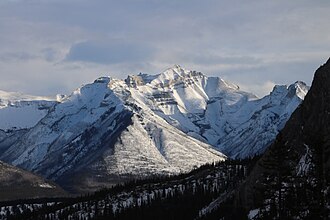
Mount Peechee is the third highest peak of the Fairholme Range in Banff National Park. Mt. Peechee is located immediately southeast of Mount Girouard in the Bow River valley south of Lake Minnewanka.
The mountain was named in 1884 by George Dawson after Indigenous guide Alexis Piché, who escorted George Simpson through the front ranges of the Canadian Rockies.1
Geology
Like other mountains in Banff National Park, Mount Peechee is composed of sedimentary rock laid down during the Precambrian to Jurassic periods.4 Formed in shallow seas, this sedimentary rock was pushed east and over the top of younger rock during the Laramide orogeny.5
Climate
Based on the Köppen climate classification, Mount Peechee is located in a subarctic climate zone with cold, snowy winters, and mild summers.6 Temperatures can drop below −20 °C with wind chill factors below −30 °C. Precipitation runoff from Mount Peechee drains into tributaries of the Bow River, which is a tributary of the Saskatchewan River.
Gallery
-
 Mount Peechee from southwest on Sulphur Mountain
References
References
- "Mt. Peechee". cdnrockiesdatabases.ca. Retrieved 2007-08-31.
- "Mount Peechee". Bivouac.com. Retrieved 2009-01-02.
- "Mount Peechee". Geographical Names Data Base. Natural Resources Canada. Retrieved 2019-08-02.
- Belyea, Helen R. (1960). The Story of the Mountains in Banff National Park (PDF). parkscanadahistory.com (Report). Ottawa: Geological Survey of Canada. Archived (PDF) from the original on 2015-10-02. Retrieved 2019-09-13.
- Gadd, Ben (2008), Geology of the Rocky Mountains and Columbias
- Peel, M. C.; Finlayson, B. L.; McMahon, T. A. (2007). "Updated world map of the Köppen−Geiger climate classification". Hydrol. Earth Syst. Sci. 11 (5): 1633–1644. Bibcode:2007HESS...11.1633P. doi:10.5194/hess-11-1633-2007. ISSN 1027-5606.
External links
External links
- Parks Canada web site: Banff National Park
- Mount Peechee weather: Mountain Forecast