| Moronobea | |
|---|---|
| |
| Moronobea coccinea | |
Scientific classification 
| |
| Kingdom: | Plantae |
| Clade: | Embryophytes |
| Clade: | Tracheophytes |
| Clade: | Spermatophytes |
| Clade: | Angiosperms |
| Clade: | Eudicots |
| Clade: | Rosids |
| Order: | Malpighiales |
| Family: | Clusiaceae |
| Tribe: | Symphonieae |
| Genus: | Moronobea Aubl. |
| Species1 | |
|
7; see text | |
| Synonyms1 | |
| |
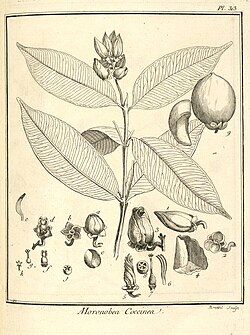
Moronobea is a flowering plant genus of the family Clusiaceae. They are glabrous medium to large trees with yellow latex.2 The genus comprises seven species native to tropical South America including Bolivia, northern Brazil, Colombia, the Guianas, Peru, and Venezuela.1 Five species are present in Venezuela. It is related to Platonia and Montrouziera.2
The resinous latex of Moronobea coccinea and Moronobea riparia has been widely used by Amerindians for caulking, as a mastic, and burned as a source of light.
Species
Seven species are accepted.1
- Moronobea candida Ducke
- Moronobea coccinea Aubl.
- Moronobea intermedia Engl.
- Moronobea jenmanii Engl.
- Moronobea ptaritepuiana Steyerm.
- Moronobea pulchra Ducke
- Moronobea riparia Planch. & Triana
References
References
- "Moronobea Aubl". Plants of the World Online. Royal Botanic Gardens, Kew. Retrieved 3 April 2026.
- Ruhfel, B. R., V. Bittrich, C. P. Bove, M. H. G. Gustafsson, C. T. Philbrick, R. Rutishauser, Z. Xi, and C. C. Davis (2011). Phylogeny of the Clusioid Clade (Malpighiales): Evidence from the Plastid and Mitochondrial Genomes. American Journal of Botany 98: 306–25.