| Monogon | |
|---|---|
 On a circle, a monogon is a tessellation with a single vertex, and one 360-degree arc edge. | |
| Type | Regular polygon |
| Edges and vertices | 1 |
| Schläfli symbol | {1} or h{2} |
| Coxeter–Dynkin diagrams |  or or   |
| Symmetry group | [ ], Cs |
| Dual polygon | Self-dual |
In geometry, a monogon is a curve, considered by some as a polygon with one edge and one vertex. It has Schläfli symbol {1}.1
In Euclidean geometry
In Euclidean geometry a monogon is a degenerate polygon because its endpoints must coincide, unlike any Euclidean line segment. Most definitions of a polygon in Euclidean geometry do not admit the monogon.
In spherical geometry
In spherical geometry, a monogon can be constructed as a vertex on a great circle (equator). This forms a dihedron, {1,2}, with two hemispherical monogonal faces which share one 360° edge and one vertex. Its dual, a hosohedron, {2,1} has two antipodal vertices at the poles, one 360° lune face, and one edge (meridian) between the two vertices.1
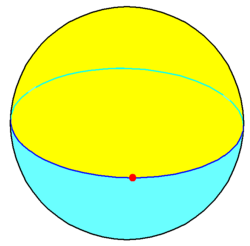 Monogonal dihedron, {1,2} |
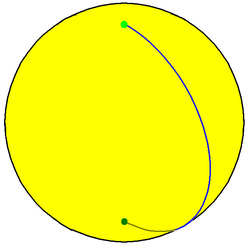 Monogonal hosohedron, {2,1} |
References
References
- Coxeter, Introduction to geometry, 1969, Second edition, sec 21.3 Regular maps, p. 386-388
- Herbert Busemann, The geometry of geodesics. New York, Academic Press, 1955