| |||
| Names | |||
|---|---|---|---|
| IUPAC name
dichlorobis(η5-cyclopentadienyl)molybdenum(IV)
| |||
| Other names
molybdocene dichloride,
molybdenocene dichloride, dichloridobis(cyclopentadienyl)molybdenum(IV) | |||
| Identifiers | |||
3D model (JSmol)
|
|||
| ChemSpider | |||
| ECHA InfoCard | 100.159.644 | ||
PubChem CID
|
|||
CompTox Dashboard (EPA)
|
|||
| |||
| |||
| Properties | |||
| C10H10Cl2Mo | |||
| Molar mass | 297.04 g·mol−1 | ||
| Appearance | greenish-brown powder | ||
| insoluble, moisture sensitive | |||
| Hazards | |||
| Safety data sheet (SDS) | 1 | ||
| Related compounds | |||
Related compounds
|
Ferrocene Zirconocene dichloride Vanadocene dichloride Niobocene dichloride Titanocene dichloride Tantalocene dichloride | ||
Except where otherwise noted, data are given for materials in their standard state (at 25 °C [77 °F], 100 kPa).
| |||

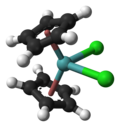
Molybdocene dichloride is the organomolybdenum compound with the formula (η5-C5H5)2MoCl2 and IUPAC name dichlorobis(η5-cyclopentadienyl)molybdenum(IV), and is commonly abbreviated as Cp2MoCl2. It is a brownish-green air- and moisture-sensitive powder. In the research laboratory, it is used to prepare many derivatives.
Preparation and structure
The compound is prepared from molybdocene dihydride by treatment with chloroform:2
- (C5H5)2MoH2 + 2 CHCl3 → (C5H5)2MoCl2 + 2 CH2Cl2
The compound adopts a "clamshell" structure where the Cp rings are not parallel, the average Cp(centroid)-M-Cp angle being 130.6°. The two chloride ligands are cis, the Cl-Mo-Cl angle of 82° being narrower than in niobocene dichloride (85.6°), which in turn is less than in zirconacene dichloride (92.1°). This trend helped to establish the orientation of the HOMO in this class of complex.3
Uses
Unlike the titanocene and zirconacene derivatives, the molybdocene compounds have yielded no commercial applications.
All metallocene dihalides exhibit some anti-cancer activity,4 but these have not yielded useful compounds in the clinic.5
References
References
- "42-0100 Molybdenum " Bis(cyclopentadienyl)molybdenum dichloride, 99%". Strem Chemicals. 27 July 2011. Retrieved 5 February 2012.
- Silavwe, Ned D.; Castellani, Michael P.; Tyler, David R. (1992). "Bis(η5-Cyclopentadienyl)Molybdenum(IV) Complexes". Inorganic Syntheses. Vol. 29. pp. 204–211. doi:10.1002/9780470132609.ch50. ISBN 9780470132609.
- K. Prout, T. S. Cameron, R. A. Forder, and in parts S. R. Critchley, B. Denton and G. V. Rees "The crystal and molecular structures of bent bis-π‑cyclopentadienyl-metal complexes: (a) bis-π‑cyclopentadienyldibromorhenium(V) tetrafluoroborate, (b) bis-π‑cyclopentadienyldichloromolybdenum(IV), (c) bis-π‑cyclopentadienylhydroxomethylaminomolybdenum(IV) hexafluorophosphate, (d) bis-π‑cyclopentadienylethylchloromolybdenum(IV), (e) bis-π‑cyclopentadienyldichloroniobium(IV), (f) bis-π‑cyclopentadienyldichloromolybdenum(V) tetrafluoroborate, (g) μ‑oxo-bis[bis-π‑cyclopentadienylchloroniobium(IV)] tetrafluoroborate, (h) bis-π‑cyclopentadienyldichlorozirconium" Acta Crystallogr. 1974, volume B30, pp. 2290–2304. doi:10.1107/S0567740874007011
- Roat-Malone, R. M. (2007). Bioinorganic Chemistry: A Short Course (2nd ed.). John Wiley & Sons. pp. 19–20. ISBN 978-0-471-76113-6.
- Waern, J. B.; Dillon, C. T.; Harding, M. M. (2005). "Organometallic Anticancer Agents: Cellular Uptake and Cytotoxicity Studies on Thiol Derivatives of the Antitumor Agent Molybdocene Dichloride". J. Med. Chem. 48 (6): 2093–2099. doi:10.1021/jm049585o. PMID 15771451.