| Miriam's skink | |
|---|---|
| |
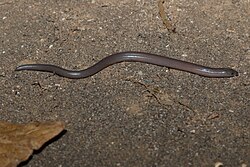
| Brachymeles miriamae in Udom Sap, Wang Nam Khiao, Thailand | |
Scientific classification 
| |
| Kingdom: | Animalia |
| Phylum: | Chordata |
| Class: | Reptilia |
| Order: | Squamata |
| Family: | Scincidae |
| Genus: | Brachymeles |
| Species: | B. miriamae
|
| Binomial name | |
| Brachymeles miriamae | |
| Synonyms2 | |
Miriam's skink (Brachymeles miriamae) is a species of lizard in the subfamily Scincinae of the family Scincidae (skinks). The species is endemic to Thailand.
Taxonomy
In 1972 Heyer described Miriam's skink as a new species in a new genus, giving it the scientific name Davewakeum miriamae.3 In 2011 Siler et al. included the genus Davewakeum in the genus Brachymeles, creating the new combination, Brachymeles miriamae (Heyer, 1972).4 In 2015 Chan-ard et al. returned the species to the genus Davewakeum.2 In 2022 Cota et al. reassigned the species to the genus Brachymeles.5
Etymology
The specific name, miriamae, is in honor of Miriam Heyer, who collected the holotype, and is married to American herpetologist W. Ronald Heyer.6
The generic name, Davewakeum, is in honor of American herpetologist David B. Wake.6
Geographic range
Miriam's skink is found in Nakhon Ratchasima Province, Thailand.2
Habitat
The preferred natural habitat of Brachymeles miriamae is forest.1
Behavior
Brachymeles miriamae is terrestrial and fossorial.1
Description
Miriam's skink is limbless.3
Reproduction
Brachymeles miriamae is viviparous.2
References
References
- Thaksintham W, Cota M, Sumontha M (2018). "Brachymeles miriamae". The IUCN Red List of Threatened Species 2018: https://dx.doi.org/10.2305/IUCN.UK.2018-2.RLTS.T104719268A104719277.en. Accessed on 18 October 2025.
- Species Brachymeles miriamae at The Reptile Database . www.reptile-database.org.
- Heyer (1972).
- Siler CD, Diesmos AC, Alcala AC, Brown RM (2011). "Phylogeny of Philippine slender skinks (Scincidae: Brachymeles) reveals underestimated species diversity, complex biogeographical relationships, and cryptic patterns of lineage diversification". Molecular Phylogenetics and Evolution 59 (1): 53-65.
- Cota, Michael; Makchai, Sunchai; Pongcharoen, Chattraphas (2022). "Updated Catalogue of the Amphibian and Reptile Type Specimens of the Natural History Specimens, National Science Museum, Thailand". Thai Specimens. 21: 31–47. (Brachymeles miriamae, pp. 43–44).
- Beolens, Bo; Watkins, Michael; Grayson, Michael (2011). The Eponym Dictionary of Reptiles. Baltimore: Johns Hopkins University Press. xiii + 296 pp. ISBN 978-1-4214-0135-5. (Genus Davewakeum, pp. 66, 278–279; species D. miriamae, p. 179).
Further reading
Further reading
- Chan-ard, Tanya; Parr, John W. K.; Nabhitabhata, Jarujin (2015). A Field Guide to the Reptiles of Thailand. New York: Oxford University Press. 352 pp. ISBN 978-0199876181.
- Heyer WR (1972). "A New Limbless Skink (Reptilia: Scincidae) from Thailand With Comments on the Generic Status of the Limbless Skinks of Southeast Asia". Fieldiana Zoology 58 (10): 109–129. (Davewakeum, new genus, p. 124, Figures 4–5; D. miriamae, new species, pp. 124–128, Figure 7).