| Microdon manitobensis | |
|---|---|
| |
| Microdon manitobensis | |
Scientific classification 
| |
| Kingdom: | Animalia |
| Phylum: | Arthropoda |
| Clade: | Pancrustacea |
| Class: | Insecta |
| Order: | Diptera |
| Family: | Syrphidae |
| Genus: | Microdon |
| Species: | M. manitobensis
|
| Binomial name | |
| Microdon manitobensis Curran, 1924
| |
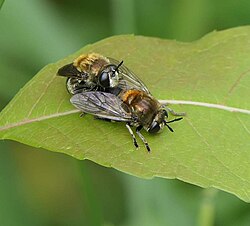
Microdon manitobensis, also commonly known as the Greater Ant Fly, is a species of hover fly that belongs to the family Syrphidae.12 They can be mainly found in the northern regions of North America in areas such as the United States (New England).34
Taxonomy
Microdon manitobensis was described by Charles Howard Curran, a Canadian entomologist specializing in the study of Diptera, in 1924.1 This species belongs to the family Syrphidae (Microdontinae), also commonly known as the hover flies. Within the genus Microdon, it is a member of the subgenus Microdon sensu stricto.256
Description
It is a robust species that grows to a length of 11-13 mm. The pilose located on the head and thorax are yellow and their hind basitarsi is not unusually swollen. Its eyes are bare.4
Ecology
They inhabit nests of Formica densiventris and Formica neoclara, both species of wood ants that belongs to the tribe Formicini.78 Their floral associations have not been recorded.9
References
References
- "Microdon manitobensis Report". Integrated Taxonomic Information System. Retrieved 2019-09-22.
- "Microdon manitobensis species Information". BugGuide.net. Retrieved 2019-09-22.
- "Microdon manitobensis". GBIF. Retrieved 2019-09-22.
- Curran, C. H. (1924). "Brief Diagnoses of Some Diptera Occurring in New England". Psyche: A Journal of Entomology. 31 (5): 051756. doi:10.1155/1924/51756. ISSN 1687-7438.
- Reemer, Menno; Ståhls, Gunilla (2013). "Generic revision and species classification of the Microdontinae (Diptera, Syrphidae)". ZooKeys (288): 1–213. Bibcode:2013ZooK..288....1R. doi:10.3897/zookeys.288.4095. ISSN 1313-2989. PMC 3690914. PMID 23798897.
- Reemer, Menno; Ståhls, Gunilla (2013). "Generic revision and species classification of the Microdontinae (Diptera, Syrphidae)". ZooKeys (288): 1–213. Bibcode:2013ZooK..288....1R. doi:10.3897/zookeys.288.4095. ISSN 1313-2989. PMC 3690914. PMID 23798897.
- Reemer, Menno (2013). "Review and Phylogenetic Evaluation of Associations between Microdontinae (Diptera: Syrphidae) and Ants (Hymenoptera: Formicidae)". Psyche: A Journal of Entomology. 2013 (1) 538316. doi:10.1155/2013/538316. ISSN 1687-7438.
- Akre, Roger D.; Garnett, William B.; Zack, Richard S. (1990). "Ant Hosts of Microdon (Diptera: Syrphidae) in the Pacific Northwest". Journal of the Kansas Entomological Society. 63 (1): 175–178. ISSN 0022-8567. JSTOR 25085158.
- Chisausky, Jacob L.; Soley, Nathan M.; Kassim, Leila; Bryan, Casey J.; Miranda, Gil Felipe Gonçalves; Gage, Karla L.; Sipes, Sedonia D. (2020). "Syrphidae of Southern Illinois: Diversity, floral associations, and preliminary assessment of their efficacy as pollinators". Biodiversity Data Journal. 8 e57331. Bibcode:2020BioDJ...857331C. doi:10.3897/BDJ.8.e57331. ISSN 1314-2828. PMC 7644652. PMID 33199967.