The Multihundred-watt radioisotope thermoelectric generator (MHW RTG) is a type of US radioisotope thermoelectric generator (RTG) developed for the Voyager spacecraft, Voyager 1 and Voyager 2.1 The Voyager generators continue to function nearly 50 years into the mission.2
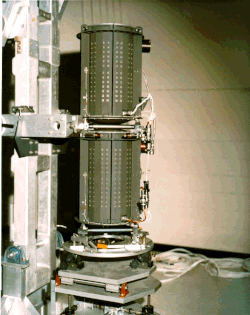
Each RTG has a total weight of 37.7 kg, including about 4.5 kg of Pu-2383 and uses 24 pressed plutonium-238 oxide spheres to provide enough heat to generate approximately 157 watts of electrical power initially – halving every 87.7 years.4
Each RTG initially generated about 2400 watts of thermal power.5 Conversion of the decay heat of the plutonium to electrical power uses 312 silicon-germanium (SiGe) thermoelectric couples. The initial thermoelectric couple hot junction temperature was 1273 K (1000 °C, 1832 °F) with a cold junction temperature of 573 K (300 °C, 572 °F).6
Each Voyager spacecraft has 3 RTGs. Collectively, the RTGs supply each Voyager spacecraft with 470 watts at launch.78
MHW-RTGs were used on the Lincoln Experimental Satellites 8 and 9.
Subsequent US spacecraft used the GPHS-RTG, which used similar SiGe thermoelectric devices but a different packaging of the fuel.
The MMRTG is a newer RTG type, used on the Curiosity rover.
-
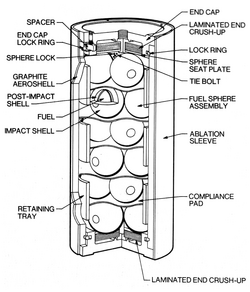 RTG heat source unit
 -
 RTG diagram 1
 -
 RTG unit
References
References
- Heacock (1980). "The Voyager Space Craft". Proceedings of the Institution of Mechanical Engineers. 194: 267–270. doi:10.1243/PIME_PROC_1980_194_026_02. Archived from the original on 2014-03-31.
- "NASA's Voyager Space Probe's Reserve Power, And The Intricacies Of RTG-Based Power Systems". Hackaday. 3 May 2023. Retrieved 22 November 2024.
- "Space Nuclear Power" G.L.Bennett 2006
- "NASA Celebrates 45 Years of Voyager 1, Enabled by Radioisotope Power". NASA. September 5, 2022. Retrieved December 11, 2022.
- "Totse.com | Nuclear Power in Space". Archived from the original on 2008-06-19. Retrieved 2012-10-19.
- Furlong, Richard R.; Wahlquist, Earl J. (1999). "U.S. space missions using radioisotope power systems" (PDF). Nuclear News. 42 (4): 26–34. Archived from the original (PDF) on 2018-10-16. Retrieved January 2, 2011.
- "VOYAGER 2:Host Information". NASA. 1989. Archived from the original on July 21, 2011. Retrieved January 2, 2011.
- "Voyager 2 Craft Details". NASA-NSSDC-Spacecraft-Details. NASA. Retrieved March 9, 2011.