 | |
 | |
| Names | |
|---|---|
| Preferred IUPAC name
Sodium methylcarbamodithioate | |
| Other names
Metham sodium
Carbathion Carbathione Carbothion Metamsodium Metam-sodium | |
| Identifiers | |
| |
3D model (JSmol)
|
|
| ChemSpider |
|
| ECHA InfoCard | 100.004.812 |
PubChem CID
|
|
| UNII | |
CompTox Dashboard (EPA)
|
|
| |
| |
| Properties | |
| C2H4NNaS2 | |
| Molar mass | 129.18 g/mol |
Except where otherwise noted, data are given for materials in their standard state (at 25 °C [77 °F], 100 kPa).
| |


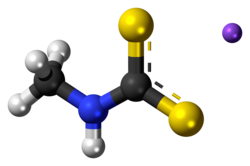
Metam sodium is an organosulfur compound with the formula CH3NHCS2Na. The compound is a sodium salt of a dithiocarbamate. The compound exists as a colorless dihydrate, but most commonly it is encountered as an aqueous solution.2 It is used as a soil fumigant, pesticide, herbicide, and fungicide. It is one of the most widely used pesticides in the United States, with approximately 60 million pounds used in 2001.3
Metam-sodium belongs to two HRAC groups, so it is designated Group A/C (Aus), Group A/C1 (global) and Group 1/5 (numeric).4
Preparation and properties
Metam sodium is prepared by combining methylamine, carbon disulfide, and sodium hydroxide:2
- CH3NH2 + CS2 + NaOH → CH3NHCS2Na + H2O
It also arises from the reaction of methyl isothiocyanate and sodium thiolate.1
Upon exposure to the environment, metam sodium decomposes to methyl isothiocyanate and other sulfur compounds.5
Safety and environmental considerations
Metam sodium is nonpersistent in the environment since it decomposes rather quickly to toxic methyl isothiocyanate and carbon disulfide.5 In 1991 a tank car with 19,000 gallons of a metam sodium based pesticide spilled into Sacramento River above Lake Shasta. This killed all fish in a 41-mile stretch of the river. 20 years later the rainbow trout population had recovered.6
References
References
- Merck Index, 11th Edition, 5860.
- Hartwig, Jürgen; Sommer, Herbert; Müller, Franz (2008). "Nematicides". Ullmann's Encyclopedia of Industrial Chemistry. doi:10.1002/14356007.a17_125.pub2. ISBN 978-3527306732.
- 2000-2001 Pesticide Market Estimates Archived 2009-02-07 at the Wayback Machine, U.S. Environmental Protection Agency
- Hertfordshire, University of. "Metam-sodium (Ref: N 869)". sitem.herts.ac.uk.
- Bretaudeau Deguigne M, Lagarce L, Boels D, Harry P (2011). "Metam sodium intoxication: the specific role of degradation products--methyl isothiocyanate and carbon disulphide--as a function of exposure". Clin Toxicol (Phila). 49 (5): 416–22. doi:10.3109/15563650.2011.585472. PMID 21740140. Archived from the original on May 23, 2024.
{{cite journal}}: CS1 maint: multiple names: authors list (link) - "Largest chemical spill in California history". dtsc.ca.gov. Retrieved 2017-12-11.