| Messier 88 | |
|---|---|
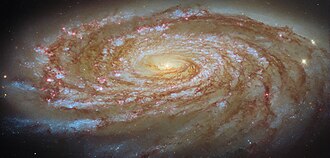 Spiral galaxy Messier 88 imaged by the Hubble Space Telescope | |
| Observation data (J2000 epoch) | |
| Constellation | Coma Berenices |
| Right ascension | 12h 31m 59.1691s1 |
| Declination | +14° 25′ 12.974″1 |
| Redshift | 0.007619±0.000005001 |
| Heliocentric radial velocity | 2,284±1 km/s1 |
| Distance | 58.66 ± 2.25 Mly (17.984 ± 0.690 Mpc)1 |
| Group or cluster | Virgo Cluster |
| Apparent magnitude (V) | 9.62 |
| Characteristics | |
| Type | SA(rs)b, HII Sy21 |
| Number of stars | 400 billion |
| Size | 131,250 ly (40.26 kpc) (estimated)1 |
| Apparent size (V) | 6.9′ × 3.7′1 |
| Other designations | |
| VCC 1401, IRAS 12294+1441, 2MASX J12315921+1425134, NGC 4501, UGC 7675, MCG +03-32-059, PGC 41517, CGCG 099-0761 | |
Messier 88 (also known as M88 or NGC 4501) is a spiral galaxy about 50 to 60 million light-years away from Earth345 in the constellation Coma Berenices. It was discovered by Charles Messier in 1781.
Properties
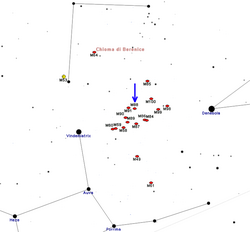
M88 is one of the fifteen Messier objects that belong to the nearby Virgo Cluster of galaxies. It is galaxy number 1401 in the Virgo Cluster Catalogue (VCC) of 2096 galaxies that are candidate members of the cluster.6 M88 appears to be on or ending a highly elliptical orbit, currently on an approximate or direct course toward the cluster center, which is occupied by the giant elliptical galaxy M87. It is currently 0.3 to 0.48 million parsecs from the center and will come closest to the core in about 200 to 300 million years. Its motion through the intergalactic medium of its cluster is creating, as expected, ram pressure that is stripping away the outer region of neutral hydrogen. To date, this has been detected along the western, leading edge of the galaxy.7
This galaxy is inclined to the line of sight by 64°.8 It is classified as an Sbc spiral, a status between Sb (medium-wound) and Sc (loosely wound) spiral arms. The spiralling arms are very regular and can be followed down to the galactic core.9 The maximum rotation velocity of the gas is 241.6 ± 4.5 km/s.10
M88 is classified as a type 2 Seyfert galaxy, which means it produces narrow spectral line emission from highly ionized gas in the nucleus.11 In the core region there is a central condensation with a 230 parsec diameter, which has two concentration peaks. This condensation is being fed by inflow from the spiral arms.12 The supermassive black hole at the core of this galaxy has 107.9 solar masses, or about 80 million solar masses (M☉).13
Supernova
One supernova has been observed in M88:
- SN 1999cl (Type Ia, mag. 16.4) was discovered by the Lick Observatory Supernova Search (LOSS) on 29 May 1999.1415
References
References
- "Results for object MESSIER 088". NASA/IPAC Extragalactic Database. NASA and Caltech. Retrieved 14 November 2006.
- "Messier 88". SEDS Messier Catalog. Retrieved 30 April 2022.
- "Object Information". 20 September 2009. Retrieved 26 December 2012.
- Nemiroff, R.; Bonnell, J., eds. (30 January 2010). "Messier 88". Astronomy Picture of the Day. NASA. Retrieved 26 December 2012.
- "M88". 29 June 2011. Retrieved 26 December 2012.
- Binggeli, B.; Sandage, A.; Tammann, G. A. (1985). "Studies of the Virgo Cluster. II – A catalog of 2096 galaxies in the Virgo Cluster area". Astronomical Journal. 90: 1681–1759. Bibcode:1985AJ.....90.1681B. doi:10.1086/113874.
- Vollmer, B.; et al. (2008). "Pre-peak ram pressure stripping in the Virgo cluster spiral galaxy NGC 4501". Astronomy & Astrophysics. 483 (1): 89–106. arXiv:0801.4874. Bibcode:2008A&A...483...89V. doi:10.1051/0004-6361:20078139. S2CID 15005390.
- Tully, R. B.; Fisher, J. R. (1977). "A new method of determining distances to galaxies". Astronomy & Astrophysics. 54 (3): 661–673. Bibcode:1977A&A....54..661T.
- Möllenhoff, C.; Heidt, J. (2001). "Surface photometry of spiral galaxies in NIR: Structural parameters of disks and bulges". Astronomy & Astrophysics. 368 (1): 16–37. Bibcode:2001A&A...368...16M. doi:10.1051/0004-6361:20000335.
- "Database for physics of galaxies". HyperLeda. Université de Lyon. Retrieved 16 September 2009.
- Sparke, L. S.; Gallagher, J. S. III (2007). Galaxies in the Universe: An Introduction. Cambridge University Press. ISBN 978-0-521-67186-6.
- Onodera, S.; Sofue, Y.; Koda, J.; Nakanishi, H.; Kohno, K. (2002). "CO (J=1-0) Observations of the Non-Barred Seyfert 2 Galaxy NGC 4501". In Ikeuchi, S.; Hearnshaw, J.; Hanawa, T. (eds.). Proceedings of the IAU 8th Asian-Pacific Regional Meeting. p. 199. Bibcode:2002aprm.conf..199O.
- Merloni, Andrea; Heinz, Sebastian; di Matteo, Tiziana (2003). "A Fundamental Plane of black hole activity". Monthly Notices of the Royal Astronomical Society. 345 (4): 1057–1076. arXiv:astro-ph/0305261. Bibcode:2003MNRAS.345.1057M. doi:10.1046/j.1365-2966.2003.07017.x. S2CID 14310323.
- Papenkova, M.; Filippenko, A. V.; Treffers, R. R. (1999). "Supernova 1999cl in NGC 4501". International Astronomical Union Circular (7185): 1. Bibcode:1999IAUC.7185....1P.
- "SN 1999cl". Transient Name Server. IAU. Retrieved 12 April 2026.
External links
External links
- Spiral Galaxy M88 @ SEDS Messier pages
- Messier 88 on WikiSky: DSS2, SDSS, GALEX, IRAS, Hydrogen α, X-Ray, Astrophoto, Sky Map, Articles and images