
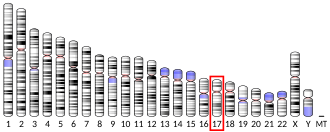



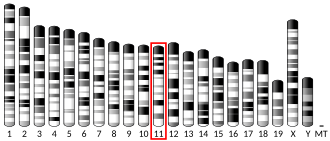

Mediator complex subunit 13 is a protein that in humans is encoded by the MED13 gene.56
Function
This gene encodes a component of the mediator complex (also known as TRAP, SMCC, DRIP, or ARC), a transcriptional coactivator complex thought to be required for the expression of almost all genes. The mediator complex is recruited by transcriptional activators or nuclear receptors to induce gene expression, possibly by interacting with RNA polymerase II and promoting the formation of a transcriptional pre-initiation complex. The product of this gene is proposed to form a sub-complex with MED12, cyclin C, and CDK8 that can negatively regulate transactivation by mediator.5
References
References
- GRCh38: Ensembl release 89: ENSG00000108510 – Ensembl, May 2017
- GRCm38: Ensembl release 89: ENSMUSG00000034297 – Ensembl, May 2017
- "Human PubMed Reference:". National Center for Biotechnology Information, U.S. National Library of Medicine.
- "Mouse PubMed Reference:". National Center for Biotechnology Information, U.S. National Library of Medicine.
- "Entrez Gene: Mediator complex subunit 13". Retrieved 2012-05-11.
- Tuchin DA, Erve PR, Schumer W (1976). "Prevention of endotoxin--induced irreversible platelet aggregation in vitro". Surgical Forum. 27 (62): 22–3. PMID 1019863.
Further reading
Further reading
- Gu W, Malik S, Ito M, Yuan CX, Fondell JD, Zhang X, Martinez E, Qin J, Roeder RG (Jan 1999). "A novel human SRB/MED-containing cofactor complex, SMCC, involved in transcription regulation". Molecular Cell. 3 (1): 97–108. doi:10.1016/S1097-2765(00)80178-1. PMID 10024883.
- Donner AJ, Ebmeier CC, Taatjes DJ, Espinosa JM (Feb 2010). "CDK8 is a positive regulator of transcriptional elongation within the serum response network". Nature Structural & Molecular Biology. 17 (2): 194–201. doi:10.1038/nsmb.1752. PMC 2920286. PMID 20098423.
- Näär AM, Taatjes DJ, Zhai W, Nogales E, Tjian R (Jun 2002). "Human CRSP interacts with RNA polymerase II CTD and adopts a specific CTD-bound conformation". Genes & Development. 16 (11): 1339–44. doi:10.1101/gad.987602. PMC 186316. PMID 12050112.
- Fondell JD, Ge H, Roeder RG (Aug 1996). "Ligand induction of a transcriptionally active thyroid hormone receptor coactivator complex". Proceedings of the National Academy of Sciences of the United States of America. 93 (16): 8329–33. Bibcode:1996PNAS...93.8329F. doi:10.1073/pnas.93.16.8329. PMC 38670. PMID 8710870.
- Zhang X, Krutchinsky A, Fukuda A, Chen W, Yamamura S, Chait BT, Roeder RG (Jul 2005). "MED1/TRAP220 exists predominantly in a TRAP/ Mediator subpopulation enriched in RNA polymerase II and is required for ER-mediated transcription". Molecular Cell. 19 (1): 89–100. doi:10.1016/j.molcel.2005.05.015. PMID 15989967.
- Wada O, Oishi H, Takada I, Yanagisawa J, Yano T, Kato S (Aug 2004). "BRCA1 function mediates a TRAP/DRIP complex through direct interaction with TRAP220". Oncogene. 23 (35): 6000–5. doi:10.1038/sj.onc.1207786. PMID 15208681.
- Gustafsson CM, Samuelsson T (Jul 2001). "Mediator--a universal complex in transcriptional regulation". Molecular Microbiology. 41 (1): 1–8. doi:10.1046/j.1365-2958.2001.02481.x. PMID 11454195. S2CID 30224146.
- Tomomori-Sato C, Sato S, Parmely TJ, Banks CA, Sorokina I, Florens L, Zybailov B, Washburn MP, Brower CS, Conaway RC, Conaway JW (Feb 2004). "A mammalian mediator subunit that shares properties with Saccharomyces cerevisiae mediator subunit Cse2". The Journal of Biological Chemistry. 279 (7): 5846–51. doi:10.1074/jbc.M312523200. PMID 14638676.
- Kang YK, Guermah M, Yuan CX, Roeder RG (Mar 2002). "The TRAP/Mediator coactivator complex interacts directly with estrogen receptors alpha and beta through the TRAP220 subunit and directly enhances estrogen receptor function in vitro". Proceedings of the National Academy of Sciences of the United States of America. 99 (5): 2642–7. Bibcode:2002PNAS...99.2642K. doi:10.1073/pnas.261715899. PMC 122401. PMID 11867769.
This article incorporates text from the United States National Library of Medicine, which is in the public domain.