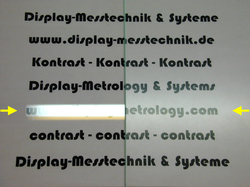
A matte display is an electronic display with a matte surface. Matte displays feature a light-scattering antireflection layer, which reduces reflectivity at the cost of decreased contrast and color intensity under dimly lit conditions.1 If the steep nanostructures are used – etched in the surface – a matte display can achieve an effect that is similar to continuous refraction index reduction.2
The image quality in displays with matte finish is not as sharp or bright as a glossy screen but is easier to color-match and calibrate with a printer.3
References
References
- Johnson, Joel. "LCD Monitors: Glossy vs. Matte" Archived 2007-11-18 at the Wayback Machine. Popular Mechanics. April 2007. Retrieved December 3, 2007.
- Hainich, Rolf; Bimber, Oliver (2016). Displays: Fundamentals and Applications. Boca Raton, FL: CRC Press. p. 239. ISBN 9781568814391.
- Glossy or Matte, Shiny or Flat. Mac Life. February 2008. p. 40.
Further references
- CIE No38-1977: Radiometric and photometric characteristics of materials and their measurement
- CIE No 44-1979: Absolute methods for reflection measurements
- CIE No17.4-1987: International lighting vocabulary, 4th ed. (Joint publication IEC/CIE)
- John C. Stover, Optical Scattering, Measurement and Analysis, SPIE Press, 1995
External links
External links
- I work for an LCD manufacturer : Insightful slashdotter on the mathematical significance of screen specs.