 | |
| Mission type | Mars flyby/lander1 |
|---|---|
| Operator | Soviet space program |
| COSPAR ID | 1973-053A 1973-053E |
| SATCAT no. | 67762 7224 |
| Mission duration | 7 months, 16 days |
| Spacecraft properties | |
| Spacecraft | 3MP No.51P |
| Manufacturer | NPO Lavochkin |
| Launch mass | 3,260 kg (7,190 lb)2 |
| Landing mass | 635 kg (1,400 lb) |
| Start of mission | |
| Launch date | 9 August 1973, 17:00:17 (1973-08-09UTC17:00:17Z) UTC3 |
| Rocket | Proton-K/D |
| Launch site | Baikonur 81/24 |
| Contractor | Khrunichev |
| End of mission | |
| Last contact | 25 March 19744 |
| Orbital parameters | |
| Reference system | Heliocentric |
| Flyby of Mars | |
| Spacecraft component | Bus |
| Closest approach | 9 March 1974 |
| Mars flyby (failed landing) | |
| Spacecraft component | Lander |
| Closest approach | 9 March 1974 |
| Distance | 1,300 km (810 mi) |
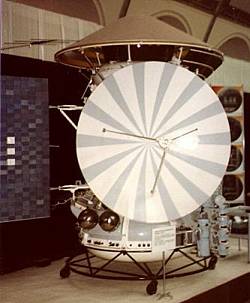
Mars 7 (Russian: Марс-7), also known as 3MP No.51P was a Soviet spacecraft launched in 1973 to explore Mars. A 3MP bus spacecraft which comprised the final mission of the Mars programme, it consisted of a lander and a coast stage with instruments to study Mars as it flew past. Due to a malfunction, the lander failed to perform a maneuver necessary to enter the Martian atmosphere, missing the planet and remaining in heliocentric orbit along with the coast stage.
Spacecraft
Mars 7 spacecraft carried an array of instruments to study Mars. The lander was equipped with a thermometer and barometer to determine the surface conditions, an accelerometer and radio altimeter for descent, and instruments to analyse the surface material including a mass spectrometer.5 The coast stage, or bus, carried a magnetometer, plasma traps, cosmic ray and micrometeoroid detectors, stereo antennae, and an instrument to study proton and electron fluxes from the Sun.5
Built by Lavochkin, Mars 7 was the second of two 3MP spacecraft launched to Mars in 1973, having been preceded by Mars 6. Two orbiters, Mars 4 and Mars 5, were launched earlier in the 1973 Mars launch window and were expected to relay data for the two landers. However, Mars 4 failed to enter orbit, and Mars 5 failed after a few days in orbit.
Launch
Mars 7 was launched by a Proton-K carrier rocket with a Blok D upper stage, flying from Baikonur Cosmodrome Site 81/24.3 The launch occurred at 17:00:17 UTC on 9 August 1973, with the first three stages placing the spacecraft and upper stage into a low Earth parking orbit before the Blok D fired to propel Mars 7 into heliocentric orbit bound for Mars. The spacecraft performed a course correction on 16 August 1973.5
Mars 7's lander separated from the flyby bus on 9 March 1974. Initially, it failed to separate. However, it was eventually released to begin its descent. Due to a retrorocket failure, the probe missed the atmosphere of Mars, and, instead of landing, flew past along with the coast stage, with a closest approach of 1,300 km (810 mi).5 Known faults with the spacecraft's transistors were blamed for the failure, along with that of Mars 4.5
References
References
- Gunter D. Krebs. "Mars 6, 7 (Mars M73 Lander #1, #2)". Gunter's Space Page. Retrieved 13 April 2013.
- "Mars 7". nssdc.gsfc.nasa.gov. NASA. Archived from the original on 24 March 2017. Retrieved 12 April 2013.
- Jonathan McDowell. "Launch Log". Jonathan's Space Page. Retrieved 12 April 2013.
- Asif A. Siddiqi (2018). Beyond Earth: A Chronicle of Deep Space Exploration, 1958–2016 (PDF) (second ed.). NASA. ISBN 978-1-626-83043-1.
- Asif A. Siddiqi (2002). Deep Space Chronicle: A Chronology of Deep Space and Planetary Probes 1958-2000 (PDF). NASA. pp. 101–106. ISBN 978-1-780-39324-7. NASA-SP-2002-4524.