| Mallomys Temporal range: Pleistocene to Recent
| |
|---|---|
| |
| Mallomys gunung | |
Scientific classification 
| |
| Kingdom: | Animalia |
| Phylum: | Chordata |
| Class: | Mammalia |
| Infraclass: | Placentalia |
| Order: | Rodentia |
| Family: | Muridae |
| Tribe: | Hydromyini |
| Genus: | Mallomys Thomas, 1898 |
| Type species | |
| Mallomys rothschildi | |
| Species | |
|
Mallomys aroaensis | |
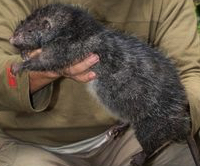
Mallomys is a genus of rodent in the family Muridae.1 The name of the genus is formed from the Greek μαλλός, mallos, wool, and μῦς, mus, mouse/rat. These very large rats weigh between 0.95 and 2 kilograms (2.1 and 4.4 lb) and are native to highlands in New Guinea.2 Little is known about their behavior, but they are believed to feed on leaves, grasses and other plant material.2
It contains the following species:
- De Vis's woolly rat (Mallomys aroaensis)
- Alpine woolly rat (Mallomys gunung)
- Subalpine woolly rat (Mallomys istapantap)
- Rothschild's woolly rat (Mallomys rothschildi)
Apparently undescribed species of Mallomys have been reported from the Foja Mountains in Northern West Papua,3 as well as within the crater of Mount Bosavi in the Southern Highlands of Papua New Guinea.4
References
References
- Musser, G.G.; Carleton, M.D. (2005). "Superfamily Muroidea". In Wilson, D.E.; Reeder, D.M (eds.). Mammal Species of the World: A Taxonomic and Geographic Reference (3rd ed.). Johns Hopkins University Press. pp. 894–1531. ISBN 978-0-8018-8221-0. OCLC 62265494.
- Flannery, T. (1995). Mammals of New Guinea. Pp. 284-291. ISBN 0-7301-0411-7
- Afp.google.com, Two new mammals found in Indonesian 'lost world': green group Archived 2007-06-09 at the Wayback Machine
- BBC News 2009-09-06: Giant rat found in 'lost volcano' https://news.bbc.co.uk/earth/hi/earth_news/newsid_8210000/8210394.stm