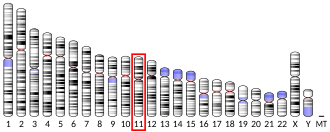
MALAT1 (Metastasis Associated Lung Adenocarcinoma Transcript 1) also known as NEAT2 (Nuclear-Enriched Abundant Transcript 2) is an infrequently spliced long non-coding RNA, which is highly conserved amongst mammals and highly expressed in the nucleus.3 It regulates the expression of metastasis-associated genes.4 It also positively regulates cell motility via the transcriptional and/or post-transcriptional regulation of motility-related genes.5 MALAT1 may play a role in temperature-dependent sex determination in the Red-eared slider turtle (Trachemys scripta).6
Expression in alcoholic brains
Transcripts of MALAT1 are significantly increased in the cerebellum of human alcoholics, as well as in similar regions of rat brains after the withdrawal of ethanol vapours. This alcohol-induced upregulation of MALAT1 may be responsible for differential expression of a number of proteins which contribute to ethanol tolerance and dependency in humans.7
Prognostic potential in cancer
Elevated MALAT1 expression is correlated with poor overall survival in various types of cancer, suggesting that this gene is a prognostic factor for different types of cancer.8910 MALAT1 is implicated in multiple hallmarks of cancer, influencing cell proliferation, migration, angiogenesis, evasion of apoptosis, epithelial–mesenchymal transition, and cancer stem cell behavior.10 It exerts these effects through diverse mechanisms, including regulation of RNA splicing, modification of chromatin states, sponging of microRNAs, and remodeling of protein interactions, thereby modulating major oncogenic pathways such as PI3K/AKT, Wnt/β-catenin, TGF-β/Smad, mTOR, and Hippo–YAP signaling. MALAT1 also shapes the tumor immune microenvironment, contributing to immune evasion, therapy resistance, metabolic reprogramming, and exosome-mediated tumor–stromal communication. Although predominantly oncogenic, it can act as a tumor suppressor in a context-dependent manner.10
See also
See also
References
References
- GRCh38: Ensembl release 89: ENSG00000251562 – Ensembl, May 2017
- "Human PubMed Reference:". National Center for Biotechnology Information, U.S. National Library of Medicine.
- Hutchinson JN, Ensminger AW, Clemson CM, Lynch CR, Lawrence JB, Chess A (2007). "A screen for nuclear transcripts identifies two linked noncoding RNAs associated with SC35 splicing domains". BMC Genomics. 8 39. doi:10.1186/1471-2164-8-39. PMC 1800850. PMID 17270048.
- Gutschner T, Hämmerle M, Eissmann M, Hsu J, Kim Y, Hung G, Revenko A, Arun G, Stentrup M, Gross M, Zörnig M, MacLeod AR, Spector DL, Diederichs S (February 2013). "The noncoding RNA MALAT1 is a critical regulator of the metastasis phenotype of lung cancer cells". Cancer Research. 73 (3): 1180–1189. doi:10.1158/0008-5472.CAN-12-2850. PMC 3589741. PMID 23243023.
- Tano K, Mizuno R, Okada T, Rakwal R, Shibato J, Masuo Y, Ijiri K, Akimitsu N (November 2010). "MALAT-1 enhances cell motility of lung adenocarcinoma cells by influencing the expression of motility-related genes". FEBS Letters. 584 (22): 4575–4580. Bibcode:2010FEBSL.584.4575T. doi:10.1016/j.febslet.2010.10.008. PMID 20937273. S2CID 207575862.
- Chojnowski JL, Braun EL (Jul 15, 2012). "An unbiased approach to identify genes involved in development in a turtle with temperature-dependent sex determination". BMC Genomics. 13: 308. doi:10.1186/1471-2164-13-308. PMC 3434017. PMID 22793670.
- Kryger R, Fan L, Wilce PA, Jaquet V (November 2012). "MALAT-1, a non protein-coding RNA is upregulated in the cerebellum, hippocampus and brain stem of human alcoholics". Alcohol. 46 (7): 629–634. doi:10.1016/j.alcohol.2012.04.002. PMID 22560368.
- Tian X, Xu G (2015). "Clinical value of lncRNA MALAT1 as a prognostic marker in human cancer: systematic review and meta-analysis". BMJ Open. 5 (9) e008653. doi:10.1136/bmjopen-2015-008653. PMC 4593150. PMID 26423854.
- Wei Y, Niu B (2015). "Role of MALAT1 as a Prognostic Factor for Survival in Various Cancers: A Systematic Review of the Literature with Meta-Analysis". Disease Markers. 2015 164635. doi:10.1155/2015/164635. PMC 4572489. PMID 26420912.
 This article incorporates text from this source, which is available under the CC BY 4.0 license.
- Bitaraf, Amirreza; Zafarani, Alireza; Jahandideh, Pardis; Hakak-Zargar, Benyamin; Haghi, Atousa; Asgaritarghi, Golareh; Babashah, Sadegh (2025-10-06). "MALAT1 as a molecular driver of tumor progression, immune evasion, and resistance to therapy". Molecular Cancer. 24 (1): 245. doi:10.1186/s12943-025-02415-6. ISSN 1476-4598. PMC 12502584. PMID 41053822.
Further reading
Further reading
- Rai KR, Wen F, Maarouf M, Cai M, Sun H, Yin Z, Wang Y, Chi X, Li Y, Chen Y, Shrestha P, Yang Z, Huang S, Wang S, Chen JL (February 2026). "The long non-coding RNA MALAT1 encodes a micropeptide that promotes influenza A virus replication by suppressing innate immune responses". Journal of Biological Chemistry. 302 (2) 111112. doi:10.1016/j.jbc.2025.111112. PMC 12857292. PMID 41461314.
- Guo F, Li Y, Liu Y, Wang J, Li Y, Li G (March 2010). "Inhibition of metastasis-associated lung adenocarcinoma transcript 1 in CaSki human cervical cancer cells suppresses cell proliferation and invasion". Acta Biochimica et Biophysica Sinica. 42 (3): 224–229. doi:10.1093/abbs/gmq008. PMID 20213048.
- Ji Q, Liu X, Fu X, Zhang L, Sui H, Zhou L, Sun J, Cai J, Qin J, Ren J, Li Q (Nov 2013). "Resveratrol inhibits invasion and metastasis of colorectal cancer cells via MALAT1 mediated Wnt/β-catenin signal pathway". PLOS ONE. 8 (11) e78700. Bibcode:2013PLoSO...878700J. doi:10.1371/journal.pone.0078700. PMC 3823921. PMID 24244343.
- Tseng JJ, Hsieh YT, Hsu SL, Chou MM (November 2009). "Metastasis associated lung adenocarcinoma transcript 1 is up-regulated in placenta previa increta/percreta and strongly associated with trophoblast-like cell invasion in vitro". Molecular Human Reproduction. 15 (11): 725–731. doi:10.1093/molehr/gap071. PMID 19690017.
- van Asseldonk M, Schepens M, de Bruijn D, Janssen B, Merkx G, Geurts van Kessel A (May 2000). "Construction of a 350-kb sequence-ready 11q13 cosmid contig encompassing the markers D11S4933 and D11S546: mapping of 11 genes and 3 tumor-associated translocation breakpoints". Genomics. 66 (1): 35–42. doi:10.1006/geno.2000.6194. PMID 10843802.
- Koshimizu TA, Fujiwara Y, Sakai N, Shibata K, Tsuchiya H (March 2010). "Oxytocin stimulates expression of a noncoding RNA tumor marker in a human neuroblastoma cell line". Life Sciences. 86 (11–12): 455–460. doi:10.1016/j.lfs.2010.02.001. PMID 20149803.
- Guru SC, Agarwal SK, Manickam P, Olufemi SE, Crabtree JS, Weisemann JM, Kester MB, Kim YS, Wang Y, Emmert-Buck MR, Liotta LA, Spiegel AM, Boguski MS, Roe BA, Collins FS, Marx SJ, Burns L, Chandrasekharappa SC (July 1997). "A transcript map for the 2.8-Mb region containing the multiple endocrine neoplasia type 1 locus". Genome Research. 7 (7): 725–735. doi:10.1101/gr.7.7.725. PMC 310681. PMID 9253601.
- Tripathi V, Ellis JD, Shen Z, Song DY, Pan Q, Watt AT, Freier SM, Bennett CF, Sharma A, Bubulya PA, Blencowe BJ, Prasanth SG, Prasanth KV (September 2010). "The nuclear-retained noncoding RNA MALAT1 regulates alternative splicing by modulating SR splicing factor phosphorylation". Molecular Cell. 39 (6): 925–938. doi:10.1016/j.molcel.2010.08.011. PMC 4158944. PMID 20797886.
- Kuiper RP, Schepens M, Thijssen J, van Asseldonk M, van den Berg E, Bridge J, Schuuring E, Schoenmakers EF, van Kessel AG (July 2003). "Upregulation of the transcription factor TFEB in t(6;11)(p21;q13)-positive renal cell carcinomas due to promoter substitution". Human Molecular Genetics. 12 (14): 1661–1669. doi:10.1093/hmg/ddg178. PMID 12837690.
- Yamada K, Kano J, Tsunoda H, Yoshikawa H, Okubo C, Ishiyama T, Noguchi M (February 2006). "Phenotypic characterization of endometrial stromal sarcoma of the uterus". Cancer Science. 97 (2): 106–112. doi:10.1111/j.1349-7006.2006.00147.x. PMC 11158577. PMID 16441420. S2CID 25815889.
- Wilusz JE, Freier SM, Spector DL (November 2008). "3′ end processing of a long nuclear-retained noncoding RNA yields a tRNA-like cytoplasmic RNA". Cell. 135 (5): 919–932. Bibcode:2008Cell..135..919W. doi:10.1016/j.cell.2008.10.012. PMC 2722846. PMID 19041754.
- Ji P, Diederichs S, Wang W, Böing S, Metzger R, Schneider PM, Tidow N, Brandt B, Buerger H, Bulk E, Thomas M, Berdel WE, Serve H, Müller-Tidow C (September 2003). "MALAT-1, a novel noncoding RNA, and thymosin beta4 predict metastasis and survival in early-stage non-small cell lung cancer". Oncogene. 22 (39): 8031–8041. doi:10.1038/sj.onc.1206928. PMID 12970751. S2CID 34070842.
- Miyagawa R, Tano K, Mizuno R, Nakamura Y, Ijiri K, Rakwal R, Shibato J, Masuo Y, Mayeda A, Hirose T, Akimitsu N (April 2012). "Identification of cis- and trans-acting factors involved in the localization of MALAT-1 noncoding RNA to nuclear speckles". RNA. 18 (4): 738–751. doi:10.1261/rna.028639.111. PMC 3312561. PMID 22355166.
External links
External links