

A Maiba or an Amaiba (literally, "priest"1) is a male religious leader authorised to perform the sacred rites and rituals of Sanamahism (Meitei religion),1 especially as a mediatory agent between human beings and one or more deities. They have the authority or power to administer religious rites as well as sacrifices to gods. Their office or institution is called Maiba Loishang (Maiba Loisang), later renamed as Pandit Loisang, during Aryanisation of Meitei culture. They also served as healers, doctors,2 magicians,3 medicine men,4 physicians and shamans.15 They play important roles in the ancestor worship (apokpa khurumjaba) ceremony.6 Chief priest or chief among the maibas is called Maichou, a term formed with the amalgamation of two words ("maiba"- priest, "achouba"- big, chief, great).7 Since their position is not hereditary, they acquire their positions through talent and skills.3 The female counterpart of a Maiba is a Maibi.
Family wise obligations of the Maiba priesthood
According to the Loiyumpa Silyel Constitution,8910
1. Asheibam family is responsible for attending to the cleansing of the monarch.8910
2. Aram-bam family is responsible for taking care of the bathe.8910
3. Toibicham family is responsible for playing the Tharaochi (Meetei musical instrument).8910
4. Arupam (Arubam) family is responsible for maintaining cleanliness and purity.8910
5. Aheibam family is responsible for making the Pukhamnati (plate with decorated rim).8910
6. Loukham family is responsible for drawing the Meiba (Meetei device to produce fire).8910
7. Maibathiyam family is responsible for throwing the Shingkhai (Meetei prognostication-device) and entering the trance of dream.8910
8. Meihoubam family is responsible for igniting the fire.8910
9. Meiphuwam family is responsible for blowing in the fire.8910
10. Tokpam family is responsible for digging in the soil.8910
11. Tokpuram (Tokpram) and Thangsabam families are responsible for piling up the earth.8910
12. Naoroibam family is responsible for taking the baby in custody.8910
13. Ngathem family is responsible for calling the Ngami (beckoning the fishes).8910
14. Shingkhangpam family is responsible for fetching the dry wood fuels.8910
15. Haomukpam family is responsible for making the phak (mattress for sitting).8910
16. Khoirisungbam family is responsible for weaving the Khoiriphi (Meetei cloth).8910
17. Khoiriyanpam family is responsible for severing the umbilical cord.8910
18. Lairencham family is responsible for washing the black clothes.8910
19. Thoupicham family is responsible for managing the plantain leaves.8910
20. Leishaonbam family is responsible for making the boats.8910
21. Yelwam family is responsible for taking in the hen.8910
22. Nganukappam family is responsible for looking after the Nganu (duck).8910
23. Khugolthem family is responsible for carrying back the hameng (goats).8910
24. Okrambam family is responsible for taking back the Ok (pig).8910
25. Waleppam (Wareppam) family is responsible for adoring the bamboo.8910
26. Maibam family is responsible for invoking the Chupshaba (priest’s invocation for cessation of recurrent deaths).8910
27. Ngangom family is responsible for throwing the Konyai (gold and silver device used by the priest).8910
28. Yenkokpam family is responsible for descending the yerum (egg) to the earth (forecast device).8910
29. Khumukcham family is responsible for taming the tiger.8910
30. Khaidem family is responsible for supervising the body under cremation.8910
31. Amakcham family is responsible for taking hold of the bow and arrow.8910
32. Mangshatabam family is responsible for supervising the grave.8910
33. Wanglenbam family is responsible for beating the drum.8910
34. Kabrambam family is responsible for managing the Leishoupung (mount of aerated soil).8910
35. Kontenakathang priest family is responsible for preparing the Chup for the deity.8910
36. Shoukrakpam family is responsible for making the chaphuwalong (pot).8910
37. Ngaseppam family is responsible for slicing the fishes.8910
38. Thingnongchaorong priest family is responsible for worshipping the Lainingthouhanba.8910
Duties of the Tampak Maiba groups (people's priests)
According to the Loiyumpa Silyel Constitution,8910
1. Khabalangthangchakaba Wamaiba group is responsible for idolizing the Naohal Ahalba (sylvan deity).8910
2. Jagoiwa priest group is responsible for deifying the Koubarel.8910
3. Langmei priest (Luwang Maiba) group is responsible for worshipping the Chakhaba.8910
4. Thongnangkaipiya priest group is responsible for deifying the Muwaningthou.8910
5. Khayoipariyang priest group is responsible for worshipping the Marjing.8910
6. Loiyamsanggai priest group is responsible for glorifying the Koubru.8910
7. Asheibam group is responsible for chanting sanalamok (hymn for deities).8910
8. Ashem Ngakhakhoi group is responsible for chanting the Yakei Eshei (Yakairol).8910
9. Paobam group is responsible for listening to the message of god at Paodahidel.8910
10. Laishram group is responsible for paying service to the Santhong.8910
11. Lantham group is responsible for singing the Lalpha song (song regarding victory in war).8910
12. Khraijam group is responsible for looking after the Khraithong (gate).8910
13. Akhongbam group is responsible for beating the Khong (musical instrument used in Chakpa sylvan festival).8910
14. Mutum group is responsible for idolizing the Lalhampung (Lalambung).8910
15. Thingnam group is responsible for deifying the Ukrong.8910
16. Shingkham group is responsible for singing the Langmairol.8910
17. Thongam group is responsible for singing the Ahonglon (song for the god Sanamahi).8910
18. Shoraisham group is responsible for singing the Khoichulamok lamkok (song in the sylvan festival).8910
19. Chandam group is responsible for singing the Khongchinglon (for the festival of Moirang Thangjing).8910
20. Thiyam group is responsible for adoring the boat.8910
21. Apucham group is responsible for paying homage to Pukshri (a paddy-eating worm in the field).8910
22. Nongpokpam group is responsible for invoking the rain god.8910
23. Waikhom group is responsible for gathering the husk.8910
24. Akoijam group is responsible for singing the hymn of Mikol (a song that harmonizes the soul and spirit).8910
25. Salam group is responsible for idolizing the Langmaiching (Nongmaijing mountain) and acting the role of Tangkhul Sharam Pakhangba (Nongpokningthou-king of the east).8910
26. Hidam group is responsible for making the Sanaliphak (royal mattress).8910
27. Khamnam group is responsible for offering the Khamnungcheiyom (offering at the royal grave).8910
28. Amaipi group is responsible for offering the Leiraiyu (offering to the local deity).8910
29. Nongton Amaibi group is responsible for dipping in the Laija Phuhing (offering of Khayomlapkpa by use of unburnt earthen pot).8910
30. Phura Amaibi group is responsible for entering the trance of Phura Laiyum and listening to the Mang (Meetei way of receiving oracle through the Maibis, white robed).8910
Gallery
-
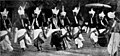 Maibas dancing to please God Thangjing at the Lai Haraoba festival in the Ibudhou Thangjing Temple in Moirang
 -
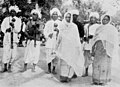 Maibas playing Penas to please God Khamlangba
 -
 A tableau showing the motif of a Maiba, on the Republic Day of India in New Delhi
Other websites
- Jeyaseelan, L. (1996). Impact of the Missionary Movement in Manipur. Scholar Publishing House. ISBN 978-81-7172-339-3.
- Humankind. Serials Publications. 2005.
- Basanta, Ningombam (2008). Modernisation, Challenge and Response: A Study of the Chakpa Community of Manipur. Akansha Publishing House. ISBN 978-81-8370-152-5.
- Kabui, Gangmumei (2004). The History of the Zeliangrong Nagas: From Makhel to Rani Gaidinliu. Spectrum Publications. ISBN 978-81-87502-76-0.
- North East India History Association. Session (2003). Proceedings of North East India History Association. The Association.
- Devi, Lairenlakpam Bino (2002). The Lois of Manipur: Andro, Khurkhul, Phayeng and Sekmai. Mittal Publications. p. 23. ISBN 978-81-7099-849-5.
- Longkumer, Arkotong (2011). Reform, Identity and Narratives of Belonging: The Heraka Movement in Northeast India. A&C Black. p. 75. ISBN 978-1-4411-8734-5.
References
References
- Longkumer, Arkotong (2011). Reform, Identity and Narratives of Belonging: The Heraka Movement in Northeast India. A&C Black. p. 75. ISBN 978-1-4411-8734-5.
- Sarat Chandra Roy (Rai Bahadur (1933). Man in India. A.K. Bose.
- Mahapatra, Mary D. (2001). Tribal Religion and Rituals: Accounts of Superstition, Sorcery and Spirits. Dominant Publishing. ISBN 978-81-87336-69-3.
- Raha, Manis Kumar (1995). The People of the Himalayas: Bio-cultural and Ecological Aspects. Anthropological Survey of India, Ministry of Human Resource Development, Department of Culture, Government of India. ISBN 978-81-85579-30-6.
- Jeyaseelan, L. (1996). Impact of the Missionary Movement in Manipur. Scholar Publishing House. ISBN 978-81-7172-339-3.
- Congress, Indian History (2004). Proceedings. Indian History Congress.
- Surajit Sinha; Centre for Studies in Social Sciences (1987). Tribal Polities and State Systems in Pre-colonial Eastern and North Eastern India. Centre for Studies in Social Sciences, Calcutta. ISBN 978-81-7074-014-8.
- Manipur: Treaties & Documents. India: Mittal Publications, 1993. p. 7–11
- Manikchand Singh, konsam (2012). Loiyumpa Silyel The Ancient Constitution Of Manipur.
- "Historical evidence | Meeyamgi Ningtam Lanmee". 2022-02-25. Retrieved 2025-05-23.