In mathematics, Möbius geometry is a branch of geometry — specifically a subfield of conformal geometry — which deals with the study of geometric objects in the extended complex plane.1 The field is named after the German mathematician August Ferdinand Möbius (1790–1868).2 Furthermore, it allows the study of planar geometries.3
Historical background
Möbius laid the foundations of this field, particularly through his mathematical work in 1827: Der barycentrische Calkul (“The Calculus of Centres of Gravity”). In this work, he introduced homogeneous coordinates — coordinates that can include a point at infinity — and addressed projective geometric transformations in particular. In 1858, he discovered the Möbius strip, a one-sided surface.2
Around the first third of the 20th century, the Austrian mathematician Wilhelm Blaschke introduced another model, whose advantage lies in the embedding of the diffeomorphism group in the described groups of linear mappings.4 This model further developed the field of Möbius geometry.
Informal introduction
Informally, Möbius geometry is the study of geometric transformations turning hyperspheres back into hyperspheres. According to the Erlanger Programm, Möbius geometry describes the effect the Möbius group has on .4
Applications
Möbius geometry has applications across different fields:
- It has been used in computer graphics to compare two three-dimensional shapes by mapping them onto a sphere and defining correspondences between the two surfaces.5
- Möbius geometry also has applications in theoretical physics, particularly special relativity. When studying the relation between the Lorentz group and Möbius transformations, it was found that the laws of physics that rule space-time work exactly like the math of the Möbius group on the sky’s sphere, meaning that the visual bending of incoming light rays for a speeding observer is controlled completely by the rules of Möbius geometry. 6
- In addition, Möbius geometry finds applications in architecture, since it enables the creation of subdivision surfaces that reproduce spheres, circular arcs, and other Möbius‑invariant geometric features, which are highly valuable in architectural design.7
- Moreover, it can be applied to engineering, such as aerospace and satellite communications. Here, Möbius transformation modules are used to expand 1D static strips into 2D linear and radial fields. The optical Möbius transformation (OMT) module can make the transformation from any single 1D scanning to 2D scanning possible.8
- One should also consider the application in mathematics, especially spherical geometry. Möbius transformations here have the ability to map specific points on a sphere, thus transforming vast circles back into great circles. This exact method is used in cartography as well, to display spherical parts onto a planar map.1
Definition
In Möbius geometry, one investigates certain invariant relationships between four distinct points, whereas in metric geometry, the focus lies on the distance between two points. Möbius geometry relies on the geometric and algebraic relationships formed by the pairings of these four points. From these four points, there are three distinct ways to partition them into pairs (e.g., grouping four points into pairs of two). We can call those three pairings (each made of two points) and .
The subfield focuses on properties that remain invariant under Möbius transformations.9
Notations
| Symbol | Meaning |
|---|---|
| complex variable | |
| complex numbers as variables ( ℂ) | |
| absolute value or modulus of the complex number 10 | |
| angle or argument of the complex number11 | |
| constants in inversion | |
| Möbius transformation | |
| stereographic projection | |
| x‑coordinate of the unit sphere | |
| y‑coordinate of the unit sphere | |
| z‑coordinate of the unit sphere |
Examples

Möbius transformation
A Möbius transformation is a mapping of the form
.
The general rule is: .
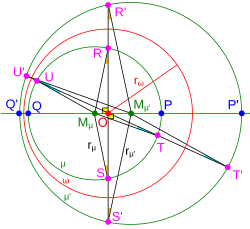
Inversion in a circle
Any Möbius transformation arises from a sequence of inversions in circles. The map is called an inversion. The map is defined on
.
Then, if and only if the circumstances below are fulfilled,
the inversion
is composed of the reflection on the unit circle
and of the reflection on the abscissa axis. To now show that
with
is any Möbius transformation, one introduces and . If now
and , then
.
Therefore, is composed of inversion.11

Möbius transformation of the Riemann sphere
Riemann sphere
The Riemann sphere is a one‑dimensional complex manifold that represents the extended complex plane, which may be defined as the set .12
Möbius transformation of the Riemann sphere
Here, the Möbius transformation is denoted as
: .
It is defined as the function of the Riemann sphere to itself, specified by the following features:
.
It is defined for all complex numbers such that
; and if ; if .

Stereographic projection
A stereographic projection is a geometric formulation. It causes a one‑to‑one relation between a complement of a fixed point on the sphere in three‑dimensional Euclidean space and some points of the plane through the centre of the sphere perpendicular to the line segment .
First, one has the unit sphere in , defined in such a way that
.
Now, let
be the stereographic projection mapping, determined so that
for every point of .13
References
References
- "Möbius Transformation". Wolfram Mathworld. Retrieved 2026-07-09.
- "August Ferdinand Möbius | Non-Euclidean geometry, topology, polyhedra | Britannica". Encyclopedia Britannica. Retrieved 2026-06-20.
- "3.2: Möbius Geometry". Mathematics LibreTexts. 2021-09-28. Retrieved 2026-06-20.
- "Möbius-Geometrie". www.spektrum.de (in German). Retrieved 2026-06-20.
- Baden, Alex; Crane, Keenan; Kazhdan, Misha (August 2018). "Möbius Registration". Computer Graphics Forum. 37 (5): 211–220. doi:10.1111/cgf.13503.
- Penrose, Roger (1999). "Relativity and Möbius Transformations". American Journal of Physics. 67 (4): 273–361.
- Vaxman, Amir; Müller, Christian; Weber, Ofir (31 December 2018). "Canonical Möbius subdivision". ACM Transactions on Graphics. 37 (6): 1–15. doi:10.1145/3272127.3275007. hdl:1874/386978.
- Yang, Dong; He, Qiang; Wu, Zituo; Wu, Lixun; Yu, Siyuan; Zhang, Yanfeng (September 2025). "Optical Möbius transformation module for expanding beam-steering dimensions". Optics & Laser Technology. 187 112784. Bibcode:2025OptLT.18712784Y. doi:10.1016/j.optlastec.2025.112784.
- Foertsch, Thomas; Schroeder, Viktor (2010). "A Möbius Characterization of Metric Spheres". arXiv:1008.3250 [math.MG].
- "Modulus". Underground Mathematics.
- "Geometrie K4b Lecture Notes" (PDF). University of Wuppertal (in German).
- "Riemann Sphere". Wolfram Mathworld.
- "Möbius Transformations and Stereographic Projection" (PDF). Archived from the original (PDF) on 2020-04-18.
External links
External links
- Prof. Viktor Schroeder. Boundaries and Möbius Geometry — lecture video. INI Seminar Room 1 (2017). YouTube https://www.youtube.com/watch?v=SZLn1ESBlcY
- Möbius-Transformation. University of Stuttgart. https://vhm.mathematik.uni-stuttgart.de/Vorlesungen/Komplexe_Analysis/Folien_Moebius-Transformation.pdf
- Rolf Sulanke. Elementary Möbius Geometry I (2017). Humboldt University of Berlin. https://www.math.hu-berlin.de/~sulanke/geo/emg1.pdf
- Douglas Arnold, Jonathan Rogness. Möbius Transformations Revealed (2010). YouTube https://www.youtube.com/watch?v=0z1fIsUNhO4
Further reading
Further reading
- Blaschke, W.: Lectures on Differential Geometry III. Julius Springer Publishing House, Berlin, 1929.
- Beardon, A. F.: The Geometry of Discrete Groups. Springer Verlag, New York, 1983.
- Kulkarni, R. S.; Pinkall, U.: Conformal Geometry. Friedr. Vieweg & Sohn, Braunschweig, 1988.