| Lymphocryptovirus | |
|---|---|
| |
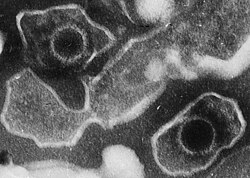
| Electron micrograph of two Epstein–Barr virus virions (viral particles) showing round capsids loosely surrounded by the membrane envelope | |
Virus classification 
| |
| (unranked): | Virus |
| Realm: | Duplodnaviria |
| Kingdom: | Heunggongvirae |
| Phylum: | Peploviricota |
| Class: | Herviviricetes |
| Order: | Herpesvirales |
| Family: | Orthoherpesviridae |
| Subfamily: | Gammaherpesvirinae |
| Genus: | Lymphocryptovirus |
| Species | |
| Synonyms1 | |
| |
Lymphocryptovirus is a genus of viruses in the order Herpesvirales, in the family Orthoherpesviridae, in the subfamily Gammaherpesvirinae. This genus includes the human-infecting Epstein–Barr virus, as well as viruses that infect both Old World monkeys and New World monkeys.2 Other names for the Lymphocryptovirus genus include Lymphocryptoviridae (suffix -viridae implying family rank, although this is not the accepted taxonomy) and gamma-1 herpesviruses. There are nine species in this genus. Diseases associated with this genus include: mononucleosis, Burkitt's lymphoma, and nasopharyngeal carcinoma.34
Species
The genus contains the following species, listed by scientific name and followed by the common name of the species:45
- Lymphocryptovirus callitrichinegamma3, Callitrichine herpesvirus 3
- Lymphocryptovirus gorillinegamma1, Herpesvirus gorilla
- Lymphocryptovirus humangamma4, Epstein–Barr virus
- Lymphocryptovirus macacinegamma4, Rhesus lymphocryptovirus
- Lymphocryptovirus macacinegamma10, Cynomolgus macaque lymphocryptovirus
- Lymphocryptovirus macacinegamma13, Macaca arctoides gammaherpesvirus 1
- Lymphocryptovirus paninegamma1, Herpesvirus pan
- Lymphocryptovirus papiinegamma1, Herpesvirus papio
- Lymphocryptovirus ponginegamma2, Orangutan herpesvirus
Structure
Viruses in Lymphocryptovirus are enveloped, with icosahedral, spherical to pleomorphic, and round geometries, and T=16 symmetry. The diameter is around 150-200 nm. Genomes are linear and non-segmented, around 180kb in length.3
| Genus | Structure | Symmetry | Capsid | Genomic arrangement | Genomic segmentation |
|---|---|---|---|---|---|
| Lymphocryptovirus | Spherical pleomorphic | T=16 | Enveloped | Linear | Monopartite |
Life cycle
Viral replication is nuclear, and is lysogenic. Entry into the host cell is achieved by attachment of the viral glycoproteins to host receptors, which mediates endocytosis. Replication follows the dsDNA bidirectional replication model. DNA-templated transcription, with some alternative splicing mechanism is the method of transcription. The virus exits the host cell by nuclear egress, and budding. Human and mammals serve as the natural host. Transmission routes are zoonosis, bite, contact, and saliva.3
| Genus | Host details | Tissue tropism | Entry details | Release details | Replication site | Assembly site | Transmission |
|---|---|---|---|---|---|---|---|
| Lymphocryptovirus | Humans; mammals | B-lymphocytes | Glycoprotiens | Budding | Nucleus | Nucleus | Saliva |
References
References
- "ICTV Taxonomy history: Lymphocryptovirus" (html). International Committee on Taxonomy of Viruses (ICTV). Retrieved 10 January 2019.
- Wang F, Rivailler P, Rao P, Cho Y (2001). "Simian homologues of Epstein-Barr virus". Philos Trans R Soc Lond B Biol Sci. 356 (1408): 489–97. doi:10.1098/rstb.2000.0776. PMC 1088440. PMID 11313007.
- "Viral Zone". ExPASy. Retrieved 15 June 2015.
- "Virus Taxonomy: 2023 Release". ictv.global. International Committee on Taxonomy of Viruses. 30 October 2024. Retrieved 30 January 2025.
- "Species List: Orthoherpesviridae". International Committee on Taxonomy of Viruses. Retrieved 5 May 2026.