| Luvunga monophylla | |
|---|---|
| |
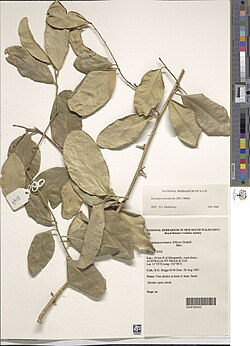
| Herbarium specimen | |
Scientific classification 
| |
| Kingdom: | Plantae |
| Clade: | Embryophytes |
| Clade: | Tracheophytes |
| Clade: | Spermatophytes |
| Clade: | Angiosperms |
| Clade: | Eudicots |
| Clade: | Rosids |
| Order: | Sapindales |
| Family: | Rutaceae |
| Genus: | Luvunga |
| Species: | L. monophylla
|
| Binomial name | |
| Luvunga monophylla | |
| Synonyms3 | |
| |
Luvunga monophylla is a species of plants in the citrus family Rutaceae found in Malesia and northern Australia. It is a scrambling vine or shrub up to a maximum of 3 m (9.8 ft) tall, often with spines in the leaf axils. Leaves are simple (i.e. undivided) and ovate to obovate in shape. They measure up to 8 cm (3.1 in) long and 5 cm (2.0 in) wide and have numerous oil glands. The inflorescences are racemes about half as long as the leaves, and the flowers are sweetly fragrant. The calyx is 3-lobed and there are 3 white or cream petals about 4 mm (0.16 in) long. The fruit is an orange-yellow botanical berry about 1 cm (0.4 in) diameter, containing 2 seeds.456
Distribution and habitat
In Australia, this species is recorded from the Kimberley region of Western Australia, the Top End of the Northern Territory, and the island of Iama in the Torres Strait. Outside Australia the plant is known from Indonesia and the Philippines.376 It grows in monsoon forest and vine thicket at altitudes up to 300 m (980 ft).456
Conservation
This species is listed as least concern under the Queensland Government's Nature Conservation Act.1 As of 30 January 2025, it has not been assessed by the International Union for Conservation of Nature (IUCN).
-
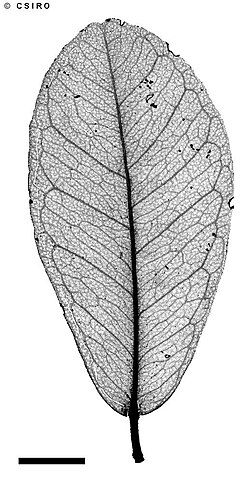 X-ray of leaf
 -
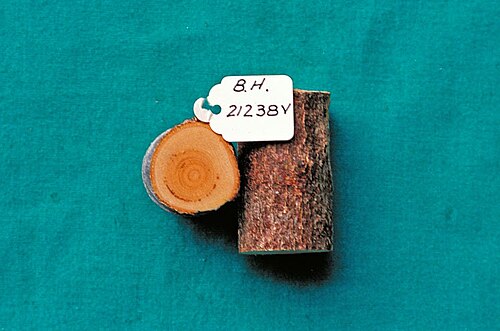 Section of stem
References
References
- "Species profile—Luvunga monophylla". Queensland Department of Environment and Science. Queensland Government. 2024. Retrieved 30 January 2025.
- "Luvunga monophylla". Australian Plant Name Index (APNI). Centre for Australian National Biodiversity Research, Australian Government. Retrieved 30 January 2025.
- "Luvunga monophylla (DC.) Mabb". Plants of the World Online. Royal Botanic Gardens, Kew. 2025. Retrieved 30 January 2025.
- F.A.Zich; B.P.M.Hyland; T.Whiffen; R.A.Kerrigan (2020). "Luvunga monophylla". Australian Tropical Rainforest Plants Edition 8 (RFK8). Centre for Australian National Biodiversity Research (CANBR), Australian Government. Retrieved 30 January 2025.
- Mabberley, D.J. (2022). Wilson, A.J.G.; Kodela, P.G. (eds.). "Luvunga monophylla". Flora of Australia. Australian Biological Resources Study, Department of Climate Change, Energy, the Environment and Water: Canberra. Retrieved 30 January 2025.
- Fell, D.G.; Stanton, D.J. (2011). "Luvunga monophylla (DC.) Mabb. (Rutaceae): a new species for Queensland". Austrobaileya. 8 (3): 431–434. doi:10.5962/p.299818. JSTOR 41965595.
- "Search: species: Luvunga monophylla | Occurrence records". Australasian Virtual Herbarium. Australian Government. Retrieved 30 January 2025.
External links
External links
- View a map of herbarium collections of this species at the Australasian Virtual Herbarium
- View observations of this species on iNaturalist
- View images of this species on Flickriver.com