| Lupinus pusillus | |
|---|---|
| |
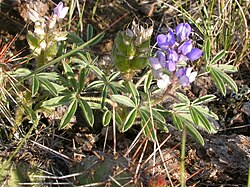
| Lupinus pusillus, Montana | |
Scientific classification 
| |
| Kingdom: | Plantae |
| Clade: | Embryophytes |
| Clade: | Tracheophytes |
| Clade: | Spermatophytes |
| Clade: | Angiosperms |
| Clade: | Eudicots |
| Clade: | Rosids |
| Order: | Fabales |
| Family: | Fabaceae |
| Subfamily: | Faboideae |
| Genus: | Lupinus |
| Species: | L. pusillus
|
| Binomial name | |
| Lupinus pusillus Pursh
| |
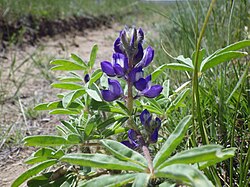
Lupinus pusillus, the rusty lupine2 or dwarf lupine, is an annual plant in the legume family (fabaceae) found in the Colorado Plateau and Canyonlands region of the southwestern United States(California),3: 159 and north to Montana.
Description
Growth pattern
It is an annual plant growing up to 9 inches (23 cm) tall. Pusillus is for the small size of the plant.3: 159
Leaves and stems
Leaves are compound palmate with 3-9 1⁄2 to 1+1⁄2 inches (1.3 to 3.8 cm) long inversely lance- shaped leaflets.3: 159
Plant stems and leaf stems (petioles) have long spreading hairs.3: 159
Inflorescence and fruit
It blooms from April to June.3: 159
Flowers are in stalks of 4-38 and bluish to purple or bicolored, with a yellow spot on the upper petal.3: 159
Seedpods are nearly oval and have constrictions separating the seeds.3: 159
Habitat and range
It can be found in desert shrubland and pinyon juniper woodland communities, from as far north as Washington, to California, and throughout the southwest.3: 159
When growing in reddish sand, the blue flowers make a striking contrast with the sun at a low angle.3: 159
Ecological and human interactions
It is pollinated by bees.3: 159
References
References
- NatureServe (2024). "Lupinus pusillus". Arlington, Virginia. Retrieved 11 July 2024.
- NRCS. "Lupinus pusillus". PLANTS Database. United States Department of Agriculture (USDA). Retrieved 10 May 2017.
- Canyon Country Wildflowers, Damian Fagan, 2nd ed., 2012, Morris Bush Publishing, LLC. in cooperation with Canyonlands Natural History Association, ISBN 978-0-7627-7013-7