| Observation data Epoch J2000 Equinox ICRS | |
|---|---|
| Constellation | Andromeda |
| Right ascension | 23h 34m 27.5216s2 |
| Declination | +43° 33′ 01.300″2 |
| Apparent magnitude (V) | 15.12 variable3 |
| Characteristics | |
| Evolutionary stage | AGB4 |
| Spectral type | C8,3.5e5 |
| Apparent magnitude (G) | 16.90412 |
| Apparent magnitude (J) | 9.6236 |
| Apparent magnitude (H) | 6.3556 |
| Apparent magnitude (K) | 2.717 |
| Variable type | Mira8 |
| Astrometry | |
| Proper motion (μ) | RA: −21.313±0.532 2 mas/yr Dec.: −22.058±0.4532 mas/yr |
| Parallax (π) | 2.5002±0.3626 mas2 |
| Distance | approx. 1,300 ly (approx. 400 pc) |
| Absolute bolometric magnitude (Mbol) | −5.21±0.264 |
| Details4 | |
| Mass | 0.8 M☉ |
| Radius | 340 – 420 R☉ |
| Luminosity | 2,900 – 16,200 L☉ |
| Temperature | 2,100 – 3,350 K |
| Other designations | |
| 2MASS J23342752+4333012, IRAS 23320+4316, RAFGL 3116 | |
| Database references | |
| SIMBAD | data |
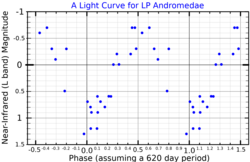
LP Andromedae (often abbreviated to LP And) is a carbon star in the constellation Andromeda. It is also a Mira variable8 whose mean apparent visual magnitude is 15.12 and has pulsations with an amplitude of 1.50 magnitudes3 and a period of 614 days.4
In 1974 LP Andromedae, known then as IRC+40540, was identified as a carbon star and also shown to be variable.9 It had previously been suspected of variability during the 2 Micron All Sky Survey (2MASS). A detailed study of its spectrum showed an unusually cool star with a basic class of C8, and Swan band strength of 3.5. It also showed strong C13 isotopic bands.5 The period was narrowed down to around 614 days, one of the longest periods known for a Mira variable.10
This star has a dusty envelope with an estimated mass of 3.2 M☉, fueled by the star itself which is losing mass at a rate 10−5 M☉/yr. Such a high mass loss rate should place LP Andromedae close to the end of its asymptotic giant branch evolution. The envelope extends to a distance of 3 parsec from the star, and is mainly made of silicon carbide and carbon particles.4
References
References
- Jones, Terry Jay; Bryja, C. O.; Gehrz, Robert D.; Harrison, Thomas E.; Johnson, Joni J.; Klebe, Dimitri I.; Lawrence, Geoffrey F. (November 1990). "Photometry of Variable AFGL Sources". Astrophysical Journal Supplement. 74: 785. Bibcode:1990ApJS...74..785J. doi:10.1086/191518.
- Brown, A. G. A.; et al. (Gaia collaboration) (August 2018). "Gaia Data Release 2: Summary of the contents and survey properties". Astronomy & Astrophysics. 616. A1. arXiv:1804.09365. Bibcode:2018A&A...616A...1G. doi:10.1051/0004-6361/201833051. Gaia DR2 record for this source at VizieR.
- Database entry, The Catalina Surveys periodic variable star catalog. (Drake+, 2014), A. J. Drake et al., CDS ID J/ApJS/213/9 Accessed on line 2018-11-14.
- Men'shchikov, A. B.; Balega, Y. Y.; Berger, M.; Driebe, T.; Hofmann, K.-H.; Maximov, A. F.; Schertl, D.; Shenavrin, V. I.; Weigelt, G. (March 2006). "Near-infrared speckle interferometry and radiative transfer modelling of the carbon star LP Andromedae". Astronomy and Astrophysics. 448 (1): 271–281. Bibcode:2006A&A...448..271M. doi:10.1051/0004-6361:20052976.
- Cohen, M. (1979). "Circumstellar envelopes and the evolution of carbon stars". Monthly Notices of the Royal Astronomical Society. 186 (4): 837–852. Bibcode:1979MNRAS.186..837C. doi:10.1093/mnras/186.4.837.
- Cutri, Roc M.; Skrutskie, Michael F.; Van Dyk, Schuyler D.; Beichman, Charles A.; Carpenter, John M.; Chester, Thomas; Cambresy, Laurent; Evans, Tracey E.; Fowler, John W.; Gizis, John E.; Howard, Elizabeth V.; Huchra, John P.; Jarrett, Thomas H.; Kopan, Eugene L.; Kirkpatrick, J. Davy; Light, Robert M.; Marsh, Kenneth A.; McCallon, Howard L.; Schneider, Stephen E.; Stiening, Rae; Sykes, Matthew J.; Weinberg, Martin D.; Wheaton, William A.; Wheelock, Sherry L.; Zacarias, N. (2003). "VizieR Online Data Catalog: 2MASS All-Sky Catalog of Point Sources (Cutri+ 2003)". CDS/ADC Collection of Electronic Catalogues. 2246: II/246. Bibcode:2003yCat.2246....0C.
- Menzies, J. W.; Feast, M. W.; Whitelock, P. A. (June 2006). "Carbon-rich Mira variables: radial velocities and distances". Monthly Notices of the Royal Astronomical Society. 369 (2): 783–790. arXiv:astro-ph/0603505. Bibcode:2006MNRAS.369..783M. CiteSeerX 10.1.1.255.9712. doi:10.1111/j.1365-2966.2006.10323.x. S2CID 18684991.
- N. N. Samus; O. V. Durlevich; et al. "LP And database entry". Combined General Catalog of Variable Stars (2017 ed.). CDS. Retrieved 2018-11-14.
- Lockwood, G. W. (1974). "Near-infrared photometry of unidentified IRC stars. II". The Astrophysical Journal. 192: 113. Bibcode:1974ApJ...192..113L. doi:10.1086/153041.
- Alksnis, A. (1989). "On the Variability of the Dusty Carbon Star LP and". Information Bulletin on Variable Stars. 3396: 1. Bibcode:1989IBVS.3396....1A.