





Lysyl oxidase homolog 2 is an enzyme that in humans is encoded by the LOXL2 gene.56
Function
This gene encodes a member of the lysyl oxidase gene family. The prototypic member of the family is essential to the biogenesis of connective tissue, encoding an extracellular copper-dependent amine oxidase that catalyses the first step in the formation of crosslinks in collagens and elastin. A highly conserved amino acid sequence at the C-terminus end appears to be sufficient for amine oxidase activity, suggesting that each family member may retain this function. The N-terminus is poorly conserved and may impart additional roles in developmental regulation, senescence, tumor suppression, cell growth control, and chemotaxis to each member of the family.6
LOXL2 can also crosslink collagen type IV and hence influence the sprouting of new blood vessels.7
Clinical significance
LOXL2 is an enzyme that is up-regulated in several types of cancer and is associated with a poorer prognosis.89 LOXL2 changes the structure of histones (proteins that are attached to DNA)10 and thus changes the shape of the cells, making it easier for the cancer cells to metastasize.11
An antibody that inhibits the activity of LOXL2, simtuzumab, is currently in clinical trials for the treatment of several types of cancer and fibrotic diseases such as liver fibrosis.12
References
References
- GRCh38: Ensembl release 89: ENSG00000134013 – Ensembl, May 2017
- GRCm38: Ensembl release 89: ENSMUSG00000034205 – Ensembl, May 2017
- "Human PubMed Reference:". National Center for Biotechnology Information, U.S. National Library of Medicine.
- "Mouse PubMed Reference:". National Center for Biotechnology Information, U.S. National Library of Medicine.
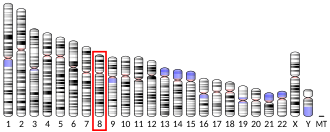
- Jourdan-Le Saux C, Le Saux O, Donlon T, Boyd CD, Csiszar K (July 1998). "The human lysyl oxidase-related gene (LOXL2) maps between markers D8S280 and D8S278 on chromosome 8p21.2-p21.3". Genomics. 51 (2): 305–307. doi:10.1006/geno.1998.5356. PMID 9722957.
- "Entrez Gene: LOXL2 lysyl oxidase-like 2".
- Bignon M, Pichol-Thievend C, Hardouin J, Malbouyres M, Bréchot N, Nasciutti L, et al. (2011). "Lysyl oxidase-like protein-2 regulates sprouting angiogenesis and type IV collagen assembly in the endothelial basement membrane". Blood. 118 (14): 3979–3989. doi:10.1182/blood-2010-10-313296. PMID 21835952. S2CID 16622717.
- Nishioka T, Eustace A, West C (2012). "Lysyl oxidase: from basic science to future cancer treatment". Cell Structure and Function. 37 (1): 75–80. doi:10.1247/csf.11015. PMID 22453058.
- Cano A, Santamaría PG, Moreno-Bueno G (2012). "LOXL2 in epithelial cell plasticity and tumor progression". Future Oncology. 8 (9). London, England: 1095–1108. doi:10.2217/fon.12.105. PMID 23030485.
- Cebrià-Costa JP, Pascual-Reguant L, Gonzalez-Perez A, Serra-Bardenys G, Querol J, Cosín M, et al. (January 2020). "LOXL2-mediated H3K4 oxidation reduces chromatin accessibility in triple-negative breast cancer cells". Oncogene. 39 (1): 79–121. doi:10.1038/s41388-019-0969-1. hdl:10230/44004. PMC 6937214. PMID 31462706.
- Moreno-Bueno G, Salvador F, Martín A, Floristán A, Cuevas EP, Santos V, et al. (2011). "Lysyl oxidase-like 2 (LOXL2), a new regulator of cell polarity required for metastatic dissemination of basal-like breast carcinomas". EMBO Molecular Medicine. 3 (9): 528–544. doi:10.1002/emmm.201100156. PMC 3377095. PMID 21732535.
- "Search of: simtuzumab - List Results". ClinicalTrials.gov. Retrieved 25 February 2015.
External links
External links
Further reading
Further reading
- Csiszar K (2001). Lysyl oxidases: a novel multifunctional amine oxidase family. Progress in Nucleic Acid Research and Molecular Biology. Vol. 70. pp. 1–32. doi:10.1016/S0079-6603(01)70012-8. ISBN 978-0-12-540070-1. PMID 11642359.
- Molnar J, Fong KS, He QP, Hayashi K, Kim Y, Fong SF, et al. (April 2003). "Structural and functional diversity of lysyl oxidase and the LOX-like proteins". Biochimica et Biophysica Acta (BBA) - Proteins and Proteomics. 1647 (1–2): 220–224. doi:10.1016/s1570-9639(03)00053-0. PMID 12686136.
- Maruyama K, Sugano S (January 1994). "Oligo-capping: a simple method to replace the cap structure of eukaryotic mRNAs with oligoribonucleotides". Gene. 138 (1–2): 171–174. doi:10.1016/0378-1119(94)90802-8. PMID 8125298.
- Saito H, Papaconstantinou J, Sato H, Goldstein S (March 1997). "Regulation of a novel gene encoding a lysyl oxidase-related protein in cellular adhesion and senescence". The Journal of Biological Chemistry. 272 (13): 8157–8160. doi:10.1074/jbc.272.13.8157. PMID 9079631.
- Suzuki Y, Yoshitomo-Nakagawa K, Maruyama K, Suyama A, Sugano S (October 1997). "Construction and characterization of a full length-enriched and a 5'-end-enriched cDNA library". Gene. 200 (1–2): 149–156. doi:10.1016/S0378-1119(97)00411-3. PMID 9373149.
- Jourdan-Le Saux C, Tronecker H, Bogic L, Bryant-Greenwood GD, Boyd CD, Csiszar K (April 1999). "The LOXL2 gene encodes a new lysyl oxidase-like protein and is expressed at high levels in reproductive tissues". The Journal of Biological Chemistry. 274 (18): 12939–12944. doi:10.1074/jbc.274.18.12939. PMID 10212285.
- Hein S, Yamamoto SY, Okazaki K, Jourdan-LeSaux C, Csiszar K, Bryant-Greenwood GD (January 2001). "Lysyl oxidases: expression in the fetal membranes and placenta". Placenta. 22 (1): 49–57. doi:10.1053/plac.2000.0580. PMID 11162352.
- Akiri G, Sabo E, Dafni H, Vadasz Z, Kartvelishvily Y, Gan N, et al. (April 2003). "Lysyl oxidase-related protein-1 promotes tumor fibrosis and tumor progression in vivo". Cancer Research. 63 (7): 1657–1666. PMID 12670920.
- Rost T, Pyritz V, Rathcke IO, Görögh T, Dünne AA, Werner JA (2003). "Reduction of LOX- and LOXL2-mRNA expression in head and neck squamous cell carcinomas". Anticancer Research. 23 (2B): 1565–1573. PMID 12820424.
- Vadasz Z, Kessler O, Akiri G, Gengrinovitch S, Kagan HM, Baruch Y, et al. (September 2005). "Abnormal deposition of collagen around hepatocytes in Wilson's disease is associated with hepatocyte specific expression of lysyl oxidase and lysyl oxidase like protein-2". Journal of Hepatology. 43 (3): 499–507. doi:10.1016/j.jhep.2005.02.052. PMID 16023247.
- Peinado H, Del Carmen Iglesias-de la Cruz M, Olmeda D, Csiszar K, Fong KS, Vega S, et al. (October 2005). "A molecular role for lysyl oxidase-like 2 enzyme in snail regulation and tumor progression". The EMBO Journal. 24 (19): 3446–3458. doi:10.1038/sj.emboj.7600781. PMC 1276164. PMID 16096638.
- Akagawa H, Narita A, Yamada H, Tajima A, Krischek B, Kasuya H, et al. (May 2007). "Systematic screening of lysyl oxidase-like (LOXL) family genes demonstrates that LOXL2 is a susceptibility gene to intracranial aneurysms". Human Genetics. 121 (3–4): 377–387. doi:10.1007/s00439-007-0333-3. PMID 17287949. S2CID 25771968.