The lowest-observed-adverse-effect level (LOAEL), or the lowest-observed-adverse-effect concentration (LOAEC), is the lowest concentration or amount of a substance found by experiment or observation that causes an adverse alteration of morphology, function, capacity, growth, development, or lifespan of a target organism distinguished from normal organisms of the same species under defined conditions of exposure.1 Federal agencies use the LOAEL during risk assessment to set approval standards below this level.2
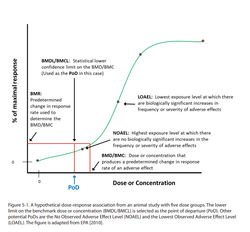
The United States Environmental Protection Agency defines LOAEL as the 'lowest level of a chemical stressor evaluated in a toxicity test that shows harmful effects on a plant or animal. While LOAELs and LOAECs are similar, they are not interchangeable. A LOAEL refers to a dose of chemical that is ingested, while a LOAEC refers to direct exposure to a chemical (e.g., through gills or the skin).3
References
References
- "IUPAC glossary of terms used in toxicology - terms starting with L". Environmental Health and Toxicology Specialized Information Services. U.S. Department of Health & Human Services. Archived from the original on October 29, 2007. Retrieved January 9, 2016. based upon Duffus, J. H.; Nordberg, M.; Templeton, D. M. (2007). "Glossary of terms used in toxicology, 2nd edition (IUPAC Recommendations 2007)". Pure and Applied Chemistry. 79 (7): 1153. doi:10.1351/pac200779071153.
- NIOSH (March 2020). NIOSH Practices in Occupational Risk Assessment. Cincinnati, OH: U.S. Department of Health and Human Services, Centers for Disease Control and Prevention, National Institute for Occupational Safety and Health. Publication No. 2020-106. doi:10.26616/NIOSHPUB2020106. Retrieved 18 July 2024.
- Registries, EPA, OEI, SOR, System Of. "Terms & Acronyms". Archived from the original on April 17, 1999.
{{cite web}}: CS1 maint: multiple names: authors list (link)
- This article incorporates public domain material from Jasper Womach. Report for Congress: Agriculture: A Glossary of Terms, Programs, and Laws, 2005 Edition (PDF). Congressional Research Service.