 | |
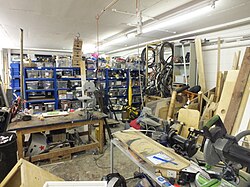 The London Hackspace workshop | |
| Formation | 2009 |
|---|---|
| Purpose | Hacking, DIY |
| Location |
|
Origin | London |
Founders | Russ Garrett, Jonty Wareing |
| Website | Homepage, Wiki |
London Hackspace (abbreviated LHS) is a non–profit hackerspace in London, UK, established in 2009.1 Originally located in Islington, it moved to Hoxton in July 2010,23 and later to Park Royal4. In 2012, it was the largest hackerspace in the United Kingdom by membership, with over 1000 paying members.56
Founding
The group held its first meeting at Ye Olde Cheshire Cheese on 10 February 2009.7
Organisational status
London Hackspace became the world's first virtualised non–profit corporation on 27 July 2011, when the members at the AGM voted to use the OneClickOrgs platform to carry out all the procedures of the board of directors.8
Facilities
London hackspace has a wide variety of facilities split across multiple sections, including equipment for electronics, 3D printing,9 craft, laser cutting, woodwork, metalwork, textile arts, amateur radio, robotics, and many other things. An incomplete list of equipment can be found on their wiki.
Projects

- At Maker Faire 2011, members combined an Xbox Kinect and a pair of Tesla Coils to make an Evil Genius Simulator.1011
- HackSat One, a femtosatellite Sprite meant to be launched as part of the KickSat dispenser was developed at the space in 2013.12
- The Nanode,13 a networked Arduino clone14 was developed at the space.15
Workshops & events
London Hackspace hosted regular workshops for Biohacking, Lockpicking, Amateur radio and Hacking on OneClickOrgs. Additional irregular workshops cover woodturning, machining, 3D printing, textile arts and welding.
There is also a regular Wednesday open evening event.16
References
References
- "History – London Hackspace". London Hackspace. Retrieved 25 August 2011.
- "London Hackspace Spacewarming Party". Retrieved 25 August 2011.
- "BBC News – Hackspaces get closer to home". BBC News. BBC. 19 August 2010. Retrieved 25 August 2011.
- https://wiki.london.hackspace.org.uk/view/London_Hackspace#Location
- Grace-Flood, Liam (9 August 2017). "Open World: Touring London's Biggest Workshops | Make". Make: DIY Projects and Ideas for Makers. Retrieved 2 February 2018.
- "About – London Hackspace". London Hackspace. 1 October 2012. Archived from the original on 18 September 2010. Retrieved 1 October 2012.
- Garrett, Russ (6 February 2009). "First Meetup: Tuesday 10th February". Google Groups. Retrieved 11 February 2011.
- "London Hackspace becomes first virtualised non-profit corporation". Retrieved 25 August 2011.
- Simonite, Tom (2 June 2010). "Rise of the replicators". New Scientist. Retrieved 21 March 2011.
- "The Evil Genius Similator". YouTube. Tom Scott. Retrieved 25 August 2011.
- Popova, Milena (16 March 2011). "Maker Faire 2011". ORG Zine. Open Rights Group. Retrieved 2 May 2011.
- https://wiki.london.hackspace.org.uk/view/Project:HackSat_One
- "Project:Nanode – London Hackspace". London Hackspace. Retrieved 25 August 2011.
- "Nanode: networked Arduino node Dangerous Prototypes". Dangerous Prototypes. May 2011. Retrieved 25 August 2011.
- "nanode kit". Earthshine Electronics. Retrieved 25 August 2011.
- https://wiki.london.hackspace.org.uk/view/Weekly_Open_Evenings
External links
External links
51°31′40″N 0°15′51″W / 51.5277788°N 0.2642050°W / 51.5277788; -0.2642050