Macropodiformes is a suborder of Australian marsupial mammals. Members of this suborder are called macropodiformes, and include kangaroos, wallabies, bettongs, potoroos, and rat-kangaroos. Macropodiformes is one of three suborders that form the order Diprotodontia, the largest extant order of marsupials. They are found in Australia and New Guinea, generally in forests, shrublands, grasslands, and savannas, though some species can also be found in deserts and rocky areas. They range in size from the musky rat-kangaroo, at 20 cm (8 in) plus a 6 cm (2 in) tail, to the red kangaroo, at 160 cm (63 in) plus a 120 cm (47 in) tail. Macropodiformes primarily eat leaves, grass, ferns, and shrubs, as well as fruit and other plant material.
Many macropodiformes do not have population estimates, but the ones that do range from 40 individuals to 500,000. Ten species are categorized as endangered: Calaby's pademelon, Cape York rock-wallaby, dingiso, Goodfellow's tree-kangaroo, ifola, Matschie's tree-kangaroo, mountain pademelon, nabarlek, northern bettong, and Proserpine rock-wallaby. A further six species are categorized as critically endangered: the black dorcopsis, Gilbert's potoroo, golden-mantled tree-kangaroo, tenkile, Wondiwoi tree-kangaroo, and woylie. Eight species have gone extinct in the modern era, all between the 1880s and the 1940s after the colonization of Australia began: the broad-faced potoroo, crescent nail-tail wallaby, desert bettong, desert rat-kangaroo, eastern hare-wallaby, Lake Mackay hare-wallaby, Nullarbor dwarf bettong, and toolache wallaby.
The seventy-two extant species of Macropodiformes are divided into three families: Hypsiprymnodontidae, containing a single species, the musky rat-kangaroo; Macropodidae, containing sixty-three species divided between the twelve genera in the subfamily Macropodinae and the single genus of the subfamily Sthenurinae; and Potoroidae, containing eight species in three extant genera. Dozens of extinct Macropodiformes species have been discovered, though due to ongoing research and discoveries the exact number and categorization is not fixed.1
Conventions
| Conservation status | |
|---|---|
| EX | Extinct (8 species) |
| EW | Extinct in the wild (0 species) |
| CR | Critically endangered (6 species) |
| EN | Endangered (10 species) |
| VU | Vulnerable (16 species) |
| NT | Near threatened (13 species) |
| LC | Least concern (27 species) |
The author citation for the species or genus is given after the scientific name; parentheses around the author citation indicate that this was not the original taxonomic placement. Conservation status codes listed follow the International Union for Conservation of Nature (IUCN) Red List of Threatened Species. Range maps are provided wherever possible; if a range map is not available, a description of the macropodiformes's range is provided. Ranges are based on the IUCN Red List for that species unless otherwise noted. All extinct genera, species, or subspecies listed alongside extant species went extinct after 1500 CE, and are indicated by a dagger symbol "†".
Classification
The suborder Macropodiformes consists of three extant families: Hypsiprymnodontidae, Macropodidae, and Potoroidae. Hypsiprymnodontidae contains a single species and Potoroidae contains eight species in three extant genera. Macropodidae is divided into two subfamilies: Macropodinae, containing sixty-three species divided between twelve genera, and Sthenurinae, containing a single species. In addition to the extant species, eight species—four in Macropodidae and four in Potoroidae, including one extinct genus—have gone extinct in the modern era, all between the 1880s and the 1940s after the colonization of Australia began.
Family Hypsiprymnodontidae
- Genus Hypsiprymnodon (musky rat-kangaroo): one species
Family Macropodidae
- Subfamily Macropodinae
- Genus Dendrolagus (tree-kangaroos): fourteen species
- Genus Dorcopsis (dorcopsises): four species
- Genus Dorcopsulus (forest wallabies): two species
- Genus Lagorchestes (hare-wallabies): four species (two extinct)
- Genus Macropus (grey kangaroos): two species
- Genus Notamacropus (wallabies): eight species (one extinct)
- Genus Osphranter (kangaroos): four species
- Genus Onychogalea (nail-tail wallabies): three species (one extinct)
- Genus Petrogale (rock-wallabies): sixteen species
- Genus Setonix (quokka): one species
- Genus Thylogale (pademelon): seven species
- Genus Wallabia (swamp wallaby): one species
- Subfamily Sthenurinae
- Genus Lagostrophus (banded hare-wallaby): one species
Family Potoroidae
- Genus Aepyprymnus (rufous rat-kangaroo): one species
- Genus Bettongia (bettongs): six species (two extinct)
- Genus Caloprymnus † (desert rat-kangaroo): one species (one extinct)
- Genus Potorous (potoroos): four species (one extinct)
Macropodiformes
The following classification is based on the taxonomy described by the reference work Mammal Species of the World (2005), with augmentation by generally accepted proposals made since using molecular phylogenetic analysis, as supported by both the IUCN and the American Society of Mammalogists.4
Hypsiprymnodontidae
| Common name | Scientific name and subspecies | Range | Size and ecology | IUCN status and estimated population |
|---|---|---|---|---|
| Musky rat-kangaroo
|
H. moschatus Ramsay, 1876 |
Northeastern Australia
|
Size: 20–35 cm (8–14 in) long, plus 6–13 cm (2–5 in) tail5 Habitat: Forest6 Diet: Insects, as well as worms, tuberous roots, and palm berries5 |
LC
|


Macropodidae
Subfamily Macropodinae
| Common name | Scientific name and subspecies | Range | Size and ecology | IUCN status and estimated population |
|---|---|---|---|---|
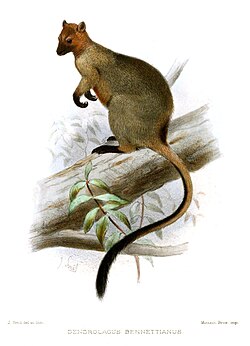
| Bennett's tree-kangaroo
|
D. bennettianus Vis, 1887 |
Northeastern Australia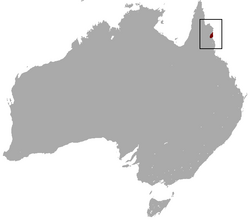
|
Size: 69–75 cm (27–30 in) long, plus 73–84 cm (29–33 in) tail7 Habitat: Forest8 Diet: Leaves and fruit7 |
NT
|
| Dingiso | D. mbaiso Flannery, Szalay & Boeadi, 1995 |
Western New Guinea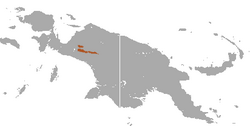
|
Size: 52–81 cm (20–32 in) long, plus 40–94 cm (16–37 in) tail9 Habitat: Forest and shrubland10 Diet: Leaves and fruit11 |
EN
|
| Doria's tree-kangaroo
|
D. dorianus Ramsay, 1883 |
Eastern New Guinea
|
Size: 41–81 cm (16–32 in) long, plus 40–94 cm (16–37 in) tail12 Habitat: Forest13 Diet: Leaves and fruit11 |
VU
|
| Golden-mantled tree-kangaroo | D. pulcherrimus Flannery, 1993 |
Northern New Guinea
|
Size: 41–81 cm (16–32 in) long, plus 40–94 cm (16–37 in) tail12 Habitat: Forest14 Diet: Leaves and fruit11 |
CR
|
| Goodfellow's tree-kangaroo
|
D. goodfellowi Thomas, 1906 Two subspecies
|
Eastern New Guinea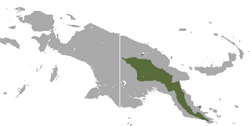
|
Size: 55–77 cm (22–30 in) long, plus 70–85 cm (28–33 in) tail15 Habitat: Forest16 Diet: Leaves, fruit, and cereals, as well as flowers and grass15 |
EN
|
| Grizzled tree-kangaroo
|
D. inustus Müller, 1840 Two subspecies
|
Western and northern New Guinea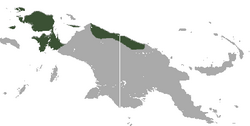
|
Size: 41–81 cm (16–32 in) long, plus 40–94 cm (16–37 in) tail12 Habitat: Forest17 Diet: Leaves, fruit, and bark18 |
VU
|
| Ifola | D. notatus Matschie, 1916 |
Eastern New Guinea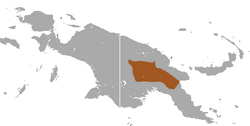
|
Size: 41–81 cm (16–32 in) long, plus 40–94 cm (16–37 in) tail12 Habitat: Forest19 Diet: Leaves and fruit11 |
EN
|
| Lowlands tree-kangaroo | D. spadix Troughton & Le Souef, 1936 |
Eastern New Guinea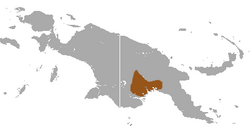
|
Size: 41–81 cm (16–32 in) long, plus 40–94 cm (16–37 in) tail12 Habitat: Forest20 Diet: Leaves and fruit11 |
VU
|
| Lumholtz's tree-kangaroo
|
D. lumholtzi Collett, 1884 |
Northeastern Australia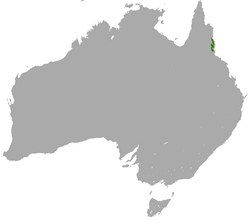
|
Size: 41–81 cm (16–32 in) long, plus 40–94 cm (16–37 in) tail12 Habitat: Forest21 Diet: A variety of leaves as well as flowers22 |
NT
|
| Matschie's tree-kangaroo
|
D. matschiei Rothschild & Förster, 1907 |
Eastern New Guinea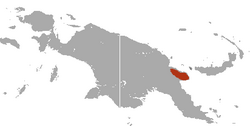
|
Size: 55–63 cm (22–25 in) long, plus 55–63 cm (22–25 in) tail23 Habitat: Forest24 Diet: Leaves, as well as fruit, flowers, nuts, insects, bark, sap, bird eggs, and young birds23 |
EN
|
| Seri's tree-kangaroo | D. stellarum Flannery & Seri, 1990 |
Central New Guinea
|
Size: 41–81 cm (16–32 in) long, plus 40–94 cm (16–37 in) tail12 Habitat: Forest25 Diet: Leaves and fruit11 |
VU
|
| Tenkile | D. scottae Flannery, 1990 |
Northern New Guinea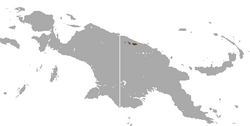
|
Size: 41–81 cm (16–32 in) long, plus 40–94 cm (16–37 in) tail12 Habitat: Forest26 Diet: Tree leaves, ferns, and soft vines27 |
CR
|
| Ursine tree-kangaroo
|
D. ursinus (Temminck, 1836) |
Western New Guinea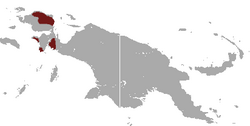
|
Size: 41–81 cm (16–32 in) long, plus 40–94 cm (16–37 in) tail12 Habitat: Forest28 Diet: Leaves and fruit11 |
VU
|
| Wondiwoi tree-kangaroo | D. mayri Rothschild & Dollman, 1933 |
Western New Guinea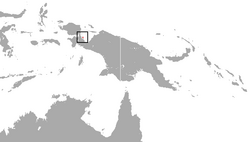
|
Size: 41–81 cm (16–32 in) long, plus 40–94 cm (16–37 in) tail12 Habitat: Forest29 Diet: Leaves and fruit11 |
CR
|


| Common name | Scientific name and subspecies | Range | Size and ecology | IUCN status and estimated population |
|---|---|---|---|---|
| Black dorcopsis | D. atrata Deusen, 1957 |
Eastern New Guinea
|
Size: 73–100 cm (29–39 in) long, plus 28–40 cm (11–16 in) tail30 Habitat: Forest31 Diet: Leaves, roots, grass and fruit30 |
CR
|
| Brown dorcopsis | D. muelleri (Lesson, 1827) Four subspecies
|
Western New Guinea
|
Size: 34–97 cm (13–38 in) long, plus 27–55 cm (11–22 in) tail32 Habitat: Forest33 Diet: Roots, leaves, grass, and fruit32 |
LC
|
| Gray dorcopsis
|
D. luctuosa (D'Albertis, 1874) Two subspecies
|
Southern New Guinea
|
Size: 34–97 cm (13–38 in) long, plus 27–55 cm (11–22 in) tail32 Habitat: Forest34 Diet: Roots, leaves, grass, and fruit32 |
VU
|
| White-striped dorcopsis
|
D. hageni Heller, 1897 |
Northern New Guinea
|
Size: 34–97 cm (13–38 in) long, plus 27–55 cm (11–22 in) tail32 Habitat: Forest35 Diet: Roots, leaves, grass, and fruit32 |
LC
|


| Common name | Scientific name and subspecies | Range | Size and ecology | IUCN status and estimated population |
|---|---|---|---|---|
| Macleay's dorcopsis
|
D. macleayi (Miklouho-Maclay, 1885) |
Eastern New Guinea
|
Size: 31–46 cm (12–18 in) long, plus 22–41 cm (9–16 in) tail36 Habitat: Forest37 Diet: Leaves, buds, and stems38 |
LC
|
| Small dorcopsis | D. vanheurni (Thomas, 1922) |
Central and eastern New Guinea
|
Size: 31–46 cm (12–18 in) long, plus 22–41 cm (9–16 in) tail36 Habitat: Forest39 Diet: Believed to be leaves and fruit36 |
NT
|

| Common name | Scientific name and subspecies | Range | Size and ecology | IUCN status and estimated population |
|---|---|---|---|---|
| Eastern hare-wallaby †
|
L. leporides Gould, 1841 |
Southeastern Australia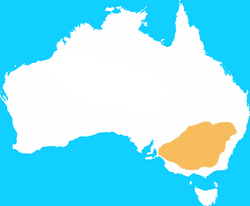
|
Size: About 45 cm (18 in) long, plus 32 cm (13 in) tail40 Habitat: Unknown41 Diet: Unknown40 |
EX
|
| Lake Mackay hare-wallaby † | L. asomatus Finlayson, 1943 |
Central Australia
|
Size: Unknown42 Habitat: Desert43 Diet: Unknown42 |
EX
|
| Rufous hare-wallaby
|
L. hirsutus Gould, 1844 |
Western Australia
|
Size: 31–39 cm (12–15 in) long, plus 24–31 cm (9–12 in) tail44 Habitat: Shrubland, grassland45 Diet: Seeds, fruit, grass, sedges, and succulent shrubs and herbs44 |
NT
|
| Spectacled hare-wallaby
|
L. conspicillatus Gould, 1842 |
Northern Australia
|
Size: 39–49 cm (15–19 in) long, plus 37–53 cm (15–21 in) tail42 Habitat: Forest, savanna, shrubland, and grassland46 Diet: Grass, forbs, and herbs42 |
LC
|


| Common name | Scientific name and subspecies | Range | Size and ecology | IUCN status and estimated population |
|---|---|---|---|---|
| Eastern grey kangaroo
|
M. giganteus Shaw, 1790 Two subspecies
|
Eastern Australia
|
Size: 85–140 cm (33–55 in) long, plus 75–100 cm (30–39 in) tail47 Habitat: Forest, savanna, shrubland, and grassland48 Diet: Grass, as well as forbs49 |
LC
|
| Western grey kangaroo
|
M. fuliginosus (Desmarest, 1817) Three subspecies
|
Southern and southwestern Australia
|
Size: 85–140 cm (33–55 in) long, plus 75–100 cm (30–39 in) tail47 Habitat: Forest, savanna, shrubland, and grassland50 Diet: Grass, forbs, leaves, tree bark, and shrubs51 |
LC
|


| Common name | Scientific name and subspecies | Range | Size and ecology | IUCN status and estimated population |
|---|---|---|---|---|
| Agile wallaby
|
N. agilis (Gould, 1842) Four subspecies
|
Northern Australia and southern New Guinea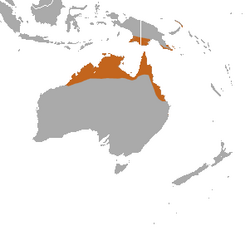
|
Size: 40–105 cm (16–41 in) long, plus 33–75 cm (13–30 in) tail52 Habitat: Savanna and grassland53 Diet: Grass, shrubs, bushes, and roots, as well as leaves and fruit54 |
LC
|
| Black-striped wallaby
|
N. dorsalis (Gray, 1837) |
Northeastern Australia
|
Size: 40–105 cm (16–41 in) long, plus 33–75 cm (13–30 in) tail52 Habitat: Forest, savanna, and shrubland55 Diet: Grass, as well as forbs and shrubs56 |
LC
|
| Parma wallaby
|
N. parma (Waterhouse, 1846) |
Eastern Australia
|
Size: 44–53 cm (17–21 in) long, plus 40–55 cm (16–22 in) tail57 Habitat: Forest58 Diet: Grass and herbs57 |
VU
|
| Red-necked wallaby
|
N. rufogriseus (Desmarest, 1817) Three subspecies
|
Eastern and southeastern Australia
|
Size: 92–105 cm (36–41 in) long, plus 70–75 cm (28–30 in) tail59 Habitat: Forest, shrubland, and grassland60 Diet: Grass and herbs, as well as roots59 |
LC
|
| Tammar wallaby
|
N. eugenii (Desmarest, 1817) |
Southern and southwestern Australia
|
Size: 52–68 cm (20–27 in) long, plus 33–45 cm (13–18 in) tail61 Habitat: Forest and shrubland62 Diet: Grass as well as shrubs62 |
LC
|
| Toolache wallaby †
|
N. greyi Waterhouse, 1846 |
Southern Australia | Size: 40–105 cm (16–41 in) long, plus 33–75 cm (13–30 in) tail52 Habitat: Savanna and grassland63 Diet: Grass, leaves, and roots64 |
EX
|
| Western brush wallaby
|
N. irma (Jourdan, 1837) |
Southwestern Australia
|
Size: 40–105 cm (16–41 in) long, plus 33–75 cm (13–30 in) tail52 Habitat: Forest, savanna, and shrubland65 Diet: Grass66 |
LC
|
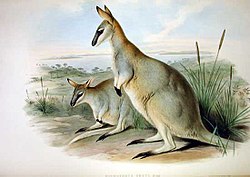
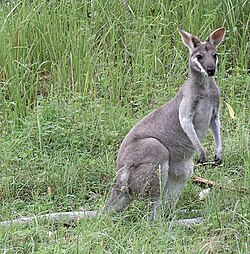
| Whiptail wallaby
|
N. parryi (Bennett, 1835) |
Northeastern Australia
|
Size: 40–105 cm (16–41 in) long, plus 33–75 cm (13–30 in) tail52 Habitat: Savanna67 Diet: Grass, ferns, and herbs68 |
LC
|


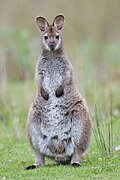
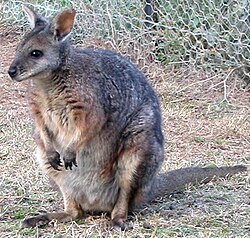

| Common name | Scientific name and subspecies | Range | Size and ecology | IUCN status and estimated population |
|---|---|---|---|---|
| Antilopine kangaroo
|
O. antilopinus Gould, 1842 |
Northern Australia
|
Size: 75–140 cm (30–55 in) long, plus 60–90 cm (24–35 in) tail47 Habitat: Forest, savanna, and grassland69 Diet: Grass70 |
LC
|
| Black wallaroo
|
O. bernardus (Rothschild, 1904) |
Northern Australia
|
Size: About 73 cm (29 in) long, plus 64 cm (25 in) tail71 Habitat: Forest, shrubland, and grassland72 Diet: Grass and shrubs, as well as other plants73 |
NT
|
| Common wallaroo
|
O. robustus (Gould, 1841) Four subspecies
|
Australia
|
Size: 75–140 cm (30–55 in) long, plus 60–90 cm (24–35 in) tail47 Habitat: Forest, savanna, shrubland, and grassland74 Diet: Grasses and shrubs74 |
LC
|
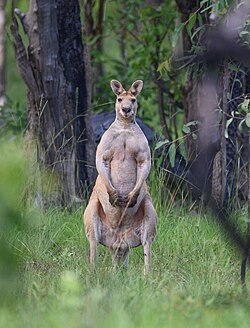
| Red kangaroo
|
O. rufus (Desmarest, 1822) |
Australia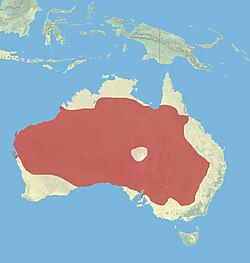
|
Size: 85–160 cm (33–63 in) long, plus 65–120 cm (26–47 in) tail75 Habitat: Savanna, shrubland, grassland, and desert76 Diet: Grass and flowering plants75 |
LC
|
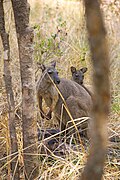
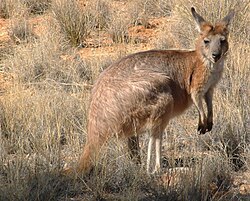
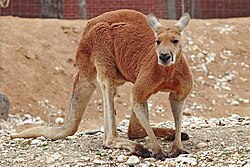
| Common name | Scientific name and subspecies | Range | Size and ecology | IUCN status and estimated population |
|---|---|---|---|---|
| Bridled nail-tail wallaby
|
O. fraenata Gould, 1841 |
Scattered eastern Australia
|
Size: 43–70 cm (17–28 in) long, plus 36–73 cm (14–29 in) tail77 Habitat: Forest, savanna, and shrubland78 Diet: Variety of forbs, grass, and shrubs77 |
VU
|
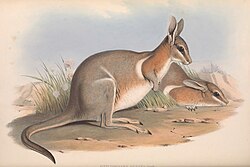
| Crescent nail-tail wallaby †
|
O. lunata (Gould, 1841) |
Western Australia | Size: 37–51 cm (15–20 in) long, plus 15–33 cm (6–13 in) tail79 Habitat: Savanna and grassland80 Diet: Unknown79 |
EX
|
| Northern nail-tail wallaby
|
O. unguifera (Gould, 1841) |
Scattered northern Australia
|
Size: 43–70 cm (17–28 in) long, plus 36–73 cm (14–29 in) tail81 Habitat: Forest, savanna, and shrubland82 Diet: Herbs, succulents, fruit, and grass81 |
LC
|
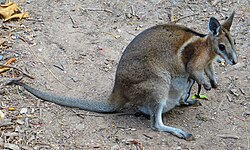

| Common name | Scientific name and subspecies | Range | Size and ecology | IUCN status and estimated population |
|---|---|---|---|---|
| Allied rock-wallaby
|
P. assimilis Ramsay, 1877 |
Northeastern Australia
|
Size: 40–70 cm (16–28 in) long, plus 30–70 cm (12–28 in) tail83 Habitat: Rocky areas84 Diet: Grass, leaves, forbs, fruit, flowers, seeds85 |
LC
|
| Black-flanked rock-wallaby
|
P. lateralis Gould, 1842 Three subspecies
|
Scattered central and western Australia
|
Size: 40–70 cm (16–28 in) long, plus 30–70 cm (12–28 in) tail83 Habitat: Savanna, shrubland, grassland, rocky areas, and desert86 Diet: Grass, leaves, forbs, fruit, flowers, seeds85 |
VU
|
| Brush-tailed rock-wallaby
|
P. penicillata Gray, 1827 |
Eastern Australia
|
Size: 40–70 cm (16–28 in) long, plus 30–70 cm (12–28 in) tail83 Habitat: Forest, savanna, and rocky areas87 Diet: Grass, as well as leaves, sedges, ferns, roots, bark, fruit, seeds and flowers88 |
VU
|
| Cape York rock-wallaby | P. coenensis Eldridge & Close, 1992 |
Northern Australia
|
Size: 40–70 cm (16–28 in) long, plus 30–70 cm (12–28 in) tail83 Habitat: Forest and rocky areas89 Diet: Grass, leaves, forbs, fruit, flowers, seeds85 |
EN
|
| Godman's rock-wallaby | P. godmani Thomas, 1923 |
Northern Australia
|
Size: 40–70 cm (16–28 in) long, plus 30–70 cm (12–28 in) tail83 Habitat: Rocky areas90 Diet: Grass, leaves, forbs, fruit, flowers, seeds85 |
NT
|
| Herbert's rock-wallaby | P. herberti Thomas, 1926 |
Eastern Australia
|
Size: 40–70 cm (16–28 in) long, plus 30–70 cm (12–28 in) tail83 Habitat: Rocky areas91 Diet: Grass, leaves, forbs, fruit, flowers, seeds85 |
LC
|
| Mareeba rock-wallaby
|
P. mareeba Eldridge & Close, 1992 |
Northern Australia
|
Size: 40–70 cm (16–28 in) long, plus 30–70 cm (12–28 in) tail83 Habitat: Rocky areas92 Diet: Grass, leaves, forbs, fruit, flowers, seeds85 |
NT
|
| Monjon
|
P. burbidgei Kitchener, 1978 |
Northwestern Australia
|
Size: 29–36 cm (11–14 in) long, plus 25–33 cm (10–13 in) tail83 Habitat: Forest and rocky areas93 Diet: Grass, leaves, forbs, fruit, flowers, seeds85 |
NT
|
| Mount Claro rock-wallaby | P. sharmani Eldridge & Close, 1992 |
Northern Australia
|
Size: 29–36 cm (11–14 in) long, plus 25–33 cm (10–13 in) tail83 Habitat: Rocky areas94 Diet: Grass, leaves, forbs, fruit, flowers, seeds85 |
VU
|
| Nabarlek
|
P. concinna Gould, 1842 |
Northwestern Australia
|
Size: 29–35 cm (11–14 in) long, plus 22–31 cm (9–12 in) tail95 Habitat: Forest, savanna, grassland, and rocky areas96 Diet: Grass and ferns95 |
EN
|
| Proserpine rock-wallaby | P. persephone Maynes, 1982 |
Northeastern Australia
|
Size: 40–70 cm (16–28 in) long, plus 30–70 cm (12–28 in) tail83 Habitat: Forest and rocky areas97 Diet: Grass and leaves, as well as shrubs, forbs, and fungi98 |
EN
|
| Purple-necked rock-wallaby
|
P. purpureicollis Le Souef, 1924 |
North central Australia
|
Size: 40–70 cm (16–28 in) long, plus 30–70 cm (12–28 in) tail83 Habitat: Rocky areas99 Diet: Grass, leaves, forbs, fruit, flowers, seeds85 |
NT
|
| Rothschild's rock-wallaby
|
P. rothschildi Thomas, 1904 |
Northwestern Australia
|
Size: 40–70 cm (16–28 in) long, plus 30–70 cm (12–28 in) tail83 Habitat: Rocky areas100 Diet: Grass, leaves, forbs, fruit, flowers, seeds85 |
LC
|
| Short-eared rock-wallaby
|
P. brachyotis (Gould, 1841) |
Northern Australia
|
Size: 40–70 cm (16–28 in) long, plus 30–70 cm (12–28 in) tail83 Habitat: Forest, savanna, and rocky areas101 Diet: Grass, as well as bark and roots102 |
LC
|
| Unadorned rock-wallaby
|
P. inornata Gould, 1842 |
Northeastern Australia
|
Size: 40–70 cm (16–28 in) long, plus 30–70 cm (12–28 in) tail83 Habitat: Rocky areas103 Diet: Grass, leaves, forbs, fruit, flowers, seeds85 |
LC
|
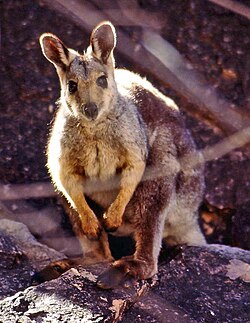
| Yellow-footed rock-wallaby
|
P. xanthopus Gray, 1855 Two subspecies
|
South central Australia
|
Size: 48–65 cm (19–26 in) long, plus 57–70 cm (22–28 in) tail104 Habitat: Rocky areas105 Diet: Grass and leaves104 |
NT
|



| Common name | Scientific name and subspecies | Range | Size and ecology | IUCN status and estimated population |
|---|---|---|---|---|
| Quokka
|
S. brachyurus (Quoy & Gaimard, 1830) |
Southwestern Australia
|
Size: 39–60 cm (15–24 in) long, plus 23–35 cm (9–14 in) tail106 Habitat: Forest, shrubland, and inland wetlands107 Diet: Succulents, shrubs, forbs, grasses and sedges, as well as seeds, berries, and fruit108 |
VU
|


| Common name | Scientific name and subspecies | Range | Size and ecology | IUCN status and estimated population |
|---|---|---|---|---|
| Brown's pademelon
|
T. browni (Ramsay, 1877) |
Eastern New Guinea (introduced in red)
|
Size: 29–67 cm (11–26 in) long, plus 24–57 cm (9–22 in) tail109 Habitat: Forest110 Diet: Grass, leaves, shoots, seeds, and fruit111 |
VU
|
| Calaby's pademelon | T. calabyi Flannery, 1992 |
Scattered eastern New Guinea
|
Size: 29–67 cm (11–26 in) long, plus 24–57 cm (9–22 in) tail109 Habitat: Grassland112 Diet: Grass, leaves, shoots, seeds, and fruit111 |
EN
|
| Dusky pademelon
|
T. brunii (Schreber, 1778) |
Southern New Guinea (introduced in red)
|
Size: 29–67 cm (11–26 in) long, plus 24–57 cm (9–22 in) tail109 Habitat: Forest and savanna113 Diet: Grass, leaves, shoots, seeds, and fruit111 |
VU
|
| Mountain pademelon | T. lanatus Thomas, 1922 |
Eastern New Guinea
|
Size: 29–67 cm (11–26 in) long, plus 24–57 cm (9–22 in) tail109 Habitat: Forest and grassland114 Diet: Grass, leaves, shoots, seeds, and fruit111 |
EN
|
| Red-legged pademelon
|
T. stigmatica (Gould, 1860) Four subspecies
|
Eastern Australia and southern New Guinea
|
Size: 38–54 cm (15–21 in) long, plus 30–48 cm (12–19 in) tail115 Habitat: Forest116 Diet: Leaves and fruit, as well as grass, bark, fungi, and cicadas115 |
LC
|
| Red-necked pademelon
|
T. thetis (Lesson, 1828) |
Eastern Australia
|
Size: 29–63 cm (11–25 in) long, plus 27–51 cm (11–20 in) tail117 Habitat: Forest118 Diet: Grass, leaves, shoots, seeds, and fruit111 |
LC
|
| Tasmanian pademelon
|
T. billardierii (Desmarest, 1822) |
Tasmania
|
Size: 29–67 cm (11–26 in) long, plus 24–57 cm (9–22 in) tail109 Habitat: Forest, shrubland, and grassland119 Diet: Grass, leaves, shoots, seeds, and fruit111 |
LC
|


| Common name | Scientific name and subspecies | Range | Size and ecology | IUCN status and estimated population |
|---|---|---|---|---|
| Swamp wallaby
|
W. bicolor (Desmarest, 1804) |
Eastern Australia
|
Size: 66–85 cm (26–33 in) long, plus 64–87 cm (25–34 in) tail120 Habitat: Forest and shrubland121 Diet: Buds, ferns, leaves, shrubs, and grasses, as well as bark and shoots from needle-leaf trees120 |
LC
|


Subfamily Sthenurinae
| Common name | Scientific name and subspecies | Range | Size and ecology | IUCN status and estimated population |
|---|---|---|---|---|
| Banded hare-wallaby
|
L. fasciatus (Péron & Lesueur, 1807) Two subspecies
|
Western Australia
|
Size: 40–46 cm (16–18 in) long, plus 32–40 cm (13–16 in) tail122 Habitat: Shrubland123 Diet: Plants and fruit122 |
VU
|

Potoroidae
| Common name | Scientific name and subspecies | Range | Size and ecology | IUCN status and estimated population |
|---|---|---|---|---|
| Rufous rat-kangaroo
|
A. rufescens (Gray, 1837) |
Northeastern Australia
|
Size: 37–52 cm (15–20 in) long, plus 35–40 cm (14–16 in) tail124 Habitat: Forest and savanna125 Diet: Grass, herbs, roots, tubers, and fungi, as well as carrion bones and larvae124 |
LC
|


| Common name | Scientific name and subspecies | Range | Size and ecology | IUCN status and estimated population |
|---|---|---|---|---|
| Boodie
|
B. lesueur (Quoy & Gaimard, 1824) |
Scattered western and southern Australia
|
Size: 37–40 cm (15–16 in) long, plus about 30 cm (12 in) tail126 Habitat: Forest, savanna, shrubland, and desert127 Diet: Leaves, seeds, fruits, nuts, tubers, bulbs, flowers, and fungi, as well as termites and marine carrion126 |
NT
|
| Desert bettong † | B. anhydra Finlayson, 1957 |
Central Australia | Size: Unknown128 Habitat: Unknown128 Diet: Unknown128 |
EX
|
| Eastern bettong
|
B. gaimardi (Desmarest, 1822) |
Eastern Tasmania
|
Size: 32–33 cm (13–13 in) long, plus 32–33 cm (13–13 in) tail129 Habitat: Forest130 Diet: Fungi, as well as plants129 |
NT
|
| Northern bettong
|
B. tropica Wakefield, 1967 |
Northeastern Australia
|
Size: 27–44 cm (11–17 in) long, plus 26–35 cm (10–14 in) tail131 Habitat: Forest132 Diet: Fungi, as well as roots, tubers, small invertebrates, and seeds132 |
EN
|
| Nullarbor dwarf bettong † | B. pusilla McNamara, 1997 |
Southern Australia | Size: Unknown133 Habitat: Unknown133 Diet: Unknown133 |
EX
|
| Woylie
|
B. penicillata (Gray, 1837) |
Scattered western and southern Australia (form distribution in yellow)
|
Size: 30–38 cm (12–15 in) long, plus 29–36 cm (11–14 in) tail134 Habitat: Forest and shrubland135 Diet: Fungi, as well as bulbs, tubers, seeds, insects and resin134 |
CR
|


| Common name | Scientific name and subspecies | Range | Size and ecology | IUCN status and estimated population |
|---|---|---|---|---|
| Desert rat-kangaroo †
|
C. campestris (Gould, 1843) |
Central Australia
|
Size: 25–29 cm (10–11 in) long, plus 29–38 cm (11–15 in) tail136 Habitat: Desert137 Diet: Leaves and stems, as well as insects138 |
EX
|

| Common name | Scientific name and subspecies | Range | Size and ecology | IUCN status and estimated population |
|---|---|---|---|---|
| Broad-faced potoroo †
|
P. platyops (Gould, 1844) |
Southwestern Australia | Size: 24–42 cm (9–17 in) long, plus 19–33 cm (7–13 in) tail139 Habitat: Inland wetlands140 Diet: Fungi, grass, roots, and other vegetation139 |
EX
|
| Gilbert's potoroo
|
P. gilbertii (Gould, 1841) |
Southwestern Australia
|
Size: 24–42 cm (9–17 in) long, plus 19–33 cm (7–13 in) tail139 Habitat: Shrubland141 Diet: Believed to be roots and fungi142 |
CR
|
| Long-footed potoroo | P. longipes Seebeck & Johnston, 1980 |
Southeastern Australia | Size: 24–42 cm (9–17 in) long, plus 19–33 cm (7–13 in) tail139 Habitat: Forest and shrubland143 Diet: Fungi, as well as insects, seeds, and plants144 |
VU
|
| Long-nosed potoroo
|
P. tridactylus (Kerr, 1792) Two subspecies
|
Southeastern Australia and Tasmania
|
Size: 24–42 cm (9–17 in) long, plus 19–33 cm (7–13 in) tail139 Habitat: Forest and shrubland145 Diet: Fungi, insects, grass, roots, and other vegetation139 |
NT
|


References
References
- "Fossilworks: Diprotodontia". Paleobiology Database. University of Wisconsin–Madison. Retrieved January 8, 2023.
- Meredith, R. W.; Westerman, M.; Springer, M. S. (2009). "A phylogeny and timescale for the living genera of kangaroos and kin (Macropodiformes : Marsupialia) based on nuclear DNA sequences". Australian Journal of Zoology. 56 (6): 395–410. Bibcode:2009AuJZ...56..395M. doi:10.1071/ZO08044.
- Meredith, R. W.; Westerman, M.; Springer, M. S. (2009). "A phylogeny of Diprotodontia (Marsupialia) based on sequences for five nuclear genes". Molecular Phylogenetics and Evolution. 51 (3): 554–571. Bibcode:2009MolPE..51..554M. doi:10.1016/j.ympev.2009.02.009. PMID 19249373.
- Wilson, Reeder, pp. 56–70
- Dougherty, Laurel (2022). "Hypsiprymnodon moschatus". Animal Diversity Web. University of Michigan. Retrieved December 28, 2022.
- Burnett, S.; Winter, J.; Martin, R. (2016). "Hypsiprymnodon moschatus". IUCN Red List of Threatened Species. 2016 e.T40559A21963734. doi:10.2305/IUCN.UK.2016-2.RLTS.T40559A21963734.en.
- Nguyen, Hien (2000). "Dendrolagus bennettianus". Animal Diversity Web. University of Michigan. Retrieved December 28, 2022.
- Winter, J.; Burnett, S.; Martin, R. (2019). "Dendrolagus bennettianus". IUCN Red List of Threatened Species. 2019 e.T6426A21957127. doi:10.2305/IUCN.UK.2019-1.RLTS.T6426A21957127.en.
- Dabek, Valentine, Blessington, Schwartz, p. 241
- Leary, T.; Seri, L.; Wright, D.; Hamilton, S.; Helgen, K.; Singadan, R.; Menzies, J.; Allison, A.; James, R.; Dickman, C.; Aplin, K.; Flannery, T.; Martin, R.; Salas, L. (2016). "Dendrolagus mbaiso". IUCN Red List of Threatened Species. 2016 e.T6437A21956108. doi:10.2305/IUCN.UK.2016-2.RLTS.T6437A21956108.en.
- Nowak 2018, p. 321
- Nowak 2018, p. 319
- Leary, T.; Seri, L.; Flannery, T.; Wright, D.; Hamilton, S.; Helgen, K.; Singadan, R.; Menzies, J.; Allison, A.; James, R. (2016). "Dendrolagus dorianus". IUCN Red List of Threatened Species. 2016 e.T6427A21957392. doi:10.2305/IUCN.UK.2016-2.RLTS.T6427A21957392.en.
- Leary, T.; Wright, D.; Hamilton, S.; Helgen, K.; Singadan, R.; Aplin, K.; Dickman, C.; Salas, L.; Flannery, T.; Martin, R.; Seri, L. (2016). "Dendrolagus pulcherrimus". IUCN Red List of Threatened Species. 2016 e.T136696A21957219. doi:10.2305/IUCN.UK.2016-2.RLTS.T136696A21957219.en.
- Johnson, Scherrie (2022). "Dendrolagus goodfellowi". Animal Diversity Web. University of Michigan. Retrieved December 28, 2022.
- Leary, T.; Seri, L.; Wright, D.; Hamilton, S.; Helgen, K.; Singadan, R.; Menzies, J.; Allison, A.; James, R.; Dickman, C.; Aplin, K.; Flannery, T.; Martin, R.; Salas, L. (2016). "Dendrolagus goodfellowi". IUCN Red List of Threatened Species. 2016 e.T6429A21957524. doi:10.2305/IUCN.UK.2016-2.RLTS.T6429A21957524.en.
- Leary, T.; Seri, L.; Wright, D.; Hamilton, S.; Helgen, K.; Singadan, R.; Menzies, J.; Allison, A.; James, R.; Dickman, C.; Aplin, K.; Flannery, T.; Martin, R.; Salas, L. (2016). "Dendrolagus inustus". IUCN Red List of Threatened Species. 2016 e.T6431A21957669. doi:10.2305/IUCN.UK.2016-2.RLTS.T6431A21957669.en.
- Ho, Yan-Iuan (2004). "Dendrolagus inustus". Animal Diversity Web. University of Michigan. Retrieved January 17, 2023.
- Leary, T.; Seri, L.; Flannery, T.; Wright, D.; Hamilton, S.; Helgen, K.; Singadan, R.; Menzies, J.; Allison, A.; James, R. (2016). "Dendrolagus notatus". IUCN Red List of Threatened Species. 2016 e.T136732A21957010. doi:10.2305/IUCN.UK.2016-2.RLTS.T136732A21957010.en.
- Leary, T.; Seri, L.; Wright, D.; Hamilton, S.; Helgen, K.; Singadan, R.; Menzies, J.; Allison, A.; James, R.; Dickman, C.; Aplin, K.; Salas, L.; Flannery, T.; Bonaccorso, F. (2016). "Dendrolagus spadix". IUCN Red List of Threatened Species. 2016 e.T6436A21956250. doi:10.2305/IUCN.UK.2016-2.RLTS.T6436A21956250.en.
- Woinarski, J.; Burbidge, A. A. (2016). "Dendrolagus lumholtzi". IUCN Red List of Threatened Species. 2016 e.T6432A21957815. doi:10.2305/IUCN.UK.2016-1.RLTS.T6432A21957815.en.
- Kellner, David (2012). "Dendrolagus lumholtzi". Animal Diversity Web. University of Michigan. Retrieved December 28, 2022.
- "Dendrolagus matschiei". Animal Diversity Web. University of Michigan. 2022. Retrieved December 28, 2022.
- Ziembicki, M.; Porolak, G. (2016). "Dendrolagus matschiei". IUCN Red List of Threatened Species. 2016 e.T6433A21956650. doi:10.2305/IUCN.UK.2016-2.RLTS.T6433A21956650.en.
- Leary, T.; Seri, L.; Flannery, T.; Wright, D.; Hamilton, S.; Helgen, K.; Singadan, R.; Menzies, J.; Allison, A.; James, R.; Aplin, K.; Salas, L.; Dickman, C. (2016). "Dendrolagus stellarum". IUCN Red List of Threatened Species. 2016 e.T136812A21956889. doi:10.2305/IUCN.UK.2016-2.RLTS.T136812A21956889.en.
- Leary, T.; Wright, D.; Hamilton, S.; Helgen, K.; Singadan, R.; Aplin, K.; Dickman, C.; Salas, L.; Flannery, T.; Martin, R.; Seri, L. (2019). "Dendrolagus scottae". IUCN Red List of Threatened Species. 2019 e.T6435A21956375. doi:10.2305/IUCN.UK.2019-1.RLTS.T6435A21956375.en.
- Cosens, Lindsay (2004). "Dendrolagus scottae". Animal Diversity Web. University of Michigan. Retrieved December 28, 2022.
- Leary, T.; Seri, L.; Wright, D.; Hamilton, S.; Helgen, K.; Singadan, R.; Menzies, J.; Allison, A.; James, R.; Dickman, C.; Aplin, K.; Salas, L.; Flannery, T.; Bonaccorso, F. (2016). "Dendrolagus ursinus". IUCN Red List of Threatened Species. 2016 e.T6434A21956516. doi:10.2305/IUCN.UK.2016-2.RLTS.T6434A21956516.en.
- Leary, T.; Seri, L.; Flannery, T.; Wright, D.; Hamilton, S; Helgen, K.; Singadan, R.; Menzies, J.; Allison, A.; James, R. (2016). "Dendrolagus mayri". IUCN Red List of Threatened Species. 2016 e.T136668A21956785. doi:10.2305/IUCN.UK.2016-2.RLTS.T136668A21956785.en.
- Borsa, Carmen (2000). "Dorcopsis atrata". Animal Diversity Web. University of Michigan. Retrieved December 28, 2022.
- Leary, T.; Wright, D.; Hamilton, S.; Singadan, R.; Menzies, J.; Bonaccorso, F.; Helgen, K.; Seri, L.; Allison, A.; James, R. (2016). "Dorcopsis atrata". IUCN Red List of Threatened Species. 2016 e.T6794A21952571. doi:10.2305/IUCN.UK.2016-2.RLTS.T6794A21952571.en.
- Nowak 2005, p. 158
- Leary, T.; Singadan, R.; Menzies, J.; Helgen, K.; Allison, A.; James, R.; Flannery, T.; Aplin, K.; Dickman, C.; Salas, L. (2016). "Dorcopsis muelleri". IUCN Red List of Threatened Species. 2016 e.T6800A21952423. doi:10.2305/IUCN.UK.2016-2.RLTS.T6800A21952423.en.
- Leary, T.; Wright, D.; Singadan, R.; Seri, L.; Allison, A.; Aplin, K.; James, R.; Flannery, T.; Dickman, C.; Salas, L. (2016). "Dorcopsis luctuosa". IUCN Red List of Threatened Species. 2016 e.T6799A21952259. doi:10.2305/IUCN.UK.2016-2.RLTS.T6799A21952259.en.
- Wright, D.; Singadan, R.; Seri, L.; Allison, A.; James, R.; Flannery, T.; Aplin, K.; Dickman, C.; Salas, L. (2016). "Dorcopsis hageni". IUCN Red List of Threatened Species. 2016 e.T6795A21952491. doi:10.2305/IUCN.UK.2016-2.RLTS.T6795A21952491.en.
- Nowak 2018, p. 317
- Aplin, K.; Dickman, C.; Salas, L. (2016). "Dorcopsulus macleayi". IUCN Red List of Threatened Species. 2016 e.T6801A21952872. doi:10.2305/IUCN.UK.2016-2.RLTS.T6801A21952872.en.
- Alvarez, Daniel Rosas (2006). "Dorcopsulus macleayi". Animal Diversity Web. University of Michigan. Retrieved December 28, 2022.
- Leary, T.; Singadan, R.; Menzies, J.; Helgen, K.; Allison, A.; James, R.; Flannery, T.; Aplin, K.; Dickman, C.; Salas, L. (2016). "Dorcopsulus vanheurni". IUCN Red List of Threatened Species. 2016 e.T6802A21952770. doi:10.2305/IUCN.UK.2016-2.RLTS.T6802A21952770.en.
- Strahan, p. 319
- Burbidge, A. A.; Woinarski, J. (2016). "Lagorchestes leporides". IUCN Red List of Threatened Species. 2016 e.T11163A21954274. doi:10.2305/IUCN.UK.2016-2.RLTS.T11163A21954274.en.
- Nowak 2018, pp. 340–341
- Burbidge, A. A.; Woinarski, J. (2016). "Lagorchestes asomatus". IUCN Red List of Threatened Species. 2016 e.T11160A21954573. doi:10.2305/IUCN.UK.2016-2.RLTS.T11160A21954573.en.
- Winter, J.; Woinarski, J.; Burbidge, A. (2016). "Lagorchestes conspicillatus". IUCN Red List of Threatened Species. 2016 e.T11161A21954319. doi:10.2305/IUCN.UK.2016-2.RLTS.T11161A21954319.en.
- Nowak 2005, p. 170
- Munny, P.; Menkhorst, P.; Winter, J. (2016). "Macropus giganteus". IUCN Red List of Threatened Species. 2016 e.T41513A21952954. doi:10.2305/IUCN.UK.2016-2.RLTS.T41513A21952954.en.
- Joo, Michael S. (2004). "Macropus giganteus". Animal Diversity Web. University of Michigan. Retrieved January 30, 2023.
- Burbidge, A.; Menkhorst, P.; Ellis, M.; Copley, P. (2016). "Macropus fuliginosus". IUCN Red List of Threatened Species. 2016 e.T40563A21953972. doi:10.2305/IUCN.UK.2016-2.RLTS.T40563A21953972.en.
- Miller, David (2002). "Macropus fuliginosus". Animal Diversity Web. University of Michigan. Retrieved January 30, 2023.
- Nowak 2005, p. 171
- Aplin, K.; Dickman, C.; Salas, L.; Woinarski, J.; Winter, J. (2016). "Macropus agilis". IUCN Red List of Threatened Species. 2016 e.T40560A21954106. doi:10.2305/IUCN.UK.2016-2.RLTS.T40560A21954106.en.
- Burian, Jonathan (2002). "Macropus agilis". Animal Diversity Web. University of Michigan. Retrieved December 28, 2022.
- Winter, J.; Burnett, S.; Menkhorst, P. (2016). "Macropus dorsalis". IUCN Red List of Threatened Species. 2016 e.T40562A21953658. doi:10.2305/IUCN.UK.2016-2.RLTS.T40562A21953658.en.
- Jewell, Todd (2004). "Macropus dorsalis". Animal Diversity Web. University of Michigan. Retrieved January 30, 2023.
- Boehmke, Ashley (2006). "Macropus parma". Animal Diversity Web. University of Michigan. Retrieved January 30, 2023.
- Lunney, D.; McKenzie, N. (2019). "Macropus parma". IUCN Red List of Threatened Species. 2019 e.T12627A21953067. doi:10.2305/IUCN.UK.2019-1.RLTS.T12627A21953067.en.
- Ballenger, Liz (2022). "Macropus rufogriseus". Animal Diversity Web. University of Michigan. Retrieved December 28, 2022.
- McKenzie, N.; Menkhorst, P.; Lunney, D. (2016). "Macropus rufogriseus". IUCN Red List of Threatened Species. 2016 e.T40566A21953329. doi:10.2305/IUCN.UK.2016-2.RLTS.T40566A21953329.en.
- Labiano-Abello, Annette M. (2022). "Macropus eugenii". Animal Diversity Web. University of Michigan. Retrieved December 28, 2022.
- Burbidge, A. A.; Woinarski, J. (2016). "Macropus eugenii". IUCN Red List of Threatened Species. 2016 e.T41512A21953803. doi:10.2305/IUCN.UK.2016-2.RLTS.T41512A21953803.en.
- Burbidge, A. A.; Woinarski, J. (2018) [errata version of 2016 assessment]. "Macropus greyi". IUCN Red List of Threatened Species. 2016 e.T12625A128952836. doi:10.2305/IUCN.UK.2016-2.RLTS.T12625A21953169.en.
- Taylor, p. 29
- Woinarski, J.; Burbidge, A. A. (2016). "Macropus irma". IUCN Red List of Threatened Species. 2016 e.T12626A21953231. doi:10.2305/IUCN.UK.2016-2.RLTS.T12626A21953231.en.
- Morningstar, Natalie (2012). "Macropus irma". Animal Diversity Web. University of Michigan. Retrieved January 30, 2023.
- Winter, J.; Burnett, S.; Martin, R. (2016). "Macropus parryi". IUCN Red List of Threatened Species. 2016 e.T40564A21953894. doi:10.2305/IUCN.UK.2016-2.RLTS.T40564A21953894.en.
- Detweiler, Erika (2000). "Macropus parryi". Animal Diversity Web. University of Michigan. Retrieved January 30, 2023.
- Woinarski, J.; Ritchie, E.; Winter, J. (2016). "Macropus antilopinus". IUCN Red List of Threatened Species. 2016 e.T40561A21953729. doi:10.2305/IUCN.UK.2016-2.RLTS.T40561A21953729.en.
- Bonser, Kurt (2011). "Macropus antilopinus". Animal Diversity Web. University of Michigan. Retrieved December 28, 2022.
- Menkhorst; Knight, p. 122
- Woinarski, J. (2016). "Macropus bernardus". IUCN Red List of Threatened Species. 2016 e.T12620A21954187. doi:10.2305/IUCN.UK.2016-2.RLTS.T12620A21954187.en.
- Hyatt, Evan (2002). "Macropus bernardus". Animal Diversity Web. University of Michigan. Retrieved December 28, 2022.
- Ellis, M.; Menkhorst, P.; Van Weenen, J.; Burbidge, A. A.; Copley, P.; Denny, M. J. S.; Zichy-Woinarski, J.; Mawson, P.; Morris, K. (2019). "Macropus robustus". IUCN Red List of Threatened Species. 2019 e.T40565A21953431. doi:10.2305/IUCN.UK.2019-1.RLTS.T40565A21953431.en.
- Dewey, Tanya; Yue, Minerva (2001). "Macropus rufus". Animal Diversity Web. University of Michigan. Retrieved December 28, 2022.
- Ellis, M.; van Weenen, J.; Copley, P.; Dickman, C.; Mawson, P.; Woinarski, J. (2016). "Macropus rufus". IUCN Red List of Threatened Species. 2016 e.T40567A21953534. doi:10.2305/IUCN.UK.2016-2.RLTS.T40567A21953534.en.
- Hundt, Peter (2004). "Onychogalea fraenata". Animal Diversity Web. University of Michigan. Retrieved December 28, 2022.
- Burbidge, A. A.; Johnson, C. N.; Zichy-Woinarski, J. (2016). "Onychogalea fraenata". IUCN Red List of Threatened Species. 2016 e.T15330A21958130. doi:10.2305/IUCN.UK.2016-1.RLTS.T15330A21958130.en.
- Menkhorst; Knight, p. 128
- Burbidge, A. A.; Woinarski, J. (2016). "Onychogalea lunata". IUCN Red List of Threatened Species. 2016 e.T15331A21957917. doi:10.2305/IUCN.UK.2016-2.RLTS.T15331A21957917.en.
- Nowak 2018, pp. 343–344
- Woinarski, J.; Winter, J.; Burbidge, A. (2016). "Onychogalea unguifera". IUCN Red List of Threatened Species. 2016 e.T40568A21958021. doi:10.2305/IUCN.UK.2016-2.RLTS.T40568A21958021.en.
- Nowak 2018, pp. 333–334
- Winter, J.; Burnett, S.; Martin, R. (2016). "Petrogale assimilis". IUCN Red List of Threatened Species. 2016 e.T40569A21954955. doi:10.2305/IUCN.UK.2016-2.RLTS.T40569A21954955.en.
- Nowak 2018, p. 335
- Burbidge, A. A.; Woinarski, J. (2016). "Petrogale lateralis". IUCN Red List of Threatened Species. 2016 e.T16751A21955343. doi:10.2305/IUCN.UK.2016-1.RLTS.T16751A21955343.en.
- Woinarski, J.; Burbidge, A. A. (2016). "Petrogale penicillata". IUCN Red List of Threatened Species. 2016 e.T16746A21955754. doi:10.2305/IUCN.UK.2016-1.RLTS.T16746A21955754.en.
- Bachynski, Kathleen (2006). "Petrogale penicillata". Animal Diversity Web. University of Michigan. Retrieved December 28, 2022.
- Woinarski, J.; Burbidge, A. A. (2020). "Petrogale coenensis". IUCN Red List of Threatened Species. 2020 e.T16752A21955261. doi:10.2305/IUCN.UK.2020-2.RLTS.T16752A21955261.en.
- Woinarski, J.; Burbidge, A. A. (2016). "Petrogale godmani". IUCN Red List of Threatened Species. 2016 e.T41514A21954814. doi:10.2305/IUCN.UK.2016-1.RLTS.T41514A21954814.en.
- Burnett, S.; Martin, R. (2016). "Petrogale herberti". IUCN Red List of Threatened Species. 2016 e.T41515A21954688. doi:10.2305/IUCN.UK.2016-2.RLTS.T41515A21954688.en.
- Woinarski, J.; Burbidge, A. A. (2016). "Petrogale mareeba". IUCN Red List of Threatened Species. 2016 e.T136509A21954621. doi:10.2305/IUCN.UK.2016-1.RLTS.T136509A21954621.en.
- Burbidge, A. A.; Woinarski, J. (2016). "Petrogale burbidgei". IUCN Red List of Threatened Species. 2016 e.T16744A21955902. doi:10.2305/IUCN.UK.2016-2.RLTS.T16744A21955902.en.
- Woinarski, J.; Burbidge, A. A. (2016). "Petrogale sharmani". IUCN Red List of Threatened Species. 2016 e.T16753A21955167. doi:10.2305/IUCN.UK.2016-1.RLTS.T16753A21955167.en.
- Nowak 2018, p. 331
- Woinarski, J.; Burbidge, A. A. (2016). "Petrogale concinna". IUCN Red List of Threatened Species. 2016 e.T16761A21955087. doi:10.2305/IUCN.UK.2016-1.RLTS.T16761A21955087.en.
- Burnett, S.; Winter, J. (2019). "Petrogale persephone". IUCN Red List of Threatened Species. 2019 e.T16747A21955635. doi:10.2305/IUCN.UK.2019-1.RLTS.T16747A21955635.en.
- Lantz, Morgan (2012). "Petrogale persephone". Animal Diversity Web. University of Michigan. Retrieved December 28, 2022.
- Burbidge, A. A.; Woinarski, J. (2016). "Petrogale purpureicollis". IUCN Red List of Threatened Species. 2016 e.T136463A21955566. doi:10.2305/IUCN.UK.2016-1.RLTS.T136463A21955566.en.
- Morris, K.; Burbidge, A. (2016). "Petrogale rothschildi". IUCN Red List of Threatened Species. 2016 e.T41517A21955022. doi:10.2305/IUCN.UK.2016-2.RLTS.T41517A21955022.en.
- Woinarski, J.; Telfer, W.; Burbidge, A. (2016). "Petrogale brachyotis". IUCN Red List of Threatened Species. 2016 e.T40570A21954883. doi:10.2305/IUCN.UK.2016-2.RLTS.T40570A21954883.en.
- Null, Jesse (2001). "Petrogale brachyotis". Animal Diversity Web. University of Michigan. Retrieved December 28, 2022.
- Burnett, S.; Martin, R. (2016). "Petrogale inornata". IUCN Red List of Threatened Species. 2016 e.T41516A21954751. doi:10.2305/IUCN.UK.2016-2.RLTS.T41516A21954751.en.
- Steinle, Allison (2003). "Petrogale xanthopus". Animal Diversity Web. University of Michigan. Retrieved December 28, 2022.
- Copley, P.; Ellis, M.; van Weenen, J. (2016). "Petrogale xanthopus". IUCN Red List of Threatened Species. 2016 e.T16750A21955455. doi:10.2305/IUCN.UK.2016-2.RLTS.T16750A21955455.en.
- Nowak 2018, p. 323
- Burbidge, A. A.; Woinarski, J. (2020) [amended version of 2019 assessment]. "Setonix brachyurus". IUCN Red List of Threatened Species. 2020 e.T20165A166611530. doi:10.2305/IUCN.UK.2020-1.RLTS.T20165A166611530.en.
- Gartmann, Breanne (2017). "Setonix brachyurus". Animal Diversity Web. University of Michigan. Retrieved December 28, 2022.
- Nowak 2018, p. 327
- Leary, T.; Seri, L.; Flannery, T.; Wright, D.; Hamilton, S.; Helgen, K.; Singadan, R.; Menzies, J.; Allison, A.; James, R. (2016). "Thylogale browni". IUCN Red List of Threatened Species. 2016 e.T21874A21958526. doi:10.2305/IUCN.UK.2016-2.RLTS.T21874A21958526.en.
- Nowak 2018, p. 328
- Leary, T.; Seri, L.; Flannery, T.; Wright, D.; Hamilton, S.; Helgen, K.; Singadan, R.; Menzies, J.; Allison, A.; James, R.; Aplin, K.; Salas, L.; Dickman, C. (2019). "Thylogale calabyi". IUCN Red List of Threatened Species. 2019 e.T21873A21958741. doi:10.2305/IUCN.UK.2019-1.RLTS.T21873A21958741.en.
- Leary, T.; Seri, L.; Flannery, T.; Wright, D.; Hamilton, S.; Helgen, K.; Singadan, R.; Menzies, J.; Allison, A.; James, R. (2016). "Thylogale brunii". IUCN Red List of Threatened Species. 2016 e.T21870A21958826. doi:10.2305/IUCN.UK.2016-2.RLTS.T21870A21958826.en.
- Leary, T.; Seri, L.; Flannery, T.; Wright, D.; Hamilton, S.; Helgen, K.; Singadan, R.; Menzies, J.; Allison, A.; James, R. (2016). "Thylogale lanatus". IUCN Red List of Threatened Species. 2016 e.T136255A21958371. doi:10.2305/IUCN.UK.2016-2.RLTS.T136255A21958371.en.
- Anani, Waseem (2006). "Thylogale stigmatica". Animal Diversity Web. University of Michigan. Retrieved December 28, 2022.
- Burnett, S.; Ellis, M. (2016). "Thylogale stigmatica". IUCN Red List of Threatened Species. 2016 e.T40574A21958270. doi:10.2305/IUCN.UK.2016-2.RLTS.T40574A21958270.en.
- Wainio, Toni Lynn (2004). "Thylogale thetis". Animal Diversity Web. University of Michigan. Retrieved December 28, 2022.
- Ellis, M.; Denny, M.; Burnett, S.; Lunney, D. (2016). "Thylogale thetis". IUCN Red List of Threatened Species. 2016 e.T40573A21958455. doi:10.2305/IUCN.UK.2016-2.RLTS.T40573A21958455.en.
- Menkhorst, P.; Denny, M. (2016). "Thylogale billardierii". IUCN Red List of Threatened Species. 2016 e.T40571A21958627. doi:10.2305/IUCN.UK.2016-2.RLTS.T40571A21958627.en.
- Ellis, Jennifer (2000). "Wallabia bicolor". Animal Diversity Web. University of Michigan. Retrieved December 28, 2022.
- Menkhorst, P.; Denny, M.; Ellis, M.; Winter, J.; Burnett, S.; Lunney, D.; van Weenen, J. (2016). "Wallabia bicolor". IUCN Red List of Threatened Species. 2016 e.T40575A21952658. doi:10.2305/IUCN.UK.2016-2.RLTS.T40575A21952658.en.
- Nowak 2005, p. 156
- Burbidge, A. A.; Woinarski, J. (2016). "Lagostrophus fasciatus". IUCN Red List of Threatened Species. 2016 e.T11171A21955969. doi:10.2305/IUCN.UK.2016-1.RLTS.T11171A21955969.en.
- Peterson, Emily (2000). "Aepyprymnus rufescens". Animal Diversity Web. University of Michigan. Retrieved December 28, 2022.
- Burnett, S.; Winter, J. (2016). "Aepyprymnus rufescens". IUCN Red List of Threatened Species. 2016 e.T40558A21961456. doi:10.2305/IUCN.UK.2016-2.RLTS.T40558A21961456.en.
- Mayfield, Jeffery (2007). "Bettongia lesueur". Animal Diversity Web. University of Michigan. Retrieved December 28, 2022.
- Woinarski, J.; Burbidge, A. A. (2019). "Bettongia lesueur". IUCN Red List of Threatened Species. 2019 e.T2784A21961179. doi:10.2305/IUCN.UK.2019-1.RLTS.T2784A21961179.en.
- Burbidge, A. A.; Zichy-Woinarski, J. (2016). "Bettongia anhydra". IUCN Red List of Threatened Species. 2016 e.T71510353A71510399. doi:10.2305/IUCN.UK.2016-2.RLTS.T71510353A71510399.en.
- Gallego, Melissa (2005). "Bettongia gaimardi". Animal Diversity Web. University of Michigan. Retrieved December 28, 2022.
- Burbidge, A. A.; Woinarski, J.; Johnson, C. N. (2016). "Bettongia gaimardi". IUCN Red List of Threatened Species. 2016 e.T2783A21960911. doi:10.2305/IUCN.UK.2016-1.RLTS.T2783A21960911.en.
- Richardson, p. 28
- Burbidge, A. A.; Woinarski, J. (2017) [errata version of 2016 assessment]. "Bettongia tropica". IUCN Red List of Threatened Species. 2016 e.T2787A115063540. doi:10.2305/IUCN.UK.2016-3.RLTS.T2787A21961037.en.
- Burbidge, A. A.; Woinarski, J. (2016). "Bettongia pusilla". IUCN Red List of Threatened Species. 2016 e.T136805A21960843. doi:10.2305/IUCN.UK.2016-2.RLTS.T136805A21960843.en.
- "Bettongia penicillata". Animal Diversity Web. University of Michigan. 2022. Retrieved December 28, 2022.
- Woinarski, J.; Burbidge, A. A. (2016). "Bettongia penicillata". IUCN Red List of Threatened Species. 2016 e.T2785A21961347. doi:10.2305/IUCN.UK.2016-2.RLTS.T2785A21961347.en.
- Nowak 2005, p. 153
- Woinarski, J.; Burbidge, A. A. (2016). "Caloprymnus campestris". IUCN Red List of Threatened Species. 2016 e.T3626A21961545. doi:10.2305/IUCN.UK.2016-2.RLTS.T3626A21961545.en.
- DuVall, Lindsay (2022). "Caloprymnus campestris". Animal Diversity Web. University of Michigan. Retrieved December 28, 2022.
- Nowak 2005, p. 150
- Burbidge, A. A.; Woinarski, J. (2016). "Potorous platyops". IUCN Red List of Threatened Species. 2016 e.T18103A21960570. doi:10.2305/IUCN.UK.2016-2.RLTS.T18103A21960570.en.
- Woinarski, J.; Burbidge, A. A. (2016). "Potorous gilbertii". IUCN Red List of Threatened Species. 2016 e.T18107A21960726. doi:10.2305/IUCN.UK.2016-2.RLTS.T18107A21960726.en.
- Gumas, Jennifer (2005). "Potorous gilbertii". Animal Diversity Web. University of Michigan. Retrieved December 28, 2022.
- Woinarski, J.; Burbidge, A. A. (2020) [amended version of 2016 assessment]. "Potorous longipes". IUCN Red List of Threatened Species. 2020 e.T18102A166498043. doi:10.2305/IUCN.UK.2020-1.RLTS.T18102A166498043.en.
- Irwin, Mark (2000). "Potorous longipes". Animal Diversity Web. University of Michigan. Retrieved December 28, 2022.
- Woinarski, J.; Burbidge, A. A. (2020) [amended version of 2016 assessment]. "Potorous tridactylus". IUCN Red List of Threatened Species. 2020 e.T41511A166499137. doi:10.2305/IUCN.UK.2020-1.RLTS.T41511A166499137.en.
Sources
Sources
- Pattiselanno, Freddy; Koibur, Juohan F.; Arobaya, Agustina Y. S. (2020). Dabek, Lisa; Valentine, Peter; Blessington, Jacque; Schwartz, Karin R. (eds.). Tree Kangaroos: Science and Conservation. Elsevier. ISBN 978-0-12-814675-0.
- Menkhorst, Peter; Knight, Frank (2011). A Field Guide to the Mammals of Australia (3rd ed.). Oxford University Press. ISBN 978-0-19-557395-4.
- Nowak, Ronald M. (2018). Walker's Mammals of the World. Vol. Monotremes, Marsupials, Afrotherians, Xenarthrans, and Sundatherians. Johns Hopkins University Press. ISBN 978-1-4214-2468-2.
- Nowak, Ronald M. (2005). Walker's Marsupials of the World. Johns Hopkins University Press. ISBN 978-0-8018-8222-7.
- Richardson, Ken (2012). Australia's Amazing Kangaroos: Their Conservation, Unique Biology and Coexistence with Humans. CSIRO Publishing. ISBN 978-0-643-09739-1.
- Strahan, Ronald (1995). Mammals of Australia. Smithsonian Institution. ISBN 978-1-56098-673-7.
- Taylor, Barbara (2022). The Magnificent Book of Extinct Animals. Weldon Owen. ISBN 978-1-68188-737-1.
- Groves, Colin P. (2005). Wilson, Don E.; Reeder, DeeAnn M. (eds.). Mammal Species of the World. Vol. 1 (3rd ed.). Johns Hopkins University Press. ISBN 978-0-8018-8221-0.