| Language Endangerment Status | |
|---|---|
| Extinct (EX) | |
| |
| Endangered | |
| Safe | |
| |
Other categories | |
Related topics | |
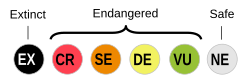 UNESCO Atlas of the World's Languages in Danger categories | |
An extinct language may be narrowly defined as a language with no native speakers and no descendant languages. Under this definition, a language becomes extinct upon the death of its last native speaker, the terminal speaker. A language like Latin is not extinct in this sense, because it evolved into the modern Romance languages; it is impossible to state when Latin became extinct because there is a diachronic continuum (compare synchronic continuum) between ancestors Late Latin and Vulgar Latin on the one hand and descendants like Old French and Old Italian on the other; any cutoff date for distinguishing ancestor from descendant is arbitrary. For many languages which have become extinct in recent centuries, attestation of usage is datable in the historical record, and sometimes the terminal speaker is identifiable. In other cases, historians and historical linguists may infer an estimated date of extinction from other events in the history of the sprachraum.
List
21st century
| Date | Language | Language family | Region | Terminal speaker | Notes |
|---|---|---|---|---|---|
| 7 March 2026 | Hupa | Na-Dene | California, United States | Verdena Parker | 1 |
| 16 October 2025 | Lekwungen dialect of North Straits Salish | Salishan | British Columbia, Canada | Čeyɬəm (Elmer George) | 2 |
| 20 September 2025 | Aurê-Aurá | Tupian | Maranhão, Brazil | Aurá | 34 |
| 14 July 2025 | Caddo | Caddoan | Oklahoma, United States | Edmond Johnson5 | Under a process of revival. |
| by 2024 | Mawes | Northwest Papuan? | West Papua, Indonesia | 67 | |
| 2 May 2023 | Columbia-Moses | Salishan | Washington, United States | Pauline Stensgar8 | |
| by 2023 | Itonama | Isolate | Beni Department, Bolivia | 9 | |
| 5 October 2022 | Mednyj Aleut | Mixed Aleut–Russian | Commander Islands, Russia | Gennady Yakovlev10 | |
| 19 April 2022 | Quapaw | Siouan | Tulsa, Oklahoma, United States | Ardina Moore | 11 |
| 16 February 2022 | Yahgan | Isolate | Magallanes, Chile | Cristina Calderón12 | |
| by 2022? | Moghol | Mongolic | Herat Province, Afghanistan | 13 | |
| 25 September 2021 | Wukchumni dialect of Tule-Kaweah Yokuts | Yokuts | California, United States | Marie Wilcox14 | |
| 27 August 2021 | Yuchi | Isolate | Tennessee (formerly) and Oklahoma in the United States | Maxine Wildcat Barnett15 | |
| 7 March 2021 | Bering Aleut dialect of Aleut | Eskimo-Aleut | Kamchatka Krai, Russia | Vera Timoshenko16 | |
| by 2021 | Warluwarra | Pama-Nyungan | Australia | Extinct by 202117 | |
| after 2020 | Dompo | Niger–Congo | Brong-Ahafo region, Banda District, Ghana | 181920 | |
| 2 December 2020 | Tuscarora | Iroquoian | North Carolina, United States | Kenneth Patterson21 | Under a process of revival.22 |
| 4 April 2020 | Aka-Cari dialect of Northern Andamanese | Great Andamanese | Andaman Islands, India | Licho23 | |
| 23 March 2019 | Ngandi | Gunwinyguan | Northern Territory, Australia | C. W. Daniels2425 | |
| 4 January 2019 | Tehuelche | Chonan | Patagonia, Argentina | Dora Manchado2627 | |
| November 2018 | Sapé | Isolate | Venezuela | Ramón Quimillo Lezama 28 | |
| 2018 | Patwin | Wintuan | California, United States | Bertha Wright Mitchell 29 | Being taught in schools and learned by adults30 |
| 2017 | Air Matoa | Etna Bay, Indonesia | 31 | ||
| by 2017 | Hokkaido Ainu | Ainu | Hokkaido, Japan | 3233 | |
| 9 December 2016 | Mandan | Siouan | North Dakota, United States | Edwin Benson34 | |
| 30 August 2016 | Wichita | Caddoan | Oklahoma, United States | Doris McLemore35 | |
| 29 July 2016 | Gugu Thaypan | Pama-Nyungan | Queensland, Australia | Tommy George36 | |
| 11 February 2016 | Nuchatlaht dialect of Nuu-chah-nulth | Wakashan | British Columbia, Canada | Alban Michael37 | |
| 4 January 2016 | Whulshootseed dialect of Lushootseed | Salishan | Washington, United States | Ellen Williams3839 | |
| by 2016 | Marti Ke | Western Daly | Northern Territory, Australia | Patrick Nudjulu or Agatha Perdjert40 | 41 |
| 4 February 2014 | Klallam | Salishan | Washington, United States | Hazel Sampson4243notes 1 | being taught as a second language on the Olympic Peninsula of Washington State44 |
| 5 June 2013 | Livonian | Uralic | Latvia | Grizelda Kristiņa45notes 2 | Under a process of revival. 1 native speaker as of 2020.46 |
| 26 March 2013 | Yurok | Algic | California, United States | Archie Thompson47 | Under a process of revival.48 |
| by 2013 | Demushbo | Panoan | Amazon Basin, Brazil | 49 1 speaker in 2010.50 | |
| by 2013 | Sabüm | Mon–Khmer | Perak, Malaysia | 51 | |
| 2 October 2012 | Cromarty dialect of Scots | Indo-European | Northern Scotland, United Kingdom | Bobby Hogg52 | |
| 11 July 2012 | Upper Chinook | Chinookan | Oregon, United States | Gladys Thompson53 | |
| 10 March 2012 | Holikachuk | Na-Dene | Alaska, United States | Wilson "Tiny" Deacon54 | |
| 2012 | Andoa | Zaparoan | Peru | Hipólito Arahuanaza | 55 |
| 2012 | Mardijker | Portuguese-based creole | Jakarta, Indonesia | Mimi Abrahams56 | |
| c. 2012 | Dhungaloo dialect of Taribelang | Pama-Nyungan | Queensland, Australia | Roy Hatfield57 | |
| by 2012 | Dura | Sino-Tibetan | Nepal | Soma Devi Dura58 | 59 |
| 10 April 2011 | Apiaká | Tupian | Mato Grosso, Brazil | Pedrinho Kamassuri60 | |
| 2011 | Lower Arrernte | Pama-Nyungan | Northern Territory, Australia | Brownie Doolan Perrurle61 | |
| 24 October 2010 | Pazeh dialect of Pazeh–Kaxabu | Austronesian | Taiwan | Pan Jin-yu62 | |
| 20 August 2010 | Cochin Indo-Portuguese Creole | Portuguese-based creole | Southern India | William Rozario62 | |
| 26 January 2010 | Aka-Bo | Andamanese | Andaman Islands, India | Boa Sr.63 | |
| by 2010 | Piru dialect of Luhu | Austronesian | Maluku, Indonesia | 64 | |
| November 2009 | Aka-Kora | Andamanese | Andaman Islands, India | Ms. Boro65 | |
| 22 February 2009 | Great Andamanese koiné | Andamanese | Andaman Islands, India | Nao Jr.66 | |
| 2009 | Olrat | Austronesian | Banks Islands, Vanuatu | Maten Olrat67 | |
| 2009 | Nyawaygi | Pama-Nyungan | Queensland, Australia | Willie Seaton68 | |
| by 2009 | Papora-Hoanya | Austronesian | Taiwan | 69 | |
| 30 July 2008 | Tübatulabal | Uto-Aztecan | California, United States | James Andreas | 70 |
| 24 February 2008 | Plains Apache | Na-Dene | Oklahoma, United States | Alfred Chalepah Jr. | |
| 21 January 2008 | Eyak | Na-Dene | Alaska, United States | Marie Smith Jones71 | |
| 2008 | Oroch | Tungusic | Khabarovsk Krai, Russia | ||
| 10 August 2007 | Gros Ventre | Algic | Montana, United States | Theresa Lamebull7273 | |
| 2007 | Northeastern Maidu | Maiduan | Central California, United States | Under process of revival | |
| by 2007 | Rusenu | Trans–New Guinea? | eastern East Timor | 74 | |
| by 2007 | Hpun | Sino-Tibetan | Myanmar | 75 | |
| 11 July 2006 | Wasco dialect of Upper Chinook | Chinookan | Oregon, United States | Madeline Brunoe McInturff76 | |
| 2006 | Omurano | Isolate | Peru | Esteban Macusi | 777879 |
| 2006 | Aghu Tharnggala | Pama-Nyungan | Queensland, Australia | 80 | |
| 2006 | Ludza dialect of South Estonian | Uralic | Latvia | Nikolājs Nikonovs81 | |
| by 2006 | Zumaya | Afroasiatic | Cameroon | 82 Most speakers have shifted to Fula. | |
| 3 November 2005 | Osage | Siouan | Oklahoma, United States | Lucille Roubedeaux83 | being revived |
| 2005 | Berbice Creole Dutch | Dutch-based creole | Guyana | Bertha Bell84 | |
| 2005 | Kerek | Chukotko-Kamchatkan | Chukotka | Ekaterina Khatkana85 | 86 |
| 2005 | Northern Pomo | Pomoan | California, United States | ||
| by 2005 | Barrow Point | Pama-Nyungan | Queensland, Australia | Urwunjin Roger Hart87 | |
| 20 September 2004 | Nüshu script | unclassified | Hunan, China | Yang Huanyi8889 | |
| 2004 | Umotína | Bororoan | Mato Grosso, Brazil | Julá Paré90 | |
| c. 2004? | Duli-Gey | Niger-Congo | Cameroon | 91 | |
| 29 December 2003 | Akkala Sami | Uralic | Kola Peninsula, Russia | Marja Sergina9293 | 4 rememberers persisted as of 2018. |
| 22 November 2003 | Wintu | Wintuan | California, United States | Flora Jones94 | |
| 14 September 2003 | Klamath-Modoc | Plateau Penutian | Oregon, United States | Neva Eggsman9596 | |
| September 2003 | Garig-Ilgar | Pama-Nyungan | Northern Territory, Australia | 97 | |
| by 2003 | Areba | Pama-Nyungan | Queensland, Australia | 98 | |
| by 2003 | Atampaya | Pama-Nyungan | Queensland, Australia | 99 | |
| by 2003 | Makolkol | unclassified | New Britain, Papua New Guinea | possible Papuan language | |
| 4 November 2002 | Serrano | Uto-Aztecan | California, United States | Dorothy Ramon | being revived |
| 31 August 2002 | Unami | Algic | Delaware, United States | Edward Thompson100notes 3 | |
| 23 May 2002 | Gaagudju | Isolate | Northern Territory, Australia | Big Bill Neidjie101 | |
| 2002 | Tandia | Austronesian | West Papua, Indonesia | Speakers shifted to Wandamen.1026 | |
| 2002 | Akurio | Cariban | Suriname | 103 | |
| by 2001 | Amanayé | Tupian | Brazil | 104 | |
| by 2001 | Umbugarla | Arnhem Land languages or Darwin Region languages |
Northern Territory, Australia | Butcher Knight | |
| by 2001 | Ngurmbur | Arnhem Land languages or Darwin Region languages |
Northern Territory, Australia | Butcher Knight | |
| 2000 | Máku (Jukude) | Isolate | Roraima, Brazil | Sinfrônio Magalhães (Kuluta) | |
| 2000 | Sowa | Austronesian | Pentecost, Vanuatu | Maurice Tabi | 105 |
| c. 2000 | Pémono | Cariban | Venezuela | Juanita Garcia | 106 |
| c. 2000 | Mapia | Austronesian | Mapia Atoll, Indonesia | ||
| c. 2000 | Mesmes | Afroasiatic | Ethiopia | Abegaz | 107108 |
| c. 2000 | Kamarian | Austronesian | west Seram Island, Indonesia | ||
| c. 2000 | Nagumi | Niger-Congo | Cameroon | 109 | |
| c. 2000 | Apolista | Arawakan | Apolobamba | It is possible there are still a few very old speakers. There may be two distinct languages under this label.110 | |
| c. 2000 | Rennellese Sign Language | unclassified | Solomon Islands | Kagobai | 111 |
| c. 2000 | Wanham | Chapacuran | Brazil | Firmino Miguelem112 | 113 |
| by 2000 | Central Pomo | Pomoan | Northern California | ||
| c. 2000s | Aribwatsa | Lower Markham languages | Morobe Province, Papua New Guinea | Butoawê | Exact date of extinction is unknown although it is believed to be in 2000. Most descendants have switched to the Bukawa language. |
| 2000s | Bahuana | Arawakan | Brazil | ||
| 2000s | Torá | Chapacuran | Brazil | few semispeakers remain |
20th century
19th century
Early modern period
| Date | Language | Language family | Region | Notes |
|---|---|---|---|---|
| late 18th century | Esuma | Kwa | southern Côte d'Ivoire | 324 |
| late 18th century | Maipure | Arawakan | Upper Orinoco region | |
| late 18th century | Ruthenian | Indo-European | Eastern Slavic regions of Poland-Lithuania | Evolved into Belarusian, Ukrainian and Rusyn. |
| after late 1790s | Chiriba | Panoan | Moxos Province, Bolivia | All that was recorded of it was a list of seven words in the late 1790s. |
| after 1794 | Magiana | Arawakan | Bolivia | Attested only with the wordlist in Palau, Mercedes and Blanca Saiz 1989 [1794]. |
| c. 1790s | Powhatan | Algic | eastern Virginia, United States | |
| c. 1790s | Ramanos | unclassified (isolate?)325 | Moxos Province, Bolivia | |
| after 1788 | Otomaco | Otomakoan | Venezuelan Llanos | Known from a wordlist by Father Gerónimo José de Luzena written in December of 1788. |
| after 1788 | Taparita | Otomakoan | Venezuelan Llanos | |
| 26 December 1777 | Cornish | Indo-European | Cornwall, England | with the death of Dolly Pentreath326notes 9 |
| after 1770 | Weyto | unclassified | Ethiopia | |
| after 1770 | Tamanaku | Cariban | Venezuela | |
| 1770 | Cuman | Turkic | north of Black Sea; Hungary | with the death of István Varró327 |
| c. 1770s | Abipón | Mataco–Guaicuru | Argentina | |
| after 1763 | Susquehannock | Iroquoian | Northeastern United States | After the Conestoga massacre. |
| by 1763 | Quingnam | unclassified | Peru | 328 |
| 1760 | Galwegian dialect, Scottish Gaelic | Indo-European | Scotland, United Kingdom | with the death of Margaret McMurray |
| 3 October 1756 | Polabian | Indo-European | around the Elbe river, Poland/Germany | with the death of Emerentz Schultze329 |
| 1740 | Pumpokol | Yeniseian | central Siberia, Russia | 200330 |
| late 1730s | Arin | Yeniseian | central Siberia, Russia | with the death of Arzamas Loskutov200 |
| after 1709 | Dzubukuá | Kariri | Pernambuco, Brazil | |
| 18th century | Ajem-Turkic | Turkic | Iran, Eastern Anatolia, the South Caucasus and Dagestan | Evolved into Azerbaijani. |
| 18th century | Chané dialect of Terêna | Arawakan | Argentina | |
| 18th century | Chibcha | Chibchan | Colombia | |
| 18th century | Classical Gaelic | Indo-European | Ireland and Scotland, United Kingdom | The literary language. Fell out of use with the collapse of Gaelic society.331 |
| 18th century | Coahuilteco | Isolate/unclassified | Mexico; Texas, United States | |
| 18th century | Loup | Algic | Massachusetts and Connecticut, United States | |
| 18th century | Manao | Arawakan | Brazil | |
| 18th century | Plateau Sign Language | Contact pidgin | Columbia Plateau, United States | |
| early 18th century | Apalachee | Muskogean | Florida, United States | |
| early 18th century | Old Prussian | Indo-European | Poland | being revived332 |
| by 18th century | Merya | Uralic | Yaroslavl Oblast, Russia | Reconstructed within the ideology of ethnofuturism from local toponymy and dialectology of the Upper Volga region in the 21st century.333 |
| 17th to 18th century? | Acaxee | Uto-Aztecan | Northwestern Mexico | unattested; all known documentation has been lost |
| 17th to 18th century? | Xixime | Uto-Aztecan? | Northwestern Mexico | |
| by 1700 | Pidgin Delaware | Delaware-based pidgin | Delaware, United States | 334 |
| late 17th century | Sudovian | Indo-European | Lithuania | |
| after 1699 | Kipeá | Kariri | Eastern Brazil | |
| after 1666 | Old Kentish Sign Language | Village sign language | Kent, England | 335 |
| after mid-17th century | Favorlang | Austronesian | Taiwan | |
| after 1643 | Narragansett | Algic | New England, United States | 336 |
| after 1640 | Yao | Cariban | Trinidad and French Guiana | Attested in a 52-word 1640 word list recorded by Joannes de Laet. |
| c. 1635 | Jurchen | Tungusic | Manchuria, China | 337 Evolved into Manchu. |
| after 1618 | Carolina Algonquian | Algic | North Carolina, United States | 338 |
| 17th century | Andalusi Arabic | Afroasiatic | southern Spain | |
| 17th century | Armeno-Kipchak | Turkic | Crimea | 339 |
| 17th century | Adhari | Indo-European | Iranian Azerbaijan | 340 |
| 17th century | Basque–Icelandic pidgin | Basque–Icelandic Pidgin | Iceland | 341 |
| 17th century | Cazcan | Uto-Aztecan | Mexico | |
| 17th century | Curonian | Indo-European | Latvia | |
| 17th century | Ebro Valley Aragonese | Indo-European | Ebro Valley | 342 |
| 17th century | Etchemin | Algic | Maine, United States | |
| 17th century | Gorgotoqui | Macro-Jê | eastern Bolivia | unattested |
| 17th century | Navarrese Romance | Indo-European | Kingdom of Navarre | |
| 16th–18th century | Gorgani | Indo-European | Gorgan | 343 |
| late 16th century | Knaanic | Indo-European | Czech Republic; Poland | |
| late 16th century | Laurentian | Iroquoian | Quebec/Ontario, Canada | |
| after 1586 | Palta | unclassified | Ecuador | known from only 4 words |
| after 1548 | Taino | Arawakan | The Bahamas and Puerto Rico | |
| c. 1535 | Cueva | Chocoan (?) | Darién Province, Panama | The Cueva people were exterminated between 1510 and 1535 during Spanish colonization. |
| after 1516 | Mamluk-Kipchak | Turkic | Egypt and Syria | 344 |
| after 1502 | Tangut | Sino-Tibetan | northwestern China; southern Mongolia | |
| 16th century | Guanahatabey | unclassified | Pinar del Río Province and Isla de la Juventud, Cuba | only known from placenames345 |
| 16th century | Guanche | unclassified, maybe Berber | Canary Islands, Spain | 346 |
| 16th century | Judaeo-Portuguese | Indo-European | Belmonte, Portugal | |
| 16th century | Meshchera | Uralic | Meshchera Lowlands | 347 |
| 16th century | Navarro-Aragonese | Indo-European | southern Navarre, Spain | Aragonese is still spoken as a minority language in Spain. |
| 16th century | Old Novgorod | Indo-European | Novgorod Republic | 348 |
| 16th century | Semigallian | Indo-European | Latvia; Lithuania |
Post-classical period
Ancient period
Unknown date
See also
See also
Notes
Notes
- Last surviving native speaker.
- Last surviving native speaker; some children still learn it as a second language.
- Brother of Lenape traditionalist and language preservation activist Nora Thompson Dean
- The last full-blooded Selkʼnam Indian, but some have suggested certain people remained fluent in the language until the 1980s.
- Last attested speaker of a Chumashan language
- Last member of the Yahi, the last surviving group of the Yana people who spoke Yana
- Considered to be the last fluent speaker of a Tasmanian language.
- Considered to be the last full-blood speaker of a Tasmanian language;299 however, Fanny Cochrane Smith, who spoke one of the Tasmanian languages, outlived her.
- Possibly the last fluent native speaker of the Cornish language, was monoglot until her twenties. See Last speaker of the Cornish language.
- Last person known to speak, read, and write in Khitan.
References
References
- "Family Statement Announcing the Passing of Verdena Leona Chase Parker". Hoopa Valley Tribe. Retrieved 27 April 2026.
- "Language Revitalization & Learning". Esquimalt Nation. Retrieved 28 April 2026.
- "Morre aos 77 anos Aurá, considerado último sobrevivente de povo indígena do MA". G1 (in Brazilian Portuguese). 25 September 2025. Retrieved 26 September 2025.
- "Funai confirma morte de último indígena de etnia desconhecida". Agência Brasil (in Brazilian Portuguese). 25 September 2025. Retrieved 26 September 2025.
- "Caddo Nation mourns loss of last fluent language speaker". KOCO News. 16 July 2025. Retrieved 16 July 2025.
- "11 Indigenous Languages Declared Extinct: Education Ministry". Jakarta Globe. 8 March 2024. Retrieved 10 September 2024.
- Desk, News. "Four Papuan languages extinct, linguist says - Archipelago". The Jakarta Post. Retrieved 8 April 2026.
- "Last Fluent Speaker of Nxamxcin Language Dies at 96". The Spokesman. Spokane, Washington.
- Crevels, Mily (16 January 2023), Epps, Patience; Michael, Lev (eds.), "11 Itonama", Language Isolates I: Aikanã to Kandozi-Shapra, De Gruyter, pp. 483–546, doi:10.1515/9783110419405-011, ISBN 978-3-11-041940-5, retrieved 20 October 2025
{{citation}}: CS1 maint: work parameter with ISBN (link) - "Last Native Speaker Of Aleut Language In Russia Dies". RadioFreeEurope. 5 October 2022.
- "Ardina Revard Moore Obituary". Osage News. 21 April 2022. Retrieved 8 May 2022.
- S.A.P, El Mercurio (16 February 2022). "Fallece a los 93 años Cristina Calderón, la última hablante del idioma Yagán | Emol.com". Emol (in Spanish). Retrieved 16 February 2022.
- Mogholi at Ethnologue (25th ed., 2022)

- Seelye, Katharine Q. (6 October 2021). "Marie Wilcox, Who Saved Her Native Language From Extinction, Dies at 87". The New York Times. ISSN 0362-4331. Retrieved 12 February 2022.
- "'Race against time': Pandemic propels fight to save Native American languages". POLITICO. 13 April 2021. Retrieved 13 April 2021.
- "Last Native Speaker Of Rare Dialect Dies In Russia". Radio Free Europe/Radio Liberty. 9 March 2021. Retrieved 18 March 2021.
- "| AIATSIS corporate website". aiatsis.gov.au. Retrieved 16 September 2025.
- "40 Ghanaian languages face extinction". Daily Graphic. Accra, Ghana. 24 February 2026. Retrieved 26 February 2026.
- https://asaaseradio.com/preserve-our-tongues-ghla-sounds-alarm-on-disappearing-languages/
- Manu-Barfo, Esther (2020). A Descriptive Grammar of the Dòmpò Language of Ghana (Thesis). pp. 7507833 Bytes. doi:10.26181/5FC4220DEE368.
- Anderson, Dale (11 December 2020). "Chief Kenneth Patterson, 93, leader in the Tuscarora Nation". The Buffalo News. Retrieved 19 March 2021.
- "NTLP". www.tuscaroralanguage.org. Retrieved 25 May 2025.
- International, Survival (1 June 2020). "The last speaker of the Sare language has died". Medium. Retrieved 28 June 2020.
- "Preserving Indigenous languages". Monash Life. Monash University. 27 October 2019. Retrieved 12 August 2020.
- "Cherry Wulumirr Daniels laid to rest". Yugul Mangi Development Aboriginal Corporation. 24 April 2019. Retrieved 12 August 2020.
- Daigneault, Anna (6 November 2019). "Museums of the mind: Why we should preserve endangered languages". Global Voices. Retrieved 23 November 2019.
- Domingo, Javier (30 January 2019). "La imborrable obra de Dora Manchado: ¿la última guardiana de la lengua tehuelche?". Infobae (in Spanish). Retrieved 23 November 2019.
- Labrada, Jorge Emilio Rosés; Medina, Francia (31 August 2019). "Sapé (Venezuela) -- Language Snapshot". Language Documentation and Description. 16: 169–175. doi:10.25894/ldd125. ISSN 2756-1224.
- "Our Language". Yocha Dehe. Retrieved 1 April 2026.
- Lawyer, Lewis C. (25 June 2012). "Request for New Language Code Element in ISO 639-3" (PDF). ISO 639-3 Registration Authority. p. 2.
- Kurniawati, Wati; Karsana, Deni; Maerina, Ryen; Fatinah, Siti; Zabadi, Fairul; Endardi, Joni; Wijayatiningsih, Yenni Febtaria; Wardhani, Aditya; Roveneldo; Sumadi (1 February 2026). "Phonological Reconstruction of the Air Matoa Language: A Contribution to the Documentation and Preservation of a Dormant Papuan Language". Theory and Practice in Language Studies. 16 (2): 617–628. doi:10.17507/tpls.1602.27. ISSN 2053-0692.
- "An Ainu-language expert illuminates their worldview". Sustainable Japan by The Japan Times. 29 November 2021. Retrieved 16 August 2025.
There are no native speakers of Ainu left in Japan.
- Dougherty, Thomas (3 October 2017), Campbell, Lyle (ed.), "Ainu", Language Isolates (1 ed.), London: Routledge, pp. 100–116, doi:10.4324/9781315750026-4, ISBN 978-1-315-75002-6, retrieved 3 November 2025
{{citation}}: CS1 maint: work parameter with ISBN (link) - Joe Skurzewski (10 December 2016). "Edwin Benson, last known fluent speaker of Mandan, passes away at 85". KFYR-TV. Archived from the original on 23 September 2023.
- Daffron, Brian (6 October 2016). "Doris McLemore, Last Fluent Wichita Speaker, Walks On". Indian Country Media Network. Archived from the original on 4 August 2017. Retrieved 24 May 2017.
- "A "Legend", Indigenous Australian Leader, Knowledge Holder Tommy George Passes On". Snowchange Cooperative. 29 July 2016. Retrieved 24 May 2017.
- Jack Knox (19 March 2016). "Jack Knox — A silenced tongue: the last Nuchatlaht speaker dies". Times Colonist. Archived from the original on 5 August 2021.
- Lacitis, Erik (8 February 2005). "Last few Whulshootseed speakers spread the word". Seattle Times. Archived from the original on 2 April 2015. Retrieved 15 September 2012.
- Sweet Dorman, Lois (21 June 2005). "Lost in translation: a connection to the sacred". Seattle Times. Archived from the original on 2 April 2015. Retrieved 15 September 2012.
- Rebgetz, Louisa (7 February 2010). "The race to save Indigenous languages". ABC News. Retrieved 7 March 2026.
- "Preserving precious Indigenous languages". Pursuit. Retrieved 7 March 2026.
- Kaminsky, Jonathan (7 February 2014). "Last native speaker of Klallam language dies in Washington state". Reuters. Archived from the original on 19 July 2023.
- "Last native Klallam speaker dies in Port Angeles". The Washington Post.
{{cite news}}: CS1 maint: deprecated archival service (link) - Redick, Geoffrey (8 June 2018). "Klallam Language Classes Taught at Port Angeles High School". KNKX Public Radio. Retrieved 28 April 2026.
- Charter, David. "Death of a language: last ever speaker of Livonian passes away aged 103". The Times.
- Ernštreits, Valts (14 December 2011). "Lībiešu valodas situācija". Livones.net (in Latvian). Archived from the original on 2 February 2014.
- Romney, Lee. (2013, February 6). Revival of nearly extinct Yurok language is a success story. The Los Angeles Times. Retrieved February 7, 2013
- "Revival of nearly extinct Yurok language is a success story". Los Angeles Times. 6 February 2013. Retrieved 19 March 2021.
- Fleck, David W. (2013). Panoan languages and linguistics. Anthropological papers of the American Museum of Natural History. New York, NY: American Museum of Natural History. ISBN 978-0-9852016-2-3.
- Fleck, David W. (19 May 2010), Gildea, Spike; Queixalós, Francesc (eds.), Ergativity in the Mayoruna branch of the Panoan family, Typological Studies in Language, vol. 89, Amsterdam: John Benjamins Publishing Company, pp. 29–64, doi:10.1075/tsl.89.03fle, ISBN 978-90-272-0670-1, retrieved 28 April 2026
- Sabüm at Ethnologue (17th ed., 2013)
- Obituary: Robert (Bobby) Hogg, engineer and last speaker of the Cromarty dialect The Scotsman. 15 October 2012.
- Foden-Vencil, Kristian. "Last Fluent Speaker Of Oregon Tribal Language 'Kiksht' Dies". Oregon Public Broadcasting. Archived from the original on 10 October 2019. Retrieved 23 May 2017.
- "Alaska Native Language Loses Last Fluent Speaker - Indian Country Media Network". indiancountrymedianetwork.com. Archived from the original on 8 June 2017. Retrieved 23 May 2017.
- Gómez Rendón, Jorge; Moreno, Magola (July 2015). "La lengua andwa: una experiencia en documentación y reapropriación lingüística a través de la educación". Zona Próxima (in Spanish) (23): 104–117. doi:10.14482/zp.22.5832. ISSN 2145-9444.
- Dimas, Dimas. "PUNAHNYA BAHASA KREOL PORTUGIS". LIPI (in Indonesian). Archived from the original on 8 August 2020. Retrieved 10 May 2020.
- "ISO 639-3 Registration Authority Request for New Language Code Element in ISO 639-3" (PDF). ISO 639-3. 23 January 2012. Retrieved 29 October 2023.
- "The last of Nepal's Dura speakers". BBC News. 15 January 2008.
- Schorer, Nicolas (2016). The dura language: grammar and phylogeny (Thesis). Leiden Boston: Koninklijke Brill nv. ISBN 9789004326408.
- "Falecimento - 12/10/2011". Projeto de Documentação de Línguas Indígenas. Retrieved 21 February 2018.
- "Another language faces sunset in dead centre". The Australian. ||
- "An Indian language recently went extinct. Why were we not told about it?". write2kill.in - Select writings of Subir Ghosh.
{{cite web}}: CS1 maint: deprecated archival service (link) - "Ancient Indian language dies out". 4 February 2010 – via news.bbc.co.uk.
- Moseley, Christopher (2010). Atlas of the world's languages in danger (3 ed.). Paris: UNESCO Publishing.
- Andamanese tribes, languages die, The Hindu
- "Great Andamanese, Mixed". Ethnologue.
- —— (2022). "Presentation of the Olrat language and audio archive". Pangloss Collection. Paris: CNRS. Retrieved 20 February 2026.
- Dixon, R.M.W (10 December 2010). I Am a Linguist. BRILL. ISBN 978-9004192355.
- "Ethnologue report for language code: ppu". archive.ethnologue.com. Archived from the original on 4 March 2016. Retrieved 23 April 2015.
- "Tübatulabal". Ethnologue. Retrieved 9 May 2018.
- John McWhorter,"No Tears For Dead Tongues"[1], Forbes, 2/21/2008 @ 6:00PM.
- "The Phraselator II". The American Magazine. Archived from the original on 7 August 2013. Retrieved 12 May 2013.
- Mithun 336
- "Noorderlicht Nieuws: Raadselachtig Rusenu" (in Dutch). Archived from the original on 18 April 2007. Retrieved 22 September 2024.
- "Hpon". Ethnologue.
- "Holy road: Speaker of Wasco language dead at 91 - Indian Country Media Network". indiancountrymedianetwork.com. Retrieved 24 May 2017.
- Haarmann, Harald. 2002. Lexikon der untergegangenen Sprachen. München: Beck; p. 188
- "Omurano". Ethnologue.
- O'Hagan, Zachary J. (22 September 2011). "Informe de campo del idioma omurano" (PDF). Retrieved 14 April 2013.
- "Ethnologue report for Australia". Archived from the original on 14 May 2014. Retrieved 8 March 2015.
- "Ludzī kīļ : The Lutsi Language". lutsimaa.lv. Retrieved 25 December 2020.
- Blench, Roger; Dendo, Mallam (14 November 2006). "The Afro-Asiatic Languages" (PDF). Retrieved 7 July 2024.
- "Language Log » Talking Osage".
- "Berbice Dutch officially extinct". Radio Netherlands Worldwide. February 25, 2010. Retrieved February 22, 2015
- "О КМНС". atlaskmns.ru. Retrieved 2 February 2025.
- Fortescue, Michael (22 December 2011). Comparative Chukotko-Kamchatkan Dictionary. p. 1.
- "Ethnologue report for language code: bpt". Archived from the original on 2 April 2015. Retrieved 7 March 2015.
- "Language dies with woman". London: Observer.guardian.co.uk. 26 September 2004. Retrieved 3 October 2012.
- Jon Watts (22 September 2005). "Jon Watts, The forbidden tongue, The Guardian 23 September 2005". Guardian. London. Retrieved 3 October 2012.
- Cidele Cruz, Mônica (28 August 2012). Povo Umutína: a busca da identidade linguística e cultural [Umutína people: the search of linguistic and cultural identity] (Doutora em Linguística thesis) (in Portuguese). Campinas, SP: Universidade Estadual de Campinas. doi:10.47749/t/unicamp.2012.876888.
- "List of Adamawa languages - Roger Blench" (PDF). www.rogerblench.info. Retrieved 23 April 2015.
- "Nordisk samekonvensjon" (PDF). Archived from the original (PDF) on 11 April 2007. Retrieved 6 February 2014.
- Rantala, Leif, Aleftina Sergina 2009. Áhkkila sápmelaččat. Oanehis muitalus sámejoavkku birra, man maŋimuš sámegielalaš olmmoš jámii 29.12.2003. Roavvenjárga.
- Golla, Victor (2011). California Indian Languages. Berkeley: University of California Press. ISBN 978-0-520-26667-4.
- Juillerat, Lee (16 September 2003). "Tribal elder who helped preserve language dies". Herald and News. Retrieved 14 August 2020.
- Haynes, Erin F. "Obstacles facing tribal language programs in Warm Springs, Klamath, and Grand Ronde" (PDF). Coyote Papers. 8: 87–102. Archived from the original (PDF) on 9 July 2010. Retrieved 30 August 2012.
- "Ethnologue report for language code: ilg". Archived from the original on 2 April 2015. Retrieved 5 March 2015.
- "Ethnologue report for language code: aea". Archived from the original on 4 March 2016. Retrieved 6 March 2015.
- "Ethnologue report for language code: amz".
{{cite web}}: CS1 maint: deprecated archival service (link) - Chambers, Steve. "The vanishing voice of the Lenape." Archived 4 May 2016 at the Wayback Machine Star-Ledger. 17 Nov 2002. Retrieved 8 Dec 2013.
- Neidjie, Bill; Stephen Davis; Allan Fox (c. 1985). Kakadu man...Bill Neidjie. Foreword by Clyde Holding. Queanbeyan, N.S.W.: Mybrood. ISBN 978-0-9589458-0-6.
- "Tandia" (in Indonesian). Ministry of Education and Culture. Retrieved 20 October 2024.
- Campbell, Lyle; Grondona, Verónica María, eds. (2012). The indigenous languages of South America: a comprehensive guide. The world of linguistics. Berlin; Boston: Mouton de Gruyter. ISBN 978-3-11-025513-3.
- "Ethnologue report for language code: ama". Archived from the original on 4 March 2016. Retrieved 21 April 2015.
- Gray (2013), The Languages of Pentecost Island
- Mattei-Muller, Marie-Claude (2003). "Pémono: eslabón perdido entre mapoyo y yawarana: lenguas caribes ergativas de la Guayana noroccidental de Venezuela" (PDF). Amérindia: Revue d'ethnolinguistique amérindienne. 28: 33–54.
- Ahland, Michael Bryan. (2010). Language death in Mesmes. Dallas: SIL International and the University of Texas at Arlington.
- Bustorf, Dirk. (2007). "Mäsmäs", in: Siegbert Uhlig (ed.): Encyclopaedia Aethiopica, vol. 3: D-Ha, Wiesbaden: Harrassowitz Verlag, p. 838-39.
- "Ethnologue report for language code: ngv". archive.ethnologue.com. Archived from the original on 4 March 2016. Retrieved 23 April 2015.
- "Glottolog 5.2 - Apolista". glottolog.org. Retrieved 16 September 2025.
- "Extinct Languages: The Languages We Have Lost in the 21st Century". Atomic Scribe. 31 January 2022. Retrieved 5 October 2024.
Extinct: Around 2000
- Angenot, Geralda de Lima Vitor (23 August 2013). "FONOTÁTICA E FONOLOGIA DO LEXEMA PROTOCHAPAKURA". Revista Eletrônica Língua Viva (in Brazilian Portuguese). 3 (1). ISSN 2237-9800.
- Birchall, Joshua; Dunn, Michael; Greenhill, Simon J. (July 2016). "A Combined Comparative and Phylogenetic Analysis of the Chapacuran Language Family". International Journal of American Linguistics. 82 (3): 255–284. doi:10.1086/687383. ISSN 0020-7071.
- Charles, Mary (1993). Winin - Why the Emu Cannot Fly. Broome, WA: Magabala Books. ISBN 978-1-875641-07-9.
- "Mlahsö". Ethnologue.
- Scholastic Book of Lists (2003)
- Holzknecht, Susanne (1997). "Aribwatsa: a 'lost' language of the Markham Family, Papua New Guinea?". hdl:1885/252092.
- Aribwatsa at Ethnologue (17th ed., 2013)
- "Yupik, Sirenik". Ethnologue.
- Alexander-Bakkerus, Astrid (2005). Eighteenth-century Cholón. LOT. Utrecht: LOT. ISBN 978-90-76864-86-0.
- "Ethnologue report for language code: mjq". archive.ethnologue.com. Archived from the original on 4 March 2016. Retrieved 7 June 2016.
- "On the Ioway Otoe-Missouria Language". iowayotoelang.nativeweb.org.
- "Ethnologue report for language code: KTQ". Archived from the original on 15 December 2001.
- "Ethnologue report for language code: pmc". Archived from the original on 4 March 2016. Retrieved 21 April 2015.
- "Ethnologue report for language code: SZD". Archived from the original on 28 January 2002.
- David Crystal (29 April 2002). Language Death. Cambridge University Press. p. 1. ISBN 978-0-521-01271-3.
- Dench, Alan (1994). Martuthunira: A Language of the Pilbara Region of Western Australia. Canberra: Pacific Linguistics.
- Aikhenvald, Alexandra Y. (1995). Baré. Languages of the world Materials 100. München [i.e.] Unterschleißheim: LINCOM Europa. ISBN 978-3-89586-050-8.
- Eylon, Lili (25 June 2022). "The Judenrein town that spoke Hebrew". Times Of Israel. Retrieved 4 November 2024.
Indeed, by 1994, reportedly only 12 people used some 200 Lachoudish words. The dialect Lachoudish had its day; it is now extinct
- Piłsudski, Bronisław; Alfred F. Majewicz (2004). The Collected Works of Bronisław Piłsudski. Trends in Linguistics Series. Vol. 3. Walter de Gruyter. p. 600. ISBN 9783110176148. Retrieved 22 May 2012.
- Warren Christopher (2013). "Smallpox at Sydney Cove – Who, When, Why". Journal of Australian Studies. 38: 68–86. doi:10.1080/14443058.2013.849750. S2CID 143644513.
- "Penobscot". Native Languages of the Americas. Retrieved 25 October 2011.
- "Eastern Abnaki language". Ethnologue. Retrieved 25 October 2011.
- Rojas-Berscia, Luis Miguel; Pérez Valderrama, Martha; Tangoa Pérez, Susy Caroly; García García, Luis Gonzalo (17 September 2023). "La última canción: al encuentro de memorias del seeptsá entre Cachicoto y Juanjuí" (PDF). Revista Brasileira de Linguística Antropológica. 15. doi:10.26512/rbla.v15i1.47149. ISSN 2317-1375.
- Epps, Patience; Michael, Lev, eds. (16 January 2023). Language Isolates I: Aikanã to Kandozi-Shapra: An International Handbook. De Gruyter. doi:10.1515/9783110419405. ISBN 978-3-11-041940-5.
- E. F. K. Koerner (1 January 1998). First Person Singular III: Autobiographies by North American Scholars in the Language Sciences. John Benjamins Publishing. p. 33. ISBN 978-90-272-4576-2.
- Artola, Koldo (2000). "Fidela Bernat anderea, euskal hiztun erronkariarra (eta II)" (PDF). Fontes Linguae Vasconum: Studia et Documenta (32): 487–512. doi:10.35462/flv85.7. Retrieved 21 February 2014.
- "Ullatan". Ethnologue. Archived from the original on 8 February 2008. Retrieved 8 July 2024.
- Thompson, Sandra A.; Park, Joseph Sung-Yul; Li, Charles N. (2006). A Reference Grammar of Wappo. University of California Press. ISBN 978-0-520-09854-1.
- "Inku". Ethnologue. Archived from the original on 14 October 2019. Retrieved 20 October 2024.
Last speakers probably survived into the 1990s.
- "Kayeli". Ethnologue.
- Taman at Ethnologue (16th ed., 2009) "Reportedly the last speaker of Taman died in the 1990s."
- Munro, Morndi (1996). Emerarra: a man from Merarra. Broome: Magabala Books.
- "Ethnologue report for language code: huw". Archived from the original on 4 March 2016. Retrieved 21 April 2015.
- Zall, By Carol (14 October 2016). "How the Miami Tribe got its language back". The World from PRX. Retrieved 17 September 2025.
- "Kungarakany". Ethnologue.
- Hillinger, Charles (23 August 1988). "Indian Woman Is Last Word on Language of the Atsugewi". Los Angeles Times. Retrieved 28 October 2012.
- "--Xegwi". Ethnologue.
- "Ethnologue report for language code: bym". Archived from the original on 26 February 2014. Retrieved 5 March 2015.
- Moseley, Christopher (2007). Encyclopedia of the world's endangered languages. Routledge. ISBN 978-0-7007-1197-0. Retrieved 19 September 2009.
- Brigandi, P. (2009). "Roscinda Nolasquez Remembered". The Journal of California and Great Basin Anthropology. 9 (1): 3.
- "Dyangadi". Ethnologue. Retrieved 16 April 2015.
- "| AIATSIS corporate website". aiatsis.gov.au. Retrieved 17 September 2025.
- "Basa-Gumna". Ethnologue.
- "Ethnologue 14 report for language code:YUB". Archived from the original on 11 April 2015. Retrieved 5 April 2015.
- Arts Webmaster, School of Languages and Linguistics (16 August 2019). "School of Languages and Linguistics".
- "Mangala". Ethnologue.
- François, Alexandre (2012), "The dynamics of linguistic diversity: Egalitarian multilingualism and power imbalance among northern Vanuatu languages", International Journal of the Sociology of Language (214): 85–110, doi:10.1515/ijsl-2012-0022, S2CID 145208588
- "Gaelic in the North East". University of Aberdeen. Retrieved 14 November 2019.
- "Yavitero". Ethnologue.
- "Language | Feis na nGleann". feisnangleann.com. Retrieved 24 May 2017.
- "Lament For Seamus 'Bhriain' Mac Amhlaigh". Glens Of Antrim Historical Society. 12 February 2006. Retrieved 24 May 2017.
- "Ethnologue report for language code: jng". Archived from the original on 4 March 2016. Retrieved 5 March 2015.
- Andreas Hölzl (2020). "Bala (China) – Language Snapshot". Academia.edu. p. 163. Retrieved 10 October 2024.
The Bala language is said to have become extinct in 1982,
- "Endangered Languages Project - Dagoman". Endangered Languages. Archived from the original on 2 April 2015. Retrieved 1 April 2015.
- "Ethnologue report for language code: dyd". Archived from the original on 2 April 2015. Retrieved 7 March 2015.
- "Ethnologue report for language code: ktw". Archived from the original on 12 April 2015. Retrieved 9 April 2015.
- "Ethnologue 14 report for language code:DIT". Archived from the original on 11 April 2015. Retrieved 5 April 2015.
- "Ethnologue report for language code: dyb". Archived from the original on 2 April 2015. Retrieved 6 March 2015.
- "Ethnologue 14 report for Australia". Archived from the original on 10 April 2015. Retrieved 5 April 2015.
- "Ethnologue 14 report for language code:ERR". Archived from the original on 10 April 2015. Retrieved 5 April 2015.
- "Ethnologue 14 report for language code:YWW". Archived from the original on 10 April 2015. Retrieved 5 April 2015.
- Ampanang at Ethnologue (16th ed., 2009)
- Hudson, Alfred B. (1994), "Linguistic relations among Bornean peoples with special reference to Sarawak: An interim report", Shifting patterns of language use in Borneo, Williamsburg, Va.: Borneo Research Council, pp. 1–40
- Knappert, S. C. (1905). "Beschrijving van de Onderafdeeling Koetei". Bijdragen tot de Taal-, Land- en Volkenkunde: 615–6.
- "Ethnologue report for language code: tmg". Archived from the original on 4 March 2016. Retrieved 21 April 2015.
- Barry J. Blake (1979). "Pitta-Pitta". In Robert M. W. Dixon & Barry J. Blake (ed.). Handbook of Australian Languages. Vol. 1. John Benjamins Publishing Company. pp. 183–242. ISBN 978-90-272-0512-4.
- "Language revitalization: revival of Warrungu (Australia) and maintenance of Maori (New Zealand)". Archived from the original on 10 October 2018.
- Arita, Eriko (17 January 2010). "Tokyo prof strives to rescue an Aboriginal language from oblivion". The Japan Times. Retrieved 14 November 2019.
- "Twana". Ethnologue.
- "Ethnologue report for language code: zmu". Archived from the original on 4 March 2016. Retrieved 8 March 2015.
- Epps, Patience (2023). Language Isolates I: An International Handbook. Handbücher Zur Sprach- und Kommunikationswissenschaft / Handbooks of Linguistics and Communication Science [HSK] Series. Lev Michael (1st ed.). Basel/Berlin/Boston: De Gruyter, Inc. ISBN 978-3-11-041940-5.
- "Kwadi". Ethnologue.
- Golla, Victor (2011). California Indian languages. University of California Press. pp. 90–91. ISBN 9780520266674. OCLC 767533019.
- "Shuadit". Ethnologue.
- Breen, Gavan (1981). The Mayi languages of the Queensland Gulf Country. Canberra: AIAS. p. 13. ISBN 0-85575-124-X.
- Broderick, George (2018). "The Arran Place-Name Survey: 1974–1975". The Journal of Scottish Name Studies. 12. University of Mannheim: 4. Retrieved 13 June 2024.
The reputedly last native speaker of Arran Gaelic, Donald Craig (1899–1977)...
- Marsh, Mikell Alan (1977). FAVORLANG-PAZEH-SAISIAT: A PUTATIVE FORMOSAN SUBGROUP. p. 2.
Taokas and Luilang might also be associated with this FPS subgroup, but available data on these now-extinct languages are too limited to determine this with any surety.
- "Kw'adza". Ethnologue.
- "Muskum". Ethnologue.
- "Homa". Ethnologue.
- Crevels, Mily (2002), "Why speakers shift and languages die: An account of Language Death in Amazonian Bolivia" (PDF), Current Studies on South American Languages, Lenguas Indígenas de América Latina (ILLA), vol. 3, Leiden: Research School of Asian, African and Amerindian Studies (CNWS), Universiteit Leiden, pp. 9–30, retrieved 8 June 2026
- Danielsen, Swintha; Gasparini, Noé (11 June 2015). Discovering two almost extinct languages in Bolivia: Jorá and Guarasu. 18e Rencontres Jeunes Chercheurs en Sciences du Langage, 2015-06-03. Paris.
- Danielsen, Swintha; Gasparini, Noé (August 2015). "News on the Jorá (Tupí-Guaraní): sociolinguistics, description, and classification". Boletim do Museu Paraense Emílio Goeldi. Ciências Humanas. 10 (2): 441–466. doi:10.1590/1981-81222015000200012. ISSN 1981-8122.
- "Manx". Ethnologue.
- "Moksela". Ethnologue.
- "Cacaopera". Ethnologue.
- Wurm, Stephen A.; Mühlhäusler, Peter; Tryon, Darrell T. (1996). Atlas of Languages of Intercultural Communication in the Pacific, Asia, and ... - Google Books. Mouton de Gruyter. ISBN 9783110134179.
- Dixon, R. M. W.; Dixon, Robert Malcolm Ward (17 February 2011). Searching for Aboriginal Languages. Cambridge University Press. ISBN 9781108025041.
- Vajda, Edward J. Loanwords in Ket; in: Haspelmath, Martin & Uri Tadmor (eds.). Loanwords in the World's Languages: A Comparative Handbook, p. 471. (2009) ISBN 978-3110218435
- "Ethnologue report for language code: llk". 4 March 2016. Archived from the original on 4 March 2016. Retrieved 31 January 2025.
- Taber, Mark (1993). "Toward a Better Understanding of the Indigenous Languages of Southwestern Maluku". Oceanic Linguistics. 32 (2): 389–441. doi:10.2307/3623199. JSTOR 3623199.
- The Amazonian Languages. 1999.
- Hercus, Luise. A. (1986), CRCL (ed.), "Outline of the Madimadi Language", Victorian Languages: A Late Survey, Pacific Linguistics, Series B, vol. 77, Canberra: Australian National University, pp. 101–151, doi:10.15144/PL-B77, hdl:1885/145386, ISBN 978-0-85883-322-7, retrieved 7 March 2026
{{citation}}: CS1 maint: work parameter with ISBN (link) - "Teagascóirí Gaeilge". Ireland Canada University Foundation.
- Kenrick, Donald (2010). The A to Z of the Gypsies (Romanies). Toronto: Scarecrow Press. p. 289. ISBN 9780810875616.
- Rawlings, Alex (22 March 2019). "The man bringing dead languages back to life". BBC Future. BBC. Retrieved 14 November 2019.
- Danielsen, Swintha (January 2013). "Evaluating historical data (wordlists) in the case of bolivian extinct languages". STUF - Language Typology and Universals. 66 (3). doi:10.1524/stuf.2013.0014. ISSN 2196-7148.
- Ernestine Ygnacio-De Soto, illustrated by Mary Yee, The Sugar Bear Story (Paperback): Introduction.
- "Ineseño". Ethnologue.
- "Wakawaka". Ethnologue.
- Migliazza, Ernest C. (31 December 1985), Klein, Harriet E. Manelis; Stark, Louisa R. (eds.), "1. Languages of the Orinoco-Amazon Region: Current Status", South American Indian Languages, University of Texas Press, pp. 15–139, doi:10.7560/775923-002, ISBN 978-1-4773-0025-1, retrieved 24 May 2026
{{citation}}: CS1 maint: work parameter with ISBN (link) - "ISO 639-3 request" (PDF). Retrieved 19 August 2008.
- Limerick, Patricia Nelson; Cowell, Andrew; Collinge, Sharon K. (2009). Remedies for a New West. University of Arizona Press. ISBN 9780816525997.
- "Ardaghy school is making great strides - Independent.ie". Independent.ie. Retrieved 24 May 2017.
- "Argentina: Historiador Rodolfo Casamiquela : 'Los mapuches son chilenos... no tienen derecho sobre la tierra'" [Argentina: Historian Rodolfo Casamiquela : "The Mapuches are Chilean... they have no right to the land"]. BWN Patagonia (in Spanish). 2007. Archived from the original on 15 December 2010. Retrieved 7 June 2019.
- Escalante Hernández, Roberto (1962). El cuitlateco. México, D.F.: Instituto Nacional de Antropología e Historia.
- "Ethnologue report for language code: tvy". Archived from the original on 4 March 2016. Retrieved 21 April 2015.
- "Catawba". Ethnologue.
- de Alviano, Fidelis (1957). "Ensaios da Lingua dos Indios Magironas ou Maiorunas do Rio Jandiatuba (Pano)". Revista do Instituto Histórico e Geográfico Brasileiro. 237: 43–60.
- "Natchez". Ethnologue.
- Kimball, G. (2013). "The Woman Who Was a Fox: The Structure of a Natchez Oral Narrative". International Journal of American Linguistics. 79 (3): 421–437. doi:10.1086/670925. JSTOR 670925. S2CID 144512594.
- Smith, Diane (15 June 2011). "University helps Native Americans save languages: Project aims to increase field linguists". Seattle Times Newspaper. Retrieved 2 June 2013.
- Becker-Donner, Etta (1956). "Archäologische Funde am mittleren Guaporé (Brasilien)" (PDF). Archiv für Völkerkunde. 11: 202–249.
- "Media Services - United Nations Educational, Scientific and Cultural Organization". Archived from the original on 11 November 2009. Retrieved 7 November 2018.
- "Tay Boi". Ethnologue.
- Haarmann, Harald. 2002. Lexikon der untergegangenen Sprachen. München: Beck; p. 188.
- "Ifo". Ethnologue.
- "Kaniet". Ethnologue.
- Stilo, D. L. (1994). Phonological systems in contact in Iran and Transcaucasia. Ibex Publishers, Inc. p. 90.
As to the present status of Kilit, it is a moribund, or more likely extinct, language mentioned and transcribed two or three times by nonlinguists from the mid-nineteenth to the mid-twentieth centuries. The last known data collected was in the 1950s when speakers numbered only a few old men using it probably only as a trade jargon or secret language.
- "Pijao". Ethnologue.
- Golla, Victor (2011). California Indian Languages. Berkeley: University of California Press. p. 89. ISBN 978-0-520-26667-4.
- Fleck, David (14 June 2020). "Los Sensi de la Familia Pano". Amazonía Peruana (33): 109–146. doi:10.52980/revistaamazonaperuana.vi33.22. ISSN 0252-886X.
- Tunica Texts, Mary R. Haas, 1950, University of California Press
- Ullendorff, Edward. The Ethiopians: An Introduction to Country and People, Second Edition (London: Oxford University Press, 1965), p. 131.
- Durbin, Marshall; Seijas, Haydée (1973). "A note on Opon-Carare". Zeitschrift für Ethnologie. 98 (2): 242–245. ISSN 0044-2666. JSTOR 25841439.
- Campbell, Lyle (25 June 2024), "Indigenous Languages of South America", The Indigenous Languages of the Americas (1 ed.), Oxford University PressNew York, pp. 182–279, doi:10.1093/oso/9780197673461.003.0004, ISBN 978-0-19-767346-1, retrieved 25 May 2025
{{citation}}: CS1 maint: work parameter with ISBN (link) - Marlow, Kathryn (2 December 2023). "It was deemed extinct. But now pentl'ach has been declared a living language thanks to Qualicum researchers". CBC News.
- "Qualicum First Nation reconstructs 'sleeping' language". Times Colonist. 18 December 2023. Retrieved 26 April 2025.
- Handbook of North American Indians, V. 14, Southeast. Government Printing Office. ISBN 9780160876165.
- The Cambridge Encyclopedia of Language (David Crystal, editor); Cambridge University Press, 1987; p. 303: "The Isle of Man was wholly Manx-speaking until the 18th century... the last mother-tongue speakers died in the late 1940s"
- "Historic Monterey: Photo Gallery - Isabel Meadows". City of Monterey. 2009. Archived from the original on 5 February 2012. Retrieved 29 November 2011.
- Seaburg, William R.; Pamela T. Amoss. Badger and Coyote were Neighbors: Melville Jacobs on Northwest Indian Myths and Tails. Oregon State University Press. pp. 6–26.
- Rivet, Paul (1947). "La langue guarú". Journal de la Société des Américanistes (in French). 36 (1): 137–138. doi:10.3406/jsa.1947.2359. ISSN 0037-9174.
- Hammarström, Harald; Forkel, Robert; Haspelmath, Martin, eds. (2026). "Guaru". Glottolog 5.3. Jena, Germany: Max Planck Institute for the Science of Human History.
- Marianne Mithun (7 June 2001). The Languages of Native North America. Cambridge University Press. pp. 431–. ISBN 978-0-521-29875-9. Retrieved 9 November 2012.
- "Narungga". Ethnologue.
- Einaudi 1976, pp. 1–3
- Tremain, Kerry (4 April 2008). "A faith in words". Archived from the original on 4 April 2008. Retrieved 2 November 2025.
- Paris Achen (11 January 2008). "Pair breathe life into dead language". Mail Tribune. Retrieved 22 April 2012.
- George van Driem (2001), Languages of the Himalayas: An Ethnolinguistic Handbook of the Greater Himalayan Region : Containing an Introduction to the Symbiotic Theory of Language, BRILL, ISBN 90-04-12062-9,
... The Aka-Kol tribe of Middle Andaman became extinct by 1921. The Oko-Juwoi of Middle Andaman and the Aka-Bea of South Andaman and Rutland Island were extinct by 1931. The Akar-Bale of Ritchie's Archipelago, the Aka-Kede of Middle Andaman and the A-Pucikwar of South Andaman Island soon followed. By 1951, the census counted a total of only 23 Greater Andamanese and 10 Sentinelese. That means that just ten men, twelve women and one child remained of the Aka-Kora, Aka-Cari and Aka-Jeru tribes of Greater Andaman and only ten natives of North Sentinel Island ...
- Austin, Peter (Ed) (2015). CRCL (ed.). "The last words of Pirlatapa" (PDF). Language and History: Essaysin Honour of Luise A. Hercus. CRCL, Pacific Linguistics And/Or The Author(S): 2.4M, 29–48 pages. doi:10.15144/PL-C116.29.
- "Science: Last of the Kitsai." Time Magazine. 27 June 1932 (retrieved 3 May 2010)
- "Ajawa". Ethnologue.
- Amery, Rob; University of Adelaide, (issuing body.) (2016), Warraparna Kaurna! : reclaiming an Australian language (PDF), University of Adelaide Press, pp. 1, 17, ISBN 978-1-925261-24-0
- Schuh, Russell G. (2001), "Shira, Teshena, Auyo: Hausa's (former) eastern neighbors", Historical Language Contact in Africa, Sprache und Geschichte in Afrika, vol. 16/17, Köln: Rüdiger Köppe, pp. 387–435
- "Tsetsaut". thecanadianencyclopedia.ca. Retrieved 18 September 2025.
- Smith, Norval (1994). "An annotated list of creoles, pidgins, and mixed languages". In Jacque Arends, Pieter Muysken & Norval Smith (ed.). Pidgins and Creoles. John Benjamins. p. 344. ISBN 90-272-9950-1. Retrieved 19 December 2024.
- Dagikhudo, Dagiev; Carole, Faucher (2018). Identity, History and Trans-Nationality in Central Asia.
Andreev explains that 100 years ago there was an ancient Vanji language used by people of Vanj valley. He then provides as example that in 1925, when travelling to Vanj Valley, him and his travel companion met an old man who told that, when he was 11 years old, he was speaking Vanji language. Unfortunately, the old man could remember only 20-30 words, but even then, he was not sure if they were all correct.
- "Ethnologue report for language code: chg". archive.ethnologue.com. Retrieved 23 April 2015.
{{cite web}}: CS1 maint: deprecated archival service (link) - George van Driem (2001), Languages of the Himalayas: An Ethnolinguistic Handbook of the Greater Himalayan Region : Containing an Introduction to the Symbiotic Theory of Language, BRILL, ISBN 90-04-12062-9,
The Aka-Kol tribe of Middle Andaman became extinct by 1921.
- Kakar, Hasan Kawun (2014). Government and Society in Afghanistan: The Reign of Amir 'Abd al-Rahman Khan (5 ed.). University of Texas Press. ISBN 9780292729001.
- Herrera Calderón (†), Américo; Ziemendorff, Michaela; Ziemendorff, Stefan (30 June 2019). "Grabaciones del extinto idioma mochica". Indiana (in Spanish). 36: 77–108. doi:10.18441/IND.V36I1.77-108.
- "mutual-intelligibility-among-the-turkic.pdf" (PDF). Retrieved 8 April 2024.
This lect is the descendant of the Fergana Kipchak language that went extinct in the late 1920's.
- Nelson, Jessica Fae (2021), Avineri, Netta; Harasta, Jesse (eds.), "Retaking Hãhãhãe: Revitalization and Reindigenization in a Context of Indigenous Erasure", Metalinguistic Communities, Cham: Springer International Publishing, pp. 161–179, doi:10.1007/978-3-030-76900-0_8, ISBN 978-3-030-76899-7, retrieved 3 November 2025
{{citation}}: CS1 maint: work parameter with ISBN (link) - Santos, Reginaldo Ramos dos (29 December 2020). "Kuin Kahab Mikahab: Hãhãhãe Pataxó Hãhãhãe Ũg Iẽ Ikhã Ikô Tâypâk Anekö: Quero comer, quero viver: a luta pelo reavivamento da língua Pataxó Hãhãhãe". Cadernos de Linguística. 1 (3): 01–14. doi:10.25189/2675-4916.2020.v1.n3.id253.
- "Ethnologue report for language code: pth". Archived from the original on 6 January 2015. Retrieved 6 January 2015.
- Campbell 1997:166
- Taylor, Douglas MacRea; Taylor, Douglas MacRea (1977). Languages of the West Indies. Johns Hopkins studies in Atlantic history and culture. Baltimore: Johns Hopkins Univ. Pr. ISBN 978-0-8018-1729-8.
- Klar, Kathryn (Winter 1991). "Precious Beyond the Power of Money to Buy: John P. Harrington's Fieldwork with Rosario Cooper". Anthropological Linguistics. 33 (4): 379–391. JSTOR 30028218.
- Parkvall, Mikael. 2006. Limits of Language, London: Battlebridge; p. 51.
- "The Linguistics of Southeast Chiapas, Mexico, page 315". contentdm.lib.byu.edu. Retrieved 6 March 2026.
- Moseley, Christopher; Asher, R. E.; Tait, Mary (1994), Atlas of the world's languages, London; New York: Routledge, ISBN 978-0-415-01925-5
- "Siraya". Ethnologue.
- Fawcett, Melissa Jayne. Medicine Trail: The Life and Lessons of Gladys Tantaquidgeon
- "Smith, Fanny Cochrane (1834–1905)". Fanny Cochrane Smith. Australian Dictionary of Biography. Retrieved 30 June 2010.
- "Fanny Cochrane Smith". Archived from the original on 19 July 2010. Retrieved 30 June 2010.
She is probably best known for her cylinder recordings of Aboriginal songs, recorded in 1899, which are the only audio recordings of an indigenous Tasmanian language.
- "UNESCO Red Book on Endangered Languages: Northeast Asia". Retrieved 8 July 2024.
Present state of the language: Extinct probably in the early 20th century, no exact date available
{{cite web}}: CS1 maint: deprecated archival service (link) - "The Jangil (Rutland Jarawa)". www.andaman.org. Archived from the original on 20 May 2013.
- Gurdon, P.R.T (1903). "The Morāns". Journal of the Asiatic Society of Bengal. 72 (1): 36.
- "Archived copy" (PDF). Archived from the original (PDF) on 22 January 2016. Retrieved 26 April 2013.
{{cite web}}: CS1 maint: archived copy as title (link) - "Ethnologue report for language code: myz". Archived from the original on 28 May 2015. Retrieved 21 April 2015.
- Magocsi, Paul R. (2015). With their backs to the mountains: a history of Carpathian Rus' and Carpatho-Rusyns. Budapest: Central European University Press. ISBN 978-963-386-107-3. OCLC 929239528.
- Siporin, Steve (24 October 2001). "Venice and the Jews". Los Angeles Times. Retrieved 10 October 2024.
...the Jewish-Venetian dialect that survived into the 20th century.
- Bakker, P. & Nielsen, F.S., 2011. Goddeis genter! Mål & mæle, 34(1), pp.13–18.
- Hercus, Luise A. (1979), "A Note on Narinari", Papers in Australian Linguistics 11, Pacific Linguistics: Series A, vol. 51, Canberra: Research School of Pacific and Asian Studies, Australian National University, pp. 119–132, doi:10.15144/PL-A51 (inactive 3 June 2026), hdl:1885/144561, ISBN 978-0-85883-179-7, retrieved 7 March 2026
{{citation}}: CS1 maint: DOI inactive as of June 2026 (link) CS1 maint: work parameter with ISBN (link) - Nelson, Jessica Fae (2018). "Pataxó Hãhãhãe: Race, Indigeneity and Language Revitalization in the Brazilian Northeast".
- Linn, Dubh (18 July 2014). "Dublin Irish: When was Dublin Irish last spoken - and where?". Dublin Irish. Retrieved 2 September 2018.
- George van Driem (May 2007). Matthias Brenzinger (ed.). "Endangered Languages of South Asia". Handbook of Endangered Languages: 303. Retrieved 20 October 2024.
Rangkas was recorded in the Western Himalayas as recently as the beginning of the 20th century, but is now extinct.
- "The notebooks of William Dawes". School of Oriental and African Studies and NSW Department of Aboriginal Affairs. Retrieved 21 September 2010.
- "Mbara". Archived from the original on 7 January 2015.
- Janhunen, Juha; Salminen, Tapani. "Endangered languages in Northeast Asia: report". helsinki.fi. Archived from the original on 11 February 2019. Retrieved 22 July 2024.
- McLaughlin, John (15 March 2008). "ISO 639-3 Registration Authority Request for New Language Code Element in ISO 639-3" (PDF).
- "Ethnologue report for language code: nwa". Archived from the original on 12 April 2015. Retrieved 9 April 2015.
- "Waling". Ethnologue. Retrieved 22 April 2015.
- Roegiest, Eugeen (2006). Vers les sources des langues romanes: un itinéraire linguistique à travers la Romania (in French). ACCO. p. 138. ISBN 978-90-334-6094-4.
- Brahms, William B. (2005). Notable Last Facts: A Compendium of Endings, Conclusions, Terminations and Final Events throughout History. Original from the University of Michigan: Reference Desk Press. p. 183. ISBN 978-0-9765325-0-7.
- Steinen, Karl von den (1886). Durch Central-Brasilien. Expedition zur Erforschung des Schingú im Jahre 1884. Mit über 100 Text- und Separatbildern von Wilhelm von den Steinen, 12 Separatbildern von Johannes Gehrts, einer Specialkarte des Schingústroms von Otto Clauss, einer ethnographischen Kartenskizze und einer Übersichtskarte. Robarts - University of Toronto. Leipzig F.A. Brockhaus.
- Crowley, Terry (2007). Field linguistics: a beginner's guide. Oxford University Press. ISBN 9780199213702.
- Girard, Victor James (1971). Proto-Carib Phonology. University of California, Berkeley.
- Brazil.; Bernardino de Souza, Francisco (1874–75). Pará e Amazonas, pelo encarregado dos trabalhos ethnographicos conego Francisco Bernardino de Souza ... Rio de Janeiro: Typographia nacional.
- "tinet.ie".
- Inoue, Aya (2006). "Grammatical Features of Yokohama Pidgin Japanese: Common Characteristics of Restricted Pidgins" (PDF). University of Hawaiʻi at Mānoa: 55. Retrieved 15 September 2024.
A pidginized variety of Japanese called Yokohamese or Japanese Ports Lingo evolved during the reign of Emperor Meiji from 1868 to 1912, and largely disappeared by the end of the nineteenth century.
- "Archived copy" (PDF). Archived from the original (PDF) on 13 October 2013. Retrieved 26 April 2013.
{{cite web}}: CS1 maint: archived copy as title (link) - "History", Nanticoke Tribe, accessed 8 Oct 2009
- "Historic Nantucket Magazine".
- "Ethnologue report for language code: smp". archive.ethnologue.com. Archived from the original on 4 March 2016. Retrieved 23 April 2015.
- Munro, P. (1994). Halvorson, W. L.; Maender, G. J. (eds.). "Takic foundations of Nicoleño vocabulary" (PDF). Fourth Multidisciplinary Channel Islands Symposium: 659–668. Archived from the original (PDF) on 19 October 2018. Retrieved 17 August 2013.
- North-western European language evolution: NOWELE, vols. 50-51 (Odense University Press, 2007), p. 240
- "Area Guide Unst".
- "Ethnologue report for language code: pli". archive.ethnologue.com. Archived from the original on 4 March 2016. Retrieved 22 April 2015.
- "Biography: Shanawdithit". Discovery Collegiate High School Bonavista, Newfoundland. K-12 school Web pages in Newfoundland and Labrador. Archived from the original on 30 December 2008. Retrieved 3 October 2009.
- "Anais do XXXI congresso internacional de Americanistas" [Proceedings of the XXXI international congress of Americanists] (PDF) (in Portuguese). Archived from the original (PDF) on 26 August 2020.
- Ustáriz, Mariano Eduardo de Rivero y (1857). Coleccion de memorias cientificas, agricolas é industriales publicadas en distintas épocas (in Spanish). H. Goemaere. p. 91.
- Ethnologue has mixed this up with Carapana-tapuya. The languages clearly belong to different families.
- Parkvall, Mikael. 2006. Limits of Language, London: Battlebridge; p. 52.
- "Krevinian". Linguist List. Archived from the original on 26 September 2012. Retrieved 7 June 2024.
Material from 15th-19th centuries AD.
- The language may have survived in isolated pockets in Upper Egypt as late as the 19th century, according to James Edward Quibell, "When did Coptic become extinct?" in Zeitschrift für ägyptische Sprache und Altertumskunde, 39 (1901), p. 87. In the village of Pi-Solsel (Az-Zayniyyah, El Zenya or Al Zeniya north of Luxor), passive speakers were recorded as late as the 1930s, and traces of traditional vernacular Coptic reported to exist in other places such as Abydos and Dendera, see Werner Vycichl, Pi-Solsel, ein Dorf mit koptischer Überlieferung in: Mitteilungen des Deutschen Archäologischen Instituts, Abteilung Kairo, (MDAIK) vol. 6, 1936, pp. 169–175 (in German).
- "- Ethnologue". Archived from the original on 23 December 2007.
- "nkp, a code documented by The Linguist List". www.ethnologue.com.
- "Saami, Kemi". www.ethnologue.com.
- Haarmann, Harald. 2002. Lexikon der untergegangenen Sprachen. München: Beck; p. 125.
- Maticsák, Sándor; Zaicz, Gábor; Lahdelma, Tuomo (2001). "Reflections on the Verb Suffix -om In Russenorsk and Some Preliminary Remarks on "Docking" in Language Contact" (PDF). Folia Uralica Debreceniensia 8.: 315–324. Retrieved 2 September 2024.
Solombala-English, first investigated by Broch (1996), probably developed during the "English period" in the history of the city of Archangel, from the eighteenth to the nineteenth century.
- "Esuma". www.ethnologue.com.
- "Glottolog 5.1 - Ramanos". glottolog.org. Retrieved 25 May 2025.
- Ken George, "Cornish", and George & Broderick, "The Revived Languages: Cornish and Manx", in Ball & Müller, eds., 2009, The Celtic Languages, 2nd edition
- Christopher Mosely, ed., 2007, Encyclopedia of the World's Endangered Languages
- Hadumod Bussmann, 1996, Routledge Dictionary of Language and Linguistics
- P.J Payton, "Cornish", in Brown & Ogilvie, eds., 2009, Concise Encyclopedia of Languages of the World
- Bernard Comrie, ed, 2009, The World's Major Languages, 2nd edition
- James Clackson, 2007, Indo-European Linguistics: An Introduction
- Gareth King, 2003, Modern Welsh: A Comprehensive Grammar, 2nd edition
- Melnyk, Mykola (2022). Byzantium and the Pechenegs: The Historiography of the Problem. Brill Publishers. ISBN 9789004505223. Retrieved 22 April 2026.
István Varró, a member of the Jász-Cuman mission to the empress of Austria Maria Theresa and the known last speaker of the Cuman language, died in 1770.
- Feyjoo, Miguel (1763). Relacion, descriptiva de la ciudad y provinia de Truxillo del Peru, con noticias exactas de su estado politico (etc.) (in Spanish). Impr. del real y supr. consejo de las Indias.
- Kapović, Mate (2008), Uvod u indoeuropsku lingvistiku [An introduction to Indo-European linguistics] (in Croatian), Zagreb: Matica hrvatska, p. 109, ISBN 978-953-150-847-6
- "The ASJP Database - Wordlist Pumpokol". asjp.clld.org. Retrieved 25 May 2025.
- "Ethnologue report for language code: ghc". Archived from the original on 2 April 2015. Retrieved 8 March 2015.
- Szatkowski, Piotr (28 January 2022). "Language Practices in a Family of Prussian Language Revivalists: Conclusions Based on Short-Term Participant Observation". Adeptus (18). doi:10.11649/a.2626. ISSN 2300-0783.
- Pauli, Rahkonen (2013). "Itämerensuomalaisten kielten kaakkoinen kontaktialue nimistöntutkimuksen valossa". Virittäjä (2).
- "Ethnologue report for language code: dep".
{{cite web}}: CS1 maint: deprecated archival service (link) - Jackson, Peter Webster (2001). A Pictorial History of Deaf Britain.
- Williams, Roger (1827). A key into the language of America. Providence: John Miller. p. 110. Retrieved 11 December 2008. Reprint of a book first published in 1643.
- "Ethnologue report for language code: juc". Archived from the original on 5 March 2016. Retrieved 21 April 2015.
- Raymond G. Gordon Jr., ed. 2005. Ethnologue: Languages of the World. 15th edition. Dallas: Summer Institute of Linguistics.
- Abdurrazak Peler, Gökçe Yükselen (2015). "Tarihte Türk – Ermeni Temasları Sonucunda Ortaya Çıkmış Bir Halk: Ermeni Kıpçakları veya Gregoryan K" [A People Emerged as A Result of Historical Turkic – Armenian Contact: The Armeno-Kipchaks or Gregorian Kipchaks]. Journal of Turkish Studies (in Turkish). 10 (8): 253. doi:10.7827/turkishstudies.8215.
- "AZERBAIJAN vii. The Iranian Language of Azerbaijan". Encyclopædia Iranica. Retrieved 22 September 2024.
- Hualde, Jose Ignatio. "Icelandic Basque pidgin". Retrieved 13 June 2024.
...translation of two manuscripts written in Iceland in the seventeenth century. Since the contact situation was interrupted in the first part of the eighteenth century and was of intermittent nature, the contact pidgin probably never developed much further than the stage recorded in the manuscripts.
- Conte, Anchel; Cortes, Chorche; Martinez, Antonio; Nagore, Francho; Vazquez, Chesus (1977). El aragonés: identidad y problemática de una lengua. Librería General. ISBN 9788470780226.
- Borjian, Habib (2008). The Extinct Language of Gurgān: Its Sources and Origins. p. 681.
Hence, Gurgani must have died out sometime after the fifteenth but certainly before the nineteenth century
- Gulnar Nadirova Logo. "Status of the Kypchak Language in Mamluk Egypt: Language - Barrier or Language - Contact?". Retrieved 25 April 2024.
Even towards the end of the Mamluk period, during the reign of the last sultan al-Ghawri (1501-1516), the Mamluk, called Asanbay min Sudun, copied the religious Hanbali tract of Abu al-Layth in Kypchak language for the royal library.
- Granberry, Julian; Vescelius, Gary (1992). Languages of the Pre-Columbian Antilles. University of Alabama Press. ISBN 081735123X.
- "Guanche". Ethnologue. Archived from the original on 27 September 2008. Retrieved 13 July 2009.
- Waldman, Carl; Mason, Catherine (2006). Encyclopedia of European Peoples. p. 521.
- "A History of the Pronominal Declension in the Novgorod Dialect of Old Russian From the Eleventh-Century to the Sixteenth-Century". ProQuest. Retrieved 9 April 2024.
the 11th century, to the end of the 15th century
- "Mozarabic:General overview". Archived from the original on 7 December 2014. Retrieved 10 March 2010.
- Loporcaro, Michele (2015). Vowel Length from Latin to Romance. Oxford University Press. p. 47.
Became extinct between 1920 and 1940.
- "Yassic". Linguist List. Retrieved 18 May 2024.
15th century AD?
{{cite web}}: CS1 maint: deprecated archival service (link) - "Old Nubian". Linguist List. Retrieved 8 July 2024.
8th-15th centuries AD.
{{cite web}}: CS1 maint: deprecated archival service (link) - Alexander Vovin (2017). "Origins of the Japanese Language". Oxford Research Encyclopedia of Linguistics. p. 1,6. Retrieved 30 September 2024.
- Mehdi Marashi, Mohammad Ali Jazayery, Persian studies in North America: studies in honor of Mohammad Ali Jazayery, Ibex Publishers, Inc., 1994, ISBN 0-936347-35-X, 9780936347356, p. 269.
- "francoveneto" (in Italian). Zanichelli DizionariPiù: La lingua, il sapere, la cultura. 27 October 2024. Retrieved 24 October 2024.
- Kane, Daniel (2009). The Kitan Language and Script. Brill. p. 4. ISBN 978-90-04-16829-9.
- "ISO 639-3 Registration Authority Request for Change to ISO 639-3 Language Code" (PDF). Retrieved 19 April 2024.
Siculo Arabic is the term used for the variety (or varieties) of Arabic spoken in Sicily under the Arabs and then the Normans from the 9th to 13th centuries.
- "Балтийские языки". lingvarium.org (in Russian). Retrieved 14 November 2024.
- "Jewish Babylonian Aramaic". Ethnologue.
- Post, Rudolf (2004). "Zur Geschichte und Erforschung des Moselromanischen". Rheinische Vierteljahrsblätter. 68: 1–35. ISSN 0035-4473.
- "iso639-3/psu". Retrieved 29 June 2024.
Most of the material in this language originates from the 3rd to 10th centuries AD...
- "Sogdian". Retrieved 24 April 2024.
100 BC - 1000 AD.
{{cite web}}: CS1 maint: deprecated archival service (link) - "Syriac". Ethnologue.
- "Samaritan Aramaic". Ethnologue.
- "Paisaci Prakrit". Linguist List. Archived from the original on 6 June 2019. Retrieved 29 June 2024.
Most of the material in this language originates from the 3rd to 10th centuries AD, though it was probably spoken as early as the 5th century BC.
- Alexandru Magdearu (2001). Centrul de Studii Transilvane, Bibliotheca Rerum Transsylvaniae (ed.). Românii în opera Notarului Anonim (in Romanian). Vol. 27.
- "The ASJP Database - Wordlist Tocharian A". asjp.clld.org. Retrieved 18 June 2025.
extinct since 850
- "The ASJP Database - Wordlist Tocharian B". asjp.clld.org. Retrieved 18 June 2025.
extinct since 850
- "The ASJP Database - Wordlist Common Tocharian". asjp.clld.org. Retrieved 18 June 2025.
extinct since 850
- "Aghwan". Retrieved 24 April 2024.
6th-8th Centuries AD.
{{cite web}}: CS1 maint: deprecated archival service (link) - Charles-Edwards, Thomas (29 November 2012). Wales and the Britons, 350-1064. Oxford University Press. p. 75. ISBN 978-0198217312.
- Savelyev, Alexander; Jeong, Choongwon (7 May 2020). "Early nomads of the Eastern Steppe and their tentative connections in the West". Cambridge University Press. 2 e20. doi:10.1017/ehs.2020.18. PMC 7612788. PMID 35663512.
the Khüis Tolgoi inscription must have been erected between 604 and 620 AD.
- "Ethnologue report for language code: ave". Archived from the original on 4 March 2016. Retrieved 21 April 2015.
- Martine Robbeets (2020). Oxford University Press (ed.). "Archaeolinguistic evidence for the farming/language dispersal of Koreanic". p. 6. Retrieved 9 September 2024.
- Cooper, Eric; Decker, Michael J. (2012). Life And Society In Byzantine Cappadocia. p. 14.
The echoes of native Cappadocian could be heard into the sixth century and perhaps beyond.
- Lockwood, William (1972). A Panorama of Indo-European Languages. Hutchinson. ISBN 0091110211.
- Alexander Vovin (December 2015). "Some notes on the Tuyuhun (吐谷渾) language: in the footsteps of Paul Pelliot". Journal of Sino-Western Communications. 7 (2). Academia.edu: 157–166. Retrieved 15 September 2024.
- Haarman, Harald, Lexikon der untergegangenen Sprachen (Munich: Beck, 2002), p. 125
- "Hieroglyphics Cracked 1,000 Years Earlier Than Thought". ScienceDaily. 7 October 2004. Retrieved 16 June 2024.
Following the Roman invasion of Egypt in 30 BC the use of hieroglyphics began to die out with the last known writing in the fifth century AD.
- "Alanic". Linguist List. Retrieved 27 May 2024.
5th century AD.
{{cite web}}: CS1 maint: deprecated archival service (link) - Swain, Simon; Adams, J. Maxwell; Janse, Mark (2002). Bilingualism in Ancient Society: Language Contact and the Written Word. Oxford [Oxfordshire]: Oxford University Press. p. 252. ISBN 0-19-924506-1.
The last mention of Phrygian in use dates from the fifth century AD.
- "Hismaic". Retrieved 10 May 2024.
i.e. first century BC to fourth century AD
- O'Leary, De Lacy Evans (2000). Comparative grammar of the Semitic languages. Routledge. p. 23.
- VOVIN, Alexander; VAJDA, Edward; DE LA VAISSIÈRE, Étienne (2016). "Who were the *Kjet and What Language did they Speak?". Journal Asiatique. 304 (1): 125–144. doi:10.2143/JA.304.1.3146838. ISSN 1783-1504.
- "The Arabic Words in Palmyrene Inscriptions". ResearchGate. Retrieved 11 May 2024.
The earliest dated Palmyrene inscription is from the year 44 BC and the latest discovery has been dated to the year 274 AD.
- Al-Jallad, Ahmad (16 November 2015). "Al-Jallad. 2018. The earliest stages of Arabic and its linguistic classification". Academia.edu. Retrieved 10 May 2024.
These inscriptions are concentrated in northwest Arabia, and one occurs alongside a Nabataean tomb inscription dated to the year 267 CE.
- "Kharosthi Manuscripts: A Window on Gandharan Buddhism". Retrieved 13 May 2024.
... the Kharosthi script was used as a literary medium, that is, from the time of Asoka in the middle of the third century B.C. until about the third century A.D.
- Al-Jallad, Ahmad (2 September 2019). "Al-Jallad. 2020. The month ʾdr in Safaitic and the status of spirantization in "Arabian" Aramaic". Academia.edu. doi:10.1163/17455227-BJA10013. Retrieved 29 April 2024.
A minority of dated texts suggest that the practice of carving Safaitic inscriptions spanned at least from the second century BCE to the third century CE.
- Shimunek, Andrew (2017). Languages of Ancient Southern Mongolia and North China: a Historical-Comparative Study of the Serbi or Xianbei Branch of the Serbi-Mongolic Language Family, with an Analysis of Northeastern Frontier Chinese and Old Tibetan Phonology. Wiesbaden: Harrassowitz Verlag. ISBN 978-3-447-10855-3. OCLC 993110372.
- "Marsian". Linguist List. Retrieved 13 June 2024.
300-150 BC.
{{cite web}}: CS1 maint: deprecated archival service (link) - "Linguist List - Description of Akkadian". Archived from the original on 25 December 2009. Retrieved 14 July 2009.
- "Armazic - MultiTree". Linguist List. Archived from the original on 12 December 2019. Retrieved 16 April 2024.
1st-2nd centuries AD.
- "Etruskisch - MultiTree". Linguist List. Archived from the original on 29 January 2019. Retrieved 9 April 2024.
7th century BC - 100 AD.
- "Hasaitic". Retrieved 10 May 2024.
They are thought to date from the first two centuries AD.
- Bonmann, Svenja; Fries, Simon (16 June 2025). "Linguistic Evidence Suggests that Xiōng-nú and Huns Spoke the Same Paleo-Siberian Language". Transactions of the Philological Society. 124 1467-968X.12321. doi:10.1111/1467-968X.12321. ISSN 0079-1636.
- "Median". Archived from the original on 12 April 2019. Retrieved 13 March 2024.
- "Cisalpine Gaulish". Linguist List. Retrieved 13 June 2024.
ca. 150-50 BC
{{cite web}}: CS1 maint: deprecated archival service (link) - "Paelignian". Linguist List. Archived from the original on 23 March 2020. Retrieved 23 October 2024.
Very few inscriptions exist, all from the 1st century BC.
- "Vestinian". Retrieved 25 January 2024.
{{cite web}}: CS1 maint: deprecated archival service (link) - Cardona, George; Jain, Dhanesh K. (2003). The Indo-Aryan Languages. p. 164.
The inscriptions of Asoka - a king of the Maurya dynasty who reigned, based in his capital Pataliputra, from 268 to 232 BC over almost the whole of India - were engraved in rocks and pillars, in various local dialects.
- Dharmadāsa, Kē. En. Ō (1992). Language, Religion, and Ethnic Assertiveness: The Growth of Sinhalese Nationalism in Sri Lanka. p. 188.
The ingredients of group consciousness mentioned above were kept alive principally because the Sinhalese people had a literate culture starting from about the third century B.C.
- Scheu, Frederick (1964). The Numismatic Chronicle and Journal of the Royal Numismatic Society.
- Joseph, Brian; Klein, Jared; Wenthe, Mark; Fritz, Matthias (11 June 2018). Handbook of Comparative and Historical Indo-European Linguistics. Vol. 3. De Gruyter. p. 1854. ISBN 978-3110542431.
- "Berbère". Linguist List. Retrieved 8 July 2024.
c. 200 BC.
{{cite web}}: CS1 maint: deprecated archival service (link) - "Kassites". Crystalinks. Retrieved 22 September 2024.
Kassite (Cassite) was a language spoken by Kassites in northern Mesopotamia from approximately the 18th to the 4th century BC.
- "South Picene". Linguist List. Retrieved 2 October 2024.
6th century BC to 4th century BC.
{{cite web}}: CS1 maint: deprecated archival service (link) - "Marrucinian". Retrieved 2 May 2024.
The tablet seems to have dated to the mid 3rd century BC.
{{cite web}}: CS1 maint: deprecated archival service (link) - "Tartessian". Retrieved 31 January 2024.
{{cite web}}: CS1 maint: deprecated archival service (link) - Matteo Calabrese (2021). "The sacred law from Tortora". Academia.edu. pp. 281–339. Retrieved 10 October 2024.
Datable between the end of the 6th and the beginning of the 5th century B.C., the inscription from Tortora is an Oenotrian text,
- "Dadanitic". Retrieved 10 May 2024.
Dadanitic was the alphabet used by the inhabitants of the ancient oasis of Dadan, probably some time during the second half of the first millennium BC.
- Haarman, Harald, Lexikon der untergegangenen Sprachen (Munich: Beck, 2002), p. 124.
- Kootstra-Ford, Fokelien (23 August 2016). "The Language of the Taymanitic Inscriptions and its Classification". Academia.edu. Retrieved 8 May 2024.
Therefore, at least part of the Taymanitic corpus can safely be dated to the second half of the 6th century BCE.
- Piwowarczyk, Dariusz R. (2011). "Formations of the perfect in the Sabellic languages with the Italic and Indo-European background" (PDF). Studia Linguistica Universitatis Iagellonicae Cracoviensis (128): 105. Retrieved 10 October 2024.
...and Pre-Samnite (500 BC).
- Ivantchik, Askold (2001). "The Current State of the Cimmerian Problem". Ancient Civilizations from Scythia to Siberia. 7 (3): 307–339. doi:10.1163/15700570152758043. Retrieved 30 March 2025.
The development of the Classical tradition on the subject of the Cimmerians after their disappearance from the historical arena, no later than the very end of the 7th or very beginning of the 6th century BC
- "Dumaitic". Retrieved 10 May 2024.
According to the Assyrian annals Dūma was the seat of successive queens of the Arabs, some of whom were also priestesses, in the eighth and seventh centuries BC.
- "The Sam'alian Language". Linguist List. Archived from the original on 31 August 2009. Retrieved 21 September 2024.
820-730 BC.
- ברוך מרגלית (October 1998). "עלילות בלעם בר-בעור מעמק סוכות" (in Hebrew). Archived from the original on 21 December 2014. Retrieved 21 September 2024.
- "Historical Memory about Migration of the Kaskians in Western Georgia". Retrieved 27 May 2024.
The Kaška first appear on the territory of the Hittite empire in the 15th c. B.C. and are mentioned till 8th c. B.C.
- Schwemer, Daniel (2024). Keilschrifttexte aus Boghazköi (in German). Vol. 71. Mainz: Akademie der Wissenschaften und der Literatur. p. XIX.
- "Frojm Proto-Indo-European to Mycenaean Greek: A Phonological Study" (PDF). Archived (PDF) from the original on 12 May 2024. Retrieved 24 April 2024.
... no tablets or any other inscribed vessels were found from ca. 1200 BC onwards.
- History of Humanity: From the Third Millennium to the Seventh Century B.C. UNESCO. 31 December 1996. p. 196. ISBN 978-92-3-102811-3. Retrieved 20 October 2024.
- "Indus Valley Language". Linguist List. Archived from the original on 24 June 2019. Retrieved 7 June 2024.
2500-1900 BC.
- Joan Oates (1979). Babylon [Revised Edition] Thames and Hudston, Ltd. 1986 p. 30, 52-53.
- "Palaeosyrian". Linguist List. Retrieved 1 August 2024.
3rd Millenium BC.
{{cite web}}: CS1 maint: deprecated archival service (link) - Miller, Wick R. (July 1983). "A Note on Extinct Languages of Northwest Mexico of Supposed Uto-Aztecan Affiliation". International Journal of American Linguistics. 49 (3): 328–334. doi:10.1086/465793. ISSN 0020-7071.