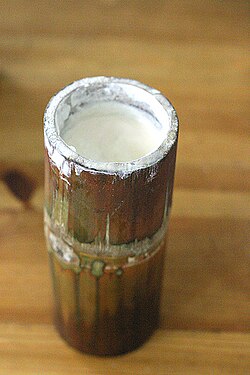
Fermented milk products or fermented dairy products, also known as cultured dairy foods, cultured dairy products, or cultured milk products, are dairy foods that have been made by fermenting milk with lactic acid bacteria such as Lactobacillus, Lactococcus, and Leuconostoc. The process of culturing increases the shelf life of the product, while enhancing its taste and improving digestibility by the fermentation breakdown of the milk sugar, lactose.1
There is evidence that fermented milk products have been produced since around 10,000 BCE.2 Numerous Lactobacilli strains have been grown in laboratories allowing for diverse cultured milk products with different flavors and characteristics.2 Most of the bacteria needed to make these products thrive under specific conditions, giving a favorable environment for production of fermented foods, such as cheese, yogurt, kefir, and buttermilk.2
Production and storage
Although milk is high in nutrients, fat, and sugars, it can spoil quickly.2 In general, fermentation by yeasts and bacteria metabolizes the lactose in dairy products into acidic breakdown products, such as lactic acid, acting to preserve the product.2 These cultures inhibit potentially harmful microbes that may cause food spoilage.2
With a longer and more complete fermentation process, a reduced amount of lactose remains.2 Less-fermented products, such as yogurts or soft cheeses, contain more lactose when compared to matured hard cheeses.3
High levels of lactose in food are linked to poor digestion in people of Africa and Far East Asia where dairy farming is uncommon, and in people who have lactose intolerance.4 This condition occurs from the loss of lactase production – an enzyme present in infant mammals to digest milk.14
Products
Many different types of cultured milk products can be found around the world, including milk, cheese, yogurt, kefir, sour cream, buttermilk, and more.2
Soured milk
Soured cream
| Country/region of origin | Product(s) |
|---|---|
| cheese | |
| British Isles, Germany and The Netherlands | sour cream |
| Central Asia | kaymak |
| Central & Eastern Europe; and Russia | smetana |
| Croatia | mileram/kiselo vrhnje |
| Estonia | hapukoor |
| Finland | kermaviili |
| France | crème fraîche |
| Iceland | sýrður rjómi |
| Hungary | tejföl |
| Latvia | skābais krējums |
| Lithuania | grietinė |
| Mexico | crema/cream espesa |
| Norway | rømme |
| Poland | kwaśna śmietana |
| Romania | smântână |
| Serbia | kisela pavlaka |
| Slovakia | smotana |
| Sweden | gräddfil |
| Tanzania | Samli |
Comparison chart
| Product | Alternative names | Typical milkfat content | Typical shelf life at 4 °C | Fermentation agent | Description |
|---|---|---|---|---|---|
| Cheese | 1-75% | varies | a variety of bacteria or mold | Any number of solid fermented milk products. | |
| Crème fraîche | creme fraiche | 30-40% | 10 days2 | naturally occurring lactic acid bacteria in cream | Mesophilic fermented cream, originally from France; higher-fat variant of sour cream |
| Cultured sour cream | sour cream | 14–40% | 4 weeks2 | Lactococcus lactis subsp. lactis*6 | Mesophilic fermented pasteurized cream with an acidity of at least 0.5%. Rennet extract may be added to make a thicker product.6 Lower fat variant of crème fraîche |
| Filmjölk | fil | 0.1-4.5% | 10–14 days2 | Lactococcus lactis* and Leuconostoc78 | Mesophilic fermented milk, originally from Scandinavia |
| Yogurt | yoghurt, yogourt, yoghourt | 0.5–4% | 35–40 days2 | Lactobacillus bulgaricus and Streptococcus thermophilus6 | Thermophilic fermented milk, cultured with Lactobacillus bulgaricus and Streptococcus thermophilus |
| Kefir | kephir, kewra, talai, mudu kekiya, milkkefir, búlgaros | 0-4% | 10–14 days2 | Kefir grains, a mixture of bacteria and yeasts | A fermented beverage, originally from the Caucasus region, made with kefir grains; can be made with any sugary liquid, such as milk from mammals, soy milk, or fruit juices |
| Kumis | koumiss, kumiss, kymys, kymyz, airag, chigee | 4%? | 10–14 days2 | Lactobacilli and yeasts | A carbonated fermented milk beverage traditionally made from horse milk |
| Viili | filbunke | 0.1-3.5% | 14 days2 | Lactococcus lactis subsp. cremoris, Lactococcus lactis* biovar. diacetylactis, Leuconostoc mesenteroides subsp. cremoris and Geotrichum candidum9 | Mesophilic fermented milk that may or may not contain fungus on the surface; originally from Sweden; a Finnish specialty9 |
| Cultured buttermilk | 1–2% | 10 days2 | Lactococcus lactis*6 (subsp. lactis*, subsp. cremoris, biovar. diacetylactis) and Leuconostoc mesenteroides subsp. cremoris2 | Mesophilic fermented pasteurized milk | |
| Acidophilus milk | acidophilus cultured milk | 0.5-2% | 2 weeks2 | Lactobacillus acidophilus26 | Thermophilic fermented milk, often lowfat (2%, 1.5%) or nonfat (0.5%), cultured with Lactobacillus acidophilus |
* Streptococcus lactis has been renamed to Lactococcus lactis subsp. lactis10
References
References
- David Crystal, ed. (2018). The Merck Manual of Diagnosis and Therapy (20th ed.). Merck, Sharp & Dohme Corp. p. 149. ISBN 978-0-911910-42-1.
- "Fermented Milk Products". Canadian Dairy Commission. 2007-06-06. Archived from the original on 2019-06-19. Retrieved 2012-12-26.
- Gille, Doreen; Walther, Barbara; Badertscher, René; Bosshart, Andreas; Brügger, Cédric; Brühlhart, Maria; Gauch, Roland; Noth, Priska; Vergères, Guy; Egger, Lotti (August 2018). "Detection of lactose in products with low lactose content". International Dairy Journal. 83: 17–19. doi:10.1016/j.idairyj.2018.03.003.
- Catanzaro R, Sciuto M, Marotta F (May 2021). "Lactose intolerance: An update on its pathogenesis, diagnosis, and treatment". Nutrition Research. 89: 23–34. doi:10.1016/j.nutres.2021.02.003. PMID 33887513.
- Amilien, Virginie; Torjusen, Hanne; Vittersø, Gunnar (2005-05-04). "From local food to terroir product ? - Some views about Tjukkmjølk, the traditional thick sour milk from Røros, Norway". Anthropology of Food. 4 (4). doi:10.4000/aof.211. Retrieved 2008-09-04.
- "Newer Knowledge of Dairy Foods: Other: Kinds of Other Dairy Foods". National Dairy Council. Archived from the original on September 25, 2006. Retrieved 2007-06-30.
- "Filmjölk" (in Swedish). Arla Foods. Archived from the original on 2007-08-08. Retrieved 2007-06-29.
- "Ekologisk filmjölk" (in Swedish). Arla Foods. Archived from the original on 2007-08-20. Retrieved 2007-06-30.
- "Viili: the Finnish specialty" (PDF). Valio Foods & Functionals. 2003 (2): 4–5. 2003. Retrieved 2007-06-30.
- Schleifer KH, Kraus J, Dvorak C, Kilpper-Balz R, Collins MD, Fischer W (1985). "Transfer of Streptococcus lactis and related streptococci to the. genus Lactococcus gen. nov". Syst. Appl. Microbiol. 6 (2): 183–195. Bibcode:1985SyApM...6..183S. doi:10.1016/s0723-2020(85)80052-7. ISSN 0723-2020.