Scatter plot

List
| Date | Event | Location | Death toll (where known; estimated) |
|---|---|---|---|
| c. 2,700 BC | Seven year famine, recorded on the Famine Stela12 | Egypt | |
| 2200 BC–2100 BC | The 4.2-kiloyear event caused famines and civilizational collapse worldwide | Global | |
| 441 BC | The first famine recorded in ancient Rome. | Ancient Rome3 | |
| 114 BC | Famine caused by drought during the third year in the Yuanding period. Starvation in over 40 commanderies east of the Hangu mountain pass.4 | Han China | |
| 103 BC–89 BC | Beminitiya Seya during the reign of the Five Dravidians5 | Anuradhapura kingdom | |
| c. 43 BC | Famine due to volcanic winter following the eruption of Mount Etna in 44 BC and the larger eruption of Mount Okmok early in 43 BC,6 affecting China (43 BC),7 Italy (43 BC), Egypt (c. 43 BC – c. 42 BC) and Greece (42 BC).6 | Roman Republic, Egypt and China | |
| 26 BC | Famine recorded throughout Near East and Levant, as recorded by Josephus | Judea | 20,000+ |
| 333 AD | Famine in Antioch8 | Coele Syria, Roman Empire | |
| 368–369 | Famine910 during the drought of the 360s–370s11 | Cappadocia, Byzantine Empire | |
| 370 | Famine in Phrygia | Phrygia | |
| 372–373 | Famine in Edessa | Edessa | |
| 375–376 | Famine during the drought of the 360s–370s11 | Byzantine Empire | |
| 383 | Famine in Rome. A policy had been introduced in 364 AD that stipulated taxes in Rome had to be paid in grain12 | Italian Peninsula | |
| 400–800 | Various famines in Western Europe associated with the Fall of the Western Roman Empire and its sack by Alaric I. Between 400 and 800 AD, the population of the city of Rome fell by over 80%, mainly because of famine and plague. | Western Europe | |
| 470 | Famine | Gaul | |
| 535–536 | Volcanic winter of 536 | Global | |
| 544 | Famine in Myra9 | Byzantine Empire | |
| 585 | Famine | Gaul | |
| 618–619 | Famine in Constantinople9 | Byzantine Empire | |
| 639 | Famine in Arabia during the reign of Umar13 | Arabia | |
| 676–678 | Famine9 | Thessalonica, Byzantine Empire | |
| 698–700 | Famine | Ireland14 | |
| 750s | Famine | Islamic Spain (Al-Andalus)15 | |
| 762–764 | Famine associated with hard winters and drought16 | Carolingian Europe, the Balkans, the Byzantine Empire and possibly north of the Black Sea | |
| 779 | Famine16 | Northern Carolingian Europe and possibly Ireland | |
| 791–794 | Famine, possibly associated with heavy rain,16 affecting England in 79317 | Carolingian Europe and England | |
| 800–1000 | Severe drought killed millions of Maya people due to famine and thirst and initiated a cascade of internal collapses that destroyed their civilization.18 | Mayan areas of Mesoamerica | 1,000,000+ |
| 805–807 | Famine associated with a hard winter and drought16 | Northern Carolingian Empire | |
| 820–824 | Famine associated with heavy rain, hard winters, drought, hail and possibly cattle pestilence16 | Carolingian Empire, possibly Ireland, England and the Byzantine Empire | |
| 841–845 | Famine associated with heavy rain and hard winters16 | Northern (and possibly southern) Carolingian Empire, the Byzantine Empire and the Middle East | |
| 867–869 | Famine associated with heavy rain, flooding and possibly cattle pestilence16 | Northern Carolingian Empire | |
| 872–874 | Famine associated with heavy rain, hail, locusts, a hard winter, drought and Saharan sand16 | Carolingian Empire | |
| 875–884 | Peasant rebellion in China inspired by famine;1920 Huang Chao captured capital | China | |
| 895–897 | Famine associated with hail and a hard winter16 | Northern Carolingian Europe, England and Ireland | |
| 927–928 | Famine caused by four months of frost2122 | Byzantine Empire | |
| 939–944 | Famine associated with hard winters, heavy rain, flooding, Saharan sand, locusts and possibly cattle pestilence16 | Northern (and possibly southern) Carolingian Europe, Ireland and the Middle East | |
| 942–944 | Famine in the Yellow River Basin caused by severe drought and locust plagues. During the first month 5387 families fled, then approximately 10% of the remaining population starved to death.23 | China | |
| 963–968 | Famine | Egypt | |
| 975–976 | Famine17 | England | |
| 975–976 | Famine24 | Iceland | |
| 996–997 | Famine in the Fatimid Caliphate, with food price increases25 | Egypt | |
| 1004–1007 | Famine, resulting in food scarcity, price increases and widespread illnesses. Caliph al-Ḥākim punished merchants who raised prices too high with the death penalty, and prohibited the slaughter of healthy cows which could be used for ploughing25 | Maghreb area in Northwest Africa: Algeria, Libya, Mauritania, Morocco, Tunisia and Egypt | |
| 1005–1006 | Famine, including in England17 | Europe26 | |
| 1010 | Famine in Nīshābūr25 | Ghaznavid Empire | |
| 1016 | Famine throughout Europe27 | Europe | |
| 1021 | Famine24 | Norway | |
| 1025 | Famine | Egypt | |
| 1031 | Famine caused by a sandstorm that destroyed crops, trees and provisions25 | Arabian Peninsula; Modern day Iraq and Saudi Arabia | |
| c. 1045 | Famine17 | England | |
| 1051 | Famine forced the Toltecs to migrate from a stricken region in what is now central Mexico28 | Mexico (present day) | |
| 1055–1056 | Famine | Egypt | |
| 1057–1058 | Famine24 | Iceland | |
| 1064–1072 | Mustansirite Hardship2930 | Egypt | 40,00029 |
| 1069–1070 | Harrying of the North | England | 100,000 |
| 1087 | Famine17 | England | |
| 1097 | Famine and plague31 | France | 100,000 |
| 1099–1101 | Probable famine32 | Denmark | |
| 1111 | Famine17 | England | |
| 1118 | Famine24 | Iceland | |
| 1124–1126 | Famine in England, the Low Countries and northern France33 | Europe | |
| 1143–1147 | Famine | Europe | |
| 1150–1151 | Famine | Europe | |
| 1150–1151 | Widespread famine due to wet/cold34 | Japan | |
| 1153 | Local famine of unknown cause34 | Japan | |
| 1155 | Widespread famine of unknown cause34 | Japan | |
| 1161 | Widespread famine of unknown cause34 | Japan | |
| 1161–1162 | Famine | Aquitaine | |
| 1174–1175 | Local famine due to wet/cold34 | Feudal Japan | |
| 1180–1182 | Yōwa famine35 | Japan | 42,300 in Kyoto |
| 1182 | Famine24 | Norway | |
| 1183 | Local famine of unknown cause34 | Japan | |
| 1185 | Widespread famine due to drought34 | Japan | |
| 1193–1198 | Famine17 | England | |
| 1196–1197 | Famine | Europe | |
| 1196–1198 | Probable famine32 | Denmark | |
| 1199–1202 | Famine due to the low water level of the Nile impacting food prices25 | Egypt | 100,000 |
| 1201 | Local famine due to wet/cold34 | Japan | |
| 1206 | Widespread famine of unknown cause34 | Japan | |
| 1207–1213 | Famine(s), e.g. in 1207 and 1211–121324 | Norway | |
| 1224–1226 | Famine | Europe | |
| 1225–1226 | Probable famine32 | Denmark | |
| 1229–1232 | The Kanki famine, possibly the worst famine in Japan's history.36 Caused by volcanic eruptions.37 | Japan | 2,000,000 |
| 1230 | Famine in the Novgorod Republic | Novgorod Republic | |
| 1233 | Local famine due to wet/cold34 | Japan | |
| 1235 | Famine38 | England | 20,000 in London |
| 1252 | Famine39 | Ethiopia | |
| 1252 | Widespread famine due to wet/cold34 | Japan | |
| 1255–126240 | Famine in Spain40 and Portugal41 | Iberian Peninsula | |
| 1256 | Famine in Tuscany42 | Tuscany | |
| 1256–1258 | Famine40 | Low Countries | |
| 1256–1258 | Famine43 | Italy | |
| 1257–1260 | Shōga famine, aggravated by the 1257 Samalas eruption44 | Japan | |
| 1258–12594044 | Famine in England,4445 Italy,42 France, the Holy Roman Empire and the Iberian Peninsula, aggravated by the 1257 Samalas eruption44 | Western Europe | |
| 1263 | Famine40 | Ireland | |
| 1264 | Famine in 662 AH (1263/1264 CE). The crisis started in February 1264, following a low flooding of the Nile.46 | Egypt | |
| 1270–1271 | Famine40 | Ireland | |
| 1271 | Widespread famine due to drought34 | Japan | |
| 1271–1272 | Famine43 | Italy | |
| 1273–1274 | Widespread famine due to drought34 | Japan | |
| 1275–1277 | Famine4043 | Italy | |
| 1275–1299 | Collapse of the Anasazi civilization, widespread famine occurred47 | United States | |
| 1279 | Famine40 | Russia/Ukraine | |
| 1281–1282 | Famine40 | Central Europe | |
| 1282 | Famine40 | Russia/Ukraine | |
| 1283 | Apparent severe famine48 | Denmark | |
| 1285–1286 | Famine.43 (Perhaps 1286 only.40) | Italy | |
| 1291 | Famine40 caused by years of drought and recorded in one chronicle48 | Sweden49 | |
| 1294–1296 | Famine caused by sandstorm that covered plantations and destroyed crops.25 | Egypt, Syria, Yemen | |
| 1294–1296 | Famine lasting 1294–1296 in Ireland and 1295–1296 in Great Britain40 | British Isles | |
| 1300 | Famine due to the eruption of Hekla24 | Iceland | |
| 1301–1302 | Famine40 | Spain | |
| 1302–1303 | Famine4043 | Italy | |
| 1304 | Famine50 | France | |
| 1305 | Famine50 | France | |
| 1308–1310 | Famine40 | Russia/Ukraine | |
| 1310 | Famine50 | France | |
| 1310 | Probable famine and apparent drought48 | Denmark | |
| 1311 | Famine40 | Spain | |
| 1311–1312 | Famine43 | Lombardy, Italy | |
| 1313 | Famine43 | Pistoia, Tuscany, Italy | |
| 1314–1315 | Famine. Dikes collapsed, fields vanished, crops rotted, and livestock died in huge numbers due to the disease "Rinderpest". The price of wheat jumped "8 fold".12 | England | |
| 1315–1317 or 1322 | Great Famine of 1315–1317. Famine lasted from 1313–1317 in Spain and 1314–1316 in Russia/Ukraine.40 Elsewhere, famine began in 1315 and ended in either 1317 (Great Britain, France, the Low Countries,40 Denmark and Sweden48) or 1318 (Central Europe40 and Ireland4051). | Europe52 | 7,500,000 |
| 1319–1320 | Great Bovine Pestilence | England | |
| 1321 | Famine | England | |
| 1322–1325 | Famine53 | Sardinia | |
| 1326–1330 | Famine in Italy43 (possibly beginning in 132840), Spain and Ireland | Europe | |
| 1330–1331 | Famine40 with humid, rainy and stormy weather51 | Ireland | |
| 1330–1332 | Famine40 | Russia/Ukraine | |
| 1330–1333 | Famine | France | |
| 1333–1336 | Famine40 (see Lo mal any primer53) | Spain | |
| 1333–1337 | Chinese famine of 1333–1337 | China54 | 6,000,000 |
| 1338–1339 | Famine40 (possibly just 133951) | Ireland | |
| 1339–1341 | Famine in Italy43 (possibly ending in 134040), Spain and Ireland | Europe | |
| 1344–1345 | Famine in India, under the reign of Muhammad bin Tughluq55 | India | |
| 1346 | Famine40 | Ireland | |
| 1346–1348 | Following a likely tropical volcanic eruption (or series of eruptions) c. 1345 and cool weather (plus heavy autumn rain in Italy) lasting 1345–1347,53 there was a widespread European famine, particularly in the south, including Italy (1346–1347),43 Spain (1346–1348)40 and southern53 France (1347).40 Dearth or famine also affected Egypt and the Levant, and cereals peaked in price in the Hejaz. Grain imports from the Black Sea region may have introduced the Black Death to Italy in 1347.53 | Europe and the Mamluk Sultanate | |
| 1349–1351 | Famine40 affecting England (1351)50 and coinciding with the Black Death56 | Great Britain | |
| 1349–1351 | Famine | France | |
| 1352–1353 | Famine43 | Italy | |
| 1358–1360 | Famine40 | France | |
| 1361–1362 | Famine40 | Russia/Ukraine | |
| 1364–1366 | Famine40 | Russia/Ukraine | |
| 1368 | Famine43 | Italy | |
| 1369 | Famine | England | |
| 1369–1370 | Famine43 | Florence, Tuscany, Italy | |
| 1370 | Famine caused by harvest failure in 136957 | Norway | |
| 1371 | Famine40 | Russia/Ukraine | |
| 1371 | Famine | France | |
| 1374 | Famine40 | Russia/Ukraine | |
| 1374–1375 | Near pan-Mediterranean famine in France, Spain40 and Italy4043 | Europe | |
| 1374–1375 | Famine | Egypt | |
| 1384–1385 | Famine43 | Italy | |
| 1389 | Famine43 | Pistoia, Tuscany, Italy | |
| 1390–1391 | Famine | France | |
| 1393 | Famine43 | Pistoia, Tuscany, Italy | |
| 1394–1396 | Famine | Egypt | |
| 1397 | Famine, with a windy, wet and cold summer and autumn51 | Ireland | |
| 1396–1407 | The Durga Devi famine | India5827 | |
| 1402–1404 | Famine8 | Ottoman Empire | |
| 1403–1404 | Famine | Egypt | |
| 1409 | Famine40 | Russia/Ukraine | |
| 1410 | Great famine4051 | Ireland | |
| 1410–1412 | Famine43 | Italy | |
| 1420–1421 | Oei famine (due to drought)59 | Japan | |
| 1420–1421 | Famine40 | France | |
| 1420–1423 | Famine40 | Russia/Ukraine | |
| 1426 | Great Famine in Majapahit Empire60 | Majapahit Empire | |
| 1429–1432 | Famine40 | France | |
| 1431 | Famine40 | Russia/Ukraine | |
| 1432–1434 | The Hungry Years | Czech Republic | |
| 1434–1437 | Famine40 | Nordic countries | |
| 1435 | Famine40 | Spain | |
| 1436–1440 | Famine in Russia/Ukraine (1436–1438), the Low Countries and Great Britain (1437–1438), France (1437–1439)40 and Germany and Switzerland (1437–1440)61 | Europe | |
| 1441 | Famine in Mayapan | Mexico62 | |
| 1442–1445 | Famine40 | Russia/Ukraine | |
| 1446 | Famine40 | Nordic countries | |
| 1447 | Famine40 (or hunger51) | Ireland | |
| 1447–1448 | Famine63 | Sweden | |
| 1450–1454 | Famine in the Aztec Empire,64 interpreted as the gods' need for sacrifices.65 | Mexico | |
| 1458 | Famine43 | Italy | |
| 1459–1461 | Kanshō famine66 (due to drought)59 | Japan | 82,000 |
| 1460 | The Deccan region faced significant famine, leading to severe food shortages.67 | India | |
| 1468 | Famine40 | Russia/Ukraine | |
| 1470 | Famine40 | France | |
| 1470 | Famine40 | Nordic countries | |
| 1472 | Famine40 | Russia/Ukraine | |
| 1472 | Famine in central Honshu due to drought68 | Japan | |
| 1472–1474 | Famine4069 | Italy | |
| 1475–1477 | Famine40 | Spain | |
| 1476 | Famine4069 | Italy | |
| 1477 | Famine in central Honshu68 | Japan | |
| 1481–1484 | Famine(s) in the Low Countries (1481–1482), France (1481–1483),40 the East of England (1481–1483)70 and Italy (1482–1484)4069 | Western Europe | |
| 1485 | Famine40 | Russia/Ukraine | |
| 1491–1492 | Famine40 | Low Countries | |
| 1491–1492 | Famine68 | Kai Province, Japan | |
| 1492 | Famine40 | Ireland | |
| 1493 | Famine4069 | Italy | |
| 1497–1498 | Great famine4051 (possibly just 149751) | Ireland | |
| 1502–1505 | Famine4069 | Italy | |
| 1503 | Famine40 | Nordic countries | |
| 1504 | Famine during a drought71 | Spain | |
| 1506–1508 | Famine40 | Spain | |
| 1512 | Famine40 | Russia/Ukraine | |
| 1513 | Famine during a drought71 | Murcia, Spain | |
| 1515 | Famine40 | France | |
| 1515–1516 | Famine40 | Russia/Ukraine | |
| 1516–1518 | Famine40 | Germany and Switzerland61 | |
| 1518–1520 | Famine4069 | Italy | |
| 1520–1523 | Famine40 | Nordic countries | |
| 1521–1522 | Famine(s)40 | France and the Low Countries | |
| 1521–1522 | Famine40 during a drought71 | Andalusia,7172 Spain | |
| 1523 | Great famine4051 | Ireland | |
| 1525 | Famine40 | Russia/Ukraine | |
| 1527–1532 | Famine(s) in Italy (1527–1529),4069 France (1527–1532,40 including Languedoc by 152873), Spain (1528–1530)40 and Austria and Switzerland (1530–1531)61 | Europe | |
| 1533–1534 | Famine4069 | Italy | |
| 1535 | Famine in Ethiopia | Ethiopia | |
| 1539–1540 | Famine6974 | Italy | |
| 1539–1540 | Tenbun famine (due to rain)59 | Japan | |
| 1540 | Famine during a drought71 | Spain | |
| 1544–1545 | Famine4069 | Italy | |
| 1545 | Famine40 | France | |
| 1550–1551 | Famine in isolated areas of central Honshu due to an earthquake and typhoon75 | Japan | |
| 1550–1552 | Famine4069 | Italy | |
| 1556 | Famine40 | Ireland | |
| 1556–1557 | Famine40 | Low Countries | |
| 1556–1557 | Famine40 (perhaps affecting Denmark but not Sweden, and perhaps only in 155663) | Nordic countries40 | |
| 155740 | Famine40 in the Volga region and northern Russia76 | Russia | |
| 1557 | Famine40 throughout Spain due to a rainy winter, coinciding with a typhus outbreak77 | Spain | |
| 1557–1558 | Famine in Honshu75 | Japan | |
| 1557–1559 | Famine40 coinciding with an influenza outbreak78 | Great Britain | |
| 1558–1560 | Famine4069 | Italy | |
| 1560–1561 | Famine40 | Russia/Ukraine | |
| 1562 | Famine40 following a harsh winter in 156179 | France | |
| 1565–1566 | Famine40 | Central Europe | |
| 1566–1567 | Famine during a drought71 | Andalusia, Spain | |
| 1567–1570 | Famine in Harar, combined with plague. The Emir of Harar died. | Ethiopia | |
| 1568–1574 | Pan-European famine or famines affecting Russia and mostly east of Ukraine (1568–1572),40 Italy (1569–1572),4069 Germany, Austria and Switzerland (1569–1574),61 the Nordic countries (1571–1572), the Low Countries (1572–1573) and France (1573–1574).40 Germany/Austria/Switzerland saw crop failures, plague and witch hunts in one of their most severe famines.61 | Europe | |
| 1573 | Famine due to drought75 | Western Japan | |
| 1585–1589 | Pan-European famine or famines, affecting Great Britain, France and the Low Countries (1585–1587),40 Italy (1586–1587)4069 and Ireland (1586–1589).4051 In Ireland, this famine followed the Second Desmond Rebellion.80 | Western Europe | |
| 1586 | Famine and drought. Rice prices skyrocketed and there was widespread population migration and starvation.81 | Qishan County, Shaanxi province, China | |
| 1588 | Famine81 | Wei County, Hebei province, China | |
| 1589 | Famine40 | Russia/Ukraine | |
| 1590–159882 | Major European famine,83 including Italy (1590–1593),406984 the Nordic countries (Denmark, Sweden, Finland and Norway,85 1590–1597),408485 Russia/Ukraine (1591),40 Spain (1591–1595),4084 France (1593 & 1598),84 Great Britain (either 1594–159884 or 1597–159940), Germany and Austria (1594–1598).61 The degree to which this should be considered one widespread famine as opposed to many regional ones is unclear: it mainly affected southern Europe in 1590–1593, then central and northern Europe in 1594–1598. The famine may also be associated with a critical phase of the Little Ice Age. It caused the large-scale restructuring of European grain trade routes, which contributed to the Low Countries' avoiding this famine.86 | Europe | |
| 1592–1594 | Famine during the Japanese invasions of Korea (1592–1598), known in Korea as the Kyegap Famine (Korean: 계갑대기근; Hanja: 癸甲大飢饉).87 | Joseon | |
| 1593–1600 | Famine88 | Portugal | |
| 1596 | Famine89 | India | |
| 1599–1600 | Famine40 | Spain | |
| 1600–1601 | Famine in Emilia and southern Lombardy90 | Italy | |
| 1600–1603 | Famine linked to the Nine Years' War91 | Ireland | |
| 1601–1602 | Cooling, famine and epidemics following the eruption of Huaynaputina in 16007 | Guizhou and Shanxi provinces, China | |
| 1601–1603 | One of the worst famines in all of Russian history, with as many as 100,000 in Moscow and up to one-third of the country's population killed; see Russian famine of 1601–1603.92 The same famine killed about half of the Estonian population. | Russia | 2,000,000 |
| 1601–160340 | Famine in 1601 in Finland93 and in 1602–1603 in Denmark, Sweden, Finland and Norway,94 following the eruption of Huaynaputina in 160095 | Nordic countries | |
| 1602 | Famine40 | Central Europe | |
| 1602 | Famine40 | Great Britain | |
| 1605–1607 | Famine40 | Spain | |
| 1607–1608 | Famine4069 | Italy | |
| 1608 | Famine40 | Russia/Ukraine | |
| 1615–1616 | Famine40 | Spain | |
| 1616–1623 | Famine88 | Portugal | |
| 1618–1622 | Famine4069 | Italy | |
| 1618–1648 | Famines in Europe caused by the Thirty Years' War, including in 1620–1623 in Germany (often attributed to Kipper und Wipper, violent conflict, the closing of borders and trade routes, and requisitioning by armies),96 possibly in 1628–1630 in Jutland97 and in 1635–1636 in Germany, Austria and Switzerland. In the 1630s, famine in these countries was frequent but more local, often resulting from occupation or sieges.96 | Europe | |
| 1619 | Famine in Japan. During the Edo period, there were 154 famines, of which 21 were widespread and serious.98 | Japan | |
| 1621–1624 | Famine40 | Nordic countries | |
| 1622–1624 | Famine (possibly 1623–1625 in Great Britain40) in North West England, Ireland,99 north-west Wales (1622–1623)100 and Scotland99 (where it hit in 1623, following harvest failures in the autumns of 1621–1622),101 due to wet and cold weather.99 | British Isles | |
| 1623 | Famine40 | Russia/Ukraine | |
| 1625–1626 | Famine40 | Low Countries | |
| 1625–1630 | Famine(s) involving plague and witch hunts, due to exceptionally bad harvests96 | Austria and Germany | |
| 1626–1627 | Pyŏngjŏng Famine (Korean: 병정대기근; Hanja: 丙丁大飢饉)102 | Joseon | |
| 1628–1630 | Famine40 or apparent famine in Sweden (1630), with people eating bark in the south of Sweden93 | Nordic countries40 | |
| 1628–1632 | Famine69 | Italy | |
| 1629–1631 | Famine.40 According to the prevailing literature, this was England's last famine.103 | Great Britain | |
| 1630–1631 | Famine in Northwest China | China | |
| 1630–1631 | Famine40 | Spain | |
| 1630–1632 | Deccan famine of 1630–1632 | India | 7,400,000 |
| 1630–1632 | Famine88 | Portugal | |
| 1631–1632 | Famine40 (possibly 1630–163189) | France | |
| 1633–1634 | Famine in Norway, Sweden, Finland and Sweden's Baltic possessions104 | Swedish Empire and Norway | |
| 1636 | Famine40 | Russia/Ukraine | |
| 1640–1643 | Kan'ei Great Famine | Japan | 50,000–100,000 |
| 1641–1643 | Famine40 | Nordic countries | |
| 1641–165240 | A succession of famines related to the Irish Confederate Wars. Deaths were concentrated in the more sparsely populated Ulster and north-east Connacht in the 1640s; afterwards, the south was worst affected and plague exacerbated the famine.80 | Ireland | |
| 1647–1649 | Famine40 including in northern England (1649)10589 | Great Britain | |
| 1647–1652 | Famine in Spain40 and Portugal88 | Iberian Peninsula | |
| 1648–1649 | Famine40106 | Italy | |
| 1648–1651 | Famine40 | Low Countries | |
| 1648–1652 | Famine40 in the east (1650–1652),107 possibly 1649–1652.89 | France | |
| 1648–1660 | The Deluge saw Poland lose an estimated 1/3 of its population due to wars, famine, and plague | Poland | |
| 1650–1652 | Famine40 | Russia/Ukraine | |
| 1650–1652 | Famine due to severe crop failures in 1650 and 1651. Grain exports were banned and grain was imported from the Baltic states. The crude death rate was over twice the normal value in the east in 1650, and in the north, middle and east in 1651–1652.108 | Sweden | |
| 1651–1652 | Famine due to exceptionally bad harvests96 | Germany | |
| 1651–1653 | Famine throughout much of Ireland during the Cromwellian conquest of Ireland.109 The more densely populated south was worst affected, and plague exacerbated the famine.110 | Ireland | |
| 1657–1663 | Famine88 | Portugal | |
| 1659–1662 | Famine(s) in Italy and Spain (1659–1662), and in France, Central Europe and the Low Countries (1661–1662)40 | Europe | |
| 1661 | Famine in India, due to lack of any rainfall for two years11127 | India | |
| 1670–1671 | Kyungshin Famine | Joseon | 1,000,000112–1,500,000 |
| 1672 | Famine in southern Italy113 | Italy | |
| 1674 | Famine40 | Russia/Ukraine | |
| 1674–1676 | Famine40 | Low Countries | |
| 1674–1677 | Famine40 | Nordic countries | |
| 1675–1677 | Famine affecting northern and central Sweden (1675), inland and coastal Norway (1676) and Denmark (1676–1677)114 | Scandinavia | |
| 1675–1678 | Famine88 | Portugal | |
| 1676 | Famine40 | France | |
| 1677 | Famine40 | Russia/Ukraine | |
| 1678–1679 | Famine40115 | Italy | |
| 1678–1685 | Famines and plague40 | Spain | |
| 1680 | Famine in Sardinia116 | Italy (present day) | 80,000117 |
| 1680–1682 | Enpo-Tenna famine (due to rain)59 | Japan | |
| 1680s | Famine in Sahel107 | West Africa | |
| 1690s | Seven Ill Years – a famine which killed 5–15% of the population118 (possibly 1697–169940) | Scotland | 60,000–180,000 |
| 1691–1695 | Particularly severe famine due to severe rain and cold, which reduced harvests119 | Germany, Austria and Switzerland | |
| 1692–1694 | Famine40 | Low Countries | |
| 1693–1694 | Great Famine of 1693–1694 | France | 700,000–1,300,00089120 |
| 1693–1697 | Major European famine103 affecting Germany, Austria and Switzerland (1691–1695),119 the Low Countries (1692–1694),40 France (Great Famine of 1693–1694),103 Italy (1693–169540121), where it was second only to the 1590s famine,103 Portugal (1693–1697),88 Spain (1694–1699),40 Finland and Estonia (Great Famine of 1695–1697),103 Russia/Ukraine (1695–1697),40 Norway (1696) and Sweden (1696–1698)122 and Great Britain (Seven Ill Years, 1697–1699)40 | Europe | |
| 1694–1699 | Famine40 | Spain | |
| 1695–1696 | First Genroku famine (due to rain)59 | Japan | |
| 1695–1697 | Great Famine of Estonia, which killed about a fifth of the population. | Swedish Estonia and Swedish Livonia | 70,000–100,000 |
| 1695–1698 | Great Famine of 1695–1697, including the Great Famine of Estonia. Famine also hit Norway (1696)122 and Sweden (1696–1698,122 80,000–100,000 dead) | Swedish Empire and Norway | 150,000 in Finland |
| 1696 | Famine in Aleppo8 | Ottoman Empire | |
| 1696–1699 | Ŭlbyŏng famine | Joseon | 1,410,000 per official Annals, but possibly higher.123 |
| 1698–1699 | Famine40 | Low Countries | |
| 1698–1701 | Famine due to severe rain and cold, which reduced harvests119 | Germany, Austria and Switzerland | |
| 1700 | Famine, with mortality around 35% above the normal rate122 | Denmark | |
| 1701–1703 | Second Genroku famine (due to rain)59 | Japan | |
| 1702–1704 | Famine in Deccan124 | India | 2,000,000124 |
| 1706–1711 | Famine40 | Spain | |
| 1708–1711103 | Famine in Spain (1706–1711), the Low Countries (1708–1710),40 Italy (170969 or 1708–170940), France (1709–1710),40 probably Sweden and Finland (1709–1710, coinciding with the Great Northern War and the Great Northern War plague outbreak), Denmark (1710)125 and Germany and Austria (1709–1712).119 | Europe | |
| 1708–1711 | Famine and disease in East Prussia killed 250,000 people or 41% of its population.73 According to other sources the great mortality was due to plague (disease), which between 1709 and 1711 killed about 200,000–250,000 out of 600,000 inhabitants of East Prussia.126 The Great Northern War plague outbreak of 1708–1712 also affected East Prussia. | East Prussia | 250,000 |
| 1709–1710 | The Great Famine of 1709 | France89127 | 600,000 |
| 1709–1712 | Famine following the Großer Winter (Great Winter) of 1708–1709, coinciding with the Great Palatine Migration of 1709119 | Germany and Austria | |
| 1714–1715 | Famine40 | Central Europe | |
| 1716 | Famine40128 | Italy | |
| 1717 | Famine in the north and west129 | Sweden | |
| 1718–1719 | Famine40 | France | |
| 1719 | High mortality probably connected to famine130 | Denmark | |
| 1719–1721 | Famine40 | Central Europe | |
| 1721–1724 | Famine40 | Russia/Ukraine | |
| 1722 | Famine | Arabia131 | |
| 1724 | Famine40128 | Italy | |
| 1724–1725 | Famine61 | Germany | |
| 1727–1728 | Perhaps England's last famine. Limited to a few parishes,89 there were food riots and increased mortality, but contemporaries did not consider this a famine, and the prevailing literature considers the 1629–1631 famine England's last.103 | The Midlands, England | |
| 1728–1730 | High mortality probably connected to famine130 | Denmark | |
| 1730 | Famine73 | Silesia | |
| 1730s | Famine in Damascus8 | Ottoman Empire | |
| 1732–1733 | Kyōhō famine | Japan | 12,172–169,000132 |
| 1738–1756 | Famine in West Africa, half the population of Timbuktu died of starvation133 | West Africa | |
| 1739–1740 | Famine associated with extremely cold winter(s) (Große Kälte)119 | Germany and Austria | |
| 1740–1741 | Irish Famine (1740–1741) | Ireland | 300,000–480,000 |
| 1740–1743 | Famine in central Sweden (1740), eastern Norway (1742), northern and central Sweden (1743) and probably Denmark (1740–1742)134 | Scandinavia | |
| 1750–1756 | Famine in the Senegambia region135 | Senegal, Gambia (present day) | |
| 1755–1757 | Horeki famine (due to rain)59 | Japan | |
| 1755–1758 | Famine coinciding with crop failures and the Seven Years' War61 | Germany | |
| 1756–1757 | Partial famine and influenza epidemic. There was a modest public relief effort and a temporary embargo on distilling.136 | Ireland | |
| 1757 | Famine8 | Syria | |
| 1758 | Regional famine following crop failures in 1756–1757, with high mortality also affecting other counties137 | Kopparberg County, Sweden | |
| 1763 | Regional famine, with high mortality also affecting other counties137 | Gothenburg and Bohus County, Sweden | |
| 1763–1764 | High mortality probably connected to famine and coinciding with an influenza pandemic130 | Denmark | |
| 1764 | Famine in Italy (including the Kingdom of Naples138) during a period of drought139 | Italy | |
| 1765 | Famine140 | Norway | |
| 1766 | Smaller famine141 | Ireland | |
| 1767 | Famine during a period of drought139 | Italy | |
| 1769–1773 | Great Bengal famine of 1770,27 10 million dead (one third of population) | India, Bangladesh (present day) | 10,000,000 |
| 1770–1772 | Severe famine in German-speaking lands and most neighbouring countries, due to a series of harvest failures. Heavy rain had affected an area stretching from France to Poland and from Scandinavia to Switzerland, impeding the storage and transportation of grain. Epidemic disease resulted from malnutrition and migration. In the Ore Mountains and Bohemia, around 200,000 people (10% of the population) either died or fled. The famine provoked migration, plus changes in education, economics, welfare and medicine.142 See also: Famines in Czech lands. | Germany, Austria, Switzerland and Bohemia | 60,000 in Saxony143 |
| 1771–1773 | Famine in Norway (1771–1773),144 central Sweden (1772–1773) and Finland.145 Norway saw a mortality crisis during 1771–1773, and famine in the east in 1773.140 In Sweden, mortailty peaked in 1773, with about half of excess mortality due to dysentery.146 | Nordic countries | |
| 1776 | Famine following a series of hurricanes that struck the island147 | Martinique | |
| 1779 | Famine in Rabat | Morocco148 | |
| 1782 | Famine in Karahisar8 | Ottoman Empire | |
| 1782–1784 | Famine leading to an embargo on food exports from June 1783–January 1784136 | Ireland | |
| 1782–1788 | Great Tenmei famine | Japan | 20,000–920,000 |
| 1783–1784 | Chalisa famine | India | 11,000,000149 |
| 1783–1785 | Famine in Iceland caused by the eruption of Laki killed around one-fifth150 or 26%151 of Iceland's population and 80% of livestock. Restrictions on fishing prevented most Icelanders from adopting fishing as an alternative to farming.151 | Iceland | |
| 1784 | Widespread famine throughout Egypt, one-sixth of the population died152 | Egypt | |
| 1784–1785 | Famine in Tunisia153 | Tunisia | |
| c. 1785 | Famine140 | Norway | |
| 1786–1787 | The last famine in Denmark, following bad harvests in 1785–1786. Due to grain imports, Copenhagen was less affected than the rest of Denmark.154 | Denmark |
|
| 1788 | The two years previous to the French Revolution saw bad harvests and harsh winters, possibly because of a strong El Niño cycle155 or caused by the 1783 Laki eruption in Iceland.156157 | France | |
| 1789 | Famine in Ethiopia afflicted the Amhara and Tigray Regions | Ethiopia | |
| 1789–1793 | Doji bara famine or Skull famine | India | 11,000,000 |
| 1796 | Famine caused by locusts39 | Northern Ethiopia | |
| 1799–1800 | Famine in Diyarbakır8 | Ottoman Empire | |
| 1799–1801 | Famine and disease. Emergency rice and maize imports were bought from the United States.158 | Ireland | 40,000 |
| 1800 | Regional famine159 | Jämtland County, Sweden | |
| 1801 | Famine (during a food crisis in Milan lasting 1799–1801)160 | Italy | |
| 1801 | Regional famine161 | Västerbotten County, Sweden | |
| 1804–1872, 1913 | A series of 14 famines in Austrian Galicia | Poland, Ukraine (present day) | 400,000–550,000 |
| 1808 | Regional famine161 | Skaraborg County, Sweden | |
| 1809 | Regional famines137 | Jämtland and Västerbotten counties, Sweden | |
| 1809–1815 | Crop failure due to dry weather conditions. | Joseon (Korea) | 2,000,000162 |
| 1811–1812 | Famine devastated Madrid163 | Spain | 20,000164 |
| 1812 | Regional famine137 | Östergötland County, Sweden | |
| 1815 | Eruption of Mount Tambora. Tens of thousands died in subsequent famine | Indonesia | 10,000 |
| 1816–1817 | Year Without a Summer | Europe and Yunnan | 65,000+ in Europe |
| 1822 | Famine165 | Western Ireland | |
| 1831 | Famine141 | Ireland | |
| 1830–1833 | Famine, claimed to have killed 42% of the population | Cape Verde | 30,000166 |
| 1832–1833 | Guntur famine of 1832 | Madras Presidency, India | 150,000 |
| 1832–1833 | Famine130 | Finland | |
| 1833–1837 | Tenpō famine | Japan | |
| 1837–1838 | Agra famine of 1837–1838 | India | 800,000 |
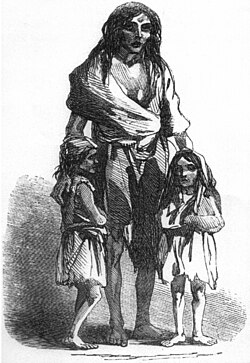
| 1845–1857 | Highland Potato Famine | Scotland | 150,000 estimated |
| 1845–1852 | Great Famine | Ireland |
1,000,000 estimated deaths167 1,500,000 to 2,000,000 that emigrated168 |
| 1846 | Famine led to the peasant revolt known as "Maria da Fonte" in the north of Portugal169 | Portugal | |
| 1846–1848 | The Newfoundland Potato Famine, related to the Great Famine of Ireland | Newfoundland, present-day Canada | |
| 1849–1850 | Demak and Grobogan in central Java, caused by four successive crop failures due to drought. | Indonesia | 83,000170 |
| 1857–1858 | Famine130 | Finland | |
| 1860–1861 | Black Winter of 1860–1861171 | Qajar Iran | |
| 1860–1861 | Upper Doab famine of 1860–1861 | India | 2,000,000 |
| 1863–1867 | Famine in Cape Verde | Cape Verde | 30,000172 |
| 1866 | Orissa famine of 1866 | India | 1,000,000173 |
| 1866 | Keio famine (due to rain)59 | Japan | |
| 1866–1868 | Finnish famine of 1866–1868. About 15% of the entire population died | Finland | 150,000+ |
| 1866–1868 | Famine in French Algeria174 | French Algeria | 820,000 |
| 1867–1869 | Swedish famine of 1867–1869 | Northern Sweden175 | |
| 1869 | Rajputana famine of 1869 | India | 1,500,000173 |
| 1869–1870 | Famines due to weather, with North Hamgyong Province particularly affected.176 | Joseon | |
| 1870–1872 | Persian famine of 1870–1872, extended by some scholars from 1869 to 1873177 | Qajar Iran | 200,000–3,000,000 Estimates vary178 |
| 1873–1874 | Famine in Anatolia caused by drought and floods179180 | Turkey (present day) | |
| 1873–1874 | Bihar famine of 1873–1874 | India | |
| 1876–1878 | Great Indian Famine of 1876–1878 | India | 5,500,000 |
| 1876–1879 | Northern Chinese Famine of 1876–1879 | China | 9,000,000–13,000,000181 |
| 1876–1878 | Brazilian drought of 1877–1878, also known as the Grande Seca | Brazil | 500,000 |
| 1878–1880 | St. Lawrence Island famine, Alaska182 | United States | 1,000 |
| 1879 | 1879 Famine in Ireland. Unlike previous famines, this famine mainly caused hunger and food shortages but little mortality. | Ireland | |
| 1879 | Famine in the Eastern areas of the Empire183 | Ottoman Empire | |
| 1883–1884 | Famine in Indramayu and Kandanghaur184 | Indonesia | |
| 1883–1885 | Famine caused by failure of rainy seasons and drought.185 | East Africa,Tanzania and Kenya | |
| 1888–1889 | Famine in Orrisa, Ganjam and Northern Bihar | India | 150,000 |
| 1888–1892 | Famine in Sudan during the Mahdist war | Sudan | 1,500,000186 |
| 1888–1892 | Ethiopian Great famine. About one-third of the population died.187188 Conditions worsen with cholera outbreaks (1889–92), a typhus epidemic, and a major smallpox epidemic (1889–90). | Ethiopia | 1,000,000 |
| 1891–1892 | Russian famine of 1891–1892. Beginning along the Volga River and spreading to the Urals and the Black Sea. | Russia | 375,000–500,000189190 |
| 1895–1898 | Famine during the Cuban War of Independence | Cuba | 200,000–300,000 |
| 1896–1902 | Indian famine of 1896–1897 and Indian famine of 1899–1900 due to drought and British policies.191192193 | India | 2,000,000 (British territories), mortality unknown in princely states |
| 1897–1901 | Famine in East Africa, caused by drought and locust swarms. Resulted in increased grain prices, starvation and smallpox epidemic. Known as Yua ya Ngomanisye, meaning the famine that went everywhere194 | East Africa, Kenya and Uganda | |
| 1900–1903 | Famine in Cape Verde | Cape Verde | 11,000–20,000172 |
| 1901 | Northern Chinese Famine in Spring 1901, caused by drought from 1898-1901. The famine was one of the causes of the anti-imperialist Boxer rebellion.195 | China (Shanxi and Shaanxi provinces) and Inner Mongolia | 200,000 in Shaanxi province. |
| 1904–1906 | Famine in Spain196197198 | Spain | |
| 1906–1907 | Chinese famine of 1906–1907 | China | 20,000,000–25,000,000199 |
| 1913–1914 | Famine, grain price rose "thirtyfold"39 | Ethiopia | |
| 1914–1918 | Mount Lebanon famine during World War I which was caused by the Entente and Ottoman blockade of food and to a swarm of locusts which killed up to 200,000 people, estimated to be half of the Mount Lebanon population200 | Lebanon | 200,000 |
| 1914–1919 | Famine caused by the Allied blockade of Germany during World War I until Germany signed the Treaty of Versailles.201 | Germany | 763,000 |
| 1917 | Famine in German East Africa | German East Africa | 300,000 |
| 1917–1919 | Persian famine of 1917–1919 | Iran | 2,000,000,202 but estimates range as high as 10,000,000203 |
| 1918–1919 | Rumanura famine in Ruanda-Burundi, causing large migrations to the Congo | Rwanda and Burundi (present day) | |
| 1918-1920 | Famine caused by Turkey during its invasion, blockade,204 and sabotaging of humanitarian supplies.205206207 | First Republic of Armenia | 180,000 thousand Armenians,208 or roughly one-fifth of the population.205 |
| 1919–1922 | Kazakh famine of 1919–1922. A series of famines in Turkestan at the time of the Bolshevik revolution killed about a sixth of the population | Turkestan | 209 |
| 1920–1921 | Famine in northern China | China | 500,000 |
| 1920–1922 | Famine in Cape Verde | Cape Verde | 24,000–25,000172 |
| 1921 | Russian famine of 1921–1922 | Russia | 5,000,000210 |
| 1921–1922 | 1921–1922 famine in Tatarstan | Russia | 500,000–2,000,000211 |
| 1921–1923 | 1921–1923 famine in Soviet Russian Ukraine | Ukraine | 250,000–1,000,000212 |
| 1924–1925 | Famine in Volga German colonies in Russia. One-third of the entire population perished213 | Russia | |
| 1924–1925 | Minor famine in Ireland due to heavy rain | Irish Free State | |
| 1926 | Famine in Darfur214 | Darfur, Anglo-Egyptian Sudan | |
| 1928–1929 | Famine in Ruanda-Burundi, causing large migrations to the Congo | Rwanda and Burundi (present day) | |
| 1928–1930 | Chinese famine of 1928–1930 in northern China. The drought resulted in millions of deaths | China | 3,000,000–10,000,000 |
| 1930–1934 | First Kere | Madagascar | 500,000 |
| 1932–1933 | Soviet famine of 1932–1933, including famine in Ukraine, and famine in Kazakhstan, caused by Soviet collectivization policy, abnormal cold period,215 and bad harvests in the years of 1931–1932.216 | Russian SFSR, Ukrainian SSR, and Kazakh ASSR | 5,000,000216–7,000,000217 |
| 1939–1952 | Famine in Spain caused primarily by the implementation of the autarkic economy | Spain | 200,000218219 |
| 1940–1943 | Famine in Cape Verde | Cape Verde | 20,000172 |
| 1940–1945 | Famine in Warsaw Ghetto, as well as other ghettos and concentration camps (note: this famine was the result of deliberate denial of food to ghetto residents on the part of Nazis).220 | Occupied Poland | |
| 1940–1948 | Famine in Morocco between 1940 and 1948, because of refueling system installed by France.221 | Morocco | 200,000 |
| 1941–1944 | Leningrad famine caused by a 900-day blockade by German troops. About a million Leningrad residents starved, froze, or were bombed to death in the winter of 1941–42, when supply routes to the city were cut off and temperatures dropped to −40 °C (−40 °F).222 According to other estimates about 800,000 out of an immediate pre-siege population of about 2.5 million perished.223 | Soviet Union | 800,000–1,000,000 |
| 1941–1944 | Famine in Greece caused by the Axis occupation.224225 | Greece | 300,000 |
| 1941–1942 | Famine in Kharkiv. In a city with a population of about 450,000 while under German occupation, there was a famine starting in the winter of 1941–42 that lasted until the end of September 1942. The local administration recorded 19,284 deaths between the second half of December 1941 and the second half of September 1942, thereof 11,918 (59.6%) from hunger.226 The Foreign Office representative at Army High Command 6 noted on 25.03.1942 that according to reports reaching municipal authorities at least 50 people were dying of hunger every day, and that the true number might be much higher as in many cases the cause of death was stated as "unknown" and besides many deaths were not reported.227 British historian Alex Kay estimates that at least 30,000 city inhabitants died in the famine.228 According to Soviet sources about 70–80,000 people died of starvation in Kharkiv during the occupation by Nazi Germany.229 | Soviet Union | 30,000–80,000 |
| 1941–1943 | Famine in Kyiv. On April 1, 1942, well after the first winter of famine, Kyiv officially had about 352,000 inhabitants. In the middle of 1943—more than four months before the end of German rule—the city officially had about 295,600. Death by starvation was not the only reason for the rapid decline in population: deportation to Germany and Nazi shootings also played their part. Nevertheless, starvation was an important factor.230 British historian Alex Kay estimates that about 10,000 city inhabitants died of starvation.228 | Soviet Union | 10,000 |
| 1942–1943 | Chinese famine of 1942–1943 | Henan, China | 700,000 − 3,000,000 |
| 1942–1943 | Iranian famine of 1942–1943 | Iran | 4,000,000231 |
| 1943 | Bengal famine of 1943 | Bengal, British India | 2,100,000 |
| 1943–1944 | Ruzagayura famine in Ruanda-Urundi, causing emigrations to Congo | Rwanda and Burundi (present day) | 36,000–50,000 |
| 1943–1945 | Famine in Hadhramaut | Yemen (present day) | 10,000232233 |
| 1943–1946 | Second Kere | Madagascar | 1,000,000 |
| 1944–1945 | Java under Japanese occupation | Java, Indonesia | 2,400,000234 |
| 1944–1945 | Dutch famine of 1944–1945 during World War II235 | Netherlands | 20,000 |
| 1944–1945 | Vietnamese famine of 1944–1945 | Vietnam | 600,000–2,000,000236 |
| 1945–1947 | Famine in Königsberg (Kaliningrad) | Soviet Union | 57,000–76,500237 |
| 1946–1947 | Hungerwinter | Germany | >100,000238 |
| 1946–1947 | Soviet famine of 1946–1947, drought. | Soviet Union | 1,000,000–1,500,000239240 |
| 1946–1948 | Famine in Cape Verde | Cape Verde | 30,000172 |
| 1949 | Nyasaland famine of 1949 | Malawi | 200 |
| 1950 | 1950 Caribou Inuit famine | Canada | 60 |
| 1955–1958 | Third Kere | Madagascar | |
| 1958 | Famine in Tigray39 | Ethiopia | 100,000 |
| 1959–1961 | The Great Chinese Famine241242243 Some researchers also include the year 1958 or 1962.244 | China (mainland) | 15,000,000–55,000,000242245246 |
| 1966–1967 | Lombok, drought and malnutrition, exacerbated by restrictions on regional rice trade | Indonesia | 50,000247 |
| 1966–1967 | Rice crisis248 | Burma | |
| 1967–1970 | Famine caused by Nigerian Civil War and blockade | Biafra | 2,000,000 |
| 1968–1972 | Sahel drought created a famine that killed a million people249 | Mauritania, Mali, Chad, Niger and Burkina Faso | 1,000,000 |
| 1970–1972 | Fourth Kere | Madagascar | |
| 1971–1973 | Afghanistan drought | Afghanistan | |
| 1972 | Politically induced famine | Burundi | 300,000250 |
| 1972–1973 | Famine in Ethiopia caused by drought and poor governance; failure of the government to handle this crisis led to the fall of Haile Selassie and to Derg rule | Ethiopia | 60,000251 |
| 1973 | Darfur drought | Darfur, Sudan | 1,000 |
| 1974 | Bangladesh famine of 1974252 | Bangladesh | 27,000–1,500,000 |
| 1975–1979 | Famine under Khmer Rouge rule. A maximum estimate of 500,000 Cambodians lost their lives to famine | Cambodia | 500,000253 |
| 1980–1981 | Caused by drought and conflict251 | Uganda | 30,000251 |
| 1980–1982 | Fifth Kere | Madagascar | |
| 1982–1983 | Sixth Kere | Madagascar | 230,000+254 |
| 1982–1985 | Famine caused by the Mozambican Civil War | Mozambique | 100,000 |
| 1983–1985 | 1983–1985 famine in Ethiopia255 | Ethiopia | 400,000–600,000256 |
| 1984–1985 | Famine caused by drought, economic crisis and the Second Sudanese Civil War | Sudan | 240,000 |
| 1986–1987 | Seventh Kere | Madagascar | 7,600 in Antananarivo257 |
| 1988 | Famine caused by the Second Sudanese Civil War | Sudan | 100,000 |
| 1988–1989 | Eighth Kere | Madagascar | |
| 1991–1992 | Famine in Somalia caused by drought and civil war251 | Somalia | 300,000251 |
| 1992–1994 | Ninth Kere | Madagascar | |
| 1993 | 1993 Sudan famine | Sudan | 20,000258 |
| 1995–2000 | North Korean famine.259260 Scholars estimate 600,000 died of starvation (other estimates range from 200,000 to 3.5 million).261 | North Korea | 200,000–3,500,000 |
| 1995–1996 | Tenth Kere | Madagascar | |
| 1997–1998 | Eleventh Kere | Madagascar | |
| 1998 | 1998 Sudan famine caused by war and drought | Sudan | 70,000251 |
| 1998 | 1998 Afghanistan famine | Afghanistan | |
| 1998–2000 | Famine in Ethiopia. The situation worsened by Eritrean–Ethiopian War | Ethiopia | |
| 1998–2004 | Second Congo War. 2.7 million people died, mostly from starvation and disease | Democratic Republic of the Congo | 2,700,000 |
| 2003–2005 | Famine during the War in Darfur | Sudan | 200,000 |
| 2004–2005 | Twelfth Kere | Madagascar | |
| 2005–2006 | 2005–2006 Niger food crisis. At least three million were affected in Niger and 10 million throughout West Africa262263264 | Niger and West Africa | 47,755265 |
| 2009–2013 | Thirteenth Kere | Madagascar | |
| 2011–2012 | Famine in Somalia, brought on by the 2011 East Africa drought266 | Somalia | 285,000 |
| 2012 | Famine in West Africa, brought on by the 2012 Sahel drought267 | Senegal, Gambia, Niger, Mauritania, Mali, Burkina Faso | |
| 2014–2017 | Fourteenth Kere | Madagascar | |
| 2016–present | Famine in Yemen, arising from the Yemeni Civil War and the subsequent blockade of Yemen by Saudi Arabia | Yemen | 85,000 children as of 2017.268 Unknown number of adults. |
| 2017 | Famine in South Sudan.269 Famine in Somalia, due to 2017 Somali drought. | South Sudan, Unity State and Somalia | |
| 2020–present | Famine in the Tigray War270 | Tigray, Ethiopia | 150,000–200,000+271 |
| 2021–present | Fifteenth Kere (2021–present Madagascar famine) | Madagascar | |
| 2021–present | Aftermath of the War in Afghanistan | Afghanistan | |
| 2023 | Blockade of Nagorno-Karabakh | Nagorno-Karabakh | 1272 |
| 2023–2025 | Gaza Strip famine | Gaza Strip, Palestine | 10,000+273 |
| 2024–present | 2024 famine in Haiti | Haiti | |
| 2024–present | Famine in Sudan (2024–present) | Sudan | 522,000+274 |
| 2025–present | 2025 hunger crisis in Syria | Syria |
See also
See also
Main article lists
- Bengal famine
- Droughts and famines in Russia and the Soviet Union
- Famine in India
- Famines in the Czech lands
- Famines in Ethiopia
- Great Bengal famine of 1770
- Great Famine of 1876–1878
- Great Chinese Famine
- Holodomor
- List of famines in China
- North Korean famine
- Timeline of major famines in India during British rule
Other articles
- 2007–2008 world food price crisis
- 2010–2012 world food price crisis
- 2022–2023 global food crises
- Disaster
- Famine Early Warning Systems Network
- Famine events
- Famine relief
- Famine scales
- Food security
- Food security during the COVID-19 pandemic
- List of natural disasters by death toll
- Live Aid
- Medieval demography
- Population decline
- Potato famine
- Starvation
- Theories of famines
- World population
References
References
- "Famine Stela: A piece of Pharaonic diary". EgyptToday. 2018-07-15. Retrieved 2025-02-23.
- Masqueradetheheart (2025-02-15). "Famine in Ancient Egypt". Egypt Museum. Archived from the original on 2025-02-16. Retrieved 2025-02-23.
- "From the Founding of the City/Book 4". en.wikisource.org. Retrieved 2024-11-01.
- Deng, Yunte (2020-07-23). The History of Famine Relief in China. Cambridge University Press. p. 14. ISBN 978-1-108-47990-5.
- Shaw, Rajib; Nguyen, Huy (2011). Droughts in Asian Monsoon Region. Emerald Group Publishing. p. 97. ISBN 9780857248640.
- McConnell, Joseph R.; Sigl, Michael; Plunkett, Gill; et al. (2020-07-07). "Extreme climate after massive eruption of Alaska's Okmok volcano in 43 BCE and effects on the late Roman Republic and Ptolemaic Kingdom". Proceedings of the National Academy of Sciences. 117 (27): 15443–15449. Bibcode:2020PNAS..11715443M. doi:10.1073/pnas.2002722117. ISSN 0027-8424. PMC 7354934. PMID 32571905.
- Fei, Jie; Zhang, David D.; Lee, Harry F. (2016-01-01). "1600 AD Huaynaputina Eruption (Peru), Abrupt Cooling, and Epidemics in China and Korea". Advances in Meteorology. 2016 (1). John Wiley & Sons, Ltd: 1–12. Bibcode:2016AdMet201617038F. doi:10.1155/2016/3217038.
- Ayalon, Yaron (2015). Natural Disasters in the Ottoman Empire. Cambridge University Press. ISBN 978-1-107-07297-8.
- Stathakopoulos, Dionysios (2017-05-15). Famine and Pestilence in the Late Roman and Early Byzantine Empire: A Systematic Survey of Subsistence Crises and Epidemics. Routledge. ISBN 978-1-351-93703-0.
- Holman, Susan R. (2001-08-09). Hunger: Famine, Relief, and Identity in Basil's Cappadocia. Oxford University Press. pp. viii, 65. doi:10.1093/0195139127.003.0003. ISBN 9780195139129. Retrieved 2025-04-04.
- Slavin, Philip (2016-05-01). "Climate and famines: a historical reassessment". WIREs Climate Change. 7 (3). John Wiley & Sons, Ltd: 433–447. Bibcode:2016WIRCC...7..433S. doi:10.1002/wcc.395. Retrieved 2025-04-04.
- Fraser, Evan D. G. (2011-05-15). "Can economic, land use and climatic stresses lead to famine, disease, warfare and death? Using Europe's calamitous 14th century as a parable for the modern age". Ecological Economics. Special Section: Ecological Economics and Environmental History. 70 (7): 1269–1279. Bibcode:2011EcoEc..70.1269F. doi:10.1016/j.ecolecon.2010.02.010. ISSN 0921-8009.
- Syed, Muzaffar Husain; Akhtar, Syed Saud; Usmani, B. D. (14 September 2011). Concise History of Islam. Vij Books India Pvt Ltd. ISBN 9789382573470.
- Ó Gráda, Cormac (2015). Eating People Is Wrong, and Other Essays on Famine, Its Past, and Its Future. Princeton: Princeton University Press. pp. 25–29. ISBN 978-1-4008-6581-9.
- Glick, Thomas F. (2005). Islamic and Christian Spain in the Early Middle Ages. BRILL. ISBN 9789047415589. Retrieved 2014-08-13.
- Newfield, Timothy P. (November 2013). "The Contours, Frequency and Causation of Subsistence Crises in Carolingian Europe (750-950 CE)". In Benito I Monclús, Pere (ed.). Crisis alimentarias en la Edad Media. Modelos, explicaciones y representaciones. Spain: Milenio Publicaciones. p. 172. ISBN 978-84-9743-491-1. Retrieved 2025-04-05.
- Hoyle 2017, p. 146.
- Gill, Richardson Benedict (2001-04-01). The Great Maya Droughts: Water, Life, and Death. UNM Press. ISBN 978-0826327741.
- Embree, Ainslie Thomas. (1988) Encyclopedia of Asian History, Vol. 2, Scribner, p. 82, ISBN 9780684186191: "rebellion between 875 and 884 that devastated almost all of China except the modern province … caused by famine conditions, oppressive taxation,
- Orient/West – Volume 7. p. 104": The central government was threatened in 875 by a peasant-supported rebellion which gained enough momentum to sweep through the empire. The rebellion, brought under control in 884, hastened the downfall of the empire by encouraging local suzerainty and … The rebellion was aided by drought, famine"
- Treadgold, Warren T. (1997). A history of the Byzantine state and society. Stanford University Press. p. 480. ISBN 978-0-8047-2630-6.
- Kazhdan, Aleksandr Petrovich; Wharton, Annabel Jane (1985). Change in Byzantine culture in the eleventh and twelfth centuries. University of California Press. p. 27. ISBN 978-0-520-05129-4.
- Fei, Jie; Zhou, Jie (2016-02-11). "The drought and locust plague of 942–944 AD in the Yellow River Basin, China". Quaternary International. Volcanic Activity and Human Society. 394: 115–122. Bibcode:2016QuInt.394..115F. doi:10.1016/j.quaint.2014.11.053. ISSN 1040-6182.
- Dribe, Olsson & Svensson 2017, pp. 190, 194.
- Rassi, Juliette (2017), "Several Natural Disasters in the Middle East (at the Beginning of the Eleventh Century) and Their Consequences", in Schenk, Gerrit Jasper (ed.), Historical Disaster Experiences: Towards a Comparative and Transcultural History of Disasters Across Asia and Europe, Transcultural Research – Heidelberg Studies on Asia and Europe in a Global Context, Cham: Springer International Publishing, pp. 63–79, doi:10.1007/978-3-319-49163-9_3, ISBN 978-3-319-49163-9, retrieved 2024-09-26
- [1] Archived May 27, 2011, at the Wayback Machine
- Chisholm, Hugh, ed. (1911). . Encyclopædia Britannica. Vol. 10 (11th ed.). Cambridge University Press. p. 167.
- [2] Archived May 9, 2009, at the Wayback Machine
- Davis, Lee Allyn (2010). Natural Disasters. Infobase Publishing. p. 120. ISBN 9781438118789.
- The Encyclopædia Britannica – Volume 9. p. 64
- "FAEC - FEARFUL FAMINES OF THE PAST". www.mitosyfraudes.org.
- Dribe, Olsson & Svensson 2017, pp. 189, 194.
- Hoyle 2017, pp. 146, 164–165.
- Farris 2006, p. 58.
- Farris 2006, pp. 29–33.
- Farris, William Wayne (2009). Japan to 1600: a social and economic history. University of Hawaii Press. p. 116. ISBN 978-0-8248-3379-4.
- Ó Gráda 2009, p. 17
- Walford, Cornelius (September 1878). "The Famines of the World". Journal of the Royal Statistical Society. 41 (3): 433–526. doi:10.2307/2338978. JSTOR 2338978.
- Webb, Patrick; Braun, Joachim Von; Yohannes, Yisehac (1992). Famine in Ethiopia: Policy Implications of Coping Failure at National and Household Levels. Intl Food Policy Res Inst. p. 20. ISBN 978-0-89629-095-2.
- Ljungqvist, Fredrik Charpentier; Seim, Andrea; Collet, Dominik (2023-10-03). "Famines in medieval and early modern Europe—Connecting climate and society". WIREs Climate Change. 15 (1): e859. doi:10.1002/wcc.859. hdl:10852/106912. Retrieved 2025-03-03.
- "Portugal > History and Events". Portugal-info.net. 2007-04-18. Retrieved 2014-08-13.
- Bufanio, Vittoria (2022-10-30). "L'eruzione del 1257 tra cronisti e vulcanologi". Studi di storia medioevale e di diplomatica. Nuova Serie (in Italian). doi:10.54103/2611-318X/18277. Retrieved 2025-03-06.
- Alfani, Mocarelli & Strangio 2015, pp. 11–12.
- Guillet, Sébastien; Corona, Christophe; Stoffel, Markus; et al. (2017-01-23). "Climate response to the Samalas volcanic eruption in 1257 revealed by proxy records". Nature Geoscience. 10 (2): 123–128. Bibcode:2017NatGe..10..123G. doi:10.1038/ngeo2875. Retrieved 2025-03-02. Accepted manuscript version accessed on 2025-03-07 from https://centaur.reading.ac.uk/68817/1/Guillet_et_al_1257_1258_Nature_Geoscience_Format_Final.pdf.
- Campbell, Bruce M. S. (2017-11-01). "Global climates, the 1257 mega-eruption of Samalas volcano, Indonesia, and the English food crisis of 1258". Transactions of the Royal Historical Society. 27: 87–121. doi:10.1017/S0080440117000056. Retrieved 2025-03-02.
- Lev, Yaacov (2004). "The regime and the urban wheat market: The famine of 662/1263-64 in Cairo" (PDF). Mamlūk Studies Review. 8 (2): 149–161. doi:10.6082/M1K072DZ. Retrieved 2025-12-07.
- "Collapse: Chaco Canyon". Learner.org. Archived from the original on 2014-08-17. Retrieved 2014-08-13.
- Dribe, Olsson & Svensson 2017, pp. 189–190.
- Dribe, Olsson & Svensson 2017, p. 190.
- Ruiz, Teofilo F. "An Age of Crisis: Hunger". Medieval Europe: Crisis and Renewal. The Teaching Company. ISBN 1-56585-710-0.
- Ó Gráda 2017, p. 183.
- "The Great Famine and the Black Death". Vlib.us. Retrieved 2014-08-13.
- Bauch, Martin; Büntgen, Ulf (2025-12-04). "Climate-driven changes in Mediterranean grain trade mitigated famine but introduced the Black Death to medieval Europe". Communications Earth & Environment. 6 (1): 986. Bibcode:2025ComEE...6..986B. doi:10.1038/s43247-025-02964-0. Retrieved 2025-12-07.
- "Projects and Events: 14th Century". Norfolkesinet.org.uk. Archived from the original on 2016-01-13. Retrieved 2014-08-13.
- Walsh, Judith E. (2006). A Brief History of India. Infobase Publishing. ISBN 978-1-4381-0825-4.
- Hoyle 2017, p. 150.
- Dribe, Olsson & Svensson 2017, pp. 191–192, 194.
- [3] Archived July 1, 2007, at the Wayback Machine
- Kato, Hirokazu; Yamada, Tsutomu (2016). "Controlling factors in stalagmite oxygen isotopic composition and the paleoprecipitation record for the last 1,100 years in Northeast Japan". Geochemical Journal. 50 (2): e4. Bibcode:2016GeocJ..50E...1K. doi:10.2343/geochemj.2.0417. Retrieved 2025-03-14.
- Noorduyn, J. (1978). "MAJAPAHIT IN THE FIFTEENTH CENTURY" (PDF). Bijdragen tot de Taal-, Land- en Volkenkunde. 134 (2/3): 207–274.
- Collet & Krämer 2017, p. 117.
- "Welcome to The Human Past". Thamesandhudsonusa.com. Archived from the original on 2012-02-27. Retrieved 2014-08-13.
- Dribe, Olsson & Svensson 2017, pp. 192, 194.
- Trigger, Bruce G. (2003), Understanding early civilizations: a comparative study, Cambridge University Press, p. 387, ISBN 978-0-521-82245-9
- Carrasco, Davíd (1998), Daily life of the Aztecs: people of the sun and earth, Greenwood Publishing Group, p. 199, ISBN 978-0-313-29558-4
- Farris 2006, p. 174.
- "Famines". Pune District Gazetteer. 1954.
- Farris 2006, p. 182.
- Alfani, Mocarelli & Strangio 2015, p. 4.
- Hoyle 2017, pp. 145, 150.
- Vassberg, David. "Land and Society in Golden Age Castile". Libro.uca.edu. Retrieved 2025-03-16.
- Moreda 2017, pp. 53–54.
- Macfarlane, Alan (2002). "The Dimension of Famine" (PDF). Retrieved 2025-04-26.
- Malanima, Paolo (2018). "Italy in the Renaissance: a leading economy in the European context, 1350–1550". The Economic History Review. 71 (1): 3–30. doi:10.1111/ehr.12650. ISSN 0013-0117.
- Farris 2006, p. 186.
- Wheatcroft, Stephen (2017). "10 - Eastern Europe (Russia and the USSR)". Famine in European History. Cambridge: Cambridge University Press. p. 218. ISBN 9781107179936. Retrieved 2025-03-23.
- Moreda 2017, pp. 52–54.
- Hoyle 2017, pp. 147–148, 150–151.
- Béaur, Gérard; Chevet, Jean-Michel (2017). "4 - France". Famine in European History. Cambridge: Cambridge University Press. p. 75. ISBN 9781107179936. Retrieved 2025-03-23.
- Ó Gráda 2017, pp. 167–168, 183.
- Tian, Fangyu; Su, Yun; Gong, Zijian (2024-08-01). "How did ancient China prevent the transition from extreme drought to famine? Taking Wanli Drought of the Ming dynasty as an example". International Journal of Disaster Risk Reduction. 110 104618. Bibcode:2024IJDRR.11004618T. doi:10.1016/j.ijdrr.2024.104618. ISSN 2212-4209.
- Alfani & Ó Gráda 2017a, pp. 9–10, 13–14.
- Alfani & Ó Gráda 2017a, pp. 9–10.
- Alfani & Ó Gráda 2017a, p. 9.
- Dribe, Olsson & Svensson 2017, pp. 192–194, 210.
- Alfani & Ó Gráda 2017a, p. 14.
- Kim, Sung-Woo (2020). "The Imjin War of 1592 and the 1593-1594 Great Famine – Focused on the Case of the To Se-sun Family in Sŏngju county, Kyŏngsang Province". The Journal of Korean History (in Korean). 188 (188): 217–256. doi:10.31791/JKH.2020.03.188.217. ISSN 1226-296X.
- Alfani & Ó Gráda 2017a, p. 11.
- Appleby, Andrew B. (Spring 1980). "Epidemics and Famine in the Little Ice Age". The Journal of Interdisciplinary History. 10 (4): 643–63. doi:10.2307/203063. JSTOR 203063.
- Alfani, Mocarelli & Strangio 2015, p. 6.
- Ó Gráda 2017, pp. 167, 183.
- "Russia before Peter the Great". Fsmitha.com. Retrieved 2014-08-13.
- Dribe, Olsson & Svensson 2017, p. 193.
- Dribe, Olsson & Svensson 2017, pp. 192–194.
- Dribe, Olsson & Svensson 2017, p. 187.
- Collet & Krämer 2017, pp. 105, 117.
- Dribe, Olsson & Svensson 2017, p. 195.
- "A Chronology of Japanese History". Shikokuhenrotrail.com. Archived from the original on 2012-06-25. Retrieved 2014-08-13.
- Hoyle, Richard W. (2010-11-01). "Famine as agricultural catastrophe: the crisis of 1622–4 in east Lancashire". The Economic History Review. 63 (4). John Wiley & Sons, Ltd: 974–1002. doi:10.1111/j.1468-0289.2009.00510.x. PMID 21140548. Retrieved 2025-04-04.
- Hoyle 2017, pp. 144, 156.
- Flinn, Michael (1977). Scottish population history from the seventeenth century to the 1930s. Cambridge: Cambridge University Press. p. 6. ISBN 0521211735. Retrieved 2025-04-04.
- 오, 항녕 (2014-05-23). "민심 잃은 정부, 재해나 사건 때문이 아니야!". Pressian (in Korean). Retrieved 2024-04-27.
- Alfani, Guido; Ó Gráda, Cormac (2018-06-01). "The timing and causes of famines in Europe". Nature Sustainability. 1 (6): 283–288. Bibcode:2018NatSu...1..283A. doi:10.1038/s41893-018-0078-0. Retrieved 2025-04-23.
- Dribe, Olsson & Svensson 2017, pp. 193–194, 210.
- Rotberg, Robert I.; Rabb, Theodore K. (July 14, 2014). Climate and History: Studies in Interdisciplinary History. Princeton University Press. ISBN 9781400854103 – via Google Books.
- Alfani, Mocarelli & Strangio 2015, pp. 4–5, 24.
- Ang, Armando, (2009) Overpopulated Philippines, p. 67, ISBN 9789719268888
- Dribe, Olsson & Svensson 2017, pp. 194–195, 210.
- "A Short History of Ireland". BBC. Archived from the original on 1 January 2009. Retrieved 18 April 2023.
- Ó Gráda 2017, p. 168.
- "The 17th Century". Ayton.id.au. Retrieved 2014-08-13.
- "대기근을 함께 넘어온 동반자… 사람이 살아야 돼지도 산다". 경북매일 (in Korean). 2019-04-17. Retrieved 2024-04-27.
- Alfani, Mocarelli & Strangio 2015, pp. 4, 6, 15, 19.
- Dribe, Olsson & Svensson 2017, pp. 194–195.
- Alfani, Mocarelli & Strangio 2015, pp. 4, 10, 15, 22.
- "Italian States in the Seventeenth Century". History.wisc.edu. Archived from the original on 2003-09-21. Retrieved 2014-08-13.
- Dyson, Stephen L; Rowland, Robert J (2007). Archaeology and history in Sardinia from the Stone Age to the Middle Ages: shepherds, sailors & conquerors. Philadelphia: UPenn Museum of Archaeology. p. 136. ISBN 1-934536-02-4.
- Cullen, Karen J. (2010) Famine in Scotland - the “Ill Years” of the 1690s. Edinburgh University Press. ISBN 9780748641840.
- Collet & Krämer 2017, pp. 106, 117.
- Ó Gráda, Cormac; Chevet, Jean-Michel (2002), "Famine And Market In Ancient Régime France", The Journal of Economic History, 62 (3): 706–33, doi:10.1017/S0022050702001055, hdl:10197/368, PMID 17494233, S2CID 8036361
- Alfani, Mocarelli & Strangio 2015, pp. 4, 6, 8–10, 15, 19, 22.
- Dribe, Olsson & Svensson 2017, pp. 194, 196.
- "'굶주린 엄마가 죽은 남매 삶아먹어'…한반도 덮친 '대재앙' 실화라니 [서울지리지]". 매일경제 (in Korean). 2024-01-16. Retrieved 2024-04-27.
- Sharma, S. Rice: Origin, Antiquity and History "1702–1704 famine in Deccan killed two million people..." p. 246
- Dribe, Olsson & Svensson 2017, pp. 194, 196–197.
- Andreas Kossert, Ostpreußen. Geschichte und Mythos, 2007 Pantheon Verlag, PDF edition, p. 99.
- Mandia, S. "The Little Ice Age in Europe". sunysuffolk.edu. Archived from the original on 2008-08-22. Retrieved 2014-08-13.
- Alfani, Mocarelli & Strangio 2015, pp. 4, 10.
- Dribe, Olsson & Svensson 2017, pp. 194, 196, 210.
- Dribe, Olsson & Svensson 2017, pp. 194, 197.
- Abdulla, Muhammad A. H. (1995-09-01). "Climatic fluctuation and natural disasters in Arabia between mid-17th and early 20th Centuries". GeoJournal. 37 (1): 176–180. Bibcode:1995GeoJo..37..176A. doi:10.1007/BF00814902. S2CID 153628431.
- "享保の大飢饉 江戸時代中期に起こった飢饉で、江戸四大飢饉(寛永・享保・天明・天保)の一つ。".
- "Len Milich: Anthropogenic Desertification vs 'Natural' Climate Trends". Ag.arizona.edu. 1997-08-10. Retrieved 2014-08-13.
- Dribe, Olsson & Svensson 2017, pp. 194, 196–198.
- Searing, James F. (2003), West African Slavery and Atlantic Commerce: The Senegal River Valley, 1700–1860, Cambridge University Press, p. 132, ISBN 978-0-521-53452-9
- Ó Gráda 2017, pp. 173, 180, 183.
- Dribe, Olsson & Svensson 2017, pp. 204–205, 210.
- Marino, John A.; Berengo, Marino; et al. "Italy - Enlightenment, Reform, Unification". Encyclopædia Britannica (Online ed.). Chicago: Encyclopædia Britannica, Inc. ISSN 1085-9721. OCLC 33663660. Retrieved 2025-03-15.
- Alfani, Mocarelli & Strangio 2015, pp. 4, 9–10, 15–16, 19, 24.
- Dribe, Olsson & Svensson 2017, p. 198.
- Ó Gráda 2017, pp. 173.
- Collet & Krämer 2017, pp. 106–109, 117.
- Collet & Krämer 2017, pp. 106–107.
- Dribe, Olsson & Svensson 2017, pp. 194, 198.
- Dribe, Olsson & Svensson 2017, pp. 194, 196–197, 202–204.
- Dribe, Olsson & Svensson 2017, p. 202.
- Horan, Joseph (2010). "The Colonial Famine Plot: Slavery, Free Trade, and Empire in the French Atlantic, 1763–1791". International Review of Social History. 55 (S18): 103–121. doi:10.1017/S0020859010000519. ISSN 1469-512X.
- "The locust plague". Ub.es. Retrieved 2014-08-13.
- Grove, Richard H. (2007), "The Great El Nino of 1789–93 and its Global Consequences: Reconstructing an Extreme Climate Event in World Environmental History", The Medieval History Journal, 10 (1–2): 80, doi:10.1177/097194580701000203, hdl:1885/51009, S2CID 162783898
- "Haze Famine (Icelandic history)". Britannica.com. Retrieved 2014-08-13.
- Dribe, Olsson & Svensson 2017, pp. 198–199.
- "Icelandic Volcano Caused Historic Famine In Egypt, Study Shows". ScienceDaily. 22 November 2006. Retrieved 2014-08-13.
- Faroqhi, Suraiya (1997-04-28). An Economic and Social History of the Ottoman Empire. Cambridge University Press. p. 651. ISBN 978-0-521-57455-6.
- Dribe, Olsson & Svensson 2017, pp. 197–198.
- Grove, Richard H. (1998), "Global Impact of the 1789–93 El Niño", Nature, 393 (6683): 318–19, Bibcode:1998Natur.393..318G, doi:10.1038/30636, S2CID 205000683
- Wood, C. A. (1992), "The climatic effects of the 1783 Laki eruption", in Harrington, C.R. (ed.), The Year Without a Summer?, Ottawa: Canadian Museum of Nature, pp. 58–77
- Neumann, J. (1977), "Great Historical Events that were Significantly Affected by the Weather: 2, The Year Leading to the Revolution of 1789 in France", Bulletin of the American Meteorological Society, 58 (2): 163–68, Bibcode:1977BAMS...58..163N, doi:10.1175/1520-0477(1977)058<0163:GHETWS>2.0.CO;2, ISSN 1520-0477
- Ó Gráda 2017, pp. 173, 180, 183–184.
- Dribe, Olsson & Svensson 2017, pp. 204, 210.
- Alfani, Mocarelli & Strangio 2015, pp. 4, 10, 23.
- Dribe, Olsson & Svensson 2017, p. 204.
- Karlsson, Anders (2007). "Famine Relief, Social Order, and State Performance in Late Chosŏn Korea". Journal of Korean Studies. 12 (1): 114–116. doi:10.1353/jks.2007.0009. ISSN 2158-1665.
- Carr, Raymond (2001), Spain: a history, Oxford University Press, p. 203, ISBN 978-0-19-280236-1
- Reader, John (2005), Cities, Atlantic Monthly Press, p. 243, ISBN 978-0-87113-898-9
- Ó Gráda 2017, pp. 173, 183.
- Ó Gráda 2009, p. 22.
- Ross, David (2002). Ireland: History of a Nation. New Lanark: Geddes & Grosset. p. 226. ISBN 1-84205-164-4.
- "The Great Famine in Ireland, 1845–1849". Ego4u.com. 2010-12-10. Retrieved 2014-08-13.
- Bonifácio, Maria de Fátima (1993). História da guerra civil da patuleia, 1846-47 (in Brazilian Portuguese). Editorial Estampa. ISBN 978-972-33-0927-0.
- Elson, R.E. (1985). "The Famine in Demak and Grobogan in 1849–50: Its Causes and Circumstances". Review of Indonesian and Malayan Affairs. 19 (1): 39–85. doi:10.1017/S0022463410000068.
- Kazemi, Ranin (2017-05-01). "The Black Winter of 1860–61". Comparative Studies of South Asia, Africa and the Middle East. 37 (1): 24–48. doi:10.1215/1089201x-3821285. ISSN 1089-201X.
- O'Grada, as above.
- Imperial Gazetteer of India vol. III (1907), The Indian Empire, Economic (Chapter X: Famine, pp. 475–502), Published under the authority of His Majesty's Secretary of State for India in Council, Oxford at the Clarendon Press. pp. 486–87, 1 map, 552.
- Slobodkin, Yan (2023-11-15). The Starving Empire: A History of Famine in France's Colonies. Cornell University Press. ISBN 978-1-5017-7236-8.
- Dribe, Olsson & Svensson 2015, pp. 16, 20–21, 26.
- 이, 이소 (June 29, 2019). "1869년, 기사년의 조선인 탈출". www.ecumenian.com (in Korean). Retrieved 2024-04-27.
- Majd, Mohammad Gholi (2017-11-22). A Victorian Holocaust: Iran in the Great Famine of 1869–1873. Rowman & Littlefield. ISBN 978-0-7618-7015-9.
- Seyf, Ahmad (2010), "Iran and the Great Famine, 1870–72", Middle East Studies, 46 (2), Taylor & Francis: 289–306, doi:10.1080/00263201003616584, S2CID 143872685
- Zürcher, Erik Jan (2004), Turkey: a modern history (3 ed.), I. B.Tauris, p. 72, ISBN 978-1-85043-399-6
- Mitchell, Stephen (1995), Anatolia: land, men, and Gods in Asia Minor (reprint ed.), Oxford University Press, p. 145, ISBN 978-0-19-815029-9
- Hasell, Joe; Roser, Max (April 2024). "Famines". Our World in Data. Retrieved 1 October 2024.
- Crowell, Aron L.; Oozevaseuk, Estelle (2006-02-06). "The St. Lawrence Island Famine and Epidemic, 1878–80: A Yupik Narrative in Cultural and Historical Context". Arctic Anthropology. 43 (1): 1–19. doi:10.1353/arc.2011.0105. ISSN 0066-6939. PMID 21847843.
- Ghazarian, Matthew (2022). "A Climate of Confessionalization: Famine and Difference in the Late Ottoman Empire". International Journal of Middle East Studies. 54 (3): 484–504. doi:10.1017/S0020743822000502. ISSN 0020-7438.
- Fernando, M.R. (2010). "Famine in a land of plenty: Plight of a rice-growing community in Java, 1883–84". Journal of Southeast Asian Studies. 31 (2): 291–320. doi:10.1017/S0022463410000068.
- Rockel, Stephen J. (2022), "A Forgotten Drought and Famine in East Africa, 1883–1885", in Gooding, Philip (ed.), Droughts, Floods, and Global Climatic Anomalies in the Indian Ocean World, Cham: Springer International Publishing, pp. 289–343, doi:10.1007/978-3-030-98198-3_10, ISBN 978-3-030-98198-3, retrieved 2024-09-26
- "Historic Famines" (PDF). World Peace Foundation. p. 2. Retrieved 16 April 2026.
- Serrill, Michael S. (1987-12-21). "Famine Hunger stalks Ethiopia once again – and aid groups fear the worst". Time. Archived from the original on February 11, 2009. Retrieved 2014-08-13.
- "El Niño and Drought Early Warning in Ethiopia". Archived from the original on 2007-09-11.
- "The History of International Humanitarian Assistance". Iupui.edu. Archived from the original on 2019-10-11. Retrieved 2014-08-13.
- Spiridovich, Alexander. Revolutionary movement in Russian. Ed. 2.; accessed June 22, 2018.(in Russian)
- Dutt, Romesh Chunder (1900). "Famines and Land Assessments in India by RC Dutt".
- Imperial Gazetteer of India vol. III (1907), The Indian Empire, Economic (Chapter X: Famine, pp. 475–502), Published under the authority of His Majesty's Secretary of State for India in Council, Oxford at the Clarendon Press. pp. xxx, 1 map, 552.
- Dyson 1991, p. 15.
- Duminy, James (2022-10-19). Food and Famine in Colonial Kenya. Springer Nature. pp. 28–31. ISBN 978-3-031-10964-5.
- Cohen, Paul A. (1997). History in three keys : the boxers as event, experience, and myth. Internet Archive. New York: Columbia University Press. ISBN 978-0-231-10650-4.
- "The terrible drought and famine of 1905 brought the strikes to an end….After the famine of 1905 anarchism seemed to disappear in the south of Spain. Only a few groups remained in the towns." Brenan, Gerald. (1990) The Spanish Labyrinth: An Account of the Social and Political Background of the Spanish Civil War. Cambridge University Press. pp. 175, 178. ISBN 9780521398275
- Harrison, R. J. (1973) "The Spanish Famine of 1904–1906". Agricultural History. Vol. 47, No. 4. Duke University Press. pp. 300–07. https://www.jstor.org/stable/3741595
- Harrison, Joseph; Hoyle, Alan (2000). Spain's 1898 crisis : regenerationism, modernism, post-colonialism. Manchester: Manchester University Press. ISBN 0-7190-5862-7. OCLC 44100623.
A debilitating famine, caused by a persistent drought which lasted from the spring of 1904 until summer 1906, bringing death and starvation to the South, raised the expectations of agrarian reformers that the Madrid authorities would vote additional funds for that region.
- Penuel, K.; Statler, Matt (2011). Encyclopedia of Disaster Relief. SAGE Publications, Inc. doi:10.4135/9781412994064. ISBN 9781412971010. Retrieved 2015-09-08.
- Basckin, Deborah (November 25, 2014). "Six unexpected WW1 battlegrounds". BBC News Magazine. BBC News. Retrieved November 26, 2014.
- "First World War | Spotlights on history". The National Archives UK. Retrieved 2020-12-02.
-
- Abrahamian 2013, pp. 26–27
- Katouzian 2013, p. 1934
- Rubin 2015, p. 508
- Majd, Mohammad Gholi (2003). The Great Famine and Genocide in Persia, 1917–1919. University Press of America. ISBN 978-0761826330.
- Kévorkian, Raymond (2011), The Armenian genocide: a complete history, London: I.B. Tauris, pp. 702–706, ISBN 978-1-84885-561-8, retrieved 2024-08-23
- Steiner, Pamela (2021). Collective Trauma and the Armenian Genocide. Hart Publishing. pp. 213–214. doi:10.5040/9781509934867. ISBN 978-1-5099-3483-6.
Social historian Nora Nercessian cites a 1918 report revealing that the Ottomans went far beyond the demands they had extracted from the Armenians in the Batum treaty. In Aleksandropol (today's Gyumri), a town just to the northwest of Yerevan, Turkish forces confiscated and transported to Turkey more than 50,000 large antlered animals, 100,000 heads of sheep, 5,000 horses, 90,282,500 pounds of wheat, tools, spades, and 80% of the carts in the province to prevent the future cultivation of lands to replace the wheat and barley the province had been stripped of. Stores were robbed, large quantities of furniture from homes were taken, and rugs and carpets along with large panes of glass, doors, window jams, and roofing had been stripped off houses. Additionally, 12,000 individuals had been taken as slaves.
- "Caucasian Armenia Between Imperial and Soviet Rule: The Interlude of National Independence (1980) | Wilson Center". www.wilsoncenter.org. 2013-04-11. p. 5. Retrieved 2025-08-20.
The Turkish armies of occupation finally withdrew from Erevan province, picking clean the fields and villages, down to sickles, doors, and railway ties, and ushering in a winter of death for the thousands of Russian Armenian peasants who hurried back into the Araxes valley to reclaim their lands.
- Balakian, Peter (2004). The burning Tigris: the Armenian genocide and America's response (1. Perennial ed.). New York: Perennial. p. 322. ISBN 978-0-06-055870-3.
An American officer named Arrol, who was stationed near Alexandropol with a small U.S. relief effort, noted in late December 1918 that as they were leaving the Armenian areas, the Turkish soldiers stole large quantities of humanitarian supplies, sabotaging the efforts to save Armenians who were dying of starvation. Arrol reported the theft of some 112,000 tons of wheat, 3,000 tons of cot ton, and household goods from the trains and stockpiles. What they couldn't carry they left along the way to rot. Arrol also noted that numerous children had been raped and beaten, and the corpses of dozens of Armenian women littered the road.
- Hayruni, Aschot (2024-02-09). "Die türkische Invasion in den Südkaukasus und das Massaker an der armenischen Bevölkerung Bakus im September 1918 vor dem Hintergrund der deutsch-türkischen Kontroverse | Թուրքական ներխուժումը Հարավային Կովկաս և Բաքվի հայ բնակչության կոտորածը 1918 թ․ սեպտեմբերին գերմանա-թուրքական տարակարծության ետնախորքում". Das kulturelle Erbe von Arzach | Արցախի մշակութային ժառանգությունը: Armenische Geschichte und deren Spuren in Berg-Karabach | Հայոց պատմությունը և դրա հետքերը Լեռնային Ղարաբաղում (in German): 235–249. doi:10.38072/978-3-928794-95-4/p11.
In nur sechs Monaten verhungerten davon im Jahr 1918 über 180 000 Menschen, viele von ihnen os manisch-armenische Flüchtlinge.
[In just six months of 1918, over 180,000 people starved to death, many of them Ottoman-Armenian refugees.] - [4] Archived February 12, 2009, at the Wayback Machine
- [5] Archived October 13, 2007, at the Wayback Machine
- Mizelle, Peter Christopher (2002), "Battle with famine" : Soviet relief and the Tatar Republic 1921-1922, University of Virginia, doi:10.18130/V37P8TC84, retrieved 2023-02-25
- Wasyl, Veryha (1984). "Famine in Ukraine in 1921–1923 and the Soviet government's countermeasures". Nationalities Papers. 12 (2). District of Columbia, USA: 265–285. doi:10.1080/00905998408408001. S2CID 154189763.
- [6] Archived February 28, 2009, at the Wayback Machine
- Daly, M. W. (2007). Darfur's Sorrow: A History of Destruction and Genocide. Cambridge University Press. p. 139. ISBN 9780521699624.
- Cameron, Sarah (2018). The Hungry Steppe. Cornell University Press. ISBN 9781501730436.
- Davies, R. W.; Wheatcroft, Stephen G. (2010-01-20). The Industrialisation of Soviet Russia Volume 5: The Years of Hunger. Basingstoke: Palgrave Macmillan. p. 415. doi:10.1057/9780230273979. ISBN 978-0-230-27397-9. OCLC 649384703.
- "Joint statement by the delegations of Azerbaijan, Bangladesh, Belarus, Benin, Bosnia and Herzegovina, Canada, Egypt, Georgia, Guatemala, Jamaica, Kazakhstan, Mongolia, Nauru, Pakistan, Qatar, the Republic of Moldova, the Russian Federation, Saudi Arabia, the Sudan, the Syrian Arab Republic, Tajikistan, Timor-Leste, Ukraine, the United Arab Emirates and the United States of America on the seventieth anniversary of the Great Famine of 1932–1933 in Ukraine (Holodomor) to the United Nations addressed to the Secretary-General"
- Blanco, Miguel Ángel del Arco (2021-01-01). "Famine in Spain During Franco's Dictatorship, 1939–52". Journal of Contemporary History. 56 (1): 3–27. doi:10.1177/0022009419876004. hdl:10481/65285. ISSN 0022-0094.
- "Franco's Famine". Bloomsbury. Archived from the original on 2024-08-08. Retrieved 2025-02-23.
- In the Warsaw Ghetto about 83,000 out of 470,000 inhabitants died between the end of 1940 and September 1942 (Raul Hilberg, The Destruction of the European Jews, Revised and Definitive Edition, 1985 by Holmes & Meier Publishers, Inc. New York, page 269). On August 24, 1942, after having decided that of the 1.5 Jews still alive in the General Government all but 300,000 working for the Germans would no longer be fed at all, Hans Frank noted by the way that 1.2 million Jews had been sentenced to die of hunger and that should the Jews not starve to death he hoped for a speeding up of anti-Jewish measures (Christian Gerlach, Krieg, Ernährung, Völkermord, Hamburger Edition, 1998, p. 220). The Belzec extermination camp, the Sobibor extermination camp and the Treblinka extermination camp were at the height of their activity in the months August, September and October 1942. In these three months alone, according to German historian Sara Berger (Experten der Vernichtung: Das T4-Reinhardt-Netzwerk in den Lagern Belzec, Sobibor und Treblinka, Hamburger Edition 2013, Table 2 on p. 254), at least 897,500 Jews were killed in these three camps – 352,100 in August, 255,500 in September and 289,900 in October.
- "Archived copy". Archived from the original on 2016-04-10. Retrieved 2015-09-13.
{{cite web}}: CS1 maint: archived copy as title (link) - [7] Archived March 1, 2013, at the Wayback Machine
- This order of magnitude is mentioned in Harrison E. Salisbury, The 900 Days. The Siege of Leningrad. (Avon Books, New York, 1970), pp. 590ff.; Anna Reid, Leningrad. The Epic Siege of World War II, 1941-1944 (2011 Bloomsbury, London), Appendix I (pp. 417–418); various sources cited in Blockade Leningrads 1941-1944. Dossiers (a publication of the Museum Berlin Karlshorst in German and Russian), pp. 110–113.
- Hionidou, Violetta (2006). Famine and death in occupied Greece, 1941-1944. Cambridge, UK: Cambridge University Press. ISBN 978-0-521-82932-8. OCLC 62532868.
- Gildea, Robert et al. (2006) Surviving Hitler and Mussolini: daily life in occupied Europe. Berg Publishers. ISBN 9781845201814.
- Document USHMM, RG-31.010M, R.7, 2982/4/390a, transcribed in Verbrechen der Wehrmacht. Dimensionen des Vernichtungskriegs, Hamburger Institut für Sozialforschung, p. 346.
- Document PAAA, R60763, transcribed in Verbrechen der Wehrmacht, p. 345.
- Kay, Alex J. (2001) Empire of Destruction. A History of Nazi Mass Killing. Yale University Press, PDF edition, p. 186
- Werth, Alexander. (2000) Russia at War 1941-1945. Carroll & Graf Publishers New York. p. 607-608
- Berkhoff, Karel C. (2004) Harvest of Despair. Life and Death in Ukraine under Nazi Rule. The Belknap Press of Harvard University Press, Cambridge, Massachusetts and London. p. 186
- Majd, Mohammad Gholi (2016-03-22). Iran Under Allied Occupation In World War II: The Bridge to Victory & A Land of Famine. UPA. p. 2. ISBN 978-0-7618-6739-5.
Although 4 million died in the famine of 1942-43...
- Fletcher, Mary. Famine in Arabia The British Empire.
- Freitag, Ulrike (2003) Indian Ocean Migrants and State Formation in Hadhramaut: Reforming the Homeland. BRILL. p. 406. ISBN 9789004128507.
- Van der Eng, Pierre (2008). "Food Supply in Java during War and Decolonisation, 1940–1950. (MPRA Paper No. 8852) pp. 35–38.". Mpra.ub.uni-muenchen.de.
- Zwarte, Ingrid de (2020-07-23). The Hunger Winter. Cambridge University Press. ISBN 978-1-108-83680-7.
- Gunn, Geoffrey. (2001) The Great Vietnamese Famine of 1944-45 Revisited, The Asia-Pacific Journal, Volume 9(5). Number 4. Article ID 3483. Jan 24. The demographics vary from French estimates of 600,000-700,000 dead, to official Vietnamese numbers of 1,000,000 to 2,000,000 victims.
- According to German historian Andreas Kossert, there were about 100,000 to 126,000 German civilians in the city at the time of Soviet conquest in early April 1945, and of these only 24,000 survived to be deported in 1947/48. Hunger accounted for 75 % of the deaths, epidemics (especially typhoid fever) for 2.6 % and violence for 15 % (Andreas Kossert, Ostpreußen. Geschichte und Mythos, 2007 Pantheon Verlag, PDF edition, p. 347). This would mean 76,000 - 102,000 deaths and 57,000 - 76,500 thereof (75 %) from hunger. Peter B. Clark (The Death of East Prussia. War and Revenge in Germany's Easternmost Province, Andover Press 2013, PDF edition, p. 326) refers to Professor Wilhelm Starlinger, the director of the city's two hospitals that cared for typhus patients, who estimated that out of a population of about 100,000 in April 1945, some 25,000 had survived by the time large-scale evacuations began in 1947. This estimate is also mentioned by Richard Bessel, "Unnatural Deaths", in: The Illustrated Oxford History of World War II, edited by Richard Overy, Oxford University Press 2015, pp. 321–343, (p. 336). The 1945-1947 humanitarian disaster is also described in Nicole Eaton, German Blood, Slavic Soil, 2023 Cornell University Press, pp. 144 to 177. According to Eaton (p. 159) "even Soviet archival records indicate approximately 20 percent mortality for the city of Königsberg’s German population between June 1945 and January 1946", and "in Soviet East Prussia, at least a quarter of the free German population, by even modest estimates, died from malnutrition or disease in the first year alone". By early 1946, "an average of eighty Germans in Königsberg were dying from starvation or cold each day" (p. 172).
- The number of excess deaths from hunger and cold has been estimated by historians at several hundred thousand, based on extrapolations from partial data (Der "weiße Tod" im Hungerwinter 1946/47, Norddeutscher Rundfunk, 07.05.2020).
- Ellman, M. (2000) The 1947 Soviet famine and the entitlement approach to famines, Cambridge Journal of Economics, 24(5), pp. 603-630
- Ganson, Nicholas (2009). The Soviet Famine of 1946–47 in Global and Historical Perspective. New York: Palgrave Macmillan. ISBN 978-0-230-61333-1. Archived from the original on 2009-09-06. Retrieved 2009-05-02.
- Hasell, Joe; Roser, Max (2013-10-10). "Famines". Our World in Data. Archived from the original on 18 April 2020. Retrieved 22 April 2020.
- Meng, Xin; Qian, Nancy; Yared, Pierre (2015). "The Institutional Causes of China's Great Famine, 1959–1961" (PDF). Review of Economic Studies. 82 (4): 1568–1611. doi:10.1093/restud/rdv016. Archived (PDF) from the original on 5 March 2020. Retrieved 22 April 2020.
- Branigan, Tania (2013-01-01). "China's Great Famine: the true story". The Guardian. ISSN 0261-3077. Archived from the original on 10 January 2016. Retrieved 2020-04-22.
- "Documenting China's lost history of famine". BBC News. 2012-05-08. Retrieved 2024-09-26.
- Wemheuer, Felix (2011). Dikötter, Frank (ed.). "SITES OF HORROR: MAO'S GREAT FAMINE [with Response]". The China Journal (66): 155–164. doi:10.1086/tcj.66.41262812. ISSN 1324-9347. JSTOR 41262812. S2CID 141874259.
- Peng Xizhe (彭希哲), "Demographic Consequences of the Great Leap Forward in China's Provinces," Population and Development Review 13, no. 4 (1987), 639–70.
For a summary of other estimates, please refer to this link - Van der Eng, Pierre (2012) "All Lies? Famines in Indonesia during the 1950s and 1960s?" Archived 2014-02-23 at the Wayback Machine, Asian Historical Economics Conference, Hitotsubashi University, Tokyo (Japan), September 13–15, 2012.
- Smith, Martin (1991). Burma: Insurgency and the Politics of Ethnicity. Bloomsbury Academic. p. 225. ISBN 9780862328689.
- Famine Casts Its Grim Global Shadow. May 13, 1974. TIME
- Christian Thibon. Famine Yesterday and Today in Burundi. Famine Demography: Perspectives from the Past and Present.
- Ó Gráda 2009, p. 24
- "Famine - Entitlement, Causes, Effects | Britannica". www.britannica.com. 2024-08-27. Retrieved 2024-10-01.
- Heuveline, Patrick (2001). "The Demographic Analysis of Mortality Crises: The Case of Cambodia, 1970–1979". Forced Migration and Mortality. National Academies Press. pp. 104–105. ISBN 9780309073349.
Food supply remained deficient for most of 1979 and the famine could not be completely avoided. The most dramatic estimates of its toll are around 500,000 deaths (Ea, 1987; Banister and Johnson, 1993; Sliwinski, 1995) but those are again contested as much too high (Kiernan, 1986).
- Ralaingita, M. I., Ennis, G., Russell-Smith, J., Sangha, K., Razanakoto, T. (26 March 2022). "The Kere of Madagascar: a qualitative exploration of community experiences and perspectives". Ecology and Society. 27 (1) art42. Bibcode:2022EcSoc..27Tr.42R. doi:10.5751/ES-12975-270142.
- "Lasting legacy of Ethiopia's famine". 2009-10-23. Retrieved 2024-09-26.
- De Waal, Alexander (1991). Evil days : thirty years of war and famine in Ethiopia. New York: Human Rights Watch. ISBN 1-56432-038-3. OCLC 24504262.
- Garenne, Michel; Waltisperger, Dominique; Cantrelle, Pierre; Ralijaona, O. The Demographic Impact of a Mild Famine in an African City: The Case of Antananarivo, 1985-7. The demography of Famines: Perspectives from the past and the present. doi:10.58079/quui.
- "A 'Silent' Famine Spreads Death in Southern Sudan : Africa: Bitter civil war, homelessness and disease in the remote area bring misery rivaling that of Somalia. - Los Angeles Times". Los Angeles Times. 10 April 1993.
- "Online NewsHour Forum: The North Korea Famine -- August 26, 1997". PBS. Archived from the original on 1999-11-12.
- [8] Archived June 1, 2009, at the Wayback Machine
- "Bruce Cumings: We look at it and see ourselves". Lrb.co.uk. Retrieved 2014-08-13.
- "Niger: An evidence base for understanding the current crisis - Niger | ReliefWeb". reliefweb.int. 2005-07-26. Retrieved 2024-11-22.
- "Amnesty International Report 2006 - Niger". Refworld. 23 May 2006. Retrieved 2024-11-22.
- "UN Seeks $240 Mln of Food Aid for West Africa". archive.globalpolicy.org. January 16, 2006. Retrieved 2024-11-22.
- Oliver Rubin. "The Niger Famine: A Collapse of Entitlements and Democratic Responsiveness". Journal of Asian and African Studies.
- "United Nations News Centre – UN declares famine in another three areas of Somalia". Un.org. 2011-08-03. Retrieved 2014-08-13.
- "Sahel Famine Crisis". UNICEF. Archived from the original on October 5, 2012. Retrieved August 29, 2013.
- Karasz, Palko (November 21, 2018). "85,000 Children in Yemen May Have Died of Starvation". The New York Times.
- "Famine declared in South Sudan". The Guardian. 2017-02-20.
- Reisen, Mirjam Van (2024-11-17). Tigray: The Hysteresis of War. African Books Collective. ISBN 978-9956-554-19-5.
- "Tigray war has seen up to half a million dead from violence and starvation, say researchers". The Globe and Mail. 2022-03-14. Retrieved 2024-09-05.
- "First death from starvation reported in blockade-struck Nagorno-Karabakh". OC Media. 2023-08-15. Retrieved 2026-01-06.
- de Waal, Alex (2025-08-28). "How Many People Have Died of Famine in Gaza? (Updated)". World Peace Foundation.
- "وفاة أكثر من 500 ألف طفل في السودان جراء سوء التغذية". سودان تربيون (in Arabic). 18 January 2025. Retrieved 27 April 2026.
The Preparatory Committee of the Sudanese Doctors Syndicate revealed on Saturday that more than 500,000 infants have died due to malnutrition. Adiba Ibrahim Al-Sayed, a member of the Omdurman Private Branch of the Preparatory Committee of the Doctors Syndicate, told Sudan Tribune that the number of child deaths reached 522,000 infants, while cases of malnutrition rose to 286,000 cases since the outbreak of the war until today.
Bibliography
Bibliography
- Abrahamian, Ervand (2013). The Coup: 1953, the CIA, and the roots of modern U.S.–Iranian relations. New York: New Press, The. ISBN 978-1-59558-826-5.
- Alfani, Guido; Ó Gráda, Cormac (2017). Famine in European History. Cambridge University Press. ISBN 978-1-316-84123-5.
- Alfani, Guido; Ó Gráda, Cormac (2017a). "1 - Famines in Europe: An Overview". Famine in European History. Cambridge: Cambridge University Press. pp. 1–24. ISBN 9781107179936. Retrieved 2025-03-23.
- Moreda, Vicente Pérez (2017). "3 - Spain". Famine in European History. Cambridge: Cambridge University Press. pp. 48–72. ISBN 9781107179936. Retrieved 2025-03-16.
- Collet, Dominik; Krämer, Daniel (2017). "5 - Germany, Switzerland and Austria". Famine in European History. Cambridge: Cambridge University Press. pp. 101–118. ISBN 9781107179936. Retrieved 2025-04-05.
- Hoyle, Richard (2017). "7 - Britain". Famine in European History. Cambridge: Cambridge University Press. pp. 141–165. ISBN 9781107179936. Retrieved 2025-04-26.
- Ó Gráda, Cormac (2017). "8 - Ireland". Famine in European History. Cambridge: Cambridge University Press. pp. 166–184. ISBN 9781107179936. Retrieved 2025-04-12.
- Dribe, Martin; Olsson, Mats; Svensson, Patrick (2017). "9 - Nordic Europe". Famine in European History. Cambridge: Cambridge University Press. pp. 185–211. ISBN 9781107179936. Retrieved 2025-04-13.
- For an open-access near-equivalent of this chapter, see Dribe, Martin; Olsson, Mats; Svensson, Patrick (2015). "Famines in the Nordic countries, AD 536 - 1875". Lund Papers in Economic History. General Issues (138). Department of Economic History, Lund University. Retrieved 2025-04-20.
- Alfani, Guido; Mocarelli, Luca; Strangio, Donatella (2015). "Italian Famines: An overview (ca. 1250-1810)". Working Papers (84). "Carlo F. Dondena" Centre for Research on Social Dynamics (DONDENA), Università Commerciale Luigi Bocconi. Accessed at https://dondena.unibocconi.eu/sites/default/files/media/attach/Dondena_WP084.pdf on 2025-03-15.
- Dyson, Tim (1991). "On the Demography of South Asian Famines: Part I". Population Studies. 45 (1): 5–25. doi:10.1080/0032472031000145056. JSTOR 2174991. PMID 11622922.
- Farris, William Wayne (2006-01-01). Japan's Medieval Population: Famine, Fertility, And Warfare in a Transformative Age. University of Hawaii Press. ISBN 978-0-8248-2973-5.
- Katouzian, Homa (2013). Iran: A Beginner's Guide. Oneworld Publications. ISBN 9781780742731.
- Ó Gráda, Cormac (2009). Famine: a short history. Princeton University Press. ISBN 978-0-691-12237-3.
- Rubin, Barry (2015). The Middle East: A Guide to Politics, Economics, Society and Culture. Routledge. ISBN 9781317455783.