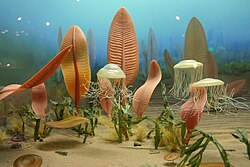
The existence of life, especially that of animals, before the Cambrian had long been the subject of debate in paleontology. The apparent suddenness of the Cambrian explosion had no firm explanation, and Charles Darwin himself recognized the challenge it posed for his theory of evolution.1 While reports of Precambrian organisms have been made since Alexander Murray's 1868 discovery of Aspidella, it wasn't until the discovery of Charnia in 1956 that considerable evidence of Precambrian life had been presented.2
The period immediately preceding the Cambrian, the Ediacaran, is now widely accepted of containing animal life. It spans from 635 to 540 million years ago, and covers approximately 2% of Earth's history. Taxonomists have purported a total of 247 described genera from the Ediacaran, 164 of which are accepted as valid.a
Key
 Valid genus - Genera that are accepted by the scientific community
 Junior synonym - Alternative name for an already existing genus
 Unknown status - Unclear if it actually represents a unique organism
 Invalid - Genera that do not represent an actual fossil organism, or are taphonomic varieties of others
List
| Name | Authority | Year | Affinity | Validity | Notes | Country |
|---|---|---|---|---|---|---|
| Akrophyllas3 | Grimes et al. | 2023 | Petalonamae |
|
 Australia Australia
| |
| Albumares45 | Fedonkin | 1976 | Trilobozoa |
|
 Russia Russia
| |
| Alienum6 | Liu et al. | 2024 | Vetulicolia? |
|
 China China
| |
| Amorphia7 | Grytsenko | 2016 |
|
 Ukraine Ukraine
| ||
| Anabylia8 | Vodanjuk | 1989 |
|
Discoid fossil with no clear diagnostic characters | Russia
| |
| Andiva9 | Fedonkin | 2002 | Proarticulata |
|
Russia
| |
| Anfesta10 | Fedonkin | 1984 | Trilobozoa |
|
Russia
| |
| Aninoides11 | Rosse‐Guillevic et al. | 2025 | Petalonamae |
|
 Canada Canada
| |
| Annularidens12 | Ouyang et al. | 2020 | Acritarcha |
|
China
| |
| Annulatubus13 | Carbone et al. | 2015 |
|
Canada
| ||
| Annulusichnus14 | Zhang | 1986 |
|
Junior synonym of Gaojiashania, tubular fossil | China
| |
| Anulitubus15 | Moczydłowska in Moczydłowska et al. | 2021 |
|
 Norway Norway
| ||
| Arborea16 | Glaessner et Wade | 1966 | Petalonamae |
|
Was considered a junior synonym of Charniodiscus, now thought to be a colonial eumetazoan unrelated to rangeomorphs17 | Australia
|
| Archaeaspinus18 | Ivantsov | 2007 | Proarticulata |
|
Russia
| |
| Archaeichnium19 | Glaessner | 1963 |
|
Tubular conical fossil |  Namibia Namibia
| |
| Archangelia520 | Fedonkin | 1979 |
|
Bilaterally symmetric organism with ovoid shape, and midline axial zone. Junior synonym of Onegia nenoxa (according to Grazhdankin, Ph.D. ms.).2122 | Russia
| |
| Arimasia23 | Runnegar et al. | 2024 | Porifera |
|
Early sponge, possibly a member of Archaeocyatha | Namibia
|
| Arkarua24 | Gehling | 1987 | Echinodermata? |
|
Has 5-sided symmetry similar to modern echinoderms | Australia
|
| Armillifera525 | Fedonkin | 1980 | Proarticulata |
|
Russia
| |
| Arumberia26 | Glaessner et Walter | 1975 |
|
Australia
| ||
| Askinica27 | Bekker | 1996 |
|
Discoid fossil with no clear diagnostic characters | Russia
| |
| Aspidella2829 | Billings | 1872 |
|
Biradial discoid fossil | Canada
| |
| Astra7 | Grytsenko | 2016 |
|
Ukraine
| ||
| Atakia30 | Palij | 1979 |
|
Ukraine
| ||
| Attenborites31 | Droser et al. | 2018 |
|
Australia
| ||
| Aulozoon32 | Gehling et Runnegar | 2021 |
|
Australia
| ||
| Auroralumina33 | Dunn et al. | 2022 | Cnidaria |
|
 UK UK
| |
| Ausia34 | Hahn et Pflug | 1985 | Tunicata? |
|
Namibia
| |
| Avalofractus35 | Narbonne, Laflamme, Greentree et Trusler | 2009 | Petalonamae |
|
Canada
| |
| Aviculaichnus36 | Grytsenko | 2009 | Trace fossil |
|
Junior synonym of Nenoxites | Ukraine
|
| Baikalina3738 | Sokolov | 1972 |
|
Junior synonym of Ernietta | Russia
| |
| Barmia27 | Bekker | 1996 |
|
Discoid fossil with no clear diagnostic characters | Russia
| |
| Beltanella39 | Sprigg | 1947 |
|
Discoid fossil with no clear diagnostic characters | Australia
| |
| Beltanelliformis40 | Menner | 1974 | Cyanobacterial colony |
|
Discoid fossil | Russia
|
| Beltanelloides3738 | Sokolov | 1972 |
|
Nomen nudum, synonym of Beltanelliformis | Russia
| |
| Beothukis41 | Brasier et Antcliffe | 2009 | Petalonamae |
|
Canada
| |
| Bernashevia7 | Grytsenko | 2016 |
|
Ukraine
| ||
| Bessarabia42 | Gureev | 1988 |
|
Discoid fossil with no clear diagnostic characters |  Moldova Moldova
| |
| Bilinichnus20 | Fedonkin et Palij | 1979 | Trace fossil |
|
Trace fossil or pseudofossil | Russia
|
| Bjarmia43 | Grazhdankin | 2016 | Scyphozoa |
|
Russia
| |
| Blackbrookia44 | Boynton et Ford | 1995 |
|
Rejected as valid taxon, "ivesheadiomorph"-type fossil structure | UK
| |
| Bomakellia45 | Fedonkin | 1985 | Petalonamae |
|
Possible junior synonym of Rangea | Russia
|
| Bonata2546 | Fedonkin | 1980 |
|
Russia
| ||
| Brachina47 | Wade | 1972 |
|
Australia
| ||
| Bradgatia44 | Boynton et Ford | 1995 | Petalonamae |
|
UK
| |
| Broccoliforma48 | Mason et Narbonne | 2016 | Petalonamae? |
|
Canada
| |
| Bronicella49 | Zaika-Novatsky | 1965 |
|
Discoid fossil with no clear diagnostic characters | Ukraine
| |
| Buchholzbrunnichnus50 | Germs | 1973 | Trace fossil |
|
Namibia
| |
| Bunyerichnus51 | Glaessner | 1969 |
|
Pseudofossil52 | Australia
| |
| Burykhia53 | Fedonkin, Vickers-Rich, Swalla, Trusler et Hall | 2012 | Tunicata? |
|
Russia
| |
| Calyptrina54 | Sokolov | 1965 | Annelida? |
|
Tubular fossil | Russia
|
| Catellichnus55 | Bekker | 1989 | Palaeopascichnida |
|
Russia
| |
| Catenasphaerophyton56 | Yan et al. | 1992 | Palaeopascichnida |
|
China
| |
| Cephalonega57 | Fedonkin in Fedonkin et al. | 2019 | Proarticulata |
|
Russia
| |
| Charnia58 | Ford | 1958 | Petalonamae |
|
UK
| |
| Charniodiscus58 | Ford | 1958 | Petalonamae |
|
UK
| |
| Chondroplon59 | Wade | 1971 |
|
Probably a junior synonym of Dickinsonia | Australia
| |
| Cloudina60 | Germs | 1972 | Annelida? |
|
Tubular fossil | Namibia
|
| Cocardia7 | Grytsenko | 2016 |
|
Ukraine
| ||
| Coniculus15 | Moczydłowska in Moczydłowska et al. | 2021 |
|
Norway
| ||
| Conomedusites16 | Glaessner et Wade | 1966 | Cnidaria? |
|
Australia
| |
| Conotubus1461 | Zhang et Lin | 1986 |
|
Tubular fossil | China
| |
| Convolutubus62 | Vaziri et al. | 2020 |
|
Tubular fossil |  Iran Iran
| |
| Coronacollina63 | Clites, Droser et Gehling | 2012 | Porifera? |
|
Australia
| |
| Corumbella64 | Hahn, Hahn, Leonardos, Pflug et Walde | 1982 |
|
Tubular fossil |  Brazil Brazil
| |
| Costatubus65 | Selly et al. | 2020 |
|
Tubular fossil |  USA USA
| |
| Crassimembrana12 | Ouyang et al. | 2020 | Acritarcha |
|
China
| |
| Culmofrons6667 | Laflamme et al. | 2012 | Petalonamae |
|
Canada
| |
| Curviacus68 | Shen et al. | 2017 | Palaeopascichnida |
|
China
| |
| Cyanorus69 | Ivantsov | 2004 | Proarticulata |
|
Russia
| |
| Cyathinema70 | Agić et al. | 2019 |
|
Norway
| ||
| Cyclomedusa39 | Sprigg | 1947 |
|
Discoid fossil with no clear diagnostic characters | Australia Ukraine Moldova
| |
| Cycliomedusa71 | Zhao et al. | 2025 |
|
Discoid fossil | China
| |
| Dactyloichnus7 | Grytsenko | 2016 | Trace fossil |
|
Ukraine
| |
| Dickinsonia39 | Sprigg | 1947 | Proarticulata |
|
Australia
| |
| Ediacaria39 | Sprigg | 1947 |
|
Discoid fossil with no clear diagnostic characters | Australia
| |
| Elainabella72 | Rowland et Rodriguez | 2014 | Viridiplantae? |
|
Multicellular alga | USA
|
| Elasenia73 | Fedonkin | 1983 |
|
Ukraine
| ||
| Eoandromeda74 | Tang, Yin, Bengtson, Liu, Wang et Gao | 2008 | Ctenophora? |
|
China
| |
| Eocyathispongia75 | Yin et al. | 2015 | Porifera? |
|
Small 3 chambered sponge-like organism | China
|
| Eoporpita47 | Wade | 1972 |
|
Australia
| ||
| Epibaion76 | Ivantsov | 2002 | Trace fossil |
|
Grazing traces of Proarticulata | Russia
|
| Ernietta7778 | Pflug | 1966 | Petalonamae |
|
Namibia
| |
| Estrella79 | Liu et Moczydłowska | 2019 | Acritarcha |
|
A microfossil | China
|
| Evmiaksia10 | Fedonkin | 1984 |
|
Discoid fossil with no clear diagnostic characters | Russia
| |
| Fedomia80 | Serezhnikova et Ivantsov | 2007 | Porifera? |
|
Russia
| |
| Finkoella81 | Martyshyn | 2021 | Tunicata? |
|
F. ucrainica is a pseudofossil, however F. oblonga is of microbial origin | Ukraine
|
| Fistula15 | Moczydłowska in Moczydłowska et al. | 2021 |
|
Not Fistula (Moerch, 1853), replaced by Silicofistula | Norway
| |
| Flavostratum82 | Serezhnikova | 2013 |
|
Russia
| ||
| Fractofusus8384 | Gehling et Narbonne | 2007 | Petalonamae |
|
Canada
| |
| Frondophyllas | Bamforth et Narbonne | 2009 | Petalonamae |
|
Canada
| |
| Funisia85 | Droser et Gehling | 2008 | Porifera? |
|
Tubular fossil | Australia
|
| Ganarake86 | Retallack | 2022 | Lichen? |
|
First interpreted as tubestones, now thought to be earliest preserved remains of a lichen | USA
|
| Gaojiashania1487 | Yang, Zhang et Lin | 1986 | Annelida? |
|
Tubular fossil | China
|
| Garania27 | Bekker | 1996 |
|
Discoid fossil with no clear diagnostic characters | Russia
| |
| Gehlingia88 | McMenamin | 1998 |
|
Australia
| ||
| Gibbavasis89 | Vaziri, Majidifard et Laflamme | 2018 | Tunicata? |
|
Small, oval-shaped form similar to Ausia fenestrata | Iran
|
| Gigarimaneta90 | Taylor et al. | 2021 | Petalonamae |
|
Canada
| |
| Glaessnerina91 | Germs | 1973 | Petalonamae |
|
Junior synonym of Charnia | Australia
|
| Gritcenia92 | Menasova | 2003 |
|
Junior synonym of Nimbia | Ukraine
| |
| Gureevella92 | Menasova | 2003 |
|
Ukraine
| ||
| Hadrynichorde93 | Hofmann, O'Brien et King | 2008 |
|
Canada
| ||
| Hadryniscala93 | Hofmann, O'Brien et King | 2008 |
|
Canada
| ||
| Hagenetta94 | Hahn et Pflug | 1988 |
|
Junior synonym of Beltanelliformis | Namibia
| |
| Hallidaya | Wade | 1969 | Trilobozoa |
|
Australia
| |
| Haootia | Liu et al. | 2014 | Cnidaria |
|
Canada
| |
| Harlaniella373895 | Sokolov | 1972 | Vendotaenid |
|
Tubular fossil | Ukraine
|
| Hapsidophyllas | Bamforth et Narbonne | 2009 | Petalonamae |
|
Canada
| |
| Helicolocellus96 | Wang et al. | 2024 | Porifera |
|
Likely a hexactinellid | China
|
| Hiemalora97 | Fedonkin | 1982 |
|
Russia
| ||
| Houjiashania98 | Liu et al. | 2023 | Phaeophyceae? |
|
China
| |
| Hylaecullulus99 | Kenchington, Dunn & Wilby | 2018 | Petalonamae |
|
Multifoliate Petalonamid similar to Primocandelabrum and Bradgatia. | UK
|
| Ichnusa | Debrenne et Naud | 1981 | Cnidaria |
|
 Italy Italy
| |
| Ikaria | Evans et al. | 2020 | Bilateria |
|
Stem-bilateran | Australia
|
| Inaria100 | Gehling | 1988 |
|
Australia
| ||
| Inkrylovia | Fedonkin | 1979 |
|
Junior synonym of Onegia | Russia
| |
| Intrites25 | Fedonkin | 1980 | Palaeopascichnida |
|
Russia
| |
| Irridinitus73 | Fedonkin | 1983 |
|
Discoid fossil with no clear diagnostic characters | Ukraine
| |
| Ivesheadia44 | Boynton et Ford | 1995 |
|
Rejected as valid taxon, "ivesheadiomorph"-type fossil structure | UK
| |
| Ivovicia18 | Ivantsov | 2007 | Proarticulata |
|
Russia
| |
| Jampolium42 | Gureev | 1988 |
|
Discoid fossil with no clear diagnostic characters | Ukraine
| |
| Kaisalia10 | Fedonkin | 1984 |
|
Discoid fossil with no clear diagnostic characters | Russia
| |
| Karakhtia101 | Ivantsov | 2004 | Proarticulata |
|
Russia
| |
| Keretsa102 | Ivantsov | 2017 |
|
Russia
| ||
| Khatyspytia45 | Fedonkin | 1985 | Petalonamae |
|
Russia
| |
| Kimberella1647103104 | Wade | 1972 | Mollusca? |
|
Australia
| |
| Kimberia16 | Glaessner et Wade | 1966 | Mollusca? |
|
Not Kimberia (Cotton & Woods, 1935), replaced by Kimberella | Australia
|
| Kimberichnus105 | Ivantsov | 2013 | Trace fossil |
|
Grazing traces of Kimberella | Russia
|
| Komarovia7 | Grytsenko | 2016 |
|
Not to be confused with Komarovia, extant genus of flowering plant. | Ukraine
| |
| Kuibisia34 | Hahn et Pflug | 1985 |
|
Namibia
| ||
| Kuckaraukia106 | Ivantsov, Novikov et Razumovskiy | 2015 |
|
Russia
| ||
| Ladariella107 | Diniz et Leme in Diniz, Leme et Boggiani | 2021 |
|
A macroalga of uncertain phylogenetic placement, possibly related to the family Eoholyniaceae. | Brazil
| |
| Ladariophyton107 | Diniz et Leme in Diniz, Leme et Boggiani | 2021 |
|
A macroalga of uncertain phylogenetic placement, possibly related to the family Eoholyniaceae. | Brazil
| |
| Lagoenaforma108 | Agić et al. | 2021 |
|
A flask-shaped microfossil. | Canada Namibia Norway
| |
| Laminasphaera79 | Liu et Moczydłowska | 2019 | Acritarcha |
|
A microfossil | China
|
| Lamonte 109 | Meyer, Xiao, Gill, Schiffbauer, Chen, Zhou et Yuan | 2014 | Trace fossil |
|
China
| |
| Lanceaphyton110 | Wang et al. | 2021 |
|
A high-level eukaryotic macroalga. | China
| |
| Lantianella111 | Wan et al. | 2016 |
|
Putative animal, bears similarities to conulariids | China
| |
| Lobodiscus112 | Zhao et al. | 2024 | Trilobozoa |
|
China
| |
| Lomoziella7 | Grytsenko | 2016 |
|
Ukraine
| ||
| Lomosovis73 | Fedonkin | 1983 |
|
Ukraine
| ||
| Longbizuiella113 | Yi et al. | 2022 |
|
Junior synonym of Horodyskia | China
| |
| Lorenzinites16 | Glaessner et Wade | 1966 | Trilobozoa |
|
Junior synonym of Rugoconites | Australia
|
| Lossinia 18 | Ivantsov | 2007 | Proarticulata |
|
Russia
| |
| Lydonia114 | Pasinetti et al. | 2025 |
|
Canada
| ||
| Madigania115 | Sprigg | 1949 |
|
Not Madigania (Whitley, 1945), replaced by Spriggia | Australia
| |
| Mamsetia116 | McIlroy et al. | 2024 | Cnidaria |
|
Canada
| |
| Margaritiflabellum | Ivantsov | 2014 |
|
Russia
| ||
| Marywadea117 | Glaessner | 1976 | Proarticulata |
|
Australia
| |
| Mawsonites16 | Glaessner et Wade | 1966 |
|
Australia
| ||
| Maxiphyton118 | Ye et al. | 2019 |
|
China
| ||
| Medusinites16 | Glaessner et Wade | 1966 |
|
Discoid fossil with no clear diagnostic characters | Australia
| |
| Medvezichnus45 | Fedonkin | 1985 | Trace fossil |
|
Unique specimen of doubtful nature | Russia
|
| Membranosphaera79 | Liu et Moczydłowska | 2019 | Acritarcha |
|
Not Membranosphaera Samoilovitch in Samoilovitch and Mtchedlishvili, 1961, replaced by Membranospinosphaera | China
|
| Membranospinosphaera119 | Shang et Liu | 2024 | Acritarcha |
|
China
| |
| Mezenia120121 | Sokolov | 1976 |
|
Russia
| ||
| Mialsemia45 | Fedonkin | 1985 | Petalonamae |
|
Junior synonym of Bomakellia (or Rangea) | Russia
|
| Nadalina122 | Narbonne et Hofmann | 1987 |
|
Discoid fossil with no clear diagnostic characters | Canada
| |
| Namacalathus123 | Grotzinger, Watters, et Knoll | 2000 | Lophotrochozoa? |
|
Namibia
| |
| Namalia | Germs | 1968 |
|
Namibia
| ||
| Namamedusium | Zessin | 2008 |
|
Junior synonym of Beltanelliformis | Namibia
| |
| Namapoikia | Wood, Grotzinger et Dickson | 2002 |
|
Namibia
| ||
| Nasepia91 | Germs | 1973 |
|
Namibia
| ||
| Nemiana | Palij | 1976 |
|
Junior synonym of Beltanelliformis | Ukraine Moldova
| |
| Nenoxites | Fedonkin | 1976 | Trace fossil |
|
Russia
| |
| Nepia124 | Golubkova in Golubkova et Kochnev | 2020 | Cyanobacteria |
|
An oscillatorian cyanobacteria. | Russia
|
| Nilpenia125 | Droser et al. | 2014 |
|
Australia
| ||
| Nimbia25 | Fedonkin | 1980 |
|
Russia
| ||
| Noffkarkys126 | Retallack et Broz | 2020 |
|
Australia
| ||
| Obamus | Dzaugis, Evans, Droser, Gehling et Hughes | 2018 |
|
Australia
| ||
| Olgerdina7 | Grytsenko | 2016 |
|
Ukraine
| ||
| Olgunia127 | Luzhnaya | 2025 | Porifera? |
|
Russia
| |
| Onega4 | Fedonkin | 1976 | Proarticulata |
|
Not Onega (Distant, 1908), replaced by Cephalonega | Russia
|
| Onegia120 | Sokolov | 1976 |
|
Russia
| ||
| Orbisiana120 | Sokolov | 1976 | Palaeopascichnida |
|
Russia
| |
| Orthogonium128129130 | Gürich | 1930 |
|
Namibia
| ||
| Ostiosphaera131 | Yin et al. | 2021 |
|
An embryo-like fossil of a eukaryote of uncertain affinities, possibly a holozoan. | China
| |
| Otavia132 | Brain et al. | 2012 | Porifera? |
|
Namibia
| |
| Ovatoscutum16 | Glaessner et Wade | 1966 | Proarticulata |
|
Australia
| |
| Palaeopascichnus133 | Palij | 1976 | Palaeopascichnida |
|
Ukraine
| |
| Palaeophragmodictya134 | Gehling et Rigby | 1996 |
|
Australia
| ||
| Palaeorhopalon135 | Dai et al. | 2024 |
|
Tubular fossil | China
| |
| Palaeospinther92 | Menasova | 2003 |
|
Ukraine
| ||
| Palaeoplatoda136 | Fedonkin | 1979 |
|
Russia
| ||
| Paliella25 | Fedonkin | 1980 |
|
Discoid fossil with no clear diagnostic characters | Russia
| |
| Pambikalbae | Jenkins et Nedin | 2007 |
|
Australia
| ||
| Papillionata39 | Sprigg | 1947 | Proarticulata |
|
Junior synonym of Dickinsonia | Australia
|
| Paracharnia | Sun | 1986 | Petalonamae |
|
China
| |
| Paramackenzia137 | Zhao et al. | 2021 | Mackenziid |
|
China
| |
| Paramedusium128129130 | Gürich | 1933 |
|
Discoid fossil with no clear diagnostic characters | Namibia
| |
| Paravendia69 | Ivantsov | 2004 | Proarticulata |
|
Russia
| |
| Parvancorina138 | Glaessner | 1958 |
|
Australia
| ||
| Parviscopa93 | Hofmann, O'Brien et King | 2008 | Petalonamae |
|
Canada
| |
| Pectinifrons139 | Bamforth, Narbonne et Anderson | 2008 | Petalonamae |
|
Canada
| |
| Persimedusites | Hahn et Pflug | 1980 |
|
Iran
| ||
| Petalostroma | Pflug | 1973 |
|
Rejected as valid taxon | Namibia
| |
| Pharyngomorpha81 | Martyshyn et Uchman | 2021 | Tunicata? |
|
Ukraine
| |
| Phyllozoon | Jenkins et Gehling | 1978 | Proarticulata |
|
Australia
| |
| Pinegia | Fedonkin | 1980 |
|
Not Pinegia (Martynov, 1928), replaced by Hiemalora | Russia
| |
| Piyuania111 | Wan et al. | 2016 |
|
Putative animal, bears similarities to Cnidaria | China
| |
| Planomedusites38 | Sokolov | 1972 |
|
Discoid fossil with no clear diagnostic characters | Ukraine
| |
| Platypholinia45 | Fedonkin | 1985 |
|
Russia
| ||
| Plexus140 | Joel, Droser & Gehling | 2014 | Bilateria |
|
Although more studies are needed, it has been identified as bilaterian. | Australia
|
| Plumeropriscum48 | Mason et Narbonne | 2016 | Petalonamae |
|
Canada
| |
| Podolimirus73 | Fedonkin | 1983 | Proarticulata |
|
Ukraine
| |
| Podoliina | Gureev | 1988 |
|
Junior synonym of Nenoxites | Ukraine
| |
| Pollukia | Gureev | 1987 |
|
Discoid fossil with no clear diagnostic characters | Ukraine
| |
| Pomoria | Fedonkin | 1980 | Trilobozoa |
|
Junior synonym of Tribrachidium | Russia
|
| Poratusiramus113 | Yi et al. | 2022 |
|
China
| ||
| Portfjeldia141 | Willman & Peel | 2022 |
|
Tubular fossil |  Greenland Greenland
| |
| Praecambridium16 | Glaessner et Wade | 1966 | Proarticulata |
|
Australia
| |
| Primocandelabrum93 | Hofmann, O'Brien et King | 2008 | Petalonamae |
|
Canada
| |
| Propaleolina92 | Menasova | 2003 |
|
Tubular fossil | Ukraine
| |
| Protechiurus142 | Glaessner | 1979 | Cnidaria? |
|
Namibia
| |
| Protocodium143 | Chai, Aria et Hua | 2022 | Codiaceae |
|
China
| |
| Protoconites144 | Chen, Xiao and Yuan | 1994 | Cnidaria? |
|
Conical organism with possible affinites to Cnidaria | China
|
| Protodipleurosoma115 | Sprigg | 1949 |
|
Discoid fossil with no clear diagnostic characters | Australia
| |
| Protoniobea115 | Sprigg | 1949 |
|
Discoid fossil with no clear diagnostic characters | Australia
| |
| Pseudohiemaloraichnus36 | Grytsenko | 2009 | Trace fossil |
|
Junior synonym of Nenoxites | Ukraine
|
| Pseudorhizostomites115 | Sprigg | 1949 |
|
Problematic biogenic structure | Australia
| |
| Pseudorhopilema115 | Sprigg | 1949 |
|
Junior synonym of Pseudorhizostomites | Australia
| |
| Pseudovendia145 | Boynton et Ford | 1979 |
|
Rejected as valid taxon, "ivesheadiomorph"-type fossil structures | UK
| |
| Pteridinium128 | Gürich | 1933 | Petalonamae |
|
Namibia
| |
| Qianchuania111 | Wan et al. | 2016 |
|
Putative animal, bears similarities to Cnidaria | China
| |
| Quaestio146 | Evans et al. | 2024 |
|
Australia
| ||
| Ramellina25 | Fedonkin | 1980 |
|
Russia
| ||
| Rangea128129130 | Gürich | 1929 | Petalonamae |
|
Namibia
| |
| Redkinia | Sokolov | 1977 |
|
Russia
| ||
| Rugoconites16 | Glaessner et Wade | 1966 | Trilobozoa |
|
Australia
| |
| Saarina | Sokolov | 1965 |
|
Tubular fossil | Russia
| |
| Seirisphaera | Chen, Xiao et Yuan | 1996 | Palaeopascichnida |
|
Junior synonym of Orbisiana | China
|
| Sekwia147 | Hofmann | 1981 |
|
Discoid fossil with no clear diagnostic characters | Canada
| |
| Sekwitubulus13 | Carbone et al. | 2015 |
|
Tubular fossil | Canada
| |
| Serebrina | Istchenko | 1983 |
|
Ukraine
| ||
| Shaanxilithes148149 | Xing et al, | 1984 |
|
Previously considered a junior synonym of Nenoxites and Gaojiashania | China
| |
| Shepshedia44 | Boynton et Ford | 1995 |
|
Rejected as valid taxon, "ivesheadiomorph"-type fossil structure | UK
| |
| Shufangtubulus135 | Dai et Hua in Dai et al. | 2024 |
|
Tubular fossil | China
| |
| Silicofistula15150 | Moczydłowska in Moczydłowska et al. | 2021 |
|
Norway
| ||
| Sinotubulites151 | Chen, Chen et Qian | 1981 |
|
Tubular fossil | China
| |
| Skinnera | Wade | 1969 | Trilobozoa |
|
Australia
| |
| Skolithos declinatus45 | Fedonkin | 1985 | Trace fossil |
|
Russia
| |
| Solza101 | Ivantsov | 2004 |
|
Russia
| ||
| Somatohelix152 | Sappenfield, Droser et Gehling | 2011 |
|
Tubular fossil | Australia
| |
| Spinomargosphaera119 | Shang et Liu | 2024 | Acritarcha |
|
China
| |
| Sporosphaera153 | Landon et al. | 2019 |
|
China
| ||
| Spriggia154 | Southcott | 1958 |
|
Discoid fossil with no clear diagnostic characters | Australia
| |
| Spriggina138 | Glaessner | 1958 | Proarticulata |
|
Australia
| |
| Staurinidia45 | Fedonkin | 1985 | Cnidaria |
|
Russia
| |
| Stellaria7 | Grytsenko | 2016 |
|
Not to be confused with Stellaria, extant genus of flowering plant. | Ukraine
| |
| Streptichnus155 | Jensen et Runnegar | 2005 | Vendotaenid156 or Trace fossil |
|
Namibia
| |
| Studenicia157 | Gureev | 1983 |
|
Putative Monocraterion trace fossil | Ukraine
| |
| Suzmites | Fedonkin | 1981 |
|
Junior synonym of Onegia | Russia
| |
| Swartpuntia158 | Narbonne, Saylor et Grotzinger | 1997 | Petalonamae |
|
Namibia
| |
| Tamengophyton107 | Diniz et Leme in Diniz, Leme et Boggiani | 2021 |
|
A macroalga of uncertain phylogenetic placement, possibly related to the family Eoholyniaceae. | Brazil
| |
| Tamga 18 | Ivantsov | 2007 | Proarticulata |
|
Russia
| |
| Tateana115 | Sprigg | 1949 |
|
Discoid fossil with no clear diagnostic characters | Australia
| |
| Temnoxa101 | Ivantsov | 2004 | Mollusca? |
|
Russia
| |
| Thectardis159 | Clapham, Narbonne, Gehling, Greentree et Anderson | 2004 | Porifera? |
|
Canada
| |
| Tirasiana5 | Palij | 1976 |
|
Discoid fossil with no clear diagnostic characters | Ukraine Moldova
| |
| Trepassia35 | Narbonne, Laflamme, Greentree et Trusler | 2009 | Petalonamae |
|
Canada
| |
| Tribrachidium160 | Glaessner | 1959 | Trilobozoa |
|
Australia
| |
| Triforillonia161 | Gehling, Narbonne et Anderson | 2000 |
|
Deformed Aspidella | Canada
| |
| Tulaneia162 | Runnegar et Horodyski | 2025 | Petalonamae |
|
USA
| |
| Tungusia163 | Kolosov et Okhlopkova | 2024 | Fungi |
|
Russia
| |
| Tymkivia164 | Martyshyn | 2023 |
|
Ukraine
| ||
| Uncus165 | Hughes, Evans et Droser | 2024 | Ecdysozoa |
|
Possible stem nematoid | Australia
|
| Vaizitsinia | Sokolov et Fedonkin | 1981 | Petalonamae |
|
Junior synonym of Rangea | Russia
|
| Valdainia73 | Fedonkin | 1983 | Proarticulata |
|
Ukraine
| |
| Vaveliksia73 | Fedonkin | 1983 | Porifera? |
|
Ukraine
| |
| Velancorina77 | Pflug | 1966 |
|
Namibia
| ||
| Vendella166 | Gureev | 1987 |
|
Discoid fossil with no clear diagnostic characters | Ukraine
| |
| Vendia | Keller | 1969 | Proarticulata |
|
Russia
| |
| Vendichnus | Fedonkin | 1979 |
|
Possible pseudofossil | Russia
| |
| Vendoconularia167 | Ivantsov et Fedonkin | 2002 | Conulata |
|
Russia
| |
| Vendoglossa | Seilacher | 2007 |
|
Junior synonym of Protechiurus168 | Namibia
| |
| Vendomia4 | Keller | 1976 | Proarticulata |
|
Junior synonym of Dickinsonia | Russia
|
| Vendomyces169 | M. B. Burzin | 1993 | Chytridiomycetes |
|
Russia
| |
| Vendotaenia | Gnilovskaya | 1971 | Vendotaenid |
|
Tubular fossil | Russia
|
| Ventogyrus | Ivantsov et Grazhdankin | 1997 | Ctenophora? |
|
Russia
| |
| Veprina25 | Fedonkin | 1980 | Trace fossil |
|
Russia
| |
| Vernanimalcula | Chen | 2004 | Acritarcha |
|
Possibly a pseudofossil. | China
|
| Verrucosphaera79 | Liu et Moczydłowska | 2019 | Acritarcha |
|
Not Verrucosphaera Górka, 1970, replaced by Spinomargosphaera | China
|
| Vimenites | Fedonkin | 1980 |
|
Russia
| ||
| Vinlandia170 | Brasier, Antcliffe et Liu | 2012 | Petalonamae |
|
Canada
| |
| Virgatia7 | Grytsenko | 2016 |
|
Ukraine
| ||
| Vladimissa45 | Fedonkin | 1985 |
|
Russia
| ||
| Wigwamiella | Runnegar | 1991 |
|
Discoid fossil with no clear diagnostic characters. Regarded as a taphomorph of Aspidella or junior synonym for Pseudorhizostomites171 | Australia
| |
| Windermeria172 | Narbonne | 1994 | Proarticulata |
|
Canada
| |
| Wutubus173 | Chen, Zhou, Xiao, Wang, Guan, Hong et Yuan | 2014 |
|
Tubular fossil | China
| |
| Yangtziramulus174 | Shen, Xiao, Zhou et Yuan | 2009 |
|
China
| ||
| Yarnemia175 | Nesov in Chistyakov et al. | 1984 | Tunicata? |
|
Russia
| |
| Yelovichnus45 | Fedonkin | 1985 | Palaeopascichnida |
|
Junior synonym of Palaeopascichnus | Russia
|
| Yorgia176 | Ivantsov | 1999 | Proarticulata |
|
Russia
| |
| Yilingia177 | Xiao et al. | 2019 | Bilateria |
|
China
| |
| Yuria7 | Grytsenko | 2016 |
|
Ukraine
| ||
| Velocephalina178 | Coutts et al. |
|
This taxon was described in 2019 exclusively in a PhD thesis, therefore it is not recognized as valid and is considered nomen ineditum. | Australia
| ||
| Zolotytsia5 | Fedonkin | 1981 |
|
Russia
| ||
| Zuunia179 | Yang et al. | 2020 | Annelida? |
|
A cloudinid. |  Mongolia Mongolia
|
Notes
Notes
- Mark McMenamin described various taxa from the Clemente Formation in Mexico which are not supported by other researchers and not included in this list.
References
References
- Schopf, J. William (June 2000). "Solution to Darwin's dilemma: Discovery of the missing Precambrian record of life". Proc. Natl. Acad. Sci. U.S.A. 97 (13): 6947–53. Bibcode:2000PNAS...97.6947S. doi:10.1073/pnas.97.13.6947. PMC 34368. PMID 10860955.
- Ford, Trevor. "The discovery of Charnia". Archived from the original on 23 July 2011. Retrieved 12 March 2011.
- Grimes, K. F.; Narbonne, G. M.; Gehling, J. G.; Trusler, P. W.; Dececchi, T. A. (2023). "Elongate Ediacaran fronds from the Flinders Ranges, South Australia". Journal of Paleontology. 98 (2): 249–265. doi:10.1017/jpa.2023.45. S2CID 261631797.
- Keller, B. M.; Fedonkin, M. A. (1976). "New Records of Fossils in the Valdaian Group of the Precambrian on the Syuz'ma River" (PDF). Izvestiya Akademii Nauk SSR. Seriya Geologicheskaya (in Russian). 3: 38–44. Archived from the original (PDF) on 2007-09-27.
- Fedonkin, M. A. (1981). "Беломорская Биота Венда (докембрийская бесскелетная фауна севера Русской платформы):: Тр. ГИН АН СССР; Вып. 342" [White Sea Vendian Biota (Precambrian non-skeleton fauna of the russian platform north)] (PDF). Proceedings of the Geological Institute of the Academy of Sciences of the USSR (in Russian). 342. Moscow: Nauka: 100.
- Liu, Junping; Chen, Ailin; Li, Binglin; Tang, Feng; Zhao, Jiangtai; Chen, Ke (6 October 2024). "Problematic Ediacaran sail-shaped fossils from eastern Yunnan, China". Historical Biology. 37 (7): 1614–1620. doi:10.1080/08912963.2024.2403588.
- Grytsenko, V. (2016). "A New Discovery of Metazoa Imprints and Ichnofossils in the Vendian Mohyliv Suite from the Bernashivka Quarry" (PDF). Proceedings of the National Museum of Natural History. 2016 (14). Kiev, Ukraine: 23–34. doi:10.15407/vnm.2016.14.023. ISSN 2219-7516.
- Vodanjuk, S.A. (1989). "Остатки бесскелетных метазоа из хатыспытской свиты Оленекского поднятия" [The remains of skeletal metazoa from the Khatyspyt suite of the Olenek uplift]. In Sovetov Yu.K., Khomentovsky V.V. (ed.). Поздний докембрий и ранний палеозой Сибири. Актуальные вопросы стратиграфии [Late Precambrian and Early Paleozoic of Siberia. Actual issues of stratigraphy.] (PDF) (in Russian). Novosibirsk: IGiG SO AN SSSR. pp. 61–75.
- Fedonkin, M. A. (2002). "Andiva ivantsovi gen. et sp. n. and related carapace-bearing Ediacaran fossils from the Vendian of the Winter Coast, White Sea, Russia". Italian Journal of Zoology. 69 (2): 175–181. Bibcode:2002IJZoo..69..175F. doi:10.1080/11250000209356456. S2CID 85352552.
- Fedonkin, M. A. (1984). "Promorphology of the Vendian Radialia". In Sokolov, B. S.; Iwanowski, A. B. (eds.). Stratigraphy and Paleontology of the Earliest Phanerozoic (in Russian). Moscow: Nauka. pp. 30–58.
- Rosse-Guillevic, Simon; Muirhead-Hunt, Heléna; McIlroy, Duncan (November 2025). "Aninoides : a new rangeomorph genus from the upper Ediacaran of Newfoundland". Papers in Palaeontology. 11 (6) e70061. Bibcode:2025PPal...1170061R. doi:10.1002/spp2.70061.
- Qing Ouyang; Chuanming Zhou; Shuhai Xiao; Chengguo Guan; Zhe Chen; Xunlai Yuan; Yunpeng Sun (2020). "Distribution of Ediacaran acanthomorphic acritarchs in the lower Doushantuo Formation of the Yangtze Gorges area, South China: Evolutionary and stratigraphic implications". Precambrian Research. 353 106005. doi:10.1016/j.precamres.2020.106005. S2CID 229474040.
- Calla A. Carbone; Guy M. Narbonne; Francis A. Macdonald; Thomas H. Boag (2015). "New Ediacaran fossils from the uppermost Blueflower Formation, northwest Canada: disentangling biostratigraphy and paleoecology". Journal of Paleontology. 89 (2): 281–291. Bibcode:2015JPal...89..281C. doi:10.1017/jpa.2014.25. S2CID 131344652.
- Zhang, L. (1986). "A discovery and preliminary study of the late stage of late Gaojiashan biota from Sinian in Ningqiang County, Shaanxi". Bulletin of the Xi'an Institute of Geology and Mineral Resources. Chinese Academy of Geological Sciences. 13: 67–88. Archived from the original on 2019-07-10. Retrieved 2019-07-10.
- Moczydłowska, M.; Kear, B. P.; Snitting, D.; Liu, L.; Lazor, P.; Majka, J. (2021). "Ediacaran metazoan fossils with siliceous skeletons from the Digermulen Peninsula of Arctic Norway". Journal of Paleontology. 95 (3): 440–475. Bibcode:2021JPal...95..440M. doi:10.1017/jpa.2020.105. S2CID 233301935.
- Glaessner, M.F.; Wade, M. (1966). "The late Precambrian fossils from Ediacara, South Australia" (PDF). Palaeontology. 9 (4): 599–628. Archived from the original on 2013-09-22.
- Dunn, Frances S.; Liu, Alexander G.; Gehling, James G. (2019-05-17). "Anatomical and ontogenetic reassessment of the Ediacaran frond Arborea arborea and its placement within total group Eumetazoa". Palaeontology. 62 (5): 851–865. Bibcode:2019Palgy..62..851D. doi:10.1111/pala.12431. hdl:1983/5677888d-1cd1-4e92-8aa8-57940f30626a. ISSN 0031-0239.
- Ivantsov, A. Yu. (2007). "Small Vendian transversely Articulated fossils". Paleontological Journal. 41 (2): 113–122. Bibcode:2007PalJ...41..113I. doi:10.1134/S0031030107020013. S2CID 86636748.
- Glaessner, M. F. (1963). "Zur Kenntnis der Nama-Fossilien Südwest-Afrikas" (PDF). Naturhistorisches Museum Wien. Bd. 66 (1962): 113–120.
- Paliy, V. M.; Posti, E.; Fedonkin, M. A. (1979). "Мягкотелые метазоа и ископаемые следы животных венда и раннего кембрия: In Палеонтология верхнедокембрийских и кембрийских отложений Восточно-Европейской платформы" [Soft-bodied Metazoa and trace fossils of Vendian and Lower Cambrian: In Upper Precambrian and Cambrian Paleontology of East-European Platform] (PDF). Беломорская Биота Вейда [White Sea Biota Veida] (in Russian). Moscow: Nauka: 49–82.
- Grazhdankin, D. (2004). "Patterns of distribution in the Ediacaran biotas: facies versus biogeography and evolution". Paleobiology. 30 (2): 203–221. Bibcode:2004Pbio...30..203G. doi:10.1666/0094-8373(2004)030<0203:PODITE>2.0.CO;2. S2CID 129376371.
- Shen, B. (2007). Contributions to the Neoproterozoic Geobiology (PDF) (Ph.D.). Virginia Tech. S2CID 131699809. Archived from the original (PDF) on 2019-07-13.
- Runnegar, Bruce; Gehling, James G.; Jensen, Sören; Saltzman, Matthew R. (October 2024). "Ediacaran paleobiology and biostratigraphy of the Nama Group, Namibia, with emphasis on the erniettomorphs, tubular and trace fossils, and a new sponge, Arimasia germsi n. gen. n. sp". Journal of Paleontology. 98 (S94): 1–59. Bibcode:2024JPal...98S...1R. doi:10.1017/jpa.2023.81.
- Gehling, J. G. (1987). "Earliest known echinoderm — a new Ediacaran fossil from the Pound Subgroup of South Australia". Alcheringa: An Australasian Journal of Palaeontology. 11 (4): 337–345. Bibcode:1987Alch...11..337G. doi:10.1080/03115518708619143.
- Fedonkin, M. A. (1980). "Новые представители докембрийских кишечнополостных на севере Русской платформы" [New representatives of Precambrian coelenterates on the north of the Russian Platform]. Paleontologicheskii Zhurnal (in Russian). 2: 183–192.
- Glaessner, M. F.; Walter, M. R. (1975). "New Precambrian fossils from the Arumbera Sandstone, Northern Territory, Australia". Alcheringa: An Australasian Journal of Palaeontology. 1 (1): 59–69. Bibcode:1975Alch....1...59G. doi:10.1080/03115517508619480.
- Bekker, Yu. R. (1996). "Discovery of the Ediacaran biota in the roof of the Vendian of the southern Ural Mountains". Regional Geology and Metallogeny. 4: 111–131.
- Billings, E. (1872). "On some fossils from the primordial rocks of Newfoundland". The Canadian Naturalist. 2nd Series. 6 (4): 465–479.
- Gehling, James G.; Narbonne, Guy M.; Anderson, Michael M. (2003). "The first named Ediacaran body fossil, Aspidella terranovica". Palaeontology. 43 (3): 427–456. Bibcode:2000Palgy..43..427G. doi:10.1111/j.0031-0239.2000.00134.x.
- Paliy, V.M. (1979). "Remains of soft-bodied fauna and trace fossils of the Upper Precambrian and Lower Cambrian deposits from Podolia". Paleontologiya I Stratigrafiya Verkhnego Dokembriya I Nizhnego Paleozoya Yugo-zapada Vostochno-Evropeiskoi Platformy [Paleontology and Stratigraphy of Upper Precambrian and Lower Cambrian in Southwestern Areas of the East European Platform] (in Russian). Kiev: Naukova Dumka: 63–76.
- Evans, S. D.; Dzaugis, P. W.; Droser, M. L.; Gehling, J. G. (2020). "You can get anything you want from Alice's Restaurant Bed: Exceptional preservation and an unusual fossil assemblage from a newly excavated bed (Ediacara Member, Nilpena, South Australia)". Australian Journal of Earth Sciences. 67 (6): 873–883. Bibcode:2020AuJES..67..873E. doi:10.1080/08120099.2018.1470110.
- Gehling, J. G.; Runnegar, B. (2021). "Phyllozoon and Aulozoon: key components of a novel Ediacaran death assemblage in Bathtub Gorge, Heysen Range, South Australia". Geological Magazine. 159 (7): 1134–1147. doi:10.1017/S0016756821000509.
- F. S. Dunn; C. G. Kenchington; L. A. Parry; J. W. Clark; R. S. Kendall; P. R. Wilby (25 July 2022). "A crown-group cnidarian from the Ediacaran of Charnwood Forest, UK". nature.com. Nature, Ecology and Evolution. doi:10.5285/4c2f9f34-184d-43db-97e0-eecb13918375. Retrieved 25 July 2022.
- Hahn, G.; Pflug, H. D. (1985). "Eight Polypenartige Organismen aus dem Jung-Präkambrium (Nama-Gruppe) von Namibia". Geologica et Palaeontologica. 19: 1–13.
- Narbonne, G. M.; Laflamme, M.; Greentree, C.; Trusler, P. (2009). "Reconstructing a Lost World: Ediacaran Rangeomorphs from Spaniard's Bay, Newfoundland". Journal of Paleontology. 83 (4): 503–523. Bibcode:2009JPal...83..503N. doi:10.1666/08-072R1.1. S2CID 129788025.
- Grytsenko, V.P. (2009). "Нові знахідки іхнофосилій у Бронницьких Верствах (могилів-подільська серія венду) та палеоекологічні умови подільського морського басейну у Бронницький час*" [New finds of ichnofossils in the Bronnitsa Beds (mohyliv-podolian series of the vendian) and environmental conditions of the podolian sea basin in the Bronnitsa time]. Collection of Scientific Works of the Institute of Geological Sciences of the NAS of Ukraine (in Ukrainian). 2. Ukraine: 30–35. doi:10.30836/igs.2522-9753.2009.147869.
- Sokolov, B. S. (1972). Вендский этап в истории Земли. Палеонтология [The Vendian stage in Earth history. Palaeontologia.]. In 24 сес. МГК. Докл. сов. геологов; Пробл. 7 (in Russian). Moscow: Nauka. pp. 114–124.
- Sokolov, B. S. (1972). The Vendian stage in Earth history. Palaeontologia. In International Geological Congress. 24th session. Reports. Vol. S.1. Montreal, Canada. pp. 78–84.
- Sprigg, R. C. (1947). "Early Cambrian (?) Jellyfishes from the Flinders Ranges, South Australia". Trans. R. Soc. S. Aust. 71: 212–224.
- Keller, B. M.; Menner, V. V.; Stepanov, V. A. & Chumakov, N. M. (1974). "Новые находки Metazoa в вендомии Руссой платформы" [New Finds of Metazoa in the Vendomii of the Russian Platform] (PDF). Izv. Akad. Nauk SSSR, Ser. Geol. (in Russian). 12: 130–134. Archived from the original (PDF) on 2007-02-07.
- Brasier, M. D.; Antcliffe, J. B. (2009). "Evolutionary relationships within the Avalonian Ediacara biota: New insights from laser analysis". Journal of the Geological Society. 166 (2): 363–384. Bibcode:2009JGSoc.166..363B. doi:10.1144/0016-76492008-011. S2CID 128827652.
- Gureev, Yu. A. (1988). "Non-skeletal Vendian Fauna". In Ryabenko, V.A. (Ed.): Biostratigrafiya I Paleogeograficheskie Rekonstruktsii Dokembriya Ukrainy (in Russian). Kiev: Naukova Dumka: 65–81.
- Dmitriy Grazhdankin (2016). "Forbidden fruits in the Garden of Ediacara". PalZ. 90 (4): 649–657. Bibcode:2016PalZ...90..649G. doi:10.1007/s12542-016-0327-3. S2CID 132483047.
- H. E. Boynton; T. D. Ford (1995). "Ediacaran Fossils from the Precambrian (Charnian Supergroup) of Charnwood Forest, Leicestershire, England". Mercian Geologist. 13 (4): 165–182.
- Fedonkin, M. A. (1985). "Systematic Description of Vendian Metazoa". In Sokolov, B. S.; Iwanowski, A. B. (eds.). Vendian System: Historical–Geological and Paleontological Foundation, Vol. 1: Paleontology (in Russian). Moscow: Nauka. pp. 70–106.
- Fedonkin, M. A.; Gehling, J. G.; Grey, K.; Narbonne, G. M.; Vickers-Rich, P. (2007). The Rise of Animals: Evolution and Diversification of the Kingdom Animalia. Vol. 2. Baltimore: Johns Hopkins University Press. p. 344. ISBN 978-0-8018-8679-9.
- Wade, M. (1972). "Hydrozoa and Scyphozoa and other medusoids from the Precambrian Ediacara fauna, South Australia" (PDF). Palaeontology. 15: 197–225. Archived from the original on 2011-04-09.
- Sara J. Mason; Guy M. Narbonne (2016). "Two new Ediacaran small fronds from Mistaken Point, Newfoundland". Journal of Paleontology. 90 (2): 183–194. Bibcode:2016JPal...90..183M. doi:10.1017/jpa.2016.14. S2CID 89425525.
- Zaika-Novatsky, V.S. (1965). New problematic imprints from the Upper Precambrian of the Dniester Region. In Vsesoyuznyisimpozium po paleontologii dokembriya i rannego kembriya: Tezi sy dok la dov (All-Union Symposium on Paleontology of the Precambrian and Early Cambrian: Theses have been proved. Novosibirsk: Inst.Geol. Geofiz. Sib. Otd. Akad.: Nauk SSSR. pp. 98–99.
- Germs, G.J.B. (1973). "Possible Sprigginid Worm and a New Trace Fossil from the Nama Group, South West Africa". Geology. 1 (2): 69–70. Bibcode:1973Geo.....1...69G. doi:10.1130/0091-7613(1973)1<69:PSWAAN>2.0.CO;2.
- Glaessner, M.F. (1969). "Trace fossils from the Precambrian and basal Cambrian". Lethaia. 2 (4). Oslo: 369–393. Bibcode:1969Letha...2..369G. doi:10.1111/j.1502-3931.1969.tb01258.x.
- Häntzschel, W. (1975). R.C. Moore (ed.). Part W, Miscellanea, Supplement 1, Trace fossils and Problematica. Treatise on Invertebrate Paleontology (2nd (Revised and Enlarged) ed.). Lawrence, Kansas: Geological Society of America and The University of Kansas Press. doi:10.17161/tip.v0i0.5426. Retrieved 31 December 2025.
- Fedonkin, M. A.; Vickers-Rich, P.; Swalla, B. J.; Trusler, P.; Hall, M. (2012). "A new metazoan from the Vendian of the White Sea, Russia, with possible affinities to the ascidians". Paleontological Journal. 46 (1): 1–11. Bibcode:2012PalJ...46....1F. doi:10.1134/S0031030112010042. S2CID 128415270.
- Sokolov, B. S. (1965). Древнейшие отложения раннего кембрия и сабеллитиды. Всесоюзный симпозиум по палеонтологии докембрия и раннего кембрия: Тез. докладов [The oldest Early Cambrian deposits and sabelliditids. All-Union Symposium on the Paleontology of the Precambrian and early Cambrian: Abstracts] (in Russian). Novosibirsk: Institute of Geology and Geophysics, Siberian Branch of the USSR Academy of Sciences. pp. 78–91.
- Becker, Yu.R.; Kishka, N.V. (1989). "Открытие эдиакарской биоты на Южном Урале" [The discovery of Ediacaran biota in the Southern Urals]. In T.N. Bogdanova & L.I. Khozatsky (ed.). Теоретические и прикладные аспекты современной палеонтологии. Тезисы докладов XXXIII сессии. Всесоюзного палеонтологического общества [Theoretical and applied aspects of modern paleontology. Proceedings of the XXXIII session of the All-Union Paleontological Society.] (PDF) (in Russian). Leningrad: Nauka. pp. 109–120. Archived from the original (PDF) on 2019-08-08. Retrieved 2019-08-08.
- Yan, Y.; Jiang, C.; Zhang, S.; Du, S.; Bi, Z. (1992). "Research of the Sinian System in the region of western Zhejiang, northern Jiangxi, and southern Anhui provinces". Bull. Nanjing Inst. Geol. Mineral Res. Supplementary Issue 12. Chinese Acad. Geol. Sci.: 1–105.
- Ivantsov, A.Y.; Fedonkin, M.A.; Nagovitsyn, A.L.; Zakrevskaya, M.A. (2019). "Cephalonega, a new generic name, and the system of Vendian Proarticulata". Paleontological Journal. 53 (5): 447–454. Bibcode:2019PalJ...53..447I. doi:10.1134/S0031030119050046. S2CID 203853224.
- Ford, T.D. (1958). "Precambrian fossils from Charnwood Forest". Yorkshire Geological Society Proceedings. 31 (3): 211–217. Bibcode:1958PYGS...31..211F. doi:10.1144/pygs.31.3.211.
- Wade, M. (1971). "Bilateral Precambrian chondrophores from the Ediacara fauna, South Australia". Proc R. Soc. Victoria. 84: 183–188.
- Germs, G.J.B. (October 1972). "New shelly fossils from Nama Group, South West Africa". American Journal of Science. 272 (8): 752–761. Bibcode:1972AmJS..272..752G. doi:10.2475/ajs.272.8.752.
- Cai, Y.; Schiffbauer, J.D.; Hua, H.; Xiao, S. (2011). "Morphology and paleoecology of the late Ediacaran tubular fossil Conotubus hemiannulatus from the Gaojiashan Lagerstätte of southern Shaanxi Province, South China". Precambrian Research. 191 (1–2): 46–57. Bibcode:2011PreR..191...46C. doi:10.1016/j.precamres.2011.09.002.
- Seyed Hamid Vaziri; Mahmoud Reza Majidifard; Simon A.F. Darroch; Marc Laflamme (2020). "Ediacaran diversity and paleoecology from central Iran". Journal of Paleontology. 95 (2): 236–251. doi:10.1017/jpa.2020.88. S2CID 232176212.
- Erica C. Clites; Mary L. Droser; James G. Gehling (2012). "The advent of hard-part structural support among the Ediacara biota: Ediacaran harbinger of a Cambrian mode of body construction". Geology. 40 (4): 307–310. Bibcode:2012Geo....40..307C. doi:10.1130/G32828.1.
- Hahn, G.; Hahn, R.; Leonardos, O.H.; Pflug, H.D.; Walde, D.H.G. (1982). "Körperlich erhaltene Scyphozoen-Reste aus dem Jungpräkambrium Brasiliens". Geologica et Palaeontologica. 16: 1–18.
- Selly, T.; Schiffbauer, J. D.; Jacquet, S. M.; Smith, E. F.; Nelson, L. L.; Andreasen, B. D.; Huntley, J. W.; Strange, M. A.; O'Neil, G. R.; Thater, C. A.; Bykova, N.; Steiner, M.; Yang, B.; Cai, Y. (2020). "A New Cloudinid Fossil Assemblage from the Terminal Ediacaran of Nevada, USA". Journal of Systematic Palaeontology. 18 (4): 357–379. Bibcode:2020JSPal..18..357S. doi:10.1080/14772019.2019.1623333. S2CID 199640050.
- Laflamme, M.; Flude, L. I.; Narbonne, G. M. (2012). "Ecological tiering and the evolution of a stem: The oldest stemmed frond from the Ediacaran of Newfoundland Canada". Journal of Paleontology. 86 (2): 193–200. Bibcode:2012JPal...86..193L. doi:10.1666/11-044.1.
- Taylor, R.S.; Hawco, J.B.; Nichols, R.; McIlroy, D. (2019). "A critical reappraisal of the holotype of Beothukis mistakensis, a unique exceptionally preserved rangeomorph organism from Mistaken Point, Newfoundland, Canada". Estudios Geológicos. 75 (2) e117. doi:10.3989/egeol.43586.572.
- Shen, Bing; Xiao, Shuhai; Zhou, Chuanming; Dong, Lin; Chang, Jieqiong; Chen, Zhe (November 2017). "A new modular palaeopascichnid fossil Curviacus ediacaranus new genus and species from the Ediacaran Dengying Formation in the Yangtze Gorges area of South China". Geological Magazine. 154 (6): 1257–1268. Bibcode:2017GeoM..154.1257S. doi:10.1017/S001675681700036X.
- Ivantsov, A. Yu (2004). "New Proarticulata from the Vendian of the Arkhangel'sk Region" (PDF). Paleontological Journal. 38 (3): 247–253. Archived from the original (PDF) on 2007-09-27.
- Heda Agić; Anette E. S. Högström; Małgorzata Moczydłowska; Sören Jensen; Teodoro Palacios; Guido Meinhold; Jan Ove R. Ebbestad; Wendy L. Taylor; Magne Høyberget (2019). "Organically-preserved multicellular eukaryote from the early Ediacaran Nyborg Formation, Arctic Norway". Scientific Reports. 9 (1) 14659. Bibcode:2019NatSR...914659A. doi:10.1038/s41598-019-50650-x. PMC 6787099. PMID 31601898.
- Zhao, Mingsheng; Zhang, Yupeng; Tang, Feng; Li, Yulan; Li, Ming; Zhong, Ling; Ren, Liudong (2025). "Enigmatic discoidal macrofossils with central ring from the Ediacaran Jiangchuan biota, Southwest China". Papers in Palaeontology. 11 (2) e70005. Bibcode:2025PPal...11E0005Z. doi:10.1002/spp2.70005. ISSN 2056-2802.
- Stephen M. (2014). Stephen M. Rowland; Margarita G. Rodriguez. (eds.). "A Multicellular Alga With Exceptional Preservation From the Ediacaran of Nevada". Journal of Paleontology. 88 (2): 263–268. Bibcode:2014JPal...88..263R. doi:10.1666/13-075. S2CID 129796477.
- Fedonkin, M. A. (1983). "Non-skeletal fauna of Podolia, Dniester River valley". In Velikanov, V. A.; Asseeva, E. A.; Fedonkin, M. A. (eds.). The Vendian of the Ukraine (in Russian). Kiev: Naukova Dumka. pp. 128–139.
- Tang, F.; Yin, C.; Bengtson, S.; Liu, P.; Wang Z.; Gao, L. (2008). "Octoradiate Spiral Organisms in the Ediacaran of South China". Acta Geologica Sinica. 82 (1): 27–34. Bibcode:2008AcGlS..82...27T. doi:10.1111/j.1755-6724.2008.tb00321.x. S2CID 128479920.
- Yin, Zongjun; Zhu, Maoyan; Davidson, Eric H.; Bottjer, David J.; Zhao, Fangchen; Tafforeau, Paul (9 March 2015). "Sponge grade body fossil with cellular resolution dating 60 Myr before the Cambrian" (PDF). Proceedings of the National Academy of Sciences. 112 (12): E1453–60. Bibcode:2015PNAS..112E1453Y. doi:10.1073/pnas.1414577112. PMC 4378401. PMID 25775601.
- Ivantsov, A.Y.; Malakhovskaya, Y.E. (2002). "Giant Traces of Vendian Animals" (PDF). Doklady Earth Sciences. 385 (6): 618–622. Archived from the original (PDF) on 2007-07-04.
- Pflug, H.D. (1966). "Neue Fossilreste aus den Nama-Schichten in Südwest-Afrika". Paläontologische Zeitschrift. 40 (1–2): 14–25. Bibcode:1966PalZ...40...14P. doi:10.1007/BF02987628. S2CID 129761531.
- Elliott, D.; Trusler, P.; Narbonne, G.; Vickers-Rich, P.; Morton, N.; Hall, M.; Hoffmann, K.H.; Schneider, G. (2016). "Ernietta from the late Edicaran Nama Group, Namibia". Journal of Paleontology. 90 (6): 1017–1026. Bibcode:2016JPal...90.1017E. doi:10.1017/jpa.2016.94. S2CID 132152164.
- Pengju Liu; Małgorzata Moczydłowska (2019). "Ediacaran microfossils from the Doushantuo Formation chert nodules in the Yangtze Gorges area, South China, and new biozones". Fossils and Strata. Fossils and Strata Series. 65: 1–172. doi:10.1002/9781119564225. ISBN 978-1-119-56422-5. S2CID 241585964.
- Serezhnikova, E. A.; Ivantsov, A. Y. (2007), "Fedomia mikhaili—A new spicule-bearing organism of sponge grade from the Vendian (Ediacaran) of the White Sea, Russia", Palaeoworld, 16 (4): 319–324, Bibcode:2007Palae..16..319S, doi:10.1016/j.palwor.2007.07.004
- Martyshyn, Andrej; Uchman, Alfred (2021). "New Ediacaran fossils from the Ukraine, some with a putative tunicate relationship". PalZ. 95 (4): 623–639. Bibcode:2021PalZ...95..623M. doi:10.1007/s12542-021-00596-1. S2CID 244957825.
- E. A. Serezhnikova (2013). "Attachments of Vendian fossils: Preservation, morphology, morphotypes, and possible morphogenesis". Paleontological Journal. 47 (3): 231–243. Bibcode:2013PalJ...47..231S. doi:10.1134/S0031030113030088. S2CID 85033089.
- Anderson, M.M.; Misra, S.B. (1968). "Fossils found in the Pre-Cambrian Conception Group of South-eastern Newfoundland". Nature. 220 (5168): 680–681. Bibcode:1968Natur.220..680A. doi:10.1038/220680a0. S2CID 4170629.
- Gehling, J.G.; Narbonne, G.M. (2007). "Spindle-shaped Ediacara fossils from the Mistaken Point assemblage, Avalon Zone, Newfoundland". Canadian Journal of Earth Sciences. 44 (3): 367–387. Bibcode:2007CaJES..44..367G. doi:10.1139/e07-003.
- Mary L. Droser & James G. Gehling (2008). "Synchronous Aggregate Growth in an Abundant New Ediacaran Tubular Organism". Science. 319 (5870): 1660–1662. Bibcode:2008Sci...319.1660D. doi:10.1126/science.1152595. PMID 18356525. S2CID 23002564.
- Retallack, Gregory J. (2022). "Early Ediacaran lichen from Death Valley, California, USA". Journal of Palaeosciences. 71 (2): 187–218. doi:10.54991/jop.2022.1841. S2CID 255330797.
- Cai, Y.; Hua, H.; Zhang, X. (2013). "Tube construction and life mode of the late Ediacaran tubular fossil Gaojiashania cyclus from the Gaojiashan Lagerstätte". Precambrian Research. 224: 255–267. Bibcode:2013PreR..224..255C. doi:10.1016/j.precamres.2012.09.022.
- McMenamin M.A.S. (1998). The Garden of Ediacara: Discovering the First Complex Life. New York: Columbia University Press. p. 368. ISBN 978-0-231-10559-0.
- Vaziri, S.H.; Majidifard, M.R.; Laflamme, M. (2018). "Diverse Assemblage of Ediacaran fossils from Central Iran". Scientific Reports. 8 (5060): 5060. Bibcode:2018NatSR...8.5060V. doi:10.1038/s41598-018-23442-y. PMC 5864923. PMID 29567986.
- Taylor, Rod S.; Matthews, Jack J.; Nicholls, Robert; McIlroy, Duncan (2021). "A re-assessment of the taxonomy, palaeobiology and taphonomy of the rangeomorph organism Hapsidophyllas flexibilis from the Ediacaran of Newfoundland, Canada". PalZ. 95 (2): 187–207. Bibcode:2021PalZ...95..187T. doi:10.1007/s12542-020-00537-4. S2CID 232377991.
- Germs, G. J. B. (1973). "A reinterpretation of Rangea schneiderhoehni and the discovery of a related new fossil from the Nama Group, South West Africa". Lethaia. 6 (1): 1–10. Bibcode:1973Letha...6....1G. doi:10.1111/j.1502-3931.1973.tb00870.x.
- Ivantsov, A.Yu.; Gritsenko, V.P.; Paliy, V.M.; Velіkanov, V.A.; Konstantinenko, L.I.; Menasova, A.Sh.; Fedonkin, M.A.; Zakrevskaya, M.A.; Serezhnikova, E.A. (2015). Макрофоссилии верхнего венда Восточной Европы. Среднее Приднестровье и Волынь. [Upper Vendian macrofossils of Eastern Europe. Middle Dniester area and Volhynia] (in Russian and English). Moscow: PIN RAS. ISBN 978-5-903825-32-5. Retrieved 31 December 2025.
- Hofmann, H. J.; O'Brien, S. J.; King, A. F. (2008). "Ediacaran biota on Bonavista Peninsula, Newfoundland, Canada". Journal of Paleontology. 82 (1): 1–36. Bibcode:2008JPal...82....1H. doi:10.1666/06-087.1. ISSN 0022-3360.
- Hahn, G.; Pflug, H.D. (1988). "Zweischalige Organismen aus dem Jung-Prakambrium (Vendium) von Namibia (SW-Afrika)". Geologica et Palaeontologica. 6: 1–19.
- Ivantsov, A.Yu. (2013). "New data on Late Vendian problematic fossils from the genus Harlaniella". Stratigraphy and Geological Correlation. 21 (6): 592–600. Bibcode:2013SGC....21..592I. doi:10.1134/S0869593813060051. S2CID 140579599.
- Wang, Xiaopeng; Liu, Alexander G.; Chen, Zhe; Wu, Chengxi; Liu, Yarong; Wan, Bin; Pang, Ke; Zhou, Chuanming; Yuan, Xunlai; Xiao, Shuhai (2024). "A late-Ediacaran crown-group sponge animal". Nature. 630 (8018): 905–911. Bibcode:2024Natur.630..905W. doi:10.1038/s41586-024-07520-y. PMID 38839967.
- Fedonkin, M.A. (1982). "New generic name for the Precambrian coelenterates". Paleontologicheskii Zhurnal (in Russian). 2: 137.
- Liu, J.; Li, M.; Tang, F.; Zhao, J.; Song, S.; Zhou, Y.; Song, X.; Ren, L. (2023). "New Benthic Fossils from the Late Ediacaran Strata of Southwestern China". Acta Geologica Sinica (English Edition). 98 (2): 311–323. doi:10.1111/1755-6724.15153.
- Kenchington, Charlotte G.; Dunn, Frances S.; Wilby, Philip R. (2018). "Modularity and Overcompensatory Growth in Ediacaran Rangeomorphs Demonstrate Early Adaptations for Coping with Environmental Pressures". Current Biology. 28 (20): 3330–3336.e2. Bibcode:2018CBio...28E3330K. doi:10.1016/j.cub.2018.08.036. PMID 30293718. S2CID 52933769.
- Gehling, James G. (1988). "A cnidarian of actinian-grade from the Ediacaran Pound Subgroup, South Australia". Alcheringa. 12 (4): 299–314. Bibcode:1988Alch...12..299G. doi:10.1080/03115518808619129.
- Ivantsov, A.Y.; Malakhovskaya, Y.E.; Serezhnikova, E.A. (2004). "Some Problematic Fossils from the Vendian of the Southeastern White Sea Region" (PDF). Paleontological Journal. 38 (1): 1–9. Archived from the original (PDF) on 2007-07-04.
- Ivantsov, A.Y. (2017). "The most probable Eumetazoa among late Precambrian macrofossils". Invertebrate Zoology. 14 (2): 127–133. doi:10.15298/invertzool.14.2.05.
- Fedonkin, M. A.; Waggoner, B. M (1997). "The Late Precambrian fossil Kimberella is a mollusc-like bilaterian organism". Nature. 388 (6645): 868–871. Bibcode:1997Natur.388..868F. doi:10.1038/42242. S2CID 4395089.
- Ivantsov, A. Yu. (2010). "Paleontological Evidence for the Supposed Precambrian Occurrence of Mollusks". Paleontological Journal. 44 (12): 1552–1559. Bibcode:2010PalJ...44.1552I. doi:10.1134/S0031030110120105. S2CID 86523806.
- Andrey Yu. Ivantsov (2013). "Trace Fossils of Precambrian Metazoans "Vendobionta" and "Mollusks"". Stratigraphy and Geological Correlation. 21 (3): 252–264. Bibcode:2013SGC....21..252I. doi:10.1134/S0869593813030039. S2CID 128638405.
- A. A. Razumovskiy; A. Yu. Ivantsov; I. A. Novikov; A. V. Korochantsev (2015). "Kuckaraukia multituberculata: A New Vendian Fossil from the Basa Formation of the Asha Group in the South Urals". Paleontological Journal. 49 (5): 449–456. Bibcode:2015PalJ...49..449R. doi:10.1134/S0031030115050111. S2CID 129965088.
- Diniz, C. Q. C.; Leme, J. M.; Boggiani, P. C. (2021). "New Species of Macroalgae from Tamengo Formation, Ediacaran, Brazil". Frontiers in Earth Science. 9 748876. Bibcode:2021FrEaS...9..884D. doi:10.3389/feart.2021.748876.
- Agić, H.; Högström, A. E. S.; Jensen, S.; Ebbestad, J. O. R.; Vickers-Rich, P.; Hall, M.; Matthews, J. J.; Meinhold, G.; Høyberget, M.; Taylor, W. L. (2022). "Late Ediacaran occurrences of the organic-walled microfossils Granomarginata and flask-shaped Lagoenaforma collaris gen. et sp. nov". Geological Magazine. 159 (7): 1071–1092. Bibcode:2022GeoM..159.1071A. doi:10.1017/S0016756821001096. hdl:10037/23056. S2CID 244285285.
- Meyer, M.; Xiao, S.; Gill, B. C.; Schiffbauer, J. D.; Chen, Z.; Zhou, C.; Yuan, X. (2014). "Interactions between Ediacaran animals and microbial mats: Insights from Lamonte trevallis, a new trace fossil from the Dengying Formation of South China". Palaeogeography, Palaeoclimatology, Palaeoecology. 396: 62–74. Bibcode:2014PPP...396...62M. doi:10.1016/j.palaeo.2013.12.026.
- Wang, Ye; Wang, Yue; Du, W.; Li, Y.; Liu, F.; Zhao, M. (2021). "Ediacaran pithy macroalga Lanceaphyton n. gen. from South China". Journal of Paleontology. 96 (2): 452–461. doi:10.1017/jpa.2021.98. S2CID 244162641.
- Wan, Bin; Yuan, Xunlai; Chen, Zhe; Guan, Chengguo; Pang, Ke; Tang, Qing; Xiao, Shuhai (July 2016). "Systematic description of putative animal fossils from the early E diacaran L antian F ormation of S outh C hina". Palaeontology. 59 (4): 515–532. Bibcode:2016Palgy..59..515W. doi:10.1111/pala.12242.
- Zhao, M.; Mussini, G.; Li, Y.; Tang, F.; Vickers-Rich, P.; Li, M.; Chen, A. (2024). "A putative triradial macrofossil from the Ediacaran Jiangchuan Biota". iScience. 27 (2) 108823. Bibcode:2024iSci...27j8823Z. doi:10.1016/j.isci.2024.108823. PMC 10831930. PMID 38303714.
- Yi, Y.; Chen, F.; Algeo, T. J.; Feng, Q. (2022). "Deep-water fossil assemblages from the Ediacaran-Cambrian transition of western Hunan, South China and their biostratigraphic and evolutionary implications". Palaeogeography, Palaeoclimatology, Palaeoecology. 591 110878. Bibcode:2022PPP...59110878Y. doi:10.1016/j.palaeo.2022.110878. S2CID 246806627.
- Pasinetti, G.; Menon, L.; Chida, N.; Olschewski, P.; McKean, C.; Pérez-Pinedo, D.; Taylor, R. S.; McIlroy, D. (2025). "The macrofossil Lydonia jiggamintia gen. et sp. nov. from the Ediacaran of Newfoundland (Canada): From pseudofossil to metazoan-grade organism". Palaeontologia Electronica. 28 (3) 28.3.a39. doi:10.26879/1386.
- Sprigg, R. C. (1949). "Early Cambrian "jellyfishes" of Ediacara, South Australia, and Mount John, Kimberley district, Western Australia". Trans. R. Soc. S. Aust. 73: 72–99.
- McIlroy, D.; Pasinetti, G.; Pérez-Pinedo, D.; McKean, C.; Dufour, S. C.; Matthews, J. J.; Menon, L. R.; Nicholls, R.; Taylor, R. S. (September 2024). "The Palaeobiology of Two Crown Group Cnidarians: Haootia quadriformis and Mamsetia manunis gen. et sp. nov. from the Ediacaran of Newfoundland, Canada". Life. 14 (9): 1096. Bibcode:2024Life...14.1096M. doi:10.3390/life14091096. ISSN 2075-1729. PMC 11432848. PMID 39337880.
- Glaessner, Martin F. (1976). "A new genus of late Precambrian polychaete worms from South Australia" (PDF). Transactions of the Royal Society of South Australia. 100 (3): 169–170. Archived from the original (PDF) on 2007-09-29.
- Qin Ye; Jinnan Tong; Zhihui An; Jun Hu; Li Tian; Kaiping Guan; Shuhai Xiao (2019). "A systematic description of new macrofossil material from the upper Ediacaran Miaohe Member in South China". Journal of Systematic Palaeontology. 17 (3): 183–238. Bibcode:2019JSPal..17..183Y. doi:10.1080/14772019.2017.1404499. S2CID 90479572.
- Shang, X.; Liu, P. (2024). "Taxonomic reviews for genera Megasphaera, Membranospinosphaera and Spinomargosphaera of the Ediacaran spheroidal acritarchs". Precambrian Research. 407 107409. 107409. Bibcode:2024PreR..40707409S. doi:10.1016/j.precamres.2024.107409.
- Sokolov, B. S. (1976). "Organicheskii mir Zemli na puti k fanerozoiskoi differentsiatsii" [Organic World of the Earth on the way to the Phanerozoic differentiation]. Vestnik Akademii Nauk SSSR (in Russian). 1: 126–143.
- Marusin, V. V.; Grazhdankin, D. V.; Maslov, A. V. (2011). "Redkino stage in evolution of Vendian macrophytes". Doklady Earth Sciences. 436 (2): 197–202. Bibcode:2011DokES.436..197M. doi:10.1134/s1028334x11020176. ISSN 1028-334X. S2CID 130597964.
- Narbonne, Guy M. (1987). "Ediacaran biota of the Wernecke Mountains, Yukon, Canada". Palaeontology. 30 (4): 660–661.
- Grotzinger, J.P.; Watters, W.A.; Knoll, A.H. (2000). "Calcified metazoans in thrombolite-stromatolite reefs of the terminal Proterozoic Nama Group, Namibia". Paleobiology. 26 (3): 334–359. Bibcode:2000Pbio...26..334G. doi:10.1666/0094-8373(2000)026<0334:CMITSR>2.0.CO;2. S2CID 52231115.
- E. Yu. Golubkova; B. B. Kochnev (2020). "Filamentous cyanobacteria from the Vendian deposits of the Nepa Regional Stage of interior areas of the Siberian Platform". Paleontological Journal. 54 (5): 542–551. Bibcode:2020PalJ...54..542G. doi:10.1134/S0031030120050068. S2CID 222180442.
- Mary L. Droser; James G. Gehling; Mary E. Dzaugis; Martin J. Kennedy; Dennis Rice; Michael F. Allen (2014). "A New Ediacaran Fossil with a Novel Sediment Displacive Life Habit". Journal of Paleontology. 88 (1): 145–151. Bibcode:2014JPal...88..145D. doi:10.1666/12-158. S2CID 59608504.
- Gregory J. Retallack; Adrian P. Broz (2020). "Arumberia and other Ediacaran fossils from central Australia". Historical Biology. 32 1755281. doi:10.1080/08912963.2020.1755281. S2CID 219432483.
- Luzhnaya, E. A. (April 2025). "New Vendian Metazoa with Colonial Organization". Paleontological Journal. 59 (2): 113–118. Bibcode:2025PalJ...59..113L. doi:10.1134/S0031030125600027.
- Gürich, G. (1933), "Die Kuibis-Fossilien der Nama-Formation von Südwestafrika: Nachträge und Zusätze", Paläontologische Zeitschrift, 15 (2–3): 137–154, doi:10.1007/BF03041648, S2CID 130968715
- Gürich, G. (1930), "Die bisland ältesten Spuren von Organismen in Südafrika", Compte Rendu XV International Geological Congress, South-Africa (1929), Bd2, Pretoria: 670–680
- Gürich, G. (1930), "Über den Kuibis-Quarzit in Südwestafrika", Zeitschrift der Deutschen Geologischen Gesellschaft (in German), 82, Berlin: 637, doi:10.1127/zdgg/82/637a
- Yin, Z.; Sun, W.; Reitner, J.; Zhu, M. (2021). "New holozoans with cellular resolution from the early Ediacaran Weng'an Biota, Southwest China". Journal of the Geological Society. in press. doi:10.1144/jgs2021-061. S2CID 245602253.
- Brain, C. K. 'Bob'; Prave, Anthony R.; Hoffmann, Karl-Heinz; Fallick, Anthony E.; Botha, Andre; Herd, Donald A.; Sturrock, Craig; Young, Iain; Condon, Daniel J.; Allison, Stuart G. (9 January 2012). "The first animals: ca. 760-million-year-old sponge-like fossils from Namibia". South African Journal of Science. 108 (1/2). Bibcode:2012SAJSc.1082.658B. doi:10.4102/sajs.v108i1/2.658. hdl:10023/2295.
- Palij, V.M. (1976). "Ostatki besskeletnoy fauny i sledy zhiznedeyatel'nosti iz otlozheniy verkhnego dokembriya i nizhnego kembriya Podolii. In Paleontologiya i stratigrafiya verkhnego dokembriya i nizhnego paleozoya yugo-zapada Vostochno-Yevropeyskoy platformy" [Remains of the diskeletal fauna and traces of life activity from the deposits of the Upper Precambrian and the lower Cambrian of Podilia. In Paleontology and Stratigraphy of the Upper Precambrian and the Lower Paleozoic of the Southwest of the Eastern European Platform]. Paleontologiya I Stratigrafiya Verkhnego Dokembriya I Nizhnego Paleozoya Jugo-zapadna Vostochno-evropejskoj Platformy (in Russian). Kiev: Naukova Dumka: 63–77.
- Gehling, J. G.; Rigby, J. K. (1996), "Long expected sponges from the Neoproterozoic Ediacara fauna of South Australia", Journal of Paleontology, 70 (2): 185–195, Bibcode:1996JPal...70..185G, doi:10.1017/S0022336000023283, JSTOR 1306383, S2CID 130802211
- Dai, Q.-K.; Hua, H.; Luo, J.-Z.; Min, X.; Pan, X.-Q.; Liu, Z.-W.; Zhang, S.; Bai, L. (2024). "New Ediacaran tubular fossils from southern Shaanxi, China". Palaeoworld. 33 (6): 1464–1477. Bibcode:2024Palae..33.1464D. doi:10.1016/j.palwor.2024.01.004.
- Fedonkin, M.A. (1979). "Палеоихнология докембрия и раннего кембрия // Палеонтология докембрия и раннего кембрия" [Paleoichnology of Precambrian and Early Cambrian In Sokolov, B. S. (ed.). Paleontology of Precambrian and Early Cambrian. 285 p., 1976]. Science (in Russian). Leningrad: Nauka: 183–192.
- Zhao, Y.; Vinther, J.; Li, Y.-J.; Wei, F.; Hou, X.-G.; Cong, P.-Y. (2021). "An early Cambrian mackenziid reveals links to modular Ediacaran macro-organisms". Papers in Palaeontology. 8 e1412. doi:10.1002/spp2.1412. S2CID 244557513.
- Glaessner, Martin F. (1958). "New Fossils from the Base of the Cambrian in South Australia" (PDF). Transactions of the Royal Society of South Australia. 81: 185–88. Archived from the original (PDF) on 2008-12-16.
- Bamforth, Emily L.; Narbonne, Guy M.; Anderson, Michael M. (2008), "Growth and Ecology of a Multi-branched Ediacaran Rangeomorph from the Mistaken Point Assemblage, Newfoundland", Journal of Paleontology, 82 (4): 763–777, Bibcode:2008JPal...82..763B, doi:10.1666/07-112.1, S2CID 128922154
- Lucas V. Joel; Mary L. Droser; James G. Gehling (2014). "A New Enigmatic, Tubular Organism from the Ediacara Member, Rawnsley Quartzite, South Australia". Journal of Paleontology. 88 (2): 253–262. Bibcode:2014JPal...88..253J. doi:10.1666/13-058. S2CID 131446358.
- Willman, S.; Peel, J. S. (2022). "Problematic tubular fossils from the Portfjeld Formation (Ediacaran) of North Greenland". Journal of Paleontology. 98 (2): 1–11. doi:10.1017/jpa.2022.43. S2CID 249330198.
- Glaessner, M. F. (1979). "An echiurid worm from the Late Precambrian". Lethaia. 12 (2): 121–124. Bibcode:1979Letha..12..121G. doi:10.1111/j.1502-3931.1979.tb00991.x. Retrieved 13 April 2026.
- Chai, S.; Aria, C.; Hua, H. (2022). "A stem group Codium alga from the latest Ediacaran of South China provides taxonomic insight into the early diversification of the plant kingdom". BMC Biology. 20 (1). 199. Bibcode:2022BMCB...20..199C. doi:10.1186/s12915-022-01394-0. PMC 9491005. PMID 36127662.
- Chen, Menge; Xioa, Zongzheng; Yuan, Xunlai (1994). 晚震旦世的特种生物群落──庙河生物群新知 [A new assemblage of megafossil-Miaohe biota from Upper Sinian Doushantuo Formation, Yangtze Gorges]. Acta Palaeontologica Sinica (in Chinese and English). 33 (4): 391–403. Retrieved 31 December 2025.
- H. E. Boynton; T. D. Ford (1979). "Pseudovendia charnwoodensis — A new Precambrian arthropod from Charnwood Forest, Leicestershire". Mercian Geologist. 7: 175–177.
- Evans, Scott D.; Hughes, Ian V.; Hughes, Emily B.; Dzaugis, Peter W.; Dzaugis, Matthew P.; Gehling, James G.; García-Bellido, Diego C.; Droser, Mary L. (September 3, 2024). "A new motile animal with implications for the evolution of axial polarity from the Ediacaran of South Australia". Evolution & Development. 26 (6) e12491. doi:10.1111/ede.12491. PMID 39228078 – via CrossRef.
- Hofmann, Hans J. (1981). "First record of a Late Proterozoic faunal assemblage in the North American Cordillera". Lethaia. 14 (4): 305–307. Bibcode:1981Letha..14..303H. doi:10.1111/j.1502-3931.1981.tb01103.x.
- Xing, Y.; Ding, Q.; Luo, H.; He, T.; Wang, Y. "The Sinian-Cambrian Boundary of China". Bulletin of the Institute of Geology of the Chinese Academy (in Chinese) (10): 1–262.
- Wang, Xin; Zhang, Xingliang; Zhang, Yuan; Cui, Linhao; Li, Luoyang (August 2021). "New materials reveal Shaanxilithes as a Cloudina-like organism of the late Ediacaran". Precambrian Research. 362 106277. Bibcode:2021PreR..36206277W. doi:10.1016/j.precamres.2021.106277.
- Moczydłowska, M.; Kear, B. P.; Snitting, D.; Liu, L.; Lazor, P.; Majka, J. (2021). "Ediacaran metazoan fossils with siliceous skeletons from the Digermulen Peninsula of Arctic Norway – CORRIGENDUM". Journal of Paleontology. 95 (5): 1112. Bibcode:2021JPal...95.1112M. doi:10.1017/jpa.2021.44.
- Chen, Meng-E.; Chen, Yi-yuan; Qian, Yi (1981). "Some tubular fossils from Sinian–lower Cambrian boundary sequences, Yangtze Gorge". Bulletin, Tianjin Institute of Geology and Mineral Resources. 3: 117–124.
- Sappenfield, A.; Droser, M. L.; Gehling, J. G. (2011). "Problematica, Trace Fossils, and Tubes within the Ediacara Member (South Australia): Redefining the Ediacaran Trace Fossil Record One Tube at a Time". Journal of Paleontology. 85 (2): 256–265. Bibcode:2011JPal...85..256S. doi:10.1666/10-068.1. S2CID 129326221.
- Emma N.U. Landon; Peng-Ju Liu; Zong-Jun Yin; Wei-Chen Sun; Xiao-Dong Shang; Philip C.J. Donoghue (2019). "Cellular preservation of excysting developmental stages of new eukaryotes from the early Ediacaran Weng'an Biota" (PDF). Palaeoworld. 28 (4): 461–468. doi:10.1016/j.palwor.2019.05.005. hdl:1983/5f1cbbee-9d1b-4fb6-b3db-55266de0599d. S2CID 182559934.
- Southcott, R.V. (1958). "South Australian jellyfish". The South Australian Naturalist. 32: 53–61.
- Jensen, S. & Runnegar, B.N. (2005). "A complex trace fossil from the Spitskop Member (terminal Ediacaran–? Lower Cambrian) of Southern Namibia". Geol. Mag. 142 (5): 561–569. Bibcode:2005GeoM..142..561J. doi:10.1017/S0016756805000853. hdl:10662/24370. S2CID 128839338.
- Ivantsov, A.Y. (2013). "New Data on Late Vendian Problematic Fossils from the Genus Harlaniella". Paleontological Journal. 21 (6): 592–600. Bibcode:2013SGC....21..592I. doi:10.1134/S0869593813060051. S2CID 140579599.
- Gureev, Yu.A. (1983). "O novoi forme iskopaemykh sledov iz nizhnebaltiyskikh otlozheniy Podolskogo Pridnestrov'iya" [On a new form of fossil traces from Lower Baltic deposits of Podolian Middle Dniester area]. Paleontol. Sbornik Lvovskogo universitet [Paleontol. Collection of Lviv University] (in Russian). Lvov: Vischa Schkola. pp. 70–73.
- Narbonne, G.M.; Saylor, B.Z.; Grotzinger, J.P. (1997). "The Youngest Ediacaran Fossils from Southern Africa". Journal of Paleontology. 71 (6): 953–967. Bibcode:1997JPal...71..953N. doi:10.1017/S0022336000035940. PMID 11541433. S2CID 28211337.
- Clapham, M.E.; Narbonne, G.M.; Gehling, J.G.; Greentree, C.; Anderson, M.M. (2004). "Thectardis avalonensis: A New Ediacaran Fossil from the Mistaken Point Biota, Newfoundland" (PDF). Journal of Paleontology. 78 (6): 1031–1036. CiteSeerX 10.1.1.506.5727. doi:10.1666/0022-3360(2004)078<1031:TAANEF>2.0.CO;2. Archived from the original (PDF) on 2012-07-31.
- Glaessner, M.F.; Daily, B. (1959). "The geology and Late Precambrian fauna of the Ediacara fossil reserve" (PDF). Records of the South Australian Museum. 13 (3): 369–401. Archived from the original (PDF) on 2008-12-17.
- Gehling, J. G.; Narbonne, G. M.; Anderson M. M. (2000). "The first named Ediacaran body fossil, Aspidella terranovica". Palaeontology. 43 (3): 427–456. Bibcode:2000Palgy..43..427G. doi:10.1111/j.0031-0239.2000.00134.x.
- Runnegar, B.; Horodyski, R. J.; Gehling, J. G.; Jensen, S.; Bengtson, S.; Peterson, K. J.; Saltzman, M. R.; Vendrasco, M. J. (2025). "Tulaneia amabilia n. gen. n. sp.: a new erniettomorph from the Wood Canyon Formation, Nevada and the age of the Ediacaran–Cambrian transition in the Great Basin". Journal of Paleontology. 98 (6): 929–951. doi:10.1017/jpa.2024.45.
- Kolosov, P.; Okhlopkova, I. (2024). "Yeast fungi in the Ediacaran stromatolites of the Siberian Platform". Revista Brasileira de Paleontologia. 27 (3). e20240403. Bibcode:2024RvBrP..27E0403K. doi:10.4072/rbp.2024.3.0403.
- Martyshyn, A. I. (2023). "Tymkivia primitiva gen. nov. sp. nov., a new type of fossils from the Late Ediacaran (Vendian) Kanylivka Group in Podolia, Ukraine". Geologičnij žurnal. 2023 (2): 58–67. doi:10.30836/igs.1025-6814.2023.2.275044. S2CID 259549401.
- Hughes, Ian V.; Evans, Scott D.; Droser, Mary L. (18 November 2024). "An Ediacaran bilaterian with an ecdysozoan affinity from South Australia". Current Biology. 34 (24): 5782–5788.e1. Bibcode:2024CBio...34.5782H. doi:10.1016/j.cub.2024.10.030. PMID 39561775.
- Gureev, Yu. A. (1987). Морфологический анализ и систематика вендиат [Morphological analysis and systematics of the vendian] (in Russian). Kiev: IGN AN USSR. p. 54.
- Ivantsov, A. Y.; Fedonkin, M. A. (2002). "Conulariid-like fossil from the Vendian of Russia: a metazoan clade across the Proterozoic/Palaeozoic boundary". Palaeontology. 45 (6): 1119–1129. Bibcode:2002Palgy..45.1219I. doi:10.1111/1475-4983.00283.
- Ivantsov, A.Yu.; Vickers-Rich, P.; Zakrevskaya, M.A.; Hall, M. (2019). "Conical Thecae of Precambrian Macroorganisms" (Free full text). Paleontological Journal. 53 (11): 1134–1146. Bibcode:2019PalJ...53.1134I. doi:10.1134/S0031030119110054. S2CID 212642725.
- Butterfield, N. J. (2005). "Probable Proterozoic fungi". Paleobiology. 31 (1): 165–182. Bibcode:2005Pbio...31..165B. doi:10.1666/0094-8373(2005)031<0165:PPF>2.0.CO;2. S2CID 86332371.
- Brasier, M.D.; Antcliffe, J.B.; Liu, A.G. (2012). "The architecture of Ediacaran Fronds". Palaeontology. 55 (5): 503–523. Bibcode:2012Palgy..55.1105B. doi:10.1111/j.1475-4983.2012.01164.x. S2CID 86538017.
- Droser, Mary L.; Tarhan, Lidya G.; Evans, Scott D.; Surprenant, Rachel L.; Gehling, James G. (6 August 2020). "Biostratinomy of the Ediacara Member (Rawnsley Quartzite, South Australia): implications for depositional environments, ecology and biology of Ediacara organisms". Interface Focus. 10 (4) 20190100. Bibcode:2020InFoc..1090100D. doi:10.1098/rsfs.2019.0100. PMC 7333909. PMID 32642047.
- Narbonne, G. M. (1994). "New Ediacaran fossils from the Mackenzie Mountains, northwestern Canada". Journal of Paleontology. 63 (3): 411–416. Bibcode:1994JPal...68..411N. doi:10.1017/S0022336000025816. JSTOR 1306192. S2CID 133215767.
- Zhe Chen; Chuanming Zhou; Shuhai Xiao; Wei Wang; Chengguo Guan; Hong Hua; Xunlai Yuan (2014). "New Ediacara fossils preserved in marine limestone and their ecological implications". Scientific Reports. 4 4180. Bibcode:2014NatSR...4.4180C. doi:10.1038/srep04180. PMC 3933909. PMID 24566959.
- Shen, B.; Xiao, S.; Chuanming, Z.; Yuan, X. (2009). "Yangtziramulus zhangi New Genus and Species, a Carbonate-Hosted Macrofossil from the Ediacaran Dengying Formation in the Yangtze Gorges Area, South China". Journal of Paleontology. 83 (4): 575–587. Bibcode:2009JPal...83..575S. doi:10.1666/08-042R1.1. S2CID 128556507.
- Chistyakov, V.G.; Kalmykova, N.A.; Nesov, L.A.; Suslov, G.A. (1984). "О наличии вендских отложений в среднем течении р. Онеги и возможном существовании оболочечников (Tunicata: Chordata) в докембрии" [On the Presence of Vendian Deposits in the Middle Course of the Onega River and Presumable Existence of Tunica (Tunicata: Chordata) in Precambrian] (PDF). Vest. Leningrad. Gos. Univ. (in Russian). 6: 11–19. Archived from the original (PDF) on 2007-02-07.
- Ivantsov, A.Y. (1999). "A New Dickinsonid from the Upper Vendian of the White Sea Winter Coast (Russia, Arkhangelsk Region)". Paleontological Journal. 33 (3): 233–241.
- Xiao, Shuhai; Chen, Zhe; Pang, Ke; Zhou, Chuanming; Yuan, Xunlai (January 2021). "The Shibantan Lagerstätte: insights into the Proterozoic–Phanerozoic transition". Journal of the Geological Society. 178 (1) jgs2020-135. Bibcode:2021JGSoc.178..135X. doi:10.1144/jgs2020-135. ISSN 0016-7649.
- Coutts, Felicity J. (January 2019). Palaeoecology of Ediacaran communities from the Flinders Ranges of South Australia (PhD thesis). University of Adelaide. pp. 99–120. doi:10.13140/RG.2.2.27075.96802.
- Ben Yang; Michael Steiner; James D. Schiffbauer; Tara Selly; Xuwen Wu; Cong Zhang; Pengju Liu (2020). "Ultrastructure of Ediacaran cloudinids suggests diverse taphonomic histories and affinities with non-biomineralized annelids". Scientific Reports. 10 (1) 535. Bibcode:2020NatSR..10..535Y. doi:10.1038/s41598-019-56317-x. PMC 6968996. PMID 31953458.