Cryptids are animals or other beings whose present existence is disputed or unsubstantiated by science. Cryptozoology, the study of cryptids, is a pseudoscience claiming that such beings may exist somewhere in the wild; it has been widely critiqued by scientists.1234 The subculture is regularly criticized for reliance on anecdotal information5 and because in the course of investigating animals that most scientists believe are unlikely to have existed, cryptozoologists do not follow the scientific method.6 Many scientists have criticized the plausibility of cryptids due to lack of physical evidence,7 likely misidentifications8 and misinterpretation of stories from folklore.9 While biologists regularly identify new species following established scientific methodology, cryptozoologists focus on entities mentioned in the folklore record and rumor.
List
Aquatic or semi-aquatic
| Name | Other names | Description | Purported location | Depiction |
|---|---|---|---|---|
| Anguila peluda10 | Hairy Eel | Pond animal | Pamital ravine, Canary Islands | |
| Beast of Busco11 | Oscar12 | Giant snapping turtle | Churubusco, Indiana, United States | |
| Bunyip13 | Bahnyip | Amphibious creature | Australia | 
|
| Cadborosaurus14 | Caddy | Sea animal | Pacific Coast of North America | 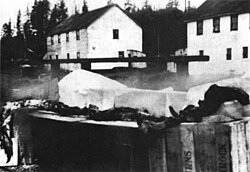
|
| Champ15 | Champy | Lake monster | Lake Champlain, North America | 
|
| Cryptid whales1617 | Giglioli's Whale, Rhinoceros dolphin, High-finned sperm whale, Alula whale, Unidentified beaked whales | Sea animal | Pacific Ocean, Atlantic Ocean, Indian Ocean | 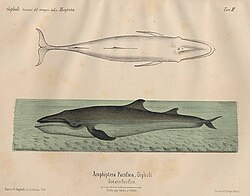
|
| Dobhar-chú18 | Water Hound, King Otter | Extra-large otter-like carnivorous aquatic mammal | Ireland | 
|
| Gloucester sea serpent19 | Large serpent | Gloucester, Massachusetts
(Cape Ann), United States |
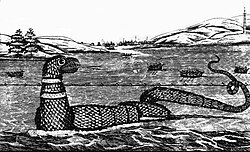 | |
| Iemisch20 | Iemisch Listai | Mix of a jaguar and otter | Patagonian region of Argentina | |
| Igopogo21 | Kempenfelt Kelly | Lake monster | Lake Simcoe, Ontario, Canada | |
| Labynkyr Devil222324 | Labynkyrsky Chert | Lake monster | Oymyakonsky Ulus, Sakha Republic, Russia | |
| Loch Ness Monster25 | Nessie | Lake monster | Loch Ness, Scotland | 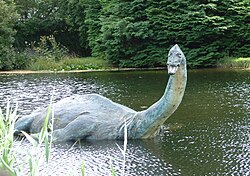
|
| Loveland Frog26 | Loveland frogman, Loveland lizard | Humanoid frog | Loveland, Ohio, United States | 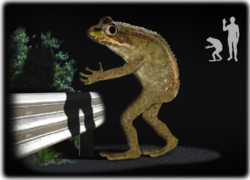
|
| Manipogo27 | Winnipogo | Lake monster | Lake Manitoba, Manitoba, Canada | |
| Mbielu-mbielu-mbielu28 | Stegosaurid dinosaur (lake, river and/or swamp monster) | Democratic Republic of the Congo | 
| |
| Megalodon (surviving populations)293031 | Otodus megalodona | Giant prehistoric shark | Oceans | 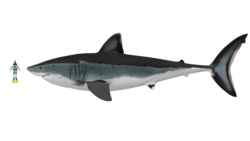
|
| Mermaid32 | Siren33 | Top half human female and bottom half fish | Oceans, various bodies of water | 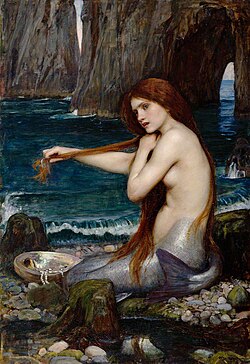
|
| Mokele-mbembe34 | Dinosaur (lake, river and/or swamp monster) | Democratic Republic of the Congo | 
| |
| Montauk Monster3536 | Small bald beaked mammal | Montauk, New York, United States | ||
| Morgawr37 | Sea serpent | Falmouth Bay, Cornwall, United Kingdom | ||
| Ogopogo15 | N'ha•a•itk, Naitaka | Lake monster | Okanagan Lake, British Columbia, Canada | 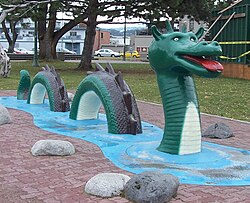
|
| Sea serpents38 | Sea animals, dinosaurs | All bodies of water | 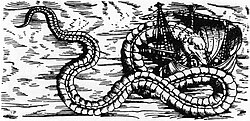
| |
| Selma39 | Seljordsormen | Lake monster | Lake Seljord, Telemark, Norway | 
|
| Steller's sea ape40 | Sea animal | Northern Pacific Ocean | 
| |
| Storsjö monster41 | Lake monster | Lake Storsjön, Jämtland, Sweden | 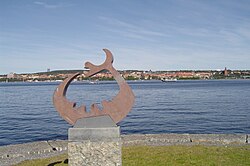
|
Terrestrial
| Name | Other names | Description | Purported location | Depiction |
|---|---|---|---|---|
| British big cats42 | Alien big cats (ABCs), phantom cats, mystery cats, English lions, Beast of Bodmin, Beast of Exmoor |
Non-native, wild big cats | Great Britain | 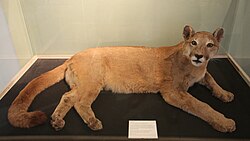
|
| Chupacabra43 | Chupacabras (Spanish for goat-sucker) | Highly variable – typically falling into two categories: 1) bipedal humanoid with spiked spines (original description); 2) a quadrupedal canid44 | Puerto Rico (originally), South and Central America, Southern North America |
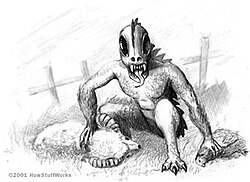
|
| Dover Demon45 | Approximately four-foot tall humanoid creature with glowing eyes | Dover, Massachusetts, United States | 
| |
| Fresno nightcrawler46 | Resembling a pair of white trousers, this creature reportedly has long, white legs immediately topped by a rounded head.47 | Fresno, California, United States | ||
| Goatman484950 | Pope Lick Monster; Lake Worth monster; Satyr; Faun | Humanoid creature with the torso and head of a man (with horns sprouting from the head) and the legs of a goat | Prince George's County, Maryland; Louisville, Kentucky; Lake Worth, Texas | |
| Katanga Snake51 | 50-foot long snake | Katanga Province, Democratic Republic of the Congo | ||
| Lizard Man of Scape Ore Swamp52 | Lizard Man of Lee County | Bipedal, humanoid reptilian creature | Lee County, South Carolina, United States | |
| Michigan Dogman53 | Humanoid dog | Wexford County, Michigan, United States | ||
| Moa (surviving original populations)54b | Dinornis robustus (South Island giant moa), Dinornis novaezelandiae (North Island giant moa), Anomalopteryx didiformis (Bush moa, little bush moa, or lesser moa) | Medium to large flightless birds | New Zealand | 
|
| Mongolian death worm55 | Allghoi (or orghoi) khorkhoi | Worm-like animal | Gobi Desert (Asia) | 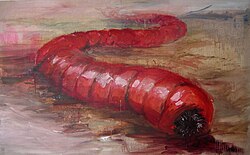
|
| Nandi bear56 | Chemosit, Kerit, Koddoelo, Ngoelo, Ngoloko, Duba | Large, powerfully built carnivore | Eastern Africa | 
|
| Phantom kangaroo5758 | Kangaroos which appear outside of their normal range of Australia and New Guinea. | Chicago, Illinois
Japan United Kingdom Sweden |
||
| Queensland Tiger59 | Yarri | Large feline | Queensland, Australia | |
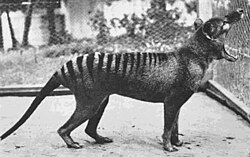
| Thylacine (surviving original populations)6061c | Tasmanian tiger, Tasmanian wolf, Thylacinus cynocephalus | Carnivorous marsupial | Australia,
Papua New Guinea |
|
| Name | Other names | Description | Purported location | Depiction |
|---|---|---|---|---|
| Almas15 | Abnauayu, almasty, albasty, bekk-bok, biabin-guli, golub-yavan, gul-biavan, auli-avan, kaptar, kra-dhun, ksy-giik, ksy-gyik, ochokochi, mirygdy, mulen, voita, wind-man, Zana |
Non-human ape or hominid | Asia/Caucasus | |
| Amomongo62 | Orang Mawas, Impakta | Ape or hominid | Negros Occidental, Philippines | |
| Bigfoot63 | Sasquatch | Large and hairy ape-like creature | United States and Canada | 
|
| Bukit Timah Monkey Man64 | BTM, BTMM | Forest-dwelling hominid or other primate | Singapore | |
| Chatawa Monster6566 | Large ape-like creature | Pike County, Mississippi, United States | ||
| Chuchunya67 | Large hominid | Russia | ||
| Fouke Monster6869 | Jonesville Monster, Southern Sasquatch, Boggy Creek Monster | Hominid or other primate | Arkansas, United States | |
| Honey Island Swamp monster70 | Letiche, Tainted Keitre | Hominid or other primate | Louisiana, United States | |
| Kandahar Giant71 | 13-foot tall, red-headed hominid with six fingers on each hand and two rows of teeth | Kandahar, Afghanistan | ||
| Mapinguari72 | Mapinguary | Man-eating hominid with a mouth on its abdomen; sometimes thought to be a ground sloth | Brazil | 
|
| Nittaewo73 | Nittevo | Small hominid | Sri Lanka | |
| Orang Pendek74 | Small hominid | Sumatra, Indonesia | 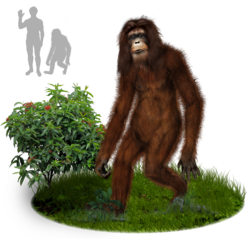
| |
| Skunk ape75 | Stink Ape, Myakka Ape, Myakka Skunk Ape | Primate | Florida, United States | 
|
| Yeren7675 | Yiren, Yeh Ren, Chinese Wildman | Primate (possible hominin) | China | |
| Yeti77 | Abominable Snowman | Large and hairy human-like entity, various other descriptions | Himalayas (Asia) | |
| Yowie73 | Large and hairy human-like entity, various other descriptions | Australia | 
|
Flying
| Name | Other names | Description | Purported location | Depiction |
|---|---|---|---|---|
| Flatwoods monster78 | Braxie, Braxton County Monster, Phantom of Flatwoods | A floating creature with a head that looks like a spade79 | Flatwoods, West Virginia | 
|
| Jersey Devil25 | Leeds Devil | Winged, bipedal horse | United States, mainly the South Jersey Pine Barrens, as well as other parts of New Jersey and southeastern Pennsylvania | 
|
| Kongamato80 | Living species of pterosaur | Mwinilunga, Zambia; | 
| |
| Mothman7881 | Winged bipedal | Mason County, West Virginia, United States | 
|
See also
See also
Notes
Notes
- Otodus is the currently accepted genus name for megalodon. Older sources refer to the genus as Carcharodon, Carcharocles, and several other names.
- There is an ongoing de-extinction project to revive the bush moa through genome editing, this entry refers to the possibility of surviving original populations
- There is an ongoing project to revive the species through genome editing, this entry refers to the unconfirmed sightings and reports of surviving original populations
References
References
- Mullis (2021: 185): "Eschewing the rigors of science, cryptozoologists publish for a popular audience rather than for experts resulting in the practice itself frequently being derided as a pseudoscience."
- Loxton & Prothero (2013: 332): "Whatever the romantic appeal of monster mysteries, cryptozoology as it exists today is unquestionably a pseudoscience." Loxton & Prothero (2013: 320): "Cryptozoology has a reputation of being part of a general pseudoscientific fringe—just one more facet of paranormal belief." (Both quotes from Donald Prothero)
- Church (2009: 251–252): "Cryptozoology has acquired a bad reputation as a pseudoscience [...] Until detailed, methodical research becomes standard practice among cryptozoologists, the field will remain disrespected by more traditional biologists and zoologists."
- Roesch & Moore (2002: 71–78): "Pointing to this rampant speculation and ignorance of established scientific theories in cryptozoology, as well as the field's poor record of success and its reliance on unsystematic, anecdotal evidence, many scientists and skeptics classify cryptozoology as a pseudoscience."
- Shermer, Michael (2 May 2003). "Show Me the Body". Scientific American. Retrieved 8 January 2025.
- Dash, Mike (2000). Borderlands. The Overlook Press. ISBN 978-0-87951-724-3.
- Simpson, George Gaylord (1984). "Mammals and Cryptozoology". Proceedings of the American Philosophical Society. Vol. 128, No. 1 (Mar. 30, 1984), pp. 1–19. American Philosophical Society.
- Cassella, Carly (31 January 2023). "Bigfoot Has a Very Simple Explanation, Scientist Says". ScienceAlert. Retrieved 7 January 2025.
- Loxton & Prothero (2013: 31-32)
- "El misterioso viaje de las anguilas desde el Triángulo de las Bermudas a los barrancos canarios" [The mysterious journey of eels from the Bermuda Triangle to the Canary Island ravines]. ABC Canary Islands (in Spanish). 10 July 2016. Archived from the original on 11 June 2025.
- Mastro, Michelle (17 July 2024). "Could Citizens of This Indiana Town Have Seen a 500-Pound Turtle?". Smithsonian Magazine.
- "Churubusco lake home to the legendary 'Beast of Busco' is on the market". WANE. 16 June 2021.
- Bunyip. (2018). Funk & Wagnalls New World Encyclopedia, 1;
- Loxton & Prothero 2013, pp. 261–295.
- Shermer, Michael; Linse, Pat (November 2002). The Skeptic Encyclopedia of Pseudoscience. Vol. 1. ABC-CLIO. p. 72. ISBN 9781576076538.
- Mörzer Bruyns, W. F. J. (1971). Field guide of whales and dolphins. Rivonverhandeling. Tor. pp. 124–125. ISBN 978-90-70055-09-7
- "Cetaceans with two dorsal fins" (PDF). Archived from the original (PDF) on 13 April 2023. Retrieved 7 January 2023.
- Rafferty, Rachel (30 May 2021). "The myths and legends of Ireland's hound of deep, the Dobhar Chu". Irish Central News. Retrieved 19 December 2018.
- Nicaise, Alexander (5 September 2019). "Gloucester Sea-Serpent Mystery: Solved after Two Centuries | Skeptical Inquirer". Retrieved 25 September 2023.
- Gilmore, David D. (2003). Monsters : evil beings, mythical beasts, and all manner of imaginary terrors. Philadelphia: University of Pennsylvania Press. ISBN 978-0-8122-0322-6. OCLC 802059457.
- "Welcome to Ogopogo Country - Canada's Lake Creature". epe.lac-bac.gc.ca. Retrieved 22 October 2024.
- Lallanilla, Marc (4 February 2013). "Reports Surface of Monster Lurking in Russian Lake". livescience.com. Live Science. Archived from the original on 29 September 2021. Retrieved 21 March 2022.
- "Divers preparing for icy waters of Russia's 'Loch Ness'". siberiantimes.com. The Siberian Times. 5 March 2014. Archived from the original on 28 January 2021. Retrieved 21 March 2022.
- "Meet the creature found by divers in Russia's Loch Ness, famed for legends of monsters". siberiantimes.com. The Siberian Times. 21 April 2014. Archived from the original on 8 November 2021. Retrieved 21 March 2022.
- Velasquez, S.J. (31 October 2015). "The monster you should never find". BBC Online. British Broadcasting Corporation. Retrieved 11 August 2018.
- Haupt, R. (30 June 2015). "Skeptoid #473: The Loveland Frog". Skeptoid. Retrieved 1 September 2021.
- Bernhardt, Darren. "Keep your camera handy: Stories of Manitoba lake monsters told for centuries but proof remains elusive". Canadian Broadcasting Corporation. Retrieved 29 June 2024.
- Mackal, Roy P. (1987). A living dinosaur? in search of Mokele-mbembe. Leiden; New York: E.J. Brill. ISBN 978-90-04-08543-5.
- Guimont, Edward (5 October 2021). "The Megalodon: A Monster of the New Mythology". M/C Journal. 24 (5). doi:10.5204/mcj.2793. ISSN 1441-2616. S2CID 241813307.
- Rouner, Jef (8 August 2013). "Prominent Cryptozoologists Denounce 'Megalodon: The Monster Shark Lives'". Houston Press. Retrieved 31 October 2024.
- Montgomery, Joy (7 June 2024). "How Megalodon Worked". How Stuff Works. Retrieved 31 October 2024.
Most scientists, paleontologists and other experts believe from the fossil evidence that megalodon became extinct over 2 million years ago during the Plio-Pleistocene period, but some cryptozoologists and researchers think that this giant shark may still exist in the undiscovered depths of the ocean… Proponents of the theory of megalodon's continued existence often point to eyewitness accounts to debate the possibility of the species' survival. Occasionally, a report will surface about a large, unidentified shark in the ocean, but those accounts have been mostly discounted as tall tales. Some researchers say that the discovery of new, unfossilized teeth proves that megalodon lives, but zoologist and cryptozoology expert Ben Speers-Roesch explains that these reports are erroneous and ignore the fact that no truly unfossilized teeth have ever belonged to megalodon.
- Floyd, E. Randall (2000). Great Southern Mysteries. Barnes & Noble Books. pp. 116–117.
- do Sameiro Barroso, Maria (2026). "Early Background of Mermaids: From Myth to Science". Proceedings of the Luso-Galician Congress on History of Medicine. 170. doi:10.57849/qfhwfe07.
- Loxton & Prothero 2013, pp. 187–188.
- Naish, Darren (2022). "A cultural phenomenon". The Biologist. Vol. 69, no. 3. p. 19.
- Henderson, Nia-Malika (3 August 2008). "Montauk residents proud of their 'monster'". Newsday. Archived from the original on 13 August 2008.
- James, Ronald M. (2022). "Morgawr and the Folkloresque: (A study of a whopping fish tale)". Shima. 16 (2): 160–172. doi:10.21463/shima.123.
- Loxton & Prothero 2013, pp. 228–326.
- Botsford, Flora (31 August 1999). "Secret life of the Norwegian Nessie". The Guardian. ISSN 0261-3077. Retrieved 30 June 2024.
- Nickell, Joe (Winter 2016–2017). "Steller's Sea Ape: Identifying an Eighteenth-Century Cryptid". Skeptical Briefs. Vol. 26, no. 4. Committee for Skeptical Inquiry.
- Oscarsson, Ulla [in Swedish] (2000) [1986]. Storsjöodjuret: The Great Lake Monster. Bell, David (tr.). Östersund: Jämtlands läns museum. ISBN 91-7948-157-4.
- Madden, Duncan (16 November 2018). "Fantastic Cryptids And Where To Find Them". Forbes. Retrieved 18 December 2018.
- Regal, Brian (15 October 2009). Pseudoscience: A Critical Encyclopedia: A Critical Encyclopedia. ABC-CLIO. ISBN 978-0-313-35508-0.
- Radford, Benjamin (2011). Tracking the Chupacabra: The Vampire Beast in Fact, Fiction, and Folklore. Albuquerque: University of New Mexico Press. pp. 1–7. ISBN 978-0-8263-5016-9.
- Sullivan, Mark (29 October 2006). "Decades later, the Dover Demon still haunts". The Boston Globe. Archived from the original on 19 April 2015. Retrieved 6 August 2021.
- "Bigfoot, Chupacabra, and … Fresno Nightcrawler? Walking pants bring Fresno freaky fame". The Fresno Bee. Retrieved 5 April 2025.
- Allan, Laura (13 September 2023). "Fresno Nightcrawlers Are Terrorizing The Dark, And They're Spreading Far From California". Ranker.
- Blitz, Matt (30 October 2015). "The Goatman–Or His Story, at Least–Still Haunts Prince George's County". Washingtonian. Retrieved 18 January 2026.
- Minogue, Hayley; Weiter, Taylor (3 November 2019). "Pope Lick Legend: Loved ones of those who died on trestle push for change". whas11.com. Retrieved 18 January 2026.
- Osborne, Ryan (8 March 2018). "Tracking Goatman: The story behind the Lake Worth Monster". wfaa.com. Retrieved 18 January 2026.
- Bennett, Max. "Is the 50-Foot Congo Snake Fact or Fiction?". Discover Magazine. Retrieved 17 January 2026.
- Laycock, Joseph P. (11 July 2018). "A Search for Mysteries and Monsters in Small Town America". Smithsonian Magazine. Retrieved 18 March 2021.
- Hudson, Alison (28 July 2015). "Skeptoid #477: Wag the Dogman". Skeptoid. Retrieved 22 June 2017.
- Foxon, Floe (30 December 2024). "Fringe Zoology: The (In)Convenience of Disappearing Evidence". Skeptical Inquirer. Retrieved 1 January 2025.
- Benjamin Radford (21 June 2014). "Mongolian Death Worm: Elusive Legend of the Gobi Desert". livescience.com. Retrieved 22 October 2023.
- Simpson, George Gaylord (1984). "Mammals and Cryptozoology". Proceedings of the American Philosophical Society. 128 (1): 1–19. ISSN 0003-049X. JSTOR 986487.
- "Mysterious Marsupials: The Case of the Phantom Kangaroo". Discovery. 5 June 2024.
- "Kangaroo On Loose!". Desert Sun. CHICAGO. 21 October 1974 – via University of California, Riverside - California Digital Newspaper Collection.
- Smith, Malcolm (1996). Bunyips & bigfoots : in search of Australia's mystery animals. Alexandria, NSW: Millennium Books. ISBN 1-86429-081-1. OCLC 36719441.
- Nickell, J., & RANDI, J. (2004). Cryptids “Down Under.” In The Mystery Chronicles: More Real-Life X-Files (pp. 289–295). University Press of Kentucky. http://www.jstor.org/stable/j.ctt2tv62q.39
- Crane, Kylie (2012). Myths of Wilderness in Contemporary Narratives: Environmental Postcolonialism in Australia and Canada. Palgrave Macmillan New York. p. 145. doi:10.1057/9781137000798. ISBN 978-1-137-00079-8.
- "'Amomongo' frightens villagers in Negros". ABS-CBN News. Archived from the original on 27 February 2017.
- Loxton & Prothero 2013, pp. 29–70.
- "On the hunt for the elusive Bukit Timah Monkey Man". Channel NewsAsia. Archived from the original on 30 October 2018. Retrieved 18 December 2018.
- "Chatawa—Indians weren't kidding about the sparkling water". Enterprise-Journal. 18 September 1985. p. 19. Retrieved 12 October 2024 – via Newspapers.com.

- Grayson, Walt (17 July 2020). "Focused on Mississippi: Chatawa Monster". WJTV. Retrieved 12 October 2024.
- O'Carroll, Eoin (28 September 2018). "Bigfoot and beyond: Why tales of wild men endure". The Christian Science Monitor. Retrieved 11 December 2018.
- Dunning, B. (4 March 2014). "Skeptoid #404: The Boggy Creek Monster". Skeptoid. Retrieved 1 September 2021.
- Thibodeau, Sunni (24 June 2001). "The Fouke Monster 30 Years Later: Ex-journalists recall sifting fact from Fouke fiction after sighting". Texarkana Gazette. Archived from the original on 3 August 2003. Retrieved 31 October 2024.
- Frances, Leary (December 2003). "The Honey Island Swamp Monster: The Development and Maintenance of Folk and Commodified Belief Tradition" (PDF). pp. 4–6. Retrieved 18 March 2021.
- Ziezulewicz, Geoff; Simkins, J. D. (1 November 2022). "Giants of Kandahar: outlandish tales of the US military in Afghanistan". Military Times. Retrieved 18 January 2026.
- "Twilight of the mammoths: Ice Age extinctions and the rewilding of America". Choice Reviews Online. 43 (8): 43–4679-43-4679. 1 April 2006. doi:10.5860/choice.43-4679 (inactive 1 July 2025). ISSN 0009-4978.
{{cite journal}}: CS1 maint: DOI inactive as of July 2025 (link) - Lack, Caleb W.; Rousseau, Jacques (8 March 2016). Critical Thinking, Science, and Pseudoscience: Why We Can't Trust Our Brains. Springer Publishing Company. p. 154. ISBN 978-0-8261-9426-8.
- Tucker, Carl R. (2025). "In the Shadow of the Rainforest: An Interdisciplinary Inquiry into the Orang Pendek". SSRN. doi:10.2139/ssrn.5257191.
- Lack, Caleb W.; Rousseau, Jacques (8 March 2016). Critical Thinking, Science, and Pseudoscience: Why We Can't Trust Our Brains. Springer Publishing Company. p. 170. ISBN 978-0-8261-9426-8.
- "It's the monstrous new trend sweeping travel – what is cryptid-tourism?". Irish Examiner. Archived from the original on 4 October 2018. Retrieved 13 December 2018.
- Loxton & Prothero 2013, p. 73.
- Elliott, Devin M. (2021). West Virginia Urban Legends and Their Impact on Cultures Both Local and Abroad (M.A. thesis). Bowling Green State University.
- "The Flatwoods Monster". Visit Braxton, WV. Retrieved 21 April 2026.
- Matthews, John (2005). The Element Encyclopedia of Magical Creatures. p. 346.
- Kantrowitz, Lia; Fitzmaurice, Larry; Terry, Josh (16 January 2018). "People Keep Seeing the Mothman in Chicago". Vice. Retrieved 26 April 2019.
Sources
Sources
External links
External links
- Media related to Cryptozoology at Wikimedia Commons
- The dictionary definition of cryptid at Wiktionary