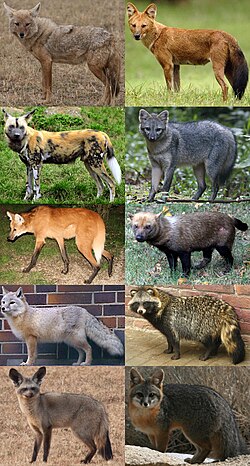
Canidae is a family of mammals in the order Carnivora, which includes domestic dogs, wolves, coyotes, foxes, jackals, dingoes, and many other extant and extinct dog-like mammals. A member of this family is called a canid; all extant species are a part of a single subfamily, Caninae, and are called canines. They are found on all continents except Antarctica, having arrived independently or accompanied human beings over extended periods of time. Canids vary in size, including tails, from the 2 meter (6 ft 7 in) wolf to the 46 cm (18 in) fennec fox. Population sizes range from the Falkland Islands wolf, extinct since 1876, to the domestic dog, which has a worldwide population of over 1 billion.1 The body forms of canids are similar, typically having long muzzles, upright ears, teeth adapted for cracking bones and slicing flesh, long legs, and bushy tails.2 Most species are social animals, living together in family units or small groups and behaving cooperatively. Typically, only the dominant pair in a group breeds, and a litter of young is reared annually in an underground den. Canids communicate by scent signals and vocalizations.3 One canid, the domestic dog, entered into a partnership with humans at least 14,000 years ago and today remains one of the most widely kept domestic animals.4
The 13 extant genera and 37 species of Caninae are primarily split into two tribes: Canini, which includes 11 genera and 19 species, comprising the wolf-like Canina subtribe and the South American Cerdocyonina subtribe; and Vulpini, the fox-like canids, comprising 3 genera and 15 species. Not included in either tribe is the genus Urocyon, which includes 2 species, mainly comprising the gray fox and believed to be basal to the family. Additionally, one genus in Canini, Dusicyon, was composed of two recently extinct species, with the South American fox going extinct around 400 years ago and the Falkland Islands wolf going extinct in 1876.
In addition to the extant Caninae, Canidae contains two extinct subfamilies designated as Hesperocyoninae and Borophaginae. Extinct species have also been placed into Caninae, in both extant and extinct genera; at least 80 extinct Caninae species have been found, as well as over 70 species in Borophaginae and nearly 30 in Hesperocyoninae, though due to ongoing research and discoveries the exact number and categorization is not fixed. The earliest canids found belong to Hesperocyoninae, and are believed to have diverged from the existing Caniformia suborder around 37 million years ago.5
Conventions
| Conservation status | |
|---|---|
| EX | Extinct (2 species) |
| EW | Extinct in the wild (0 species) |
| CR | Critically endangered (0 species) |
| EN | Endangered (4 species) |
| VU | Vulnerable (0 species) |
| NT | Near threatened (5 species) |
| LC | Least concern (26 species) |
| Other categories | |
| DD | Data deficient (0 species) |
| NE | Not evaluated (1 species) |
The author citation for the species or genus is given after the scientific name; parentheses around the author citation indicate that this was not the original taxonomic placement. Conservation status codes listed follow the International Union for Conservation of Nature (IUCN) Red List of Threatened Species. Range maps are provided wherever possible; if a range map is not available, a description of the canid's range is provided. Ranges are based on the IUCN Red List for that species, unless otherwise noted. All extinct species (or subspecies) listed alongside extant species went extinct after 1500 CE, and are indicated by a dagger symbol: "†".
Classification
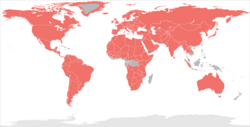
The family Canidae consists of 37 extant species belonging to 13 genera and divided into 194 extant subspecies, as well the extinct genus Dusicyon, comprising two extinct species, and 13 extinct wolf subspecies, which are the only canid species to go extinct since prehistoric times. This does not include hybrid species (such as wolfdogs or coywolves) or extinct prehistoric species (such as the dire wolf or Epicyon). Modern molecular studies indicate that the 13 genera can be grouped into 3 tribes or clades.
Subfamily Caninae
- Tribe Canini (true canines)
- Subtribe Canina (wolf-like canids)
- Subtribe Cerdocyonina (South American canids)
- Genus Atelocynus: one species
- Genus Cerdocyon: one species
- Genus Chrysocyon: one species
- Genus Dusicyon†: two species
- Genus Lycalopex: six species
- Genus Speothos: one species
- Tribe Vulpini (true foxes)
- Genus Nyctereutes: two species
- Genus Otocyon: one species
- Genus Vulpes: twelve species
- Genus Urocyon (gray foxes): two species
Canids
The following classification is based on the taxonomy described by Mammal Species of the World (2005), with augmentation by generally accepted proposals made since using molecular phylogenetic analysis, such as the promotion of the African golden wolf to a separate species from the golden jackal, and splitting out the Lupulella genus from Canis. Range maps are based on IUCN range data. There are several additional proposals which are disputed, such as the promotion of the red wolf and eastern wolf as species from subspecies of the wolf, which are marked with a "(debated)" tag.
Subfamily Caninae
Tribe Canini
| Common name | Scientific name and subspecies | Range | Size and ecology | IUCN status and estimated populationa |
|---|---|---|---|---|
| Short-eared dog
|
A. microtis (Cabrera, 1940) Two subspecies
|
Western Amazon rainforest in South America
|
Size: 72–100 cm (28–39 in) long, plus 24–35 cm (9–14 in) tail6 Habitat: Wetlands, forest, and savanna7 Diet: Fish, insects, and small mammals, as well as fruit, birds, and crabs78 |
NT
|


| Common name | Scientific name and subspecies | Range | Size and ecology | IUCN status and estimated populationa |
|---|---|---|---|---|
| African wolf
|
C. lupaster Hemprich and Ehrenberg, 1832 Six subspecies
|
North and northeastern Africa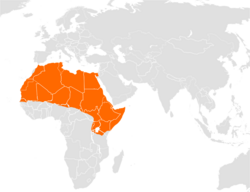
|
Size: 100 cm (39 in) long, plus 20 cm (8 in) tail9 Habitat: Grassland, shrubland, and savanna10 Diet: Wild boar and livestock, as well as other mammals and fruit1011 |
LC
|
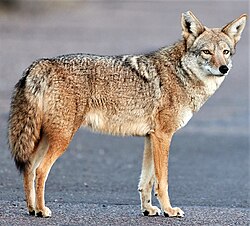
| Coyote
|
C. latrans Say, 1823 Nineteen subspecies
|
North America
|
Size: 100–135 cm (39–53 in) long, plus 40 cm (16 in) tail12 Habitat: Forest, desert, shrubland, and grassland13 Diet: Wide variety of foods, including both small and large mammals, fruit, and insects13 |
LC |
| Dog
|
C. familiaris Linnaeus, 1758 |
Worldwide | Size: Varies by breed Habitat: Domesticated Diet: Varied |
NE
|
| Ethiopian wolf
|
C. simensis Rüppell, 1840 Two subspecies
|
Ethiopian Highlands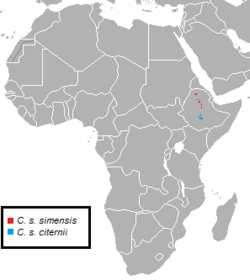
|
Size: 84–100 cm (33–39 in) long, plus 27–40 cm (11–16 in) tail15 Habitat: Inland wetlands, grassland, shrubland, and rocky areas16 Diet: Rodents as well as small mammals1617 |
EN
|
| Golden jackal
|
C. aureus Linnaeus, 1758 Six subspecies
|
Eastern Europe, Middle East, and southern Asia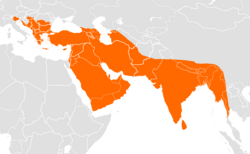
|
Size: 60–132 cm (24–52 in) long, plus 20–30 cm (8–12 in) tail18 Habitat: Forest, grassland, shrubland, and savanna19 Diet: Wide variety of foods, including small to large mammals, birds, fish, fruit, and insects1918 |
LC
|
| Wolf
|
C. lupus Linnaeus, 1758 39 subspecies
|
Eurasia and northern North America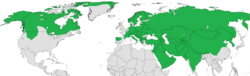
|
Size: 105–160 cm (41–63 in) long, plus 29–50 cm (11–20 in) tail20 Habitat: Forest, desert, rocky areas, shrubland, grassland, and inland wetlands21 Diet: Large ungulates, as well as small animals, carrion, and berries2122 |
LC |



| Common name | Scientific name and subspecies | Range | Size and ecology | IUCN status and estimated populationa |
|---|---|---|---|---|
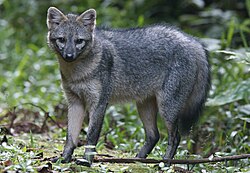
| Crab-eating fox
|
C. thous (Linnaeus, 1766) Five subspecies
|
Eastern and northern South America
|
Size: 64 cm (25 in) long, plus 28 cm (11 in) tail24 Habitat: Forest, savanna, shrubland, grassland, and inland wetlands25 Diet: Crabs and insects, as well as rodents, birds, turtles, eggs, fruit, and carrion2425 |
LC
|
| Common name | Scientific name and subspecies | Range | Size and ecology | IUCN status and estimated populationa |
|---|---|---|---|---|
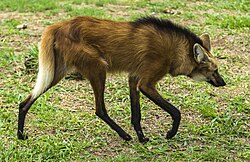
| Maned wolf
|
C. brachyurus (Illiger, 1815) |
Central South America
|
Size: 100–130 cm (39–51 in) long, plus 45 cm (18 in) tail2627 Habitat: Forest, wetlands, grassland, shrubland, and savanna28 Diet: Fruit, arthropods, and small and medium vertebrates28 |
NT
|
| Common name | Scientific name and subspecies | Range | Size and ecology | IUCN status and estimated populationa |
|---|---|---|---|---|
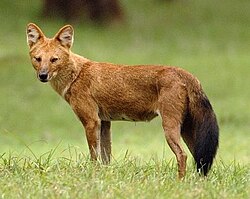
| Dhole
|
C. alpinus (Pallas, 1811) Three subspecies
|
Southeast Asia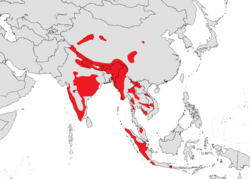
|
Size: 90 cm (35 in) long, plus 40–45 cm (16–18 in) tail29 Habitat: Forest, grassland, and shrubland30 Diet: Ungulates, as well as small rodents and hares30 |
EN
|
| Common name | Scientific name and subspecies | Range | Size and ecology | IUCN status and estimated populationa |
|---|---|---|---|---|
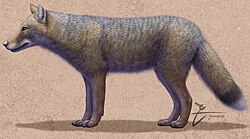
| Falkland Islands wolf†
|
D. australis (Kerr, 1792) |
Falkland Islands at tip of South America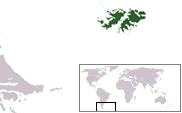
|
Size: Unknown Habitat: Grassland and shrubland31 Diet: Unknown31 |
EX |
| South American fox†
|
D. avus (Burmeister, 1866) |
Southern South America | Size: Unknown Habitat: Grassland and shrubland32 Diet: Unknown32 |
EX |

| Common name | Scientific name and subspecies | Range | Size and ecology | IUCN status and estimated populationa |
|---|---|---|---|---|
| Black-backed jackal
|
L. mesomelas (Schreber, 1775) Two subspecies
|
Southern Africa and eastern Africa
|
Size: 60–95 cm (24–37 in) long, plus 16–40 cm (6–16 in) tail34 Habitat: Marine intertidal, forest, desert, grassland, shrubland, and savanna35 Diet: Small to medium-sized mammals and birds3536 |
LC
|
| Side-striped jackal
|
L. adustus (Sundevall, 1847) Seven subspecies
|
Central Africa
|
Size: 69–81 cm (27–32 in) long, plus 30–41 cm (12–16 in) tail37 Habitat: Forest, shrubland, savanna, grassland, and inland wetlands38 Diet: Small to medium-sized mammals and fruit, as well as birds, insects, grass, and carrion3839 |
LC |


| Common name | Scientific name and subspecies | Range | Size and ecology | IUCN status and estimated populationa |
|---|---|---|---|---|
| Culpeo
|
L. culpeo (Molina, 1782) Six subspecies
|
Western South America
|
Size: 95–132 cm (37–52 in) long, plus 32–44 cm (13–17 in) tail41 Habitat: Forest, rocky areas, grassland, shrubland, and savanna42 Diet: Rodents and lagomorphs, as well as livestock and guanacos4243 |
LC
|
| Darwin's fox
|
L. fulvipes (Martin, 1837) |
Limited areas in southern Chile
|
Size: 48–59 cm (19–23 in) long, plus 18–26 cm (7–10 in) tail44 Habitat: Forest and shrubland45 Diet: Small mammals, insects, crabs, and fruit4445 |
EN
|
| Hoary fox
|
L. vetulus (Lund, 1842) |
South-central Brazil
|
Size: 49–71 cm (19–28 in) long, plus 25–38 cm (10–15 in) tail44 Habitat: Savanna46 Diet: Insects, as well as small rodents, birds, reptiles, and fruit4446 |
LC
|
| Pampas fox
|
L. gymnocercus (Waldheim, 1814) Five subspecies
|
Southern South America
|
Size: 51–74 cm (20–29 in) long, plus 25–41 cm (10–16 in) tail44 Habitat: Forest, shrubland, and savanna47 Diet: Small rodents, hares, birds, insects, and fruit, as well as carrion4447 |
LC
|
| Sechuran fox
|
L. sechurae (Thomas, 1900) |
Sechura Desert in southwestern Ecuador and northwestern Peru
|
Size: 50–78 cm (20–31 in) long, plus 27–34 cm (11–13 in) tail44 Habitat: Forest, desert, grassland, and shrubland48 Diet: Fruit and seeds, as well as small rodents, birds, reptiles, insects, scorpions, and carrion4448 |
NT |
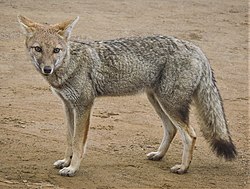
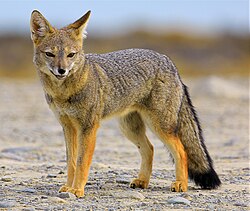
| South American gray fox
|
L. griseus (Gray, 1837) |
Southern South America
|
Size: 50–66 cm (20–26 in) long, plus 12–34 cm (5–13 in) tail44 Habitat: Forest, grassland, and shrubland50 Diet: Small rodents, hares, and carrion4450 |
LC
|



| Common name | Scientific name and subspecies | Range | Size and ecology | IUCN status and estimated populationa |
|---|---|---|---|---|
| African wild dog
|
L. pictus (Temminck, 1820) Five subspecies
|
Scattered areas of Africa. Extant regions in red; probably extant region in yellow.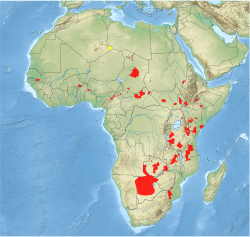
|
Size: 76–112 cm (30–44 in) long, plus 30–42 cm (12–17 in) tail44 Habitat: Forest, grassland, shrubland, savanna, and desert51 Diet: Medium-sized antelope51 |
EN
|

| Common name | Scientific name and subspecies | Range | Size and ecology | IUCN status and estimated populationa |
|---|---|---|---|---|
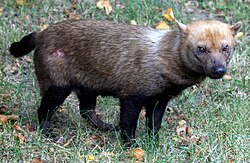
| Bush dog
|
S. venaticus (Lund, 1842) Three subspecies
|
Northern South America
|
Size: 57–75 cm (22–30 in) long, plus 12–15 cm (5–6 in) tail52 Habitat: Shrubland, forest, grassland, and savanna53 Diet: Small and medium mammals, as well as birds, reptiles, and fruit53 |
NT |
Tribe Vulpini
| Common name | Scientific name and subspecies | Range | Size and ecology | IUCN status and estimated populationa |
|---|---|---|---|---|
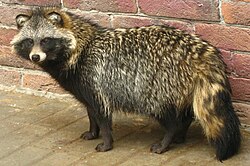
| Common raccoon dog
|
N. procyonoides (Gray, 1834) Four subspecies
|
Mainland Eastern Asia, introduced to Central and Eastern Europe (note: map includes range of N. viverrinus)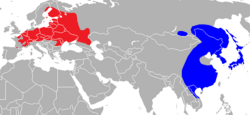
|
Size: 49–71 cm (19–28 in) long, plus 15–23 cm (6–9 in) tail44 Habitat: Forest, grassland, and shrubland55 Diet: Insects, rodents, amphibians, birds, fish, and reptiles, as well as fruit, nuts, and berries55 |
LC |
| Japanese raccoon dog
|
N. viverrinus (Temminck, 1838) |
Japan | Size: 49–71 cm (19–28 in) long, plus 15–23 cm (6–9 in) tail44 Habitat: Forest, grassland, and shrubland55 Diet: Insects, rodents, amphibians, birds, fish, and reptiles, as well as fruit, nuts, and berries55 |
NE
|

| Common name | Scientific name and subspecies | Range | Size and ecology | IUCN status and estimated populationa |
|---|---|---|---|---|
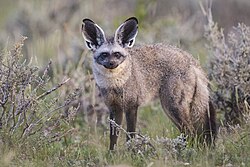
| Bat-eared fox
|
O. megalotis (Desmarest, 1822) Two subspecies
|
Southern and Eastern Africa (megalotis in green, virgatus in red)
|
Size: 46–61 cm (18–24 in) long, plus 23–34 cm (9–13 in) tail44 Habitat: Grassland, shrubland, and savanna57 Diet: Harvester termites as well as other arthropods57 |
LC
|
| Common name | Scientific name and subspecies | Range | Size and ecology | IUCN status and estimated populationa |
|---|---|---|---|---|
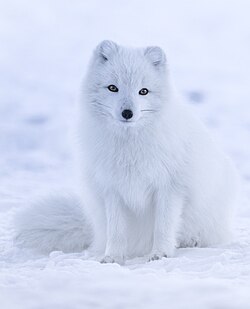
| Arctic fox
|
V. lagopus (Linnaeus, 1758) Five subspecies
|
Arctic North America and Eurasia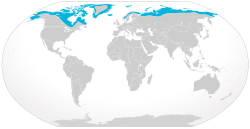
|
Size: 50–75 cm (20–30 in) long, plus 25–43 cm (10–17 in) tail44 Habitat: Grassland58 Diet: Lemmings, as well as other rodents, birds, and reindeer58 |
LC
|
| Bengal fox
|
V. bengalensis (Shaw, 1800) |
India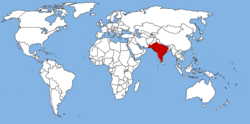
|
Size: 39–58 cm (15–23 in) long, plus 25–32 cm (10–13 in) tail44 Habitat: Grassland and shrubland59 Diet: Arthropods, rodents, reptiles, fruit, and birds59 |
LC
|
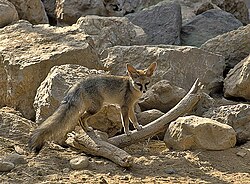
| Blanford's fox
|
V. cana Blanford, 1877 |
The Middle East and Central Asia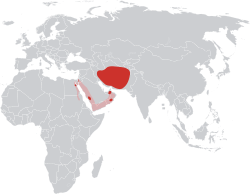
|
Size: 34–47 cm (13–19 in) long, plus 26–36 cm (10–14 in) tail44 Habitat: Desert and rocky areas60 Diet: Fruit and insects60 |
LC
|
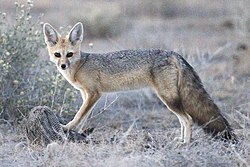
| Cape fox
|
V. chama (A Smith, 1833) |
Southern Africa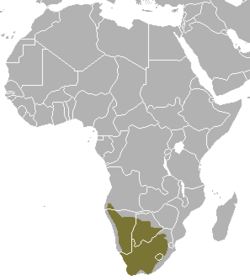
|
Size: 45–61 cm (18–24 in) long, plus 25–41 cm (10–16 in) tail44 Habitat: Rocky areas, grassland, shrubland, and savanna61 Diet: Fruit and insects61 |
LC
|
| Corsac fox
|
V. corsac (Linnaeus, 1768) Three subspecies
|
Central Asia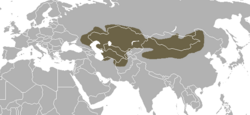
|
Size: 45–60 cm (18–24 in) long, plus 19–34 cm (7–13 in) tail44 Habitat: Desert, grassland, and shrubland62 Diet: Insects and small rodents62 |
LC
|
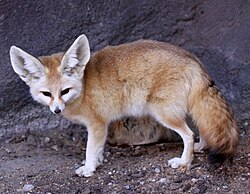
| Fennec fox
|
V. zerda (Zimmermann, 1780) |
Northern Africa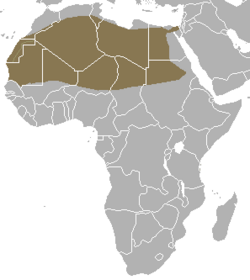
|
Size: 33–40 cm (13–16 in) long, plus 13–23 cm (5–9 in) tail44 Habitat: Desert and marine coastal/supratidal63 Diet: Rodents, insects, birds, eggs, and rabbits63 |
LC
|
| Kit fox
|
V. macrotis Merriam, 1888 Two subspecies
|
Western North America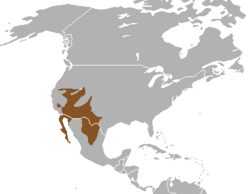
|
Size: 46–54 cm (18–21 in) long, plus 25–34 cm (10–13 in) tail44 Habitat: Shrubland, savanna, and grassland64 Diet: Rodents, rabbits, invertebrates, birds, lizards, and snakes64 |
LC
|
| Pale fox
|
V. pallida (Cretzschmar, 1827) Five subspecies
|
Upper middle Africa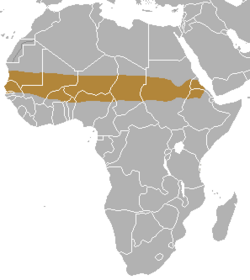
|
Size: 38–55 cm (15–22 in) long, plus 23–29 cm (9–11 in) tail44 Habitat: Desert, grassland, shrubland, and savanna65 Diet: Plants and berries as well as rodents, reptiles, and insects65 |
LC
|
| Rüppell's fox
|
V. rueppellii (Schinz, 1825) |
Northern Africa and the Middle East
|
Size: 35–56 cm (14–22 in) long, plus 25–39 cm (10–15 in) tail44 Habitat: Desert, shrubland, and marine coastal/supratidal66 Diet: Small mammals, lizards, birds, and insects, as well as fruit and succulents66 |
LC
|
| Red fox
|
V. vulpes (Linnaeus, 1758) 44 subspecies
|
North America, Europe, Asia, and Australia
|
Size: 62–72 cm (24–28 in) long, plus 40 cm (16 in) tail67 Habitat: Shrubland, grassland, inland wetlands, forest, and desert68 Diet: Small rodents, as well as birds, larger mammals, reptiles, insects, and fish68 |
LC
|
| Swift fox
|
V. velox (Say, 1823) |
Western grasslands of North America
|
Size: 48–54 cm (19–21 in) long, plus 25–34 cm (10–13 in) tail44 Habitat: Grassland69 Diet: Rabbits, mice, ground squirrels, birds, insects and lizards, as well as grasses and fruit69 |
LC
|
| Tibetan fox
|
V. ferrilata Hodgson, 1842 |
High plateaus in Nepal and western China
|
Size: 49–70 cm (19–28 in) long, plus 22–29 cm (9–11 in) tail44 Habitat: Desert, rocky areas, grassland, and shrubland70 Diet: Pikas, as well as carrion and other small mammals70 |
LC
|


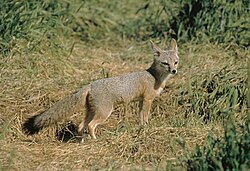
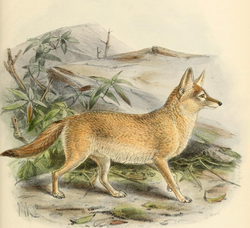
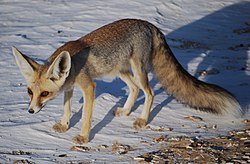


Urocyon
| Common name | Scientific name and subspecies | Range | Size and ecology | IUCN status and estimated populationa |
|---|---|---|---|---|
| Gray fox
|
U. cinereoargenteus (Schreber, 1775) Sixteen subspecies
|
North America and Central America
|
Size: 53–66 cm (21–26 in) long, plus 28–44 cm (11–17 in) tail44 Habitat: Forest and shrubland71 Diet: Rabbits, voles, shrews, and birds, as well as insects and fruit71 |
LC
|
| Island fox
|
U. littoralis (Baird, 1857) Six subspecies
|
Channel Islands of California
|
Size: 46–63 cm (18–25 in) long, plus 12–32 cm (5–13 in) tail44 Habitat: Marine intertidal, forest, grassland, and shrubland72 Diet: Fruit, insects, birds, eggs, crabs, lizards, and small mammals72 |
NT
|


Notes
Notes
- Population figures rounded to the nearest hundred. Population trends as described by the International Union for Conservation of Nature.
- The Falklands Island wolf is believed to have been driven extinct in 187631
- The South American fox is believed to have gone extinct sometime between 1454 and 162633
References
References
- Gompper, Matthew E. (October 17, 2013). "1.4 – The demographics and ownership of free-ranging dogs". Free-Ranging Dogs and Wildlife Conservation. Oxford University Press. ISBN 978-0-19-164011-7.
- Mivart, St. George Jackson (1890). Dogs, Jackals, Wolves, and Foxes: A Monograph of the Canidae. R. H. Porter. pp. xiv–xxxvi. Archived from the original on April 12, 2016. Retrieved October 1, 2019.
- Fahey, Bridget; Myers, Phil (2000). "Canidae: Coyotes, dogs, foxes, jackals, and wolves". Animal Diversity Web. University of Michigan. Archived from the original on April 18, 2019. Retrieved September 30, 2019.
- Giemsch, Liane; Feine, Susanne C.; Alt, Kurt W.; Fu, Qiaomei; Knipper, Corina; Krause, Johannes; Lacy, Sarah; Nehlich, Olaf; Niess, Constanze; Pääbo, Svante; Pawlik, Alfred; Richards, Michael P.; Schünemann, Verena; Street, Martin; Thalmann, Olaf; Tinnes, Johann; Trinkaus, Erik; Schmitz, Ralf W. (April 7–11, 2015). Interdisciplinary investigations of the late glacial double burial from Bonn-Oberkassel. 57th Annual Meeting. Heidenheim an der Brenz, Germany: Hugo Obermaier Society for Quaternary Research and Archaeology of the Stone Age. pp. 36–37.
- Wang, X. (1994). "Phylogenetic systematics of the Hesperocyoninae". Bulletin of the American Museum of Natural History. 221: 1–207. hdl:2246/829.
- "Small-eared zorro (Atelocynus microtis)". ARKive. Wildscreen. Archived from the original on February 6, 2019. Retrieved May 28, 2019.
- Leite-Pitman, M. R. P.; Williams, R. S. R. (2011). "Atelocynus microtis". IUCN Red List of Threatened Species. 2011 e.T6924A12814890. doi:10.2305/IUCN.UK.2011-2.RLTS.T6924A12814890.en.
- Leite Pitman, Renata; S. R. Williams, Robert (2004). Sillero-Zubiri, C.; Gingsberg, J. R.; Macdonald, D. W. (eds.). Canids: Species status and conservation (2004 ed.). International Union for Conservation of Nature. pp. 26–31.
- Viranta, S.; Atickem, A.; Werdelin, L.; et al. (December 2017). "Rediscovering a forgotten canid species". BMC Zoology. 2 (6) 6. doi:10.1186/s40850-017-0015-0. hdl:10852/55258. Archived from the original on July 20, 2018. Retrieved August 28, 2019.
- Hoffmann, M.; Atickem, A. (2019). "Canis lupaster". IUCN Red List of Threatened Species. 2019 e.T118264888A118265889. doi:10.2305/IUCN.UK.2019-1.RLTS.T118264888A118265889.en.
- Eddine, A.; Mostefai, N.; De Smet, K.; Klees, D.; Ansorge, H.; Karssene, Y.; Nowak, C.; Leer, P. (November 1, 2017). "Diet composition of a Newly Recognized Canid Species, the African Golden Wolf (Canis anthus), in Northern Algeria". Annales Zoologici Fennici. 54 (5–6): 347–356. doi:10.5735/086.054.0506. S2CID 90155276.
- Bekoff, M. (1977). "Canis latrans". Mammalian Species (79): 1–9. doi:10.2307/3503817. ISSN 1545-1410. JSTOR 3503817. OCLC 46381503.
- Kays, R. (2018). "Canis latrans". IUCN Red List of Threatened Species. 2018 e.T3745A103893556. doi:10.2305/IUCN.UK.2018-2.RLTS.T3745A103893556.en.
- Schneck, Marcus (February 2018). "Coyotes in Pennsylvania: What's the latest information and research?". The Patriot-News. Archived from the original on August 21, 2019. Retrieved August 21, 2019.
- "Ethiopian wolf (Canis simensis)". ARKive. Wildscreen. Archived from the original on April 21, 2016. Retrieved August 21, 2019.
- Marino, J.; Sillero-Zubiri, C. (2011). "Canis simensis". IUCN Red List of Threatened Species. 2011 e.T3748A10051312. doi:10.2305/IUCN.UK.2011-1.RLTS.T3748A10051312.en.
- Sillero-Zubiri, C.; Gottelli, D. (December 2, 1994). "Canis simensis" (PDF). Mammalian Species. 485 (385): 1–6. Bibcode:1994MamSp.485....1S. doi:10.2307/3504136. JSTOR 3504136. S2CID 253988540. Archived from the original (PDF) on September 24, 2015. Retrieved August 21, 2019.
- "Golden jackal (Canis aureus)". ARKive. Wildscreen. Archived from the original on April 23, 2016. Retrieved August 21, 2019.
- Hoffmann, M.; Arnold, J.; Duckworth, J. W.; Jhala, Y.; Kamler, J. F.; Krofel, M. (2020) [errata version of 2018 assessment]. "Canis aureus". IUCN Red List of Threatened Species. 2018 e.T118264161A163507876. doi:10.2305/IUCN.UK.2018-2.RLTS.T118264161A163507876.en.
- Heptner, V. G.; Naumov, N. P. (1998). Mammals of the Soviet Union Vol. II Part 1a, Sirenia and Carnivora (Sea cows; Wolves and Bears). Science Publishers. pp. 164–270. ISBN 978-1-886106-81-9. Archived from the original on December 28, 2018. Retrieved August 21, 2019.
- Boitani, L.; Phillips, M.; Jhala, Y. (2018). "Canis lupus". IUCN Red List of Threatened Species. 2018 e.T3746A119623865. doi:10.2305/IUCN.UK.2018-2.RLTS.T3746A119623865.en.
- "Grey wolf (Canis lupus)". ARKive. Wildscreen. Archived from the original on May 1, 2016. Retrieved August 21, 2019.
- Mech, L. David; Boitani, Luigi, eds. (2003). Wolves: Behaviour, Ecology and Conservation. University of Chicago Press. p. 230. ISBN 978-0-226-51696-7.
- Berta, A. (November 23, 1982). "Cerdocyon thous". Mammalian Species (186): 1–4. Bibcode:1982MamSp.186....1B. doi:10.2307/3503974. JSTOR 3503974.
- Lucherini, M. (2015). "Cerdocyon thous". IUCN Red List of Threatened Species. 2015 e.T4248A81266293. doi:10.2305/IUCN.UK.2015-4.RLTS.T4248A81266293.en.
- "Maned wolf (Chrysocyon brachyurus)". ARKive. Wildscreen. Archived from the original on September 13, 2009. Retrieved May 23, 2019.
- Dietz, J. M. (1984). "Ecology and social organization of the maned wolf (Chrysocyon brachyurus)". Smithsonian Contributions to Zoology. 392 (392): 1–51. Bibcode:1984SCZoo.392....1D. doi:10.5479/si.00810282.392.
- Paula, R. C.; DeMatteo, K. (2015). "Chrysocyon brachyurus". IUCN Red List of Threatened Species. 2015 e.T4819A82316878. doi:10.2305/IUCN.UK.2015-4.RLTS.T4819A82316878.en.
- "Dhole (Cuon alpinus)". ARKive. Wildscreen. Archived from the original on September 7, 2017. Retrieved August 21, 2019.
- Kamler, J. F.; Songsasen, N.; Jenks, K.; Srivathsa, A.; Sheng, L.; Kunkel, K. (2015). "Cuon alpinus". IUCN Red List of Threatened Species. 2015 e.T5953A72477893. doi:10.2305/IUCN.UK.2015-4.RLTS.T5953A72477893.en.
- Sillero-Zubiri, C. (2015). "Dusicyon australis". IUCN Red List of Threatened Species. 2015 e.T6923A82310440. doi:10.2305/IUCN.UK.2015-4.RLTS.T6923A82310440.en.
- de Waal, H. O. (September 2017). "Demography and morphometry of black-backed jackals Canis mesomelasin South Africa and Namibia" (PDF). African Large Predator Research Unit. Retrieved August 21, 2019.
- Hoffmann, M. (2014). "Canis mesomelas". IUCN Red List of Threatened Species. 2014 e.T3755A46122476. doi:10.2305/IUCN.UK.2014-1.RLTS.T3755A46122476.en.
- Minnie, Liaan; Avenant, N.; Drouilly, Marine; Samuels, Mogamat (November 2018). "Biology and ecology of black-backed jackal and caracal". Livestock predation and its management in South Africa: a scientific assessment. Centre for African Conservation Ecology. pp. 178–204.
- Burnie, D.; Wilson, D. E., eds. (August 29, 2011). "Side-striped jackal". Animal: The Definitive Visual Guide to the World's Wildlife (2nd ed.). DK Adult. ISBN 978-0-7894-7764-4.
- Hoffmann, M. (2014). "Canis adustus". IUCN Red List of Threatened Species. 2014 e.T3753A46254734. doi:10.2305/IUCN.UK.2014-1.RLTS.T3753A46254734.en.
- Camacho, G.; Page-Nicholson, S.; Child, M. F.; Do Linh San, E. (2016). "7. A conservation assessment of Canis adustus" (PDF). The Red List of Mammals of South Africa, Swaziland and Lesotho. South African National Biodiversity Institute and Endangered Wildlife Trust. Archived from the original (PDF) on October 19, 2022. Retrieved August 21, 2019.
- "Side-Striped Jackal". IUCN Canid Specialist Group. Archived from the original on August 21, 2019. Retrieved August 21, 2019.
- Burnie, D.; Wilson, D. E., eds. (August 29, 2011). "Culpeo". Animal: The Definitive Visual Guide to the World's Wildlife (2nd ed.). DK Adult. ISBN 978-0-7894-7764-4.
- Lucherini, M. (2016). "Lycalopex culpaeus". IUCN Red List of Threatened Species. 2016 e.T6929A85324366. doi:10.2305/IUCN.UK.2016-1.RLTS.T6929A85324366.en.
- Novaro, Andres J.; Moraga, Claudio A.; Bricen, Cristobal; Funes, Martin C.; Marino, Andrea (2009). "First records of culpeo (Lycalopex culpaeus) attacks and cooperative defense by guanacos (Lama guanicoe)". Mammalian Species. 73 (2). doi:10.1515/MAMM.2009.016. hdl:11336/102311. S2CID 84525738.
- Hunter, Luke (January 8, 2019). Carnivores of the World (2nd ed.). Princeton University Press. pp. 110–126. ISBN 978-0-691-18295-7.
- Silva-Rodríguez, E.; Farias, A.; Moreira-Arce, D.; Cabello, J.; Hidalgo-Hermoso, E.; Lucherini, M.; Jiménez, J. (2016). "Lycalopex fulvipes". IUCN Red List of Threatened Species. 2016 e.T41586A85370871. doi:10.2305/IUCN.UK.2016-1.RLTS.T41586A85370871.en.
- Dalponte, J.; Courtenay, O. (2008). "Lycalopex vetulus". IUCN Red List of Threatened Species. 2008 e.T6926A12815527. doi:10.2305/IUCN.UK.2008.RLTS.T6926A12815527.en.
- Lucherini, M. (2016). "Lycalopex gymnocercus". IUCN Red List of Threatened Species. 2016 e.T6928A85371194. doi:10.2305/IUCN.UK.2016-1.RLTS.T6928A85371194.en.
- Cossios, D. (2017). "Lycalopex sechurae". IUCN Red List of Threatened Species. 2017 e.T6925A86074993. doi:10.2305/IUCN.UK.2017-2.RLTS.T6925A86074993.en.
- "Sechuran fox". IUCN Canid Specialist Group. Archived from the original on August 21, 2019. Retrieved August 21, 2019.
- Lucherini, M. (2016). "Lycalopex griseus". IUCN Red List of Threatened Species. 2016 e.T6927A86440397. doi:10.2305/IUCN.UK.2016-1.RLTS.T6927A86440397.en.
- Woodroffe, R.; Sillero-Zubiri, C. (2012). "Lycaon pictus". IUCN Red List of Threatened Species. 2012 e.T12436A16711116. doi:10.2305/IUCN.UK.2012.RLTS.T12436A16711116.en.
- "Bush dog (Speothos venaticus)". ARKive. Wildscreen. Archived from the original on December 5, 2008. Retrieved May 23, 2019.
- DeMatteo, K.; Michalski, F.; Leite-Pitman, M. R. P. (2011). "Speothos venaticus". IUCN Red List of Threatened Species. 2011 e.T20468A9203243. doi:10.2305/IUCN.UK.2011-2.RLTS.T20468A9203243.en.
- Castelló, José R. (September 11, 2018). Canids of the World. Princeton University Press. p. 33. ISBN 978-0-691-17685-7.
- Kauhala, K.; Saeki, M. (2016). "Nyctereutes procyonoides". IUCN Red List of Threatened Species. 2016 e.T14925A85658776. doi:10.2305/IUCN.UK.2016-1.RLTS.T14925A85658776.en.
- Hsieh-Yi; Yi-Chiao; Fu, Yu; Rissi, Mark; Maas, Barbera (August 22, 2019). Fun Fur? A report on the Chinese fur industry (PDF). Care for the Wild International. Archived from the original (PDF) on February 11, 2006.
- Hoffmann, M. (2014). "Otocyon megalotis". IUCN Red List of Threatened Species. 2014 e.T15642A46123809. doi:10.2305/IUCN.UK.2014-1.RLTS.T15642A46123809.en.
- Angerbjörn, A.; Tannerfeldt, M. (2014). "Vulpes lagopus". IUCN Red List of Threatened Species. 2014 e.T899A57549321. doi:10.2305/IUCN.UK.2014-2.RLTS.T899A57549321.en.
- Jhala, Y. (2016). "Vulpes bengalensis". IUCN Red List of Threatened Species. 2016 e.T23049A81069636. doi:10.2305/IUCN.UK.2016-1.RLTS.T23049A81069636.en.
- Hoffmann, M.; Sillero-Zubiri, C. (2015). "Vulpes cana". IUCN Red List of Threatened Species. 2015 e.T23050A48075169. doi:10.2305/IUCN.UK.2015-4.RLTS.T23050A48075169.en.
- Hoffmann, M. (2014). "Vulpes chama". IUCN Red List of Threatened Species. 2014 e.T23060A46126992. doi:10.2305/IUCN.UK.2014-1.RLTS.T23060A46126992.en.
- Murdoch, J. D. (2014). "Vulpes corsac". IUCN Red List of Threatened Species. 2014 e.T23051A59049446. doi:10.2305/IUCN.UK.2014-2.RLTS.T23051A59049446.en.
- Wacher, T.; Bauman, K.; Cuzin, F. (2015). "Vulpes zerda". IUCN Red List of Threatened Species. 2015 e.T41588A46173447. doi:10.2305/IUCN.UK.2015-4.RLTS.T41588A46173447.en.
- Cypher, B.; List, R. (2014). "Vulpes macrotis". IUCN Red List of Threatened Species. 2014 e.T41587A62259374. doi:10.2305/IUCN.UK.2014-3.RLTS.T41587A62259374.en.
- Sillero-Zubiri, C.; Wacher, T. (2012). "Vulpes pallida". IUCN Red List of Threatened Species. 2012 e.T23052A16813736. doi:10.2305/IUCN.UK.2012.RLTS.T23052A16813736.en.
- Mallon, D.; Murdoch, J. D.; Wacher, T. (2015). "Vulpes rueppellii". IUCN Red List of Threatened Species. 2015 e.T23053A46197483. doi:10.2305/IUCN.UK.2015-4.RLTS.T23053A46197483.en.
- "Red fox (Vulpes vulpes)". ARKive. Wildscreen. Archived from the original on June 22, 2017. Retrieved August 22, 2019.
- Hoffmann, M.; Sillero-Zubiri, C. (2016). "Vulpes vulpes". IUCN Red List of Threatened Species. 2016 e.T23062A46190249. doi:10.2305/IUCN.UK.2016-1.RLTS.T23062A46190249.en.
- Moehrenschlager, A.; Sovada, M. (2016). "Vulpes velox". IUCN Red List of Threatened Species. 2016 e.T23059A57629306. doi:10.2305/IUCN.UK.2016-3.RLTS.T23059A57629306.en.
- Harris, R. (2014). "Vulpes ferrilata". IUCN Red List of Threatened Species. 2014 e.T23061A46179412. doi:10.2305/IUCN.UK.2014-3.RLTS.T23061A46179412.en.
- Roemer, G.; Cypher, B.; List, R. (2016). "Urocyon cinereoargenteus". IUCN Red List of Threatened Species. 2016 e.T22780A46178068. doi:10.2305/IUCN.UK.2016-1.RLTS.T22780A46178068.en.
- Coonan, T.; Ralls, K.; Hudgens, B.; Cypher, B.; Boser, C. (2013). "Urocyon littoralis". IUCN Red List of Threatened Species. 2013 e.T22781A13985603. doi:10.2305/IUCN.UK.2013-2.RLTS.T22781A13985603.en.