

Brick Romanesque is an architectural style and chronological phase of architectural history. The term described Romanesque buildings built of brick; like the subsequent Brick Gothic, it is geographically limited to Central Europe. Structures in other regions are not described as Brick Romanesque but as "Romanesque brick-built church" or similar terms.
In comparison to Brick Gothic, Brick Romanesque is a less established and less frequently used term. On the one hand, this is caused by the fact that the Baltic region was only beginning to develop its own stylistic identity during the Romanesque period, on the other by the relatively low number of surviving buildings. Many of the major Brick Gothic edifices had Brick Romanesque predecessors, remains of which are often still visible. Nearly all preserved buildings are churches. The buildings contrast with earlier stone-built churches (fieldstone churches), which were constructed of glacial erratics and rubble. Such rounded stones limit the potential size of a building; the material and technique do not permit the construction of structures larger than a village church for static reasons. Monumental constructions only became possible through the growing use and perfection of brick building.
Import of technique and style
Already in the antique Roman Empire huge brick buildings had been erected north of the Alps, but present-day Denmark and present-day northern Germany east of Elbe River never had been part of that empire, and west of the Elbe its rule had been too short to build more than some military camps. Even in the northern Roman provinces, the techniques of building in brick were forgotten with the decay of the empire.
-
 Elaborated technique in the 10th c. – Church of the Holy Sepulchre of Santo Stefano compound in Bologna
 -
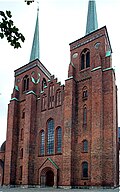 Roskilde Cathedral,
since 1170 -
 Apse of Lehnin Abbey,
since 1180 -
 Jerichow Monastery,
since 1149
But in Langobardia Major, northern Italy, there was a continuity of building in bricks from late Antiquity to early Middle Ages. In Early Lombard Romanesque style, technique and shapes, later on, typical for the Baltic Sea were already completely developed. During the 12th century, Northern Germany and Denmark, at that time the major power of North Sea and Baltic Sea, imported the techniques and many elements of style from the Padan Region.1
St. John's Church (Sankt-Johannis-Kirche) in Oldenburg (Holstein) is considered to be the oldest brick church in Northern Europe. The first monumental churches were Ratzeburg Cathedral and Lübeck Cathedral, both begun shortly after 1160 under Henry the Lion. Lübeck Cathedral was later converted into a Gothic hall church (1266 to 1335). Jerichow Monastery with its convent church of which construction started in 1148 played an influential role for the brick architecture in the Margraviate of Brandenburg. For Scandinavia, the stylistically independent Roskilde Cathedral, started in the 1170s and used as the burial church for Danish monarchs, is of special importance. The last flourish and the transition to the Gothic style is marked by the Cistercian Lehnin Abbey in the Margraviate of Brandenburg.
-
 San Michele in Cremona, Lombardy
 -
 Sorø Abbey on Zealand, since 1161
 -

| Place | Building | Main period of construction | Special features | Image |
|---|---|---|---|---|
| Kalundborg | Church of Our Lady | circa 1170–1200 | central structure on Greek cross plan; central tower and 4 side towers of nearly the same height |  |
| Ledøje | Residential Church | circa 1225 |  | |
| Nyborg | Nyborg Castle | about 1170 | mid 13th century to 1416 main residence of the Kings of Denmark |  |
| Ringsted | St. Benedict | built 1163–1170 | one of the earliest brick churches in Northern Europe, basilica |  |
| Roskilde | Cathedral | mainly 1170–1280 | UNESCO World Heritage Site, burial church of Danish monarchs |  |
| Sorø | Abbey | after 1161 | former Cistercian basilica |  |
West of Weser River
| Place | Building | Main period of construction | Special features | Image |
|---|---|---|---|---|
| Bagband (Großefehn, East Frisia) | Village Church |  | ||
| Bassum | Collegiate Church | begun in Romanesque, completed in Gothic style, hall church |  | |
| Bingum (incorporated to Leer, East Frisia) | St. Matthew's | 1st quarter of 13th century |  | |
| Blexen (Weser estuary) | St. Hippolyte | choir in the 11./12th century begun in cubes of granite and completed in brick, nave and tower (13th century) completely of brick |  | |
| Bücken (Weser) | Collegiate Church | stone building of the 11th century enlarged in brick in the 13th century |  | |
| Bunde (East Frisia) | Reformed Church | about 1200 | begun in Romanesque style |  |
| Canum (Krummhörn) | Village Church | 2nd half of the 13th century |  | |
| Ditzum (Rheiderland) | Village Church | early or mid 13th century |  | |
| Dunum (Esens, East Frisia) | Village Church | 1200–1220 |  | |
| Emden | Große Kirche (Large Church) | about 1200 | Romanesque, later enlarged in Gothic style, 1943 completely destroyed by bombs, new building in 1948/49 |  |
| Fedderwarden (Wilhelmshaven) | St.-Stephanus-Kirche2 | about 1250 | Romano-Gothic, tower added in 1875 |  |
| Freepsum (Krummhörn) | Village Church | about 1260 |  | |
| Golzwarden (Stadland) | St.-Bartholomäus-Kirche | 1263 | Northern wall mixed with fieldstone, choir newer |  |
| Hage (East Frisia) | St.-Ansgari-Kirche | 1220 |  | |
| Heiligenfelde (Syke) | Michaeliskirche | early 13th century |  | |
| Hinte (East Frisia) | Bell house of the Village Church | 13th century | Romanesque bell house, late Gothic nave |  |
| Holtgaste (Rheiderland) | Liudgeri-Kirche | 1st half of 13th century |  | |
| Holtrop (Großefehn, East Frisia) | Village Church |  | ||
| Kirchweyhe (a parish of Weyhe) | Felicianuskirche | tower about 1250 | nave in 1906 replaced by a Gothic Revival one |  |
| Midlum (Rheiderland) | Village Church | early or middle 13th century | nave about 1840 very much altered |  |
| Norden (East Frisia) | Ludgeri-Kirche | 1200–1220 or 1230–1250 | Western part of the nave Romanesque, Gothic enlargement (transept and choir) |  |
| Pilsum (Krummhörn) | Village Church | 13th century |  |
 |
| Sengwarden (Wilhelmshaven) | St.-Georgs-Kirche | about 1250 | gothified in the 15th century |  |
| Strackholt (Großefehn, East Frisia) | Village Church |  | ||
| Suurhusen (Hinte, East Frisia) | Village Church | nave mid 13th century, later a bit altered, (leaning) tower built about 1450, but in Romanesque style |  | |
| Victorbur (Südbrookmerland, East Frisia) | Village Church | 1st half of 13th century | aisleless church |  |
| Wiegboldsbur (Südbrookmerland, East Frisia) | Village Church | about 1250 |  | |
| Bad Zwischenahn | St.-John's-Church |
|
 | |
Between Weser and Elbe
| Place | Building | Main period of construction | Special features | Image |
|---|---|---|---|---|
| Anhalt Castle (near Harzgerode) | 1123 and 1147 | Ascan hill castle, only little relics |  | |
| Arendsee | Arendsee Monastery | 1184–1240, consecrated already in 1208 |  | |
| Beuster | Collegiate church (Stiftskirche) St. Nikolaus | 12th c. (choir completed in 1172) |  | |
| Blockland, Bremen | Wasserhorst Parish Church | tower 13th century | Romano-Gothic, nave remodeled in 1743 to very moderate Baroque |  |
| Diesdorf | Diesdorf Monastery | 1161–1220 | late Romanesque |  |
| Giesenslage near Behrendorf | Village Church | probably late 12th century |  | |
| Königsmark3 | Village Church | probably 12th century | originally a basilica |  |
| Wolterslage Village Church | tower Romanesque, nave altered to Gothic |  | ||
| Mandelsloh (incorporated to Neustadt am Rübenberge) |
St. Osdag Church | 1180 | basilica of brick with a tower of boulers |  |
| Mildensee (incorporated to Dessau-Roßlau) | Pötnitz Church | consecrated 1198 | originally triple-aisled basilica. Side aisles demolished in the 17th century. Southernmost Brick Romanesque in Central Germany. |  |
| Osterholz-Scharmbeck | Monastic Church of St Mary | 1185–1197 |  |
 |
| Salzwedel | St Laurence Church | 13th c. | basilica |  |
| Verden | tower of Verden Cathedral | since c. 1160 | Gothic nave of sandstone, else Brick Gothic |  |
| St. John's | onset in the mid 12th century |  |
 | |
| Wittingen | St. Steven's Church | about 1250 | nave romanesque, tower & choir Gothic |  |
East of Elbe River
| Place | Building | Main period of construction | Special features | Image |
|---|---|---|---|---|
| Altenkirchen | Parish Church | begun probably about 1185 | near previous Slavic cult place of the god Svantevit on Cape Arkona |  |
| Altenkrempe | Basilica | 1190 to 1240 |  | |
| Bad Segeberg | St. Mary's |  | ||
| Bergen auf Rügen | St. Mary's |  | ||
| Eutin | St. Michael's | 1180s to early 13th century |  | |
| Gadebusch | Town Church St. Jacob and St. Dionysius | Late Romanesque, begun about 1220 |  | |
| Jerichow | Jerichow Monastery | 1148–1172 | former Premonstratensian collegiate church, oldest brick structure East of the Elbe River |  |
| Lehnin | Lehnin Abbey | circa 1185–1235, altered up to 1260 |  | |
| Lübeck | Cathedral | 1163–1230 | Romanesque nave, Gothic choir |  |
| Lübow | Village Church | 1st half 13th century | possibly residential church of nearby Mecklenburg Castle |  |
| Melkow (Wust-Fischbeck) | Village Church | circa 1200 |  | |
| Mölln | St. Nicholas | early 13th century | basilica |  |
| Neubukow | Parish Church | double-naved hall church |  | |
| Neukloster | St. Mary's, church of Monastery Sonnenkamp | before 1227 |  | |
| Oldenburg (Holstein) | St. John's | mainly built 1156–1160 | oldest brick church in Northern Europe |  |
| Ratzeburg | Cathedral | mainly 1160–1220 | oldest fully preserved brick church east of Elbe |  |
| Rehna | Rehna Monastery | Late Romanesque | single-naved monastery church |  |
| Rieseby | Village Church | circa 1220/1230 |  | |
| Sagard | St. Michael's Church | 1210 | choir replaced at about 1400 and tower added at about 1500 in Gothic style |  |
| Schaprode | Village Church | 1st half 13th century |  | |
| Schlagsdorf | Village Church | 1st half 13th century |  | |
| Schleswig | Schleswig Cathedral | 1134 – c. 1200 | built of granite, tufa and brick; Gothic additions 1275-1300; tower 20th century |  |
| Schönhausen | Village Church | consecrated 1212 |  | |
| Bad Segeberg | St. Mary's Church |  | ||
| Vietlübbe (near Dragun) | Village Church | early 13th century | Latin cross plan |  |
| Wust | Village Church | circa 1200 | tower added in the 18th century |  |
| Place | Building | Main period of construction | Special features | Image |
|---|---|---|---|---|
| Inowrocław | St. Mary's Church | 12th and 13th century | brick towers |  |
| Kamień Pomorski | Cathedral St. John | after 1175 to 1250 |  | |
| Kołbacz | Abbey | begun shortly after 1200 | former Cistercian basilica |  |
| Lublin | Lublin Castle Donjon | 12th century | upper parts in brick, lower in limestone |  |
| Oliwa | Abbey | after 1178 | former Cistercian Monastery |  |
| Płock | Płock Cathedral | 1130–1144 | rebuilt several times |  |
| Poznań | Church of Saint John of Jerusalem outside the walls | c. 1187 | one of the first brick-built churches in Poland4 |  |
| Sandomierz | Church of St. Jacob | 13th century |  | |
| Strzelno | Holy Trinity Church | 12th century – 1216 |  | |
| Rotunda of St. Prokop | brick parts 15th or 16th century | Romanesque and brick, but no Romanesque brick: the Romanesque original parts, erected since before 1133, are of red granite |  | |
| Święta Katarzyna | St. Catherine's Church |  | ||
| Wąchock | Wąchock Abbey | after 1179 | brick and sandstone |  |
| Wrocław | St. Giles's (św. Idziego) Church | about 1220–12305 | probably before the Battle of Legnica |  |
| Place | Building | Main period of construction | Special features | Image |
|---|---|---|---|---|
| Vinslöv | Gumlösa Parish Church | consecrated 1192 | oldest brick building in present-day South Sweden (then Danish) |  |
| Linköping | Cathedral | 1230 onwards | took 250 years to build, so most visible parts Gothic |  |
Bibliography
Bibliography
- Wolf Karge: Romanische Kirchen im Ostseeraum. Rostock, Hinstorff 1996 (in German). ISBN 3-356-00689-4
References
References
- RDK-Labor: digitized text of Reallexikon zur Deutschen Kunstgeschichte (1937), Backsteinbau by Otto Stiehl (chapters I–III) and Hans Wentzel (chapters IV–VI)
- "Evangelisch Lutherische Kirchengemeinde Fedderwarden (Bei Wilhelmshaven)".
- "Stadt Osterburg: OT Königsmark".
- (in English) "Ostrów Tumski and Śródka". www.poznan.pl. Retrieved 2009-12-17.
- "www.szlakikulturowe.dolnyslask.pl, Saint Giles's Church and the Tower of the Chapter House". Archived from the original on 2016-01-30. Retrieved 2016-01-22.